I've mentioned several times my admiration for the pioneering work of Elisabeth Sanxay Holding in the field of domestic suspense. That field is very crowded now, but Holding was writing incisive stories about people under stress in domestic surroundings back in the 30s and 40s, and her work was of high quality. That's certainly true of The Innocent Mrs Duff, which first appeared in 1946.
The protagonist is Jacob Duff, 42, relatively prosperous, and rather handsome, but putting on weight. It quickly becomes clear that he's an extremely discontented man, and a particular focus of his unhappiness is his wife Regina, always known as Reggie. She's his second wife, and half his age. She's pretty and charming, and I waited some time to discover what dark secrets might lie behind the charming exterior. But really, with Reggie, what you see is what you get.
Jacob is a lucky guy, but he doesn't realise it. Worse, he sets about trying to extricate himself from Reggie in a very unwise manner. He starts drinking heavily, while persuading himself that his alcohol intake is moderate. His judgement is erratic, and gets worse, as his behaviour leads to catastrophic consequences.
There are quite a few similarities between this book and the rather less well-known but impressive The Unfinished Crime, not only in terms of the nature of the protagonist (a stupid man, who doesn't appreciate the admirable women around him; Holding's message on this is very clear), but also in terms of plot structure. But there are also enough differences to make both books a rewarding read.
Friday, 6 September 2019

Wednesday, 4 September 2019
Stockholm

I'm back home briefly from a short but splendid trip to Stockholm to enjoy a bit of quality time with my favourite journalist, Catherine Edwards and her charming boyfriend. It's my fourth trip to Sweden, and my third to the capital, and it continues to grow on me. In summer, it's quite delightful, and the fact that Stockholm is really a collection of islands gives it a great deal of character and interest. It's also a city with a fascinating history.

A boat trip was high on my list of travel priorities - I've managed at least one trip on the water on each of my previous visits to Sweden, and this time there was the opportunity to do an extensive tour of the waterways, including the vast lake, which is associated with a fascinating legend. While listening to the guide's commentary about this, I had the idea for a story - something I've striven for in vain on my earlier visits. This story is provisionally titled 'Thin Ice'. Mind you, given that I've got a number of major projects on the go at present, I'm not entirely sure when I'll get round to writing it up.


Among other highlights was a visit to the vast wooded cemetery where Greta Garbo is buried. The scale of the place reminded me of my visit to England's National Memorial Arboretum. There are plenty of great walks around the centre, both in Gamla Stan, the old town, and along various waterfronts. If you haven't visited Stockholm, you've a treat in store.


On the flights to and from Stockholm, I read a couple of entertaining books. Only one of them will be reviewed, though. This is because, to my amazement, I discovered after I'd finished the other book that I'd not only read it before, but I'd reviewed it on this blog - albeit quite a few years ago. The amazing thing was that it is a fairly enjoyable (if slightly trashy) story, even though none of it had stuck. The only consolation I have is that my feelings about the book haven't changed from those expressed in the review!


Monday, 2 September 2019
The Fatal Passion of Alma Rattenbury by Sean O'Connor

The Rattenbury-Stoner murder trial of 1935 was, as the dustjacket blurb of Sean O'Connor's new study of the case says, one of the great tabloid sensations of the interwar period. The story behind the trial is poignant and complicated and it certainly doesn't have a happy ending. But it does have a great deal of human interest, and casts light on the mores and legal process of the Thirties.
The story has fascinated a number of crime writers, most notably Francis Iles, who wrote a long essay about it in the Detection Club book The Anatomy of Murder (recently reissued in paperback, and a very good read covering famous and little-known murder cases) as well as As for the Woman. That book took some elements from the case as well as from the even more famous Thompson-Bywaters case, to which the Rattenbury-Stoner case bore certain striking similarities.
Another novelist who made good use of the story was Shelley Smith, in The Woman in the Sea, a book now so forgotten that it doesn't earn a mention even in this wide-ranging and well-researched study. And without giving too much away, I can say that there are one or two elements from the story that inspired one of the plot strands in Mortmain Hall, the sequel to Gallows Court, which I've been working on recently and which will be published next year.
Sean O'Connor is a writer, director, and producer who first came to my attention a few years ago with his interesting examination of the Neville Heath case, Handsome Brute. He makes the point in his foreword to this book that the Rattenbury case has been examined not only by the famous criminologist F. Tennyson Jesse but also by such leading lawyers as Sir Michael Havers and Sir David Napley. But he has undertaken extensive investigation of his own, and the result is a book that will, I'm sure, be of great interest to true crime fans.
Friday, 30 August 2019
Forgotten Book - The Double Agent
It's salutary that John Bingham, a major crime writer of the 50s and for much of the 60s (and whose career continued for a considerable time thereafter, though with decreasing success) is now unquestionably a forgotten author. I've highlighted his work several times on this blog, focusing on his crime fiction. But he also ventured into spy thrillers - and did so with a considerable advantage, given that he was himself a high-ranking spy.
The Double Agent (1966) is a classic Cold War thriller. It involves a businessman from Yorkshire, Reg Sugden, who is recruited to undertake some low-level spying behind the Iron Curtain, and also to help flush out a traitor in the domestic Secret Services. This novel isn't a fictonalisation of a real life case, but it's impossible not to see a few parallels with the case of Greville Wynne, a businessman and spy who was caught by the Russians and ultimately returned to Britain in exchange for a Russian spy, known here as Gordon Lonsdale.
Bingham was a skilled interrogator, and police interrogations of hapless suspects play a major part in his early books. Here again, the interrogation of Sugden takes up a sizeable chunk of the book. My personal feeling is that this results in a lack of action and pace for part of the story; Bingham, I suspect, realised this, and tried to address the problem, but not entirely successfully. For this reason, the book isn't quite in the class of Len Deighton and John Le Carre, but even so, it's a good read. Julian Symons recommended it strongly, saying that the story is "intellectually and emotionally absorbing because it is so thoroughly authentic."
There are a couple of good twists late in the story, and Bingham's wry observations about spying are always interesting, again in part because he was speaking from experience. He knew that the Cold War was then just the latest in a long series of human conflicts in which cunning and treachery have played a key part. In real life he was much more of an establishment man than either Deighton or Le Carre, but you wouldn't necessarily guess that from this accomplished thriller.
Wednesday, 28 August 2019
Merci Pour Le Chocolat - 2000 film review
Claude Chabrol was a gifted film-maker, and as I've become increasingly interested in the work of Charlotte Armstrong, the American suspense novelist, I was intrigued to see his version of her novel The Chocolate Cobweb, a novel published in 1948, which became Merci Pour Le Chocolat just over fifty years later. (Chabrol also adapted an Armstrong novel into La Rupture, which is on my list for the future...)
The DVD version has several special features, and in an interview, Chabrol explains that he'd read the book long ago and was fascinated by the idea of making a film about a woman who was superficially delightful, but instinctively evil. In the movie, this character is Mika, played by Isabelle Huppert. I haven't read the novel, so I don't know how faithful the film is to the source; not very, I imagine. But that's perhaps inevitable.
The setting of the film is Lausanne, a place I'd rather like to visit. Mika owns a chocolate business, and has recently remarried a pianist, Andre Polonski, played by Jacques Dutronc. Their first marriage ended in divorce, and Polonski remarried, only for his second wife to die in a car accident. They had a son, Guillaume, but there was a mix-up when the child was born, resulting in brief confusion as to whether Polonski's child was a girl, born at the same time. Now that girl, Jeanne, learns about the mix-up and decides to trace Polonski. She's also a pianist and Polonski encourages her. So does Mika, but what are her motives?
This is an enigmatic film, but it's not lacking in suspense, and I enjoyed watching it. Huppert is, as always, very good, and although the mystery component of the story isn't very strong, there's enough uncertainty about the characters' fate to keep one engaged. Now I'm tempted to track down the book to compare it with the film...
Monday, 26 August 2019
Killing with Confetti by Peter Lovesey (2019) - review

A new novel by Peter Lovesey is always an event to be savoured. Readers can be assured of first-rate entertainment, but not only that, they can be confident that he won't be content to repeat his successes of the past. This willingness on his part to keep trying fresh approaches to the crime genre is an enduring strength, and it is a key reason, in addition to the sheer quality of his writing, why his work will last and continue to entertain future generations of readers with a taste for well-crafted stories.
His latest, Killing with Confetti, is another in the long series featuring that rather anarchic cop from Bath, Peter Diamond. The first book in the series appeared as long ago as 1991, but there is no question of Diamond or Lovesey becoming stale. Here we have a story which is structured in an unexpected way and develops quite differently from his other Diamond novels.
In fact, Diamond doesn't even make an appearance until chapter 11. The first ten chapters are set in a prison, where a jail break is being planned, although one of the inmates, whose release date is fast approaching, is reluctant to get involved. As canny readers we suspect that the events that unfold must have an important bearing on what follows, and we're right, but it is far from easy to figure out what is really going on, not least when Diamond receives an unusual request - to look after security at a forthcoming wedding which involves an unlikely alliance between the son of a senior police officer and the daughter of a hardened criminal.
It's all a long way from the conventional whodunit scenario. And I don't want to say too much about what happens next, for fear of giving spoilers. But I think it's fair to say that, in breathtaking manner, Lovesey turns the story around so that we finish up with a highly entertaining puzzle involving an impossible crime and a reconstruction of what actually happened that results in a brilliant plot twist. This is an unexpected book by a master of tales of the unexpected.
Friday, 23 August 2019
Forgotten Book - Midsummer Murder
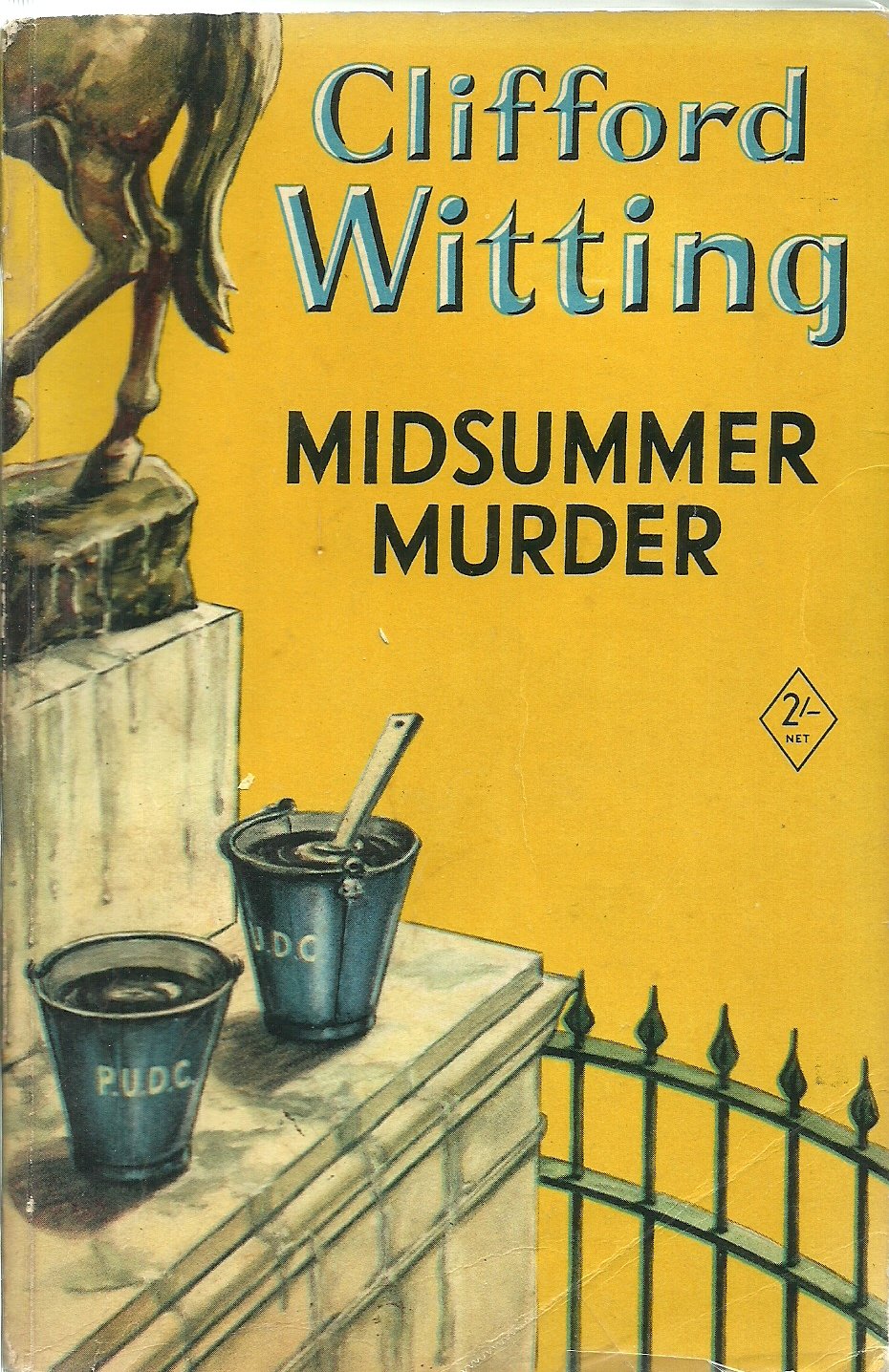
I've read a couple of books by Clifford Witting, which I'd rank as very competent Golden Age stories, towards the top end of the second division. And now I've devoured Midsummer Murder, his second novel, which I found extremely enjoyable. It's a story about a series of sniper killings in a small town, and it comes complete with map of the crime scene and an ironic reference to the Detection Club in the very last sentence.
Witting was a witty writer, and occasionally he overdoes the facetiousness. There's also a bit too much authorial intervention for modern tastes (although that amusing final sentence makes up for it, in my opinion). But I'd say that he is a writer whose work is likely to appeal to anyone who is a fan of George Bellairs. And on the basis of what I've read, I'd add that he's the superior crime novelist. Indeed, twenty years after his jokey reference to the Detection Club, he was elected to become a member.
The story begins, I was pleased to note, on my birthday, in July, in the tranquil setting of Paulsfield, soon to be tranquil no more. A workman is shot while cleaning a statue in the town square, an extraordinary crime which is apparently motiveless. For a long time I wondered if we were looking at a riff on The ABC Murders. I don't think it's a spoiler to say that this is not a book of that kind, and although (I choose my words with care) some readers will quibble about the slenderness of the connecting link between the deaths that plague Paulsfield, that didn't spoil my enjoyment.
Indeed, a great pleasure of this book is the characterisation, which is consistently amusing and appealing. Among the cast is a widow whose voluminous card index system contains masses of information about the local inhabitants. Inspector Charlton and Sergeant Martin make a likeable investigating duo, and although the book is perhaps a little longer than it needed to be, it held my interest from start to finish. Recommended.
Tuesday, 20 August 2019
When Eight Bells Toll - 1971 film review
Alistair MacLean wrote the film script of When Eight Bells Toll, and the novel of the same name, after enjoying a big hit with Where Eagles Dare. Producer Elliott Kastner thought that the James Bond franchise would fade away once Sean Connery departed, and he envisaged MacLean's new hero as a successor to 007. He persuaded Anthony Hopkins to take on his first lead film role as Philip Calvert, a tough guy in the Bond mould.
I read the book and saw the film as a teenager, at the height of my enthusiasm for MacLean's writing. At that stage, I'd read pretty much everything he'd produced, and I preferred him to Ian Fleming. I enjoyed both book and film, although I could remember nothing about them when I got the chance the other day to watch the movie again. I wondered if it would be a disappointment, because I lost interest in MacLean about the same time as he - it seems to me - lost interest in writing, in the Seventies. As a reader, I began to feel he no longer cared much about his work, and that's fatal for a writer. Having read Jack Webster's interesting biography of MacLean not long ago, it seems I wasn't far off the mark. Drink was MacLean's downfall. That, and too much money.
Anyway, what of the film? Well, the cast is top-notch. Corin Redgrave plays Hopkins' friend, and Robert Morley plays their boss, supplying comic relief. The suspicious characters in the cast include Ferdy Mayne, Oliver MacGreevy and the excellent Jack Hawkins, although the latter is rather miscast as a foreign tycoon. A Bond-style film of that era required sexy women aplenty, and Nathalie Delon plays Charlotte, while the under-rated Wendy Allnutt is Sue Kirkside. Wally Stott's soundtrack music is a sub-John Barry contribution.
The film wasn't a box office success, and Philip Calvert didn't return for new adventures. But I found it still enjoyable, undemanding entertainment. The story? Calvert is sent on a mission to halt piracy off the west coast of Scotland. Much of the filming was done on and around Mull, and the scenery is very watchable. So, of course, is Anthony Hopkins.
Sunday, 18 August 2019
An Instance of the Fingerpost by Iain Pears
I've had a copy of Iain Pears' most renowned novel, An Instance of the Fingerpost, for more years than I care to admit. Like all too many others, it's stared at me reproachfully from the shelf, but to be honest I was put off by its sheer length, and its reputation for density - even though it enjoys, overall, a very good reputation. But I knew it was set in 17th century Oxford, and my recent Atlantic crossing, to be followed by five days in Oxford, seemed like the ideal opportunity to have a read of it at last.
This is a sort of "casebook" novel, in the manner of The Moonstone, and I should probably have freshened up my understanding of the historical period before plunging in. Many of the characters are taken from real life, and there's a helpful Who's Who at the back, though I didn't realise that until I got to the end of the story.
Four characters tell their version of, effectively, the same sequence of events concerning the death of Robert Grove, a fellow of New College, of which a pretty but enigmatic young woman Sarah Blundy is accused. We start with an Italian visitor to Oxford, a man with medical skills, Marco da Cola. I found his account engaging, though there is a development towards the end of his account that was truly shocking. Then it's the turn of Jack Prescott, son of a supposed traitor; his story was in some ways the least satisfying of the four. After that comes John Wallis, a cryptographer and deeply unpleasant individual. Like Grove, but unlike Prescott, da Cola, and Sarah Blundy, he is taken from real life.
Finally we have the story of a young antiquary, again a real life figure, Anthony Wood. He's a more likeable fellow, though he has his moments of weakness. Towards the end of the book comes a remarkable plot twist that I simply wasn't prepared for - but it's very well done. At times I thought the book was heavy going, perhaps in part due to my ignorance of the historical detail; I suspect that it could have been cut by a hundred pages without any great loss. But despite this, I was impressed with Pears' writing. This is a fascinating novel, and I'm glad I finally made time to read it, even though it took me until the end of the Oxford trip to reach the climax.
Saturday, 17 August 2019
Fifty Years of Shoot!

Fifty years ago, man landed on the Moon, I was a teenager from a football-mad family, and Manchester City were one of the best teams in the country. And a football magazine called Shoot! was launched. I remember that my Dad bought me a copy (and devoured it himself, of course). Now, a book has been published by Carlton celebrating 50 Years of Shoot!
Leafing through the pages amounts to a nostalgia trip. It's an amusing walk down memory lane, to those long-ago days when eyebrows were raised by player transfers of a million pounds, and Don Revie was possibly the most admired English manager. On a more serious note, the article about black footballers is very thought-provoking, to say the least. I was pleased to be reminded of Manchester City's League Cup winning team from my student days by a full-colour two page squad photo. And yes, I had a team picture on the wall of my college room...
Well, a lot has changed since then. Nowadays, I can look back on a legal career advising a Premier League Club as well as the F.A. and my neighbours include a couple of young City players. I never imagined any of that when I was a student. What's more, there's no longer any room for sensible argument - City are the best team in the country and surely the best team England has ever seen. (Be quiet, LFC fans! Pipe down, United supporters!)
But who knows what the future will bring? Football, as we all know, is a funny old game, and this celebratory book is a reminder of how much has changed over the years, as well as a salutary warning that nothing stays the same, and that more changes in the beautiful game are bound to come.
Subscribe to:
Posts (Atom)