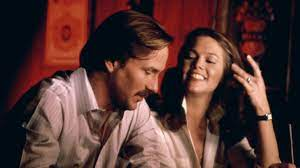
Showing posts with label Body Heat. Show all posts

Monday, 14 March 2022

William Hurt R.I.P.


I was very sorry to learn of the death of William Hurt, at the age of 71, and following some years of ill-health. If you search references to him on this blog, you'll find a number of reviews of his films, most recently The Village, which I enjoyed and which were enhanced by his presence in the cast.

To me, though, he'll always be Ned Racine, in Body Heat, one of the most enjoyable crime films ever made. I loved the idea of the slick and slightly sleazy lawyer who, as his friend (played by Ted Danson) said, 'used his incompetence as a weapon'. I've met one or two lawyers like that in real life, but they didn't have Ned Racine's charm. In the photo above he is with Kathleen Turner, who made her name in the film. 

Naturally, I referenced Ned in the Harry Devlin series, and I've watched Body Heat several times, always with relish. It's a great illustration of a story and film that is, on the surface, derivative, because it uses well-established tropes and ideas, yet makes something fresh of them. As for William Hurt, he was a superb actor with a truly impressive range. 

Monday, 27 April 2020

One Deadly Summer - 1983 film review

Four years ago I extolled Sebastien Japrisot's novel One Deadly Summer on this blog, mentioning the film version, which dates from 1983 and benefits from a script co-written by Japrisot, along with the director Jean Becker. The film was a huge hit in France in its day and I've finally caught up with a sub-titled version.

The film came out a couple of years after Lawrence Kasdan's brilliant updating of the film noir, Body Heat and this movie has been called an example of "pastoral noir". Certainly, the French countryside, lovingly presented, is bathed in sunshine, but after a while the darkness of the story and the central character's motivations begins to dominate.

The book is subtly written and can't have been easy to film, but Japrisot's involvement means that the movie is a good one. It also has one massive plus, the casting of Isabelle Adjani as Eliane, or Elle, the young woman who seduces the amiable but naive fireman Pin-Pon (Alain Souchon). She's as much a femme fatale as the women in Double Indemnity and The Postman Always Rings Twice, but her motivations are subtle and the demons that possess her are, for a long time, difficult to identify.

Adjani captures Elle's beauty and wilfulness, as well as the complexity of her nature. I imagine that the nude scenes in which she appears did no harm to the film's viewing figures and I do wonder if the movie would be shot in quite the same way today. On the whole, though, the sexual content is appropriate to the storyline. It's a long film, and at times I felt it moved too slowly. But the power of the story is such that it's definitely worth waiting for the calamitous events to unfold, leading to a shocking finale. It's a very different film from Body Heat, but quite compelling.

Monday, 29 April 2019

Body Heat - 1981 film


Image result for body heat film

Over the years, I've mentioned Lawrence Kasdan's 1981 film Body Heat numerous times on this blog, but I've never discussed it in much detail. Time to put that right, because it is, quite simply, my favourite crime film. I first saw it at the cinema in Leicester Square shortly after its release. I was impressed, and despite knowing what happens, I've enjoyed watching it several times since.

Body Heat is in the tradition of that great film (and book) Double Indemnity. That is, it's the story of a charming but weak man who falls for a femme fatale with an inconvenient husband. Some critics have taken the view that Body Heat is a mere act of homage, but although I am a great admirer of Double Indemnity, I think that Kasdan takes the central idea and theme and makes a truly distinctive film of his own, a film of real and lasting quality.

Everything about it is right. There isn't a wasted word in the script, and the film is visually alluring, with the oppressive heat of Florida's coast captured tellingly. And the brilliant score by John Barry is superbly atmospheric. Barry won five Oscars and also composed the definitive James Bond soundtracks, but I don't think this gifted musician did anything much better than Body Heat.

And then there is the acting. William Hurt is fantastic as the likeable but sleazy lawyer Ned Racine, whose incompetence at his job plays a crucial part in the very clever plot. Kathleen Turner made her name in this film, and although some critics have been rather dismissive of her acting skills, I think she gives a terrifically well-judged performance. You can really believe in Ned's obsession about her. The supporting cast, including Mickey Rourke, Ted Danson, and J.A. Preston, is exceptionally good.

What's not to like? If you're a crime fan, and you haven't seen Body Heat, you really do have a treat in store.

Wednesday, 13 September 2017

Marilyn - 1953 film, aka Roadhouse Girl

There are several surprising things about the shortish 1953 British film Marilyn (renamed Roadhouse Girl in the US). For a start, it's a film noir in the tradition of The Postman Always Rings Twice, but quite distinctive. And I was very taken with the fact that it was based on a play (later televised) called Marion, written by Peter Jones - the same Peter Jones who became a very well known actor in later years.

The story begins with a young man, down on his luck, taking a job as a garage hand, the garage owner being a grumpy older man played by Leslie Dwyer (best known as the Punch and Judy man in Hi-De-Hi). When we learn that the old guy is married to a pretty but discontented young blonde woman (Sandra Dorne), we rather suspect that the marriage will come under strain. An added complication is that there's a housemaid called Rosie who idolises the younger woman, and is desperate for her affection.

Before long, the inevitable happens, and the old guy is killed. An inquest rules the death to be an accident. So far so good? Well, as ever in these stories when a naive chap is ensnared by a blonde femme fatale, things don't go according to plan. The femme fatale here is selfish and not very bright rather than sophisticated in her calculations, and her lover is rather less sophisticated than, say, the doomed lovers in Double Indemnity and Body Heat.

The story zips along entertainingly from start to finish. The moral standards of the time meant that the lesbian sub-text, which might have added a bit of depth, is only hinted at, and the quality of the acting, like the script, is competent rather than dazzling. All the same, I enjoyed it.

Wednesday, 17 December 2014

Niagara - movie review

Niagara is a 1953 movie, directed by Henry Hathaway, which I found tucked away on the tv schedules. It was described as "Hitchcockian" and starred Marilyn Monroe, and these twin temptations proved irresistible. And I'm glad I watched it, although it doesn't rank as a classic crime film by a long stretch. The most memorable aspect of the film is not even Marilyn, but the vivid photography of Niagara Falls, which play a key part in the story-line.

Casey Adams and Jean Peters play a honeymooning couple whose cabin at the Falls is taken by another pair, George and Rose Loomis, played by Monroe and Joseph Cotten. Monroe is young and sexy, but her husband is jealous and depressive. It soon emerges that he has plenty to be jealous and depressed about, since his wife is encouraging her lover to kill him.

There are a few pleasing plot developments, but on the whole the story is commonplace. In a sense, the story-line is that of a film noir - but Niagara is shot in glorious Technicolor. The contradiction is by no means utterly fatal to the mood of unhealthy emotional tension, but it does contribute to the slightly unrealistic "feel" of the film. You can have a "noir" film shot in sunlight and colour- the brilliant Body Heat is an example - but Niagara  isn't in the same league as Lawrence Kasdan's masterpiece.

Niagara is, perhaps, an attempt to focus more on the characters' emotional lives than the typical Hitchcock thriller. Again, though, this was much better done years later in Body Heat. When a film is described as "Hitchcockian", one expects edge-of-the-chair suspense, of the kind delivered in some of the best thrillers by Chabrol and Truffaut. Niagara is a lesser work, but still worth watching. And it does make me want to visit those Falls....

Monday, 31 January 2011

John Barry R.I.P.


John Barry has always been one of my favourite musicians and the news of his death today saddens me. I've mentioned Barry several times in this blog and given that he won five Oscars,I think it can safely be said that he was Britain's finest ever writer of film music.

John Barry will forever be associated with the music for James Bond, and rightly so, but he achieved so much more. Working with a variety of lyricists, including Don Black and the great Hal David, he produced some of the finest songs of the 60s. My personal favourite is 'We Have All the Time in the World', co-written with Hal David and sung by Louis Armstrong, of all people, in On Her Majesty's Secret Service. And the best tune might just be 'The Girl with the Sun in her Hair', from You Only Live Twice, even though most people associate it with a TV commercial.

There's a drama and a dynamism about Barry's music that sets it apart. He's associated with lush, romantic sounds, but it's no coincidence that he wrote music for classic crime films and TV shows. His music is truly exciting.

Think of The Ipcress File, The Persuaders, and the magnificent score to that brilliant film Body Heat. All of them gain a great deal, in different ways, from Barry's music. There are plenty of other examples of his gifts from the crime genre, even before we come to Midnight Cowboy, Born Free and Dances with Wolves. A little while ago, I tried to find a DVD of one of his concerts - but there are none available. Astonishing. John Barry was a superstar among modern composers.

Wednesday, 8 December 2010

Last Will


Last Will is a recent movie starring Tatum O’Neill as a newlywed who marries into a very rich family. Her husband, played by Tom Berenger, is a nice guy who is also a surgeon, but it soon becomes apparent that his two younger brothers are much less appealing characters. Tatum is perceived by the brothers as a gold-digger – which she isn’t – and things take a nasty turn after she becomes involved in the family business.

The husband, an older man, has a history of health problems and it is soon telegraphed that he is not in great shape. When a rich person in a crime movie makes a fuss about signing a new will, it does not take a Poirot to deduce that he isn’t long for this world. And, all too soon, Tatum is widowed. But worse is to follow when evidence points to her having killed her husband in order to inherit.

Fortunately, a likeable cop, played by James Brolin, is on hand, and he has good reason not to like the surviving brothers. But matters go from bad to worse during a court case over the inheritance, when it emerges that the judge is in the brother’s pocket. Tatum’s brother, who is also her lawyer, does a bit of amateur detective work, and is beaten up for his pains. How can the grieving widow save herself?

This is quite an entertaining thriller, and it isn’t formulaic. I really liked Brolin’s performance, which was the strongest part of the film. But I did think that the story-line jumped around a lot, and some of it struck me as unconvincing. I know that American law is different from British law, but even so.... I’d rate this as worth watching, but not much above average. If you want a great film with plenty of legal twists and turns, Body Heat remains at the top of the heap.


Thursday, 28 May 2009

Themes and Laurie Johnson


Music is an important element in many crime films and television series. A great theme can add an extra dimension to any story. Sometimes the music lingers longer in the memory than the film or tv show itself (an example is the score for the 1967 version of Casino Royale), but when all the elements come together perfectly, the result is superb.

In the movie world, I think of Roy Budd’s theme for Get Carter and John Barry’s haunting score for Body Heat as quite unbeatable. The mood of each film is set by the opening moments, in which the main theme creates a sense of unresolved tension and menace – on Jack Carter’s train ride to Newcastle in Get Carter, and the sinuous credits that precede our introduction to Ned Racine in Body Heat.

In the tv world, one of the best themes ever written was composed by Laurie Johnson, who wrote the music for The Avengers. It’s a great tune, which I loved as a boy and still much admire. Now a box set of Johnson’s work, including his masterpiece, and many other pieces of music written for the series (including ‘Return of the Cybernauts’ – not the easiest story to set to music) has been made available. Three CDs for under a fiver on Amazon can’t be bad.

Of course, as with so many box sets, some items are included which will not feature in anyone’s list of favourites. Johnson is a professional who has turned out a lot of good material in the course of a long career (other well-remembered crime themes of his include The Professionals) but I think most people will regard The Avengers as his greatest achievement.

Wednesday, 18 February 2009

The Proposition

William Hurt is an actor I’ve admired ever since I came across him in that brilliant movie Body Heat. He was superb as the not very competent lawyer Ned Racine, and in the years that have followed, his acting range has earned him well-deserved acclaim.

In The Proposition, set in Boston in the 1930s (the film came out ten years ago and is not to be confused with an action thriller of the same name), Hurt plays the part of an apparently chilly and very wealthy man called Arthur Barret. Arthur is highly successful and is married to a beautiful writer with feminist inclinations (Madeleine Stowe.) The snag is that Arthur is sterile. He wants an heir and his wife wants to give birth to her own child. So they come up with a proposition – an intelligent young man will be recruited to impregnate Mrs Barret, and paid handsomely on the basis that he has no claim upon the child.

Needless to say, this dodgy arrangement runs into all kinds of trouble. Further complications ensue when a recently appointed priest, played by Kenneth Branagh, starts to take a less than altruistic interest in Arthur’s wife. And it turns out that the priest has a secret of his own to hide.

The story involves a murder, but it would be a stretch to call it a crime movie. From the start, the music very definitely signals that this is not a mystery, and it must be said that the film suffers from a certain lack of pace, even though there are several moments of high drama. But although it wasn’t what I was expecting, I found it a watchable and thought-provoking drama, with acting of high quality.