Showing posts with label Bruce Hamilton. Show all posts

Friday, 11 February 2022

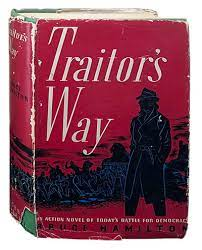
Forgotten Book - Traitor's Way


Traitor's Way by Bruce Hamilton was published in 1938 in Britain and in the US in the following year. It's a lively manhunt thriller, very much in the tradition of John Buchan's The Thirty-Nine Steps. I found it a fast and easy read, but this is a book that has hardly ever been discussed, though it receives one or two glances in books about spy fiction. 

One reason for this neglect may be Bruce Hamilton's lack of celebrity. For instance, his early novels Hue and Cry and Middle-Class Murder are also elusive. But it's also true that the political premise on which he based the plot was rendered absurd shortly after the book was written and I guess publishers would think that this made a nonsense of his story. 

I'll try to discuss the book without giving too much away - not an easy task. The ten chapters have short, snappy titles, such as 'Fracas' and 'Conspiracy', and this is in keeping with the writing style - this is Hamilton at his paciest. The story is told by Noel Mason, an ordinary individual, who starts out as 'an entirely non-political person' but finds himself caught up in a web of political intrigue, and a game played for very high stakes indeed.

This is an anti-Fascist novel, featuring a charismatic chap called Greatorex who leads something called the Order of British Chivalry. Not that they are at all chivalrous in practice. Poor Mason ends up committing a crime and he finds himself in Dartmoor. But when the chance to escape arises, he grabs it...

I enjoyed this story, even though it's not in the Buchan class and I felt it showed Hamilton's naivete about politics. What happens in his story is very, very different from what actually happened in the world a year or two later. He wasn't much of a crystal ball gazer. But at his best, he could tell a good story.


Friday, 6 November 2020

Forgotten Book - So I Killed Her

I came across Leonard O. Mosley's 1936 novel So I Killed Her by chance, while browsing a dealer's catalogue. I'd never heard of it, but the blurb sounded interesting, so I investigated further and gained the impression that this was a book very much in the Francis Iles tradition. But there has been little or no discussion of it, so far as I could find, by crime fiction fans.

I'm not quite sure why this is. The book has been reprinted a time or two - I obtained a cheap paperback copy from the late 50s. Mosley was a young man - a very young man - when he wrote the story - and although he wrote one or two other crime novels, he became much better known as a biographer. I don't know if he was related to Oswald Mosley - his own second name was Oswald - but if so, there appears to be no obvious connection between them. When I read the book, I felt that, for all its limitations, it has a certain dark power, and definitely does not deserve the critical neglect that has been its fate.

Mosley must have been about 22 when he wrote the novel. He came from my neck of the woods, the north west, but travelled extensively and spent time in the US prior to writing this book. So one of the unusual features of the story is that, unlike the novels by Iles, Richard Hull, Bruce Hamilton and others who wrote in the ironic vein, it is predominantly set in the US. And the American hardboiled influence lurks, far in the background. There's more candour about sex in this book than you find in the overwhelming majority of Golden Age stories.

This is a first person narrative, and we know from the start that we are in the company of a murderer - apparently one who has committed the perfect crime, murdering his wife and framing someone else -who is about to be executed. The killer happens to be a detective novelist, although perhaps Mosley doesn't make quite as much of this idea as he could. The prose has verve, but the characters are mostly very unpleasant, and the wit that flavoured the books of Iles and the best of Hull is generally absent. All the same, it's a highly readable book, and I'm amazed that it has been ignored by the commentators.

Friday, 24 July 2020

Forgotten Book - Too Much of Water

Bruce Hamilton, the brother of Patrick Hamilton, was an interesting and under-estimated novelist whose career as a crime writer lasted for more than a quarter of a century without ever really earning him a significant reputation. I've written about him several times, here on this blog, in The Golden Age of Murder, and in The Story of Classic Crime in 100 Books, but I've not found many other fans of his work - although I live in hope!

After a long silence, he produced a final novel in 1958, which was very much a nod to the Golden Age of detective fiction. This was characteristically idiosyncratic, given that during the Golden Age itself, he'd never bothered with the conventional whodunit. I first read the novel many years ago, and was rather underwhelmed by it. So I decided it was about time I gave Too Much of Water (the title is a quote from Hamlet) a second chance to make a good impression.

This is a cruise mystery - the good ship Goyaz is sailing from Liverpool, via Portugal, to the West Indies. In classic fashion, a plan of the three decks is included. We are introduced to a motley assortment of passengers, and Hamilton's interest in cricket and also in music is evident in the text. (He makes passing mention of Eric Blom, the music critic; whether he was aware that Blom wrote Death on the Downbeat, an interesting mystery novel published as by Sebastian Farr, I don't know, but I suspect he didn't.)

I wanted to love this book, but I feel compelled to say that I didn't. It's well-written, and the characters and setting are competently realised, but there is a lamentable lack of pace and even (despite the number of mysterious deaths that occur on the ill-fated ship) suspense. When one reads, say, Death on the Nile, one is excited by the mystery, if one is a whodunit fan. Here, I'm afraid I wasn't excited at all. I'd even forgotten that Hamilton borrows (with due acknowledgement) a plot device from Agatha Christie. Alas, he doesn't handle it anything like as well as the Queen of Crime. There's a nice twist at the end, but it's not enough. All in all, this is a book that sums up why Hamilton was one of the genre's nearly men.

Sunday, 9 June 2019

Cricket and the World Cup

This is a blog about crime fiction, but occasionally I like to feature other books that interest me, especially if I can introduce a crime-related element. With the ICC Cricket World Cup now in full swing, I've had a chance to catch up with the official book about the tournament, put together by Chris Hawkes, and published by Carlton. It's a glossy production, lavishly illustrated, with plenty of interesting background information.

For instance, I had no idea that cricket was being played in Afghanistan way back in 1839, long before Dr Watson picked up a Jezail bullet prior to meeting Sherlock Holmes. Arthur Conan Doyle was a keen cricketer, and the names of Sherlock and his brother Mycroft both derived from cricketers - Frank Shacklock and William Mycroft, who played for Derbyshire, a county that Doyle knew well.

International cricket has occasionally featured in crime fiction - for instance in Testkill, co-authored by cricketer Ted Dexter and journalist Clifford Makins - but more often it crops up incidentally, in the context of county or (more often) village matches. Authors as diverse as Julian Symons and Henry Wade have set scenes in their crime novels at cricket games, though perhaps the best known example is the cricket match in Dorothy L. Sayers' Murder Must Advertise. And in my current novel-in-progress, for the first time, I am featuring a cricket match in a key scene. The game plays a significant part in one of the sub-plots.

When I get the chance I am keen to watch some of the games in the World Cup, but there is always the consolation that if rain stops play, there are plenty of books to keep me fully occupied; not just the souvenir book about the tournament, but novels which it's time I re-read, such as Alibi Innings by Barbara Worsley-Gough, Pro by Bruce Hamilton (a crime novelist, though it isn't a crime novel) and my favourite cricket book, Settling the Score by Peter Gibbs.

Friday, 25 May 2018

Forgotten Book - To Be Hanged

Bruce Hamilton was one of the most under-rated crime writers of the 1930s. I've mentioned my interest in his work several times on this blog, and today I'd like to focus on his first novel. (Incidentally, in a fit of enthusiasm allied to technical incompetence, I published a draft version of this post last week, along with a couple of other premature posts; my apologies for inundating you). While Bruce is less renowned than his brother Patrick, for the perfectly good reason that his literary gifts were of a lower order, I think that comparison with Patrick is the key reason why the quality of his work has been under-valued. I certainly accept that it has flaws, but I admire the way he kept trying to do something different, and avoided the constraints of formula.

To Be Hanged was published by Faber in 1930, and it's very different from the conventional Golden Age whodunit. A journalist overhears a conversation which leads him to suspect that a man's conviction for murder is a miscarriage of justice. He then sets himself the task (seemingly untroubled by any other calls on his time) of securing the wretched fellow's release. Which in turn means that he has to establish the guilt of someone else.

This is, therefore,  a detective story, but of an unconventional sort; at times it seems more like a straightforward thriller. The detective is aided by a barrister who again doesn't seem to have anything else to occupy his time, and together they follow an elaborate trail. Could it be that the scapegoat has been deceived by the woman he loved? The answer to that soon becomes obvious, but Hamilton has one or two pleasing plot twists up his sleeve.

Overall, I'd say that this is an accomplished piece of crime writing, especially given its date, and the fact that it was a first novel. Arthur Conan Doyle is quoted on the jacket as saying how clever the story is, and although one has to bear in mind that he was Bruce Hamilton's godfather, this is a novel that doesn't deserve to be forgotten. It should have heralded a career of distinction, but in the event, Bruce's crime writing proceeded in fits and starts before spluttering to a dead halt in the 50s. A real shame.

Friday, 30 March 2018

Forgotten Book - The West Pier

Patrick Hamilton was a fascinating writer. I've read no fewer than three biographies of him, those by his brother Bruce, Nigel Jones, and Sean French (all are good, by the way), and I find his life story intriguing, though I have to say he was welcome to it; a classic case of money not being everything, really. He suffered disability and disfigurement as a result of a road accident that wasn't his fault, but even by then he was a heavy drinker, and his health deteriorated steadily until he died in his late fifties.

It's as a playwright that he's best remembered. Rope and Gaslight were both highly successful, and both were filmed. But he felt that his novels were more important, and even if  many would disagree, I find them highly readable. The West Pier, set in Brighton, is a case in point. It was also the first of a trilogy that he wrote about the same character, Ernest Ralph Gorse.

The first thing to say about Gorse is that he's a deeply unpleasant individual. Hamilton makes that clear right away - in fact, the author's voice intrudes constantly, an odd feature that some would find irritating and others old-fashioned. Personally, I didn't mind, although I was surprised that such an experienced novelist resorted to such a device.

Gorse bears some comparison to Patricia Highsmith's Tom Ripley, because he possesses a certain charm, and he lacks a conscience. But this isn't a murder story. It is, instead, the story of a minor crime, the work of an embryonic confidence trickster, and his deceitful treatment of a decent girl and two schoolfriends. And despite the lack of "high stakes", it's compelling because Hamilton creates a frighteningly credible picture of someone who indulges in petty acts of cruelty and revenge - and has a knack of getting away with it.


Friday, 2 June 2017

Forgotten Book - The Arsenal Stadium Mystery

Football seldom features in Golden Age detective fiction. Hue and Cry by Bruce Hamilton, which features a football player who goes on the run after killing someone is a very rare exception. But in 1939, Leonard R. Gribble had the audacious idea of setting one of his Inspector Slade mysteries against the background of a real football club, one of the most famous in the world - Arsenal F.C.

Gribble was a writer with considerable commercial nous. He found support from the club, whose players and manager feature in the story, and The Arsenal Stadium Mystery was quickly filmed, by Thorold Dickinson, with Leslie Banks -at that time a very popular actor - playing the part of Slade. I watched and reviewed the film nearly nine years ago, and now the time has come to talk about the novel.

The setting, as the title makes clear, is Highbury (Arsenal only moved to the Emirates Stadium in recent times) and a match between Arsenal and a leading team of amateurs called The Trojans. During the game, one of the Trojans' players, a right-half (ah, those were the days) called Doyce, is taken ill and dies. It soon emerges that the cause of death is aconite poisoning. He has been murdered.

This is a highly readable fair play detective novel, and although I figured out the solution in good time, I enjoyed the story, not least as a reminder of how much the game has changed since the book was written. My copy is one of my most prized items in my personal collection - it was signed by the team and manager in 1942. One of those who signed, and who features in the story, is a player called Cliff Bastin, on whom my father - a useful amateur footballer in his day - modelled himself. I suspect he'd have been amused to learn that, even though I'm an avid Manchester City fan, I went to some lengths to track this copy down.

Monday, 26 September 2016

Collecting Crime Fiction


There is, it seems to me, increasing interest in collecting crime fiction. This is reflected in a new Pan Macmillan  blog post on the subject. PanMac talked to the rare book dealers, Peter Harrington, who in turn asked me for my thoughts. Take a look at that illustrated copy of Poirot Investigates, then take a deep breath, and take a look at the price. £75,000! Wow...

Coincidentally, it was a first edition copy of Poirot Investigates that first fired my interest in rare and collectible detective fiction. My law firm decided to celebrate my 21st anniversary with the business, and presented me with a copy. No dust jacket, needless to say, (I've since acquired a facsimile of the original to keep the book in good condition) but I was and remain enormously pleased by this wonderful gift.

Until that time, I'd been an avid collector of crime fiction, but entirely from the point of view of reading the books. Given the choice between a first edition and a cheap and battered copy, I'd opt for economy every time. But Poirot Investigates introduced me to a new world, which I have to say I have found unexpectedly fascinating and rewarding. I soon became enamoured of signed and inscribed books from the past, and those of you who have read The Golden Age of Murder will know that these made a very significant - and, I like to think, unusual, perhaps unique - contribution to that book.

My most recent major acquisition was at Bouchercon just over a week ago. I decide to celebrate my receipt of the Macavity award by buying a rare item - a first American edition of Bruce Hamilton's first book, To Be Hanged - complete with blurb from his famous godfather, Sir Arthur Conan Doyle, and the original wrap-around band which is in itself scarce. I'll be adding that to my web page on collecting crime fiction before long. In the meantime, the illustration at the top of this blog shows another unusual book - John Creasey's long-forgotten thriller Thunder in Europe, again with a wrap-around band, and most interestingly of all, with a personal inscription to fellow thriller writer Dennis Wheatley.

Wednesday, 6 August 2014

Top Ten Obscure Golden Age novels that deserve to be better known

Following on from last week's post, here's an admittedly idiosyncratic list of obscure Golden Age novels that are fairly hard to find (at the moment) but which in my opinion deserve to be more widely known. One thing that most of them have in common is that they are unorthodox - the books by Connington and Bowers are the only really conventional ones of the type people associate with the Golden Age. I suppose I'm making the point that the Golden Age was more varied than many people believe...

10. Death Has a Past by Anita Boutell. This variant of the "whowasdunin" is set in England but written by a very talented American. What a shame her career was so short.

9. Nightmare by Lynn Brock. An odd book, quite different from his convoluted mysteries starring Colonal Gore, and an ambitious study in psychology. A downbest ending is a flaw, but it's a very interesting book.

8. Poison in the Parish by Milward Kennedy. Kennedy was influenced by Anthony Berkeley, and was almost equally innovative, although not with the same degree of success. This is a fascinating and original spin on the village mystery which deserves to be much better known.

7. No Walls of Jasper by Joanna Cannan. This is a very impressive piece of work, so good that I felt quite distraught when I read the same author's more orthodox novel The Body in the Beck, and found it tedious. But at her best, she really could write. This book is somewhat in the Francis Iles vein, but quite distinctive. It just pushed out of the list Portrait of a Murderer by Anne Meredith, which I also recommend.

6. The Divison Bell Mystery by Ellen Wilkinson. This was the solo detective effort of "Red Ellen", the left wing Labour MP who was a prime mover in the Jarrow Crusade. The House of Commons setting is very well evoked, and the book is free of didacticism. The plot is so-so, but never mind, the story is very readable.

5. The Sweepstake Murder by J.J. Connington. This is a really clever and enthralling story, a fresh take on the "who will be next?" theme that makes And Then There Were None so irresistible.

4. The Grindle Nightmare by Q.Patrick. A very clever mystery with a great US setting and an astonishingly dark storyline. An unforgettable book. I'm very much indebted to John Norris for supplying me with a copy.

3. Middle-Class Murder by Bruce Hamilton. Brother of the better known Patrick, Bruce wrote a few extremely interesting novels. This is very much in the Francis Iles tradition, and is really well done.

2. As for the Woman by Francis Iles. This book was a commercial failure, and marked the end of the novel-writing career of Anthony Berkeley, aka Francis Iles. Hardly anyone seems to like it. So why do I rate it? Because it's an intriguing and unusual novel, which repays careful study. More on this topic in the future.

1. A Deed Without a Name by Dorothy Bowers. My choice of this as number one is, I readily admit, partly influenced by sentiment, but it would be a grim world if there were no place for a bit of sentiment every now and then. It's a nicely clued whodunit of real merit, by a writer of genuine ability and it evokes the "phoney war" nicely. Yes, it is not perfect, but I think it's utterly heartbreaking that Bowers died of TB months after being invited to join the Detection Club and at a time when she hoped her life was changing for the better. Had she lived, I'm confident she would have become a major star. And the good news is, this book is the easiest to find of those on this list. It was reprinted by the splendid Rue Morgue Press a few years ago.

Wednesday, 13 March 2013

Settling the Score by Peter Gibbs

Settling the Score by Peter Gibbs, a paperback original published by Methuen, is a debut novel, although from the pen of an experienced screenwriter. There are special reasons why, for me, it was a wonderfully satisfying read, and although I had a perhaps unique interest in the book, I can recommend it very strongly. There is a 'whodunit' element in the plot, and one or two minor crimes are committed, but it's not a murder mystery, or indeed anything like any book I've ever reviewed on this blog. But let me first explain why I was so glad to have the chance to read it.

When I was growing up, I was not only a keen cricket fan, but one of the few who supported Derbyshire, a team widely regarded as perennial strugglers. I dreamed of opening the batting for them, but the brutal truth was that I was never a good enough cricketer to have any chance of that. But their opening batsman came from Cheshire, as I did, and had studied at Oxford University, which impressed me greatly. From occasional articles that he contributed to club brochures, I deduced that he enjoyed writing comedy, as I did at the time. He seemed to me to have a perfect life. And then, despite the fact that he was a very good player, he gave it all up at the young age of 28. I was baffled, since I hadn't yet learned that no life is perfect. His name was Peter Gibbs.

Some years later, he began writing for TV. One series, about a lawyer called Kinsey, was especially good. He also became the lead scriptwriter for Heartbeat, and so got to know Peter Walker, who first introduced me to the northern chapter of the Crime Writers' Association, and on whose books Heartbeat was based. I would guess that he's always harboured an ambition to publish a novel and now, in his 60s, he's achieved it.  And his background is... a Derbyshire cricket match in the late 60s, a period when I could claim to have an almost encyclopaedic knowledge of the players' records. But, of course, no knowledge of what went on behind the scenes.

This book lifts the lid in quite a fascinating way on the lives of youngish men, living and working together seven days a week for a large part of the year. It's received numerous positive reviews already, and I suspect that people will increasingly say that he's a much better writer than he was a cricketer; but that would be a bit unfair, since P.J.K. Gibbs, as one journalist who wasn't a fan always called him, was in fact a very good batsman to watch.

The story involves the conflict between two brothers, team rivalries spiced by illicit affairs, and a great many wittily described scenes. I found it laugh-out-loud funny, but there are also moments of poignancy, not least in one sub-plot that echoes a real life scandal in which a Derbyshire cricketer of the sixties was victimised by the establishment. There is a lot about cricket in Settling the Score, but I hope that even those who have no interest in the game will be tempted to give this book a try. It's the best novel about cricket I've ever read, even better than Pro, by Bruce Hamilton (brother of Patrick, whose crime novels I've mentioned before on this blog.) I'd go further, and say that, much as I admire the Dick Francis books, now carried on by Felix Francis, Peter Gibbs' debut is the most enjoyable sport-based novel I've ever read.


Friday, 20 July 2012

Forgotten Book - Middle-Class Murder

Anthony Berkeley’s famous book Malice Aforethought, with its sardonic account of a murderer’s misadventures, influenced a number of other authors, including Bruce Hamilton, whose Middle Class Murder appeared in 1936. It was known in the US as Dead Reckoning, and it’s my Forgotten Book for today.

I’m surprised that it isn’t better known, and hasn’t been reprinted more often, since it’s an accomplished and highly readable book of its type. Not as ground-breaking as Berkeley’s classic, for sure, but still genuinely entertaining. Perhaps its lack of fame owes something to the sporadic nature of Bruce Hamilton’s crime writing career. He wrote just seven mystery novels in the space of 28 years.

The story opens brilliantly, with dentist Tim Kennedy composing a fake suicide note from his disabled wife Esther. Is it a coincidence that the protagonist bears the same surname as Milward, another of Berkeley’s followers, or that the names of Berkeley and Cox (Berkeley’s real name) also feature in the story? I rather doubt it – I suspect Hamilton was giving a nod to a couple of fellow writers whom he admired, though I’m not sure whether they were friends of his.

Kennedy’s plot to kill Esther is bedevilled by all kinds of snags, but he refuses to give up, and eventually she dies. Not only is Kennedy not a suspect – he earns the sympathy of family and friends, and is free to pursue his interest in an attractive local woman. But of course, the course of murder in a book like this never runs smooth...

I really enjoyed this book the first time I read it, and enjoyed it again on a recent re-reading. It isn’t easy to find, but let’s hope someone reprints it before too long. Hamilton does not deserve to be forgotten, and nor does this book.

Friday, 15 June 2012

Forgotten Book - Hue and Cry

Here’s a question for you. Which Golden Age crime novel begins at a football match in a working class town, and features a footballer as its protagonist? Not a book by Sayers, Christie or Dickson Carr, you can bet your bottom dollar! The answer is a book that I found a very enjoyable and breezy read when a kind friend lent it to me recently.

Bruce Hamilton, brother of the more celebrated Patrick, is an author who has long interested me, and I’m delighted to feature his debut novel as today’s Forgotten Book. This is Hue and Cry, originally published by the Crime Club in 1931, and the footballer is young Tom Payton, who kills one of his club’s directors in a drunken rage, and then goes on the run.

There’s no mystery at all about whodunit – the real question is whether Tom will get away with it. He flees to London, where he gets mixed up with a prostitute, and then with a kindly Jewess who offers him sexual comfort as well as board and lodging. Tom is definitely not a Peter Wimsey type, and Hamilton’s radical politics are in evidence at key moments of this book.

Hamilton keeps up the pace from start to finish, and as he piles the pressure on Tom, the reader finds it almost impossible (well, this reader did) not to hope that he will escape the consequences of his crime. There are some nice touches of satire in the book, too, and overall, it is a real pity that Hamilton’s policy of avoiding formula in his writing meant that his career as a crime novelist never had the success that I, at least, think he deserved. His work does have flaws, but it is genuinely interesting.

Friday, 4 May 2012

Forgotten Book - Rex v Rhodes

I've mentioned Bruce Hamilton once or twice in passing in previous blog posts, sometimes in relation to his much more celebrated brother Patrick. I see, though, that I've never devoted a full post to this under-estimated writer, even though I find his work very interesting. So today I'm rectifying this omission by discussing Rex v. Rhodes, which he published in 1937.

The sub-title of this book is "The Brighton Murder Trial", and it is presented as being edited by Hamilton. The idea is to ape the style of the Famous Trials series that was very popular in the first half of the 20th century in Britain. The series had introductions which were often highly informative, and Hamilton's intro makes it clear that he is setting the book a few years in the future. He envisages a situation where, increasingly, there is conflict between the forces of the left and the extreme right, and although he makes it clear that ultimately the Communists will prevail, the events of the story take place at a time when they are under sustained attack, not just from fascist groups, but also from the establishment.

The man on trial, Rhodes, is a Communist, and he is accused of killing a leader of the Brighton branch of a right-wing group. The main evidence against him - which seems damning - comes from two young, and possibly thuggish, men who worked for the victim. Hamilton makes it reasonably clear early on what has actually happened. The key question is whether Rhodes will survive the trial process.

In some ways, this book is - at least to my knowledge - unique. A sort of futuristic fantasy, presented as a sober courtroom drama, with an intense political message. It's a book with some flaws, but I found it fascinating. Hamilton, in later years, realised that he'd misunderstood the nature of Communism, and the naivete of some of his opinions and forecasts is breathtaking. But he was certainly not alone in the mid-30s in holding the views he did, and even though I don't usually care for didactic fiction, this book holds great interest as a historical curiosity.

Friday, 14 October 2011

Forgotten Book - Hangover Square


Patrick Hamilton is one of those writers who teetered on the brink of greatness, but never quite made it. He is, however, in the top echelon of literature’s nearly men, hence the intermittent revivals of interest in his work. And there is a modern type of edge to his best books that has helped to cement his reputation.

Hangover Square, published in 1941, is my choice this week as a Forgotten Book that deserves to be remembered. It is the story of George Harvey Bone, a burly but quiet man who is undone by his passion for the worthless Netta. An alcoholic who suffers from a touch of schizophrenia, he torments himself so much that the reader almost forgives him both his stupidity (Netta clearly wasn’t worth it, as his smarter friends instantly recognise) and his homicidal tendencies.

My copy of this book is the current Penguin reprint, which includes an introduction by J.B. Priestley. Now, I am keen on intros, which can add a great deal of value to a classic title. And Priestley, who knew Hamilton personally, makes several interesting points. But his piece is flawed, above all because he discloses what happens at the end of the book .This isn’t a conventional whodunit, far from it, but Priestley shouldn’t have been so crass

I think it’s interesting that this book prefigures the interest of modern readers in the psychology of the criminal. Bone is portrayed in some depth, though his ‘dead moods’ did not strike me as entirely convincing. Yet the novel is well worth reading, at a time when the psychology of crime is a big topic. Patrick Hamilton was a pioneer of the crime genre, much more so than his capable but less gifted brother Bruce. It’s no surprise that he remain a crime writer of choice for a good number of critics. This book is, by some standards, a failure. But it is a rather brilliant failure.

Sunday, 8 November 2009

Patrick Hamilton


There are three interesting biographies of Patrick Hamilton – few writers who work in the crime genre are so blessed, although maybe this is because Hamilton is not always described as a ‘crime writer’ (though he would be if he were working today, I think.) One of the books is Through a Glass Darkly, by Nigel Jones, a sound piece of work that is well worth reading.

Jones is in possession of many private papers relating to Hamilton, and was generous enough to make these available to Sean French, who wrote another biography not long afterwards. Sean French is now better known as one half of the best-selling crime-writing duo Nicci French, but his Patrick Hamilton: a life shows him to be a very accomplished biographer as well.

Rather spookily, French describes the sociopathic Ralph Ernest Gorse as an ‘oblique self-portrait’ of Hamilton. Like Jones, he doesn’t try to place Hamilton in the context of crime writing history generally (a missed opportunity, I feel) but he describes with some poignancy the bitter life of a man who knew great success, but also tragedy – he was disabled and disfigured when a motor car ran into him while he was crossing the road, his sex life was often depressing, he suffered mental problems, and his addiction to alcohol ultimately cost him his life. His judgment, it has to be said, was hopeless – a Marxist who never joined the Communist Party, he was a big fan of Stalin, and was bemused when the truth about his hero came out.

The third biography is The Light Went Out, by Patrick’s elder brother, Bruce Hamilton. There was a close and curious relationship between the two men. Bruce was also a writer, and much of his work unquestionably falls within the crime genre. His frustrated devotion to Patrick shines through the pages, even though, according to Sean French, the longer and unpublished version of the memoir casts a rather different light – he seems to have been jealous of Patrick’s greater literary talents.

Because Patrick was a fine writer, Bruce’s own literary achievements tend to be under-estimated, even by Sean French. I’ve read several of Bruce’s books, and they are interestingly different from the run of the mill whodunits of the time, though one or two of them show the same weird adoration of Stalin and Soviet Russia. But there’s no doubt that Patrick is, and will remain, better remembered, and these three books, taken together, provide copious fascinating nformation about a life of soured brilliance.

Another thing about Bruce, by the way (sorry, I just can’t resist trivia.) His godfather was Sir Arthur Conan Doyle.

Friday, 6 February 2009

Forgotten Book - Payment Deferred

My latest contribution to Patti Abbott's series is a book by C.S. Forester, who is best known as the creator of Horatio Hornblower. As well as his swashbuckling maritime stories, however, he wrote a couple of crime novels. The first was Payment Deferred, which came out in 1926. For me, it is a book that was way ahead of its time – it anticipates, for instance, the brilliant Malice Aforethought by Francis Iles. And its relentless bleakness also makes it seem rather modern (so do the references to economic woes, unfortunately...)

I first read the book as a teenager, and found it both dark and intensely gripping (it also has the merit of being short and brisk in pace.) The basic premise is simple. Mr Marble, a bank clerk, is desperately short of cash. Unexpectedly, a rich nephew from Australia comes to visit his seedy suburban home. Marble sees in him the answer to all his troubles. He poisons the nephew and buries him in the garden. It seems like the perfect crime – but, needless to say, things prove to be much less straightforward than the wretched Marble anticipated.

The irony of the story set a pattern not only for Iles, but also for various other writers of a similar bent, such as Richard Hull and Bruce Hamilton. Forester returned to crime genre a few years later with Plain Murder, but on the whole this book, although very readable, did no more than repeat the themes of its predecessor. Soon Forester decided to concentrate on Hornblower. But his pioneering contribution to the genre is too often overlooked – it’s time he got the credit he deserves.