When I blogged about Richard Wiseman's unusual first novel, First Person Plural I knew nothing about the author. Thanks to Jamie Sturgeon, I learned that this was a pen-name of Nick Bartlett, who had written two mainstream novels before trying his hand at crime fiction. Thanks again to Jamie, I have obtained a copy of his second and final crime novel, Duncan Is In His Grave.
First Person Plural was published by Macmillan - a good start for a new crime novelist, but the book never appeared in paperback. Perhaps sales were poor, perhaps reviews were few. It's certainly a little-known book, though I think that it is a compelling if uncomfortable read. Duncan Is In His Grave was published by Robert Hale, who were library publishers and, to be honest, a step down from Macmillan. A step down taken by many good writers, admittedly, but either Macmillan didn't like this book or felt disappointed by reaction to the first one.
Like First Person Plural, which otherwise it doesn't resemble in terms of storyline, this is a mystery which revolves around warped sexual feelings. It was published in 1978, a year after Jacqueline Wilson's Making Hate, which was a similarly interesting (but flawed) attempt to explore sexual psychology in the crime novel.
The narrator is Stephen Inglis, an advertising copywriter (as Bartlett had been). He falls out with a client called Frimley and embarks on a childish campaign of revenge. In so doing, he's encouraged by discussions with a character called Duncan, and it soon becomes clear that Duncan is imaginary. What follows is a crisply related descent into madness. The author was no doubt influenced by the work of writers such as Symons, Highsmith, and Rendell, and he could certainly write well. This is a very readable story, and it's a shame that Bartlett-Wiseman gave up on the genre. I can only surmise that he was disappointed by lack of success.
Showing posts with label Jamie Sturgeon. Show all posts
Showing posts with label Jamie Sturgeon. Show all posts
Friday, 18 September 2020

Friday, 7 February 2020
Forgotten Book - Sudden Fear
One of the wonderful consequences of global communication via the internet is that it's now possible to come across information in a matter of moments that in the not too distant past would either have been unobtainable or would have take extensive research to track down. For anyone with a special interest, that's terrific. Book lovers like me have really benefited from the dissemination of information worldwide via blogs and other means.
I look at a good many blogs sporadically; one of those I check out regularly is Kate Jackson's Cross Examining Crime, because she seems able to read more books than almost anyone and her taste is excellent. When she raved about Edna Sherry's Sudden Fear, I sat up and took notice - and it took me a while to realise that I'd already seen and enjoyed the film based on the book. The book came out in 1948 and the film in the early 50s. Thanks to Jamie Sturgeon I've now been able to read the book for myself, and it turns out that Kate was spot on. It's a gripping story.
I don't know much about Sherry, but it seems that although she'd done plenty of writing, this was her first crime novel to be published under her own name, when she was 67. She continue to publish, but this appears to be far and away her most successful novel, though John Norris (another of my favourite bloggers) has praised Girl Missing. Certainly, the portrayal of Myra, the ruthless playwright who discovers that her younger husband is plotting with his lover to kill her and inherit her fortune, is compelling.
Kate is, I think, right to say that in some respects this story is in the Francis Iles vein, but she's also right to highlight its distinctive qualities. There are one or two oddities about the writing (e.g. some unnecessary mid-chapter shifts of viewpoint) but these are minor matters - Sherry knew how to tell a good story. Much as I liked the film, the book seems to me to be better.
I look at a good many blogs sporadically; one of those I check out regularly is Kate Jackson's Cross Examining Crime, because she seems able to read more books than almost anyone and her taste is excellent. When she raved about Edna Sherry's Sudden Fear, I sat up and took notice - and it took me a while to realise that I'd already seen and enjoyed the film based on the book. The book came out in 1948 and the film in the early 50s. Thanks to Jamie Sturgeon I've now been able to read the book for myself, and it turns out that Kate was spot on. It's a gripping story.
I don't know much about Sherry, but it seems that although she'd done plenty of writing, this was her first crime novel to be published under her own name, when she was 67. She continue to publish, but this appears to be far and away her most successful novel, though John Norris (another of my favourite bloggers) has praised Girl Missing. Certainly, the portrayal of Myra, the ruthless playwright who discovers that her younger husband is plotting with his lover to kill her and inherit her fortune, is compelling.
Kate is, I think, right to say that in some respects this story is in the Francis Iles vein, but she's also right to highlight its distinctive qualities. There are one or two oddities about the writing (e.g. some unnecessary mid-chapter shifts of viewpoint) but these are minor matters - Sherry knew how to tell a good story. Much as I liked the film, the book seems to me to be better.
Monday, 10 June 2019
Deep Waters - Publication Day!
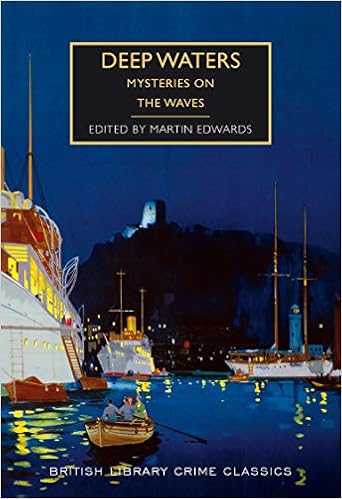
Today sees the publication of my latest anthology for the British Library. Deep Waters is subtitled Mysteries on the Waves, and boasts a rather good cover which for me represents a pleasant reminder of my recent Atlantic crossing. I've talked about cruise mysteries on this blog recently, and there's no doubt that stories set around the sea, or indeed rivers, canals or lakes offer a lot of potential for the crime writer.
This is, I think, the chunkiest of all my British Library anthologies, running to no fewer than 364 pages, and I'm pleased about this. I do think that it's good to offer readers plenty of value, and my only regret is that it wasn't possible to find space for a long-time favourite of mine, "Three Miles Up" by Elizabeth Jane Howard, a terrific story. I have to admit, however, that it's a bit of a stretch to call it a crime story, even though it's very mysterious indeed.
So what of the stories that did make the cut? We kick off with a case for Sherlock Holmes, and other eminent detectives who are featured include Reggie Fortune, Dr Thorndyke, John Appleby, and Gervase Fen. There are also some little-known names in the list of contributors, including Kem Bennett; I was introduced to his story, and another by Christopher St John Sprigg, by Jamie Sturgeon, one of a small group of friends who have given me valuable advice about possible stories for inclusion.
There is a story by Andrew Garve, a writer whose love of sailing is evident in many of his novels, and another by Phyllis Bentley, who is perhaps best remembered for her Yorkshire-based family saga novels. As usual, I'm aimed for variety in my selection, and I like to think that Deep Waters is a book which, whatever your preference in terms of classic crime, will offer plenty to enjoy.
Friday, 28 October 2016
Forgotten Book - Dumb Vengeance
Dumb Vengeance is a rare and little-known detective novel written by Stella Tower, published in 1933, and so far as I know, never reprinted. It was drawn to my attention by Jamie Sturgeon, a highly recommended book dealer, and thanks to him, I've just read it. This was the first novel by Tower (who wrote one more book under that name, and then a handful (and at least one stage play, Open Verdict) under the name Faith Wolseley
The dust jacket blurb makes the bold claim that "It is fair to say that few thrillers yet published have contained as great an element of surprise in their denouement as Dumb Vengeance". To be honest, I think this is over-stating the case, because I had a rough idea of what was likely to happen at the end, but that said, the book does end well.
It also begins very well. The story is told in the first person by a character called Miss Jenkins, who lives at Houghton, the home of well-to-do John Vine and his wife Gloria. Vine is a likeable chap, and Miss Jenkins is devoted to him. But here comes the first twist - Miss Jenkins is a dog.
This book was, as far as I know the first crime novel to be narrated by an animal (please let me know if you are aware of an earlier example). And although it's a traditional whodunit, it's by no means as "cosy" as many of the novels featuring cats that are especially popular in the United States. It's also conspicuously well-written, and at times very witty. For a first novel, it's a very assured piece of work.
It does, however, in my opinion sag somewhat in the middle, and one could argue that this is because there isn't enough meat in the plot - a brilliant short story idea has been expanded beyond its ideal length. But I can understand why Tower wanted to make the most of her original concept. I enjoyed reading Dumb Vengeance, and I look forward to reading more of her work. She really could write.
The dust jacket blurb makes the bold claim that "It is fair to say that few thrillers yet published have contained as great an element of surprise in their denouement as Dumb Vengeance". To be honest, I think this is over-stating the case, because I had a rough idea of what was likely to happen at the end, but that said, the book does end well.
It also begins very well. The story is told in the first person by a character called Miss Jenkins, who lives at Houghton, the home of well-to-do John Vine and his wife Gloria. Vine is a likeable chap, and Miss Jenkins is devoted to him. But here comes the first twist - Miss Jenkins is a dog.
This book was, as far as I know the first crime novel to be narrated by an animal (please let me know if you are aware of an earlier example). And although it's a traditional whodunit, it's by no means as "cosy" as many of the novels featuring cats that are especially popular in the United States. It's also conspicuously well-written, and at times very witty. For a first novel, it's a very assured piece of work.
It does, however, in my opinion sag somewhat in the middle, and one could argue that this is because there isn't enough meat in the plot - a brilliant short story idea has been expanded beyond its ideal length. But I can understand why Tower wanted to make the most of her original concept. I enjoyed reading Dumb Vengeance, and I look forward to reading more of her work. She really could write.
Wednesday, 24 July 2013
Valuing a rare detective novel
One of the joys of digital publishing is that it has made it possible for those of us who are fans of Golden Age detective fiction to acquire, at long last, copies of books that have long proved elusive. I've mentioned Bello and Faber Finds here in the past, and there are various other outfits who are doing sterling work in reviving old titles so that a new generation of readers can enjoy them.
But, at least for the present, there remain a great many obscure books that are still very hard to find. (Okay, some of them deserve their obscurity, but by no means all of them!) And there is something about having an original hard copy edition that is still very appealing to book lovers. But even if one can find a rare title, the question is whether one can afford it. And often, the answer is no.
There was a startling case on eBay recently when a little-known book by the prolific John Rhode, under his other pen-name, Miles Burton, was sold for in excess of £500. Yet this was a former library book that, from its description (by a totally honest bookseller from whom I've bought many much cheaper titles) was in pretty scruffy shape. The book was To Catch a Thief - no connection with the Cary Grant movie, though. Normally, you expect that a really expensive book will be accompanied by a dust jacket in good condition, or perhaps a really significant signature or inscription.
This did make me wonder if prices for rare Golden Age books are shooting up well ahead of inflation, driven by scarcity plus increasing interest and demand. When I talk to dealers like Jamie Sturgeon and Mark Sutcliffe, partly out of interest and partly as research for my portrayal of the world of Marc Amos in the in the Lake District Mysteries,the general theme is that it is harder to find old books in good condition than ever before. There is one rule that I've learned. If I come across an old book acceptably priced that I'm interested in, I tend to go for it. But the other day, at a book fair, I broke my own rule, and when I returned to the stall a few minutes later, the book I wanted had gone. A lesson learned!
But, at least for the present, there remain a great many obscure books that are still very hard to find. (Okay, some of them deserve their obscurity, but by no means all of them!) And there is something about having an original hard copy edition that is still very appealing to book lovers. But even if one can find a rare title, the question is whether one can afford it. And often, the answer is no.
There was a startling case on eBay recently when a little-known book by the prolific John Rhode, under his other pen-name, Miles Burton, was sold for in excess of £500. Yet this was a former library book that, from its description (by a totally honest bookseller from whom I've bought many much cheaper titles) was in pretty scruffy shape. The book was To Catch a Thief - no connection with the Cary Grant movie, though. Normally, you expect that a really expensive book will be accompanied by a dust jacket in good condition, or perhaps a really significant signature or inscription.
This did make me wonder if prices for rare Golden Age books are shooting up well ahead of inflation, driven by scarcity plus increasing interest and demand. When I talk to dealers like Jamie Sturgeon and Mark Sutcliffe, partly out of interest and partly as research for my portrayal of the world of Marc Amos in the in the Lake District Mysteries,the general theme is that it is harder to find old books in good condition than ever before. There is one rule that I've learned. If I come across an old book acceptably priced that I'm interested in, I tend to go for it. But the other day, at a book fair, I broke my own rule, and when I returned to the stall a few minutes later, the book I wanted had gone. A lesson learned!
Monday, 19 March 2012
Book collections


I am fascinated by other people’s book collections. You can tell quite a bit (but far from everything!) about someone from the books they own, and once or twice I’ve used this as an element in my own stories. As recently as last week, I was writing a scene for my new book, set in the sadly fictional Amos Books in the Lake District, and drawing on what I have learned from various expert book dealers and collectors.
Last September, I had the great pleasure of visiting John Curran’s home, and admiring his extensive and very well-organised book collection. As you would expect of a great expert on Agatha Christie, the Queen of Crime is prominent, but John also has some fine examples of the work of other Golden Age writers, as well as some enviable signed and inscribed classics.
Just before Christmas, I called on James M. Pickard, who – like those other excellent bookdealers, Mark Sutcliffe and Jamie Sturgeon, all of whom I can recommend – has a terrific stock of second hand crime novels. James is not just a dealer, but also a collector, and he has a marvellous array of books and artwork associated with Ian Fleming.
I was fascinated to see some of the obscure Golden Age titles in James’ collection. One of the remarkable features of them was the excellence of their condition – very important to keen collectors, since in some cases, a fine dust jacket can increase the value of a book tenfold. Many investors are interested in rare books these days, not least because of the unreliability of the stock market. I don’t myself look on books as investments, but I can understand why some people do. But whether as possible investments or just lovely things to have, James’ stock is truly impressive. If you’d like to know more, take a look at
his website
Finally, after my Sayers lecture, I travelled to the Home Counties to stay with another friend who has a truly astonishing collection. And it is his books that feature in the photos. For any Golden Age fan, truly mouth-watering!
Wednesday, 9 February 2011
Milward Kennedy's Big Mistake
When I bought Jessica Mann’s A Charitable End from Jamie Sturgeon recently, he told me a story that I never knew before. We were discussing Milward Kennedy, an interesting writer whom I’ve blogged about recently, and he mentioned a libel case in which Kennedy featured. The story is told in a true crime book called The Ordeal of Philip Yale Drew. It’s written by Richard Whittington-Egan, a chap of immense knowledge, whom I’ve never met, but to whom I’ve chatted on the phone several times. He was very helpful indeed when I was writing Dancing for the Hangman, and was kind enough to read and comment on the manuscript. Apparently, a novel that Kennedy wrote featured a thinly disguised version of Drew. The snag was that, though Drew had been suspected of murder, and was grilled at a coroner’s inquest, he was never tried and the case was never solved. Drew sued Kennedy and his publishers, Gollancz, for libel. The case was settled at the last minute before the trial, as often happens. The compensation didn’t do Drew much good, however, as he died only three years later. Kennedy’s barrister was H.C. Leon, who later became well-known as a writer under the name Henry Cecil. This mishap rather messed up Kennedy’s career as a crime writer, or so it would seem. Until the court case, he had been prolific, a rising star of the genre. Afterwards, though he lived for thirty years or more, he only published four more books. A sobering story, to my mind. And a reminder of why it’s a good idea to try not to libel anyone. The trouble is, avoiding accidental libel is by definition rather difficult.
Friday, 13 November 2009
Forgotten Book - Woman at Risk
I’m fairly confident that few readers of this blog will be familiar with my latest entry in Patti Abbott’s series of Forgotten Books – even though it dates back only as far as 1974, and its author died just nine years ago, not too long after publishing his final novel. The book I’ve chosen is Woman at Risk, the author is Miles Tripp.
Tripp qualified as a solicitor after serving in the RAF during the war, and he produced no fewer than 37 novels, 14 of them featuring a private eye called John Samson. During the 1970s, I had a phase of enthusiasm for his work, and I’ve blogged previously about a very unusual novel of psychological suspense of his called Five Minutes with a Stranger.
Woman at Risk is a very different, possibly unique, novel. I don’t want to say too much about its structure, because that would spoil some of the surprises in store for anyone who cares to read it. In a nutshell, it’s a short but clever novel, with a number of quite remarkable twists.
On the face of it, the story is about a rather selfish solicitor called Robert, whose wife mysteriously disappeared three years ago. He is a workaholic and his social life is confined to a regular Friday evening get-together in a pub with three other men. But he starts an affair with the wife of a client, and in the first few pages of the story, the woman dies in his house. In a panic, he decides to bury her body in a wood. Suffice to say that this is not a wise decision, and that his sins are bound to find him out. But what his sins are, and how they are found out, are questions to which few readers will guess the answers at an early stage of this ingenious narrative.
There’s just a hint of Boileau and Narcejac about some of the melodramatic touches in this novel, and I really enjoyed devouring it. I picked up my copy by chance from a catalogue issued by that very good bookseller, Jamie Sturgeon of Littlehampton. I was attracted by Tripp’s inscription in this copy to a policeman friend. He says that ‘Anglia TV bought the TV rights of this book but couldn’t get a suitable script written.’ This puzzled me, until I realised how the complexity of the story might well defeat a script writer. To find out what I mean, you’ll have to read the book – and if you do, I don’t think you will be disappointed.
Subscribe to:
Posts (Atom)