Wednesday, 20 December 2023

End Game - a Christmas mystery


Back in the 1990s, I wrote a Christmas story, a short story featuring my first series detective Harry Devlin. Fast forward to this year, and I was approached by Otto Penzler, owner of the legendary Mysterious Bookshop and head of the Mysterious Press, to write another. For thirty years, Otto has been commissioning writers to produce a Christmas story which he then presents as a free gift to customers of the shop in the run-up to Christmas.

As I mentioned on Monday, in the context of School of Hard Knox, I'm always very grateful for such invitations. The roll-call of authors who have written in this particular Christmas series is quite something: names like Donald E. Westlake, Ed McBain, Andrew Klavan, Mary Higgins Clark, Laura Lippman, and Jeffrey Deaver. Otto's only requirements are that the story should be set at the festive season and that the shop should be mentioned in some way.

Happily, an idea soon came to me. The result was End Game, and in many ways, it's a quintessentially British story, despite the reference to New York. There are various ingredients - Christmas, a ghost story by the fireside, and something to do with crime - and I enjoyed writing it. Just as important, Otto was happy with the result.

And just the other day I received the happy news that Otto is planning an anthology of these Christmas stories, which will include End Game. Another cause for festive celebration!


Monday, 18 December 2023

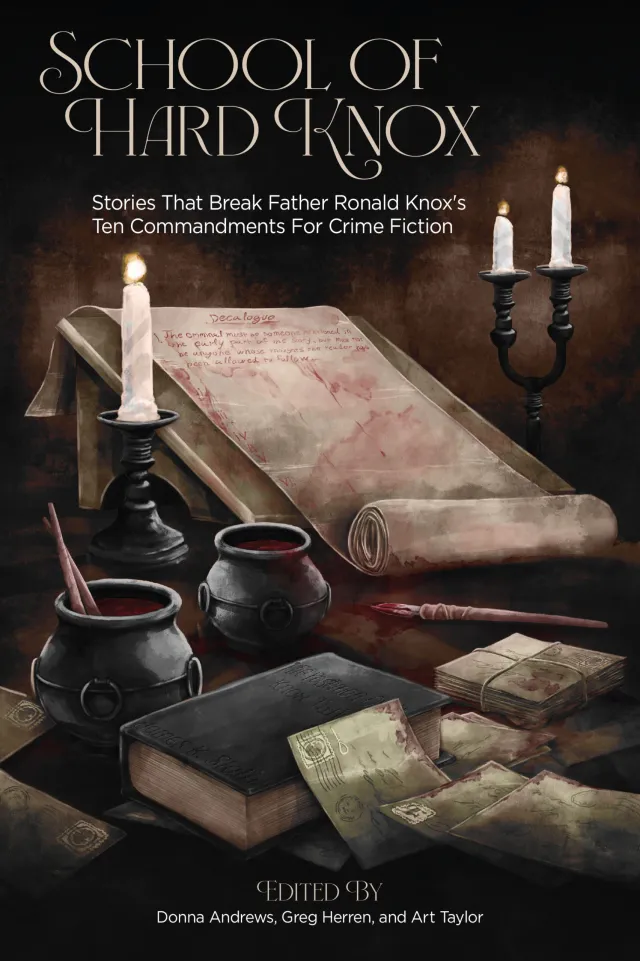
School of Hard Knox


School of Hard Knox is a just-published anthology of new short stories 'that break Father Ronald Knox's Ten Commandments for Crime Fiction'. The book is edited by a formidable trio of American crime writers, namely Donna Andrews, Greg Herren, and Art Taylor, and is published by that redoubtable imprint Crippen & Landru. I am one of the contributors, so I don't think it's appropriate for me to try to review the book, but naturally I'm very keen to talk about it! For those who would like a more objective view than I can offer, I suggest Jim Noy's review on The Invisible Event.

I was first approached with a view to contributing to the book more than a year ago. I'm always grateful when editors think of me as a prospective contributor to an anthology, not simply because it's good for morale, but mainly because the theme of the proposed book gives me a chance to stretch my imagination in a fresh direction, and that's always good. Unfortunately, it's not always possible, because of other commitments, to say yes to an approach of this kind. For instance, I've just regretfully turned down another approach from a couple of pleasant editors I've worked happily with in the past, simply because I'm too busy at present and the deadline wasn't manageable. A shame. But I felt that if I could come up with a strong enough idea related to Ronald Knox's 'rules', I'd like to have a go.

Having the right idea at the right time is crucial. When I was approached, at around the same time, to write a story for a Beatles-inspired anthology, I thought almost immediately of a story idea inspired by the song 'She's Leaving Home' - and that will be the subject of a future blog post. For the Knox book, an appropriate idea came to me quite quickly and that meant the project was feasible. After quite a lot of work, the idea morphed into a story called 'The Intruder'. Although it's entirely fictional, the setting is inspired by the immediate surroundings of my house in Lymm, and that made the writing especially enjoyable. No need to go travelling to do the research!

My fellow contributors include the three editors, Frankie Bailey (whom I had the pleasure of meeting for the first time recently, when we were both waiting for a bus in San Diego!), Marcia Talley, Dan Stashower, and Toni Kelner. And there's a wonderful bonus at the end - a very enjoyable poem by Peter Lovesey, 'Knox Vomica', which is characteristically witty and clever. A very interesting project to be part of, and I'm grateful to the editors and publishers for thinking of me and giving me the chance to contribute. 

Friday, 15 December 2023

Forgotten Book - Wake in Fright


I've had a copy of Kenneth Cook's Wake in Fright lurking on my shelves for a long time - upwards of fifteen years, I shudder to admit, even thought it boasts an intro by Peter Temple. And it's only recently that I got round to reading it. Now I'm wondering why on earth it took me so long. This is a debut novel of high calibre, chilling and memorable. 

John Grant is a school teacher who is, for financial reasons, tied to working at a remote school in a small village in the outback. As term comes to an end, he is desperate to get back to Sydney, where an attractive but distant girl called Robyn may or may not be pleased to see him again. He has just enough money to make a success of the trip.

The story has a low-key beginning, and Grant gets off the train at Bundanyabba (based on Broken Hill, a town which Cook clearly disliked) and is befriended by a local cop who is a bit of a slob. They drink together and the cop takes Grant to a gambling den. At first, Grant enjoys a winning streak. But it doesn't last...

Events become increasingly nightmarish as Grant - whose attitude towards the remote towns of the far west of Australia, and the people who live in them is condescending and negative - finds himself mixed up with a strange bunch of locals who are welcoming, but whose way of life is quite terrifying. I don't want to say more about the story than that. Anthony Boucher, who admired the book, questioned whether it is really a crime novel. Certainly, though, it has elements of suspense and menace - and yes, crimes are committed, although they are not necessarily of the kind you'd expect. Cook was obviously an interesting character, who had a rollercoaster life and career. This book and his second, Chain of Darkness, made it into the green Penguin series and I'm keen to read the latter. Wake in Fright was, incidentally, filmed in 1971, ten years after the novel was published.

Wednesday, 13 December 2023

Perfect Friday - 1970 film review


Perfect Friday is a fairly obscure film released in 1970 and directed by Peter Hall, better known for his work in the theatre. The cast is impressive and is led by Ursula Andress, Stanley Baker, and David Warner, with T.P. Mckenna, Garfield Morgan, and Julian Orchard also in attendance. The writers, less renowned, were Anthony Greville-Bell and Scott Forbes, and they came up with a screenplay that is uneven to say the least. But the result is very watchable.  

This is a bank heist film which teeters between comedy and drama, with some tense moments as well as one or two unexpected developments. Baker is an assistant manager at a bank, highly respectable but bored. We learn nothing much about his background and life, but when he meets Andress, his fate is sealed. He falls for her and they have an affair. He also wants to conspire with her to rob a bank. She is, however, married, to Warner, and they rope the husband into their little plot. But it's a scenario ripe for betrayal and I could see the final, by no means original, twist coming a mile off.

Before we got to that point, however, there was some enjoyable entertainment. Baker's plan involves taking advantage of the absence from the office of the senior manager to con McKenna's character (Baker's immediate superior) into believing that Warner is actually an envoy from head office, sent over to inspect the money in the bank vault. This part of the story is ingenious and well presented.

The lack of depth in the characterisation, coupled with Warner's innate eccentricity, mean that it's hard to take the key players seriously, even though Baker - as usual - delivers a strong performance. The score is by John Dankworth, but although he was a notable film composer, I found his jaunty themes intrusive. I suspect Hall wasn't quite sure what sort of film he was going to make, while the writers also seem to have been uncertain in their approach. So Perfect Friday is not a complete success, but the ingredients are genuinely interesting.

Monday, 11 December 2023

Cambridge Spies - 2003 TV series review


I missed Cambridge Spies when it was first shown on BBC2 twenty years ago, but having heard good things about it, I acquired the DVD and I've belatedly got around to watching it. I'm glad I did, because it's an entertaining account of a fascinating part of our history. When the series was first broadcast, several commentators made the point that historical accuracy is sometimes sacrificed. That's true, but of course in the murky world of spying, figuring out the precise truth is very difficult.

There's a distinct touch of glamour about the series, deriving in part from the Cambridge setting of key early scenes. This is the story of Kim Philby, Donald McLean, Guy Burgess, and Anthony Blunt, who were contemporaries at Cambridge and betrayed Britain because of a blind devotion to Russia. The casting is interesting. Toby Stephens, Rupert Penry-Jones, Tom Hollander, and Samuel West are all fine actors. What's more, they come from pretty privileged backgrounds - as does Benedict Cumberbatch, who has a smaller part - and I think their understanding of the world the spies inhabited gives their performances added zip.

Imelda Staunton, Anna Louise-Plowman, Anthony Andrews, and Ronald Pickup are among the other members of a high-calibre cast, while Peter Moffat's script copes pretty well with the extended timeline of events. Where the script doesn't work quite so well is in its failure to probe the inherent flaws of blind idealism, which are hinted at but not developed quite as effectively as they might have been.

Because of some of the blurring of historical fact, Cambridge Spies is emphatically an entertainment rather than a documentary. But it's nicely done and remains well worth watching because of the quality of the actors and the high production values.


Friday, 8 December 2023

Forgotten Book - The Manuscript Murder


In the course of his regrettably short career, Lewis Robinson, who also wrote as George Limnelius, displayed considerable flair as a mystery writer, making excellent use of his inside knowledge of military life. His best-known book is The Medbury Fort Murder, a locked room mystery of distinction that Bob Adey (who introduced me to his work) greatly admired. 

I acquired from Bob's estate Robinson's personal copy of The Manuscript Murder, published under his own name in 1933. He made a few handwritten notes on the text and also pasted on to the endpapers various reviews of the book. These included in particular a very positive notice in the Sunday Times from Dorothy L. Sayers, which must have given him enormous pleasure. My copy doesn't have a jacket and the above image comes from an excellent blog, The Grandest Game in the World

The Manuscript Murder is, as the title suggests, a 'bibliomystery', of an unusual and intriguing sort. An unconventional structural device is used in a very interesting way. A rich but disliked man dies and there is a very small pool of suspects. One of them, who is Jewish, is a detective novelist. He actually writes a story about the events leading up to the murder. But is he trying to pull the wool over the police's eyes? And what happens when another suspect then puts pen to paper?

I think this is a terrific concept and the story is well-written. The way in which the Jewish character is described would not be acceptable in a modern writer, but Robinson presents him fairly sympathetically and makes use of the antisemitic 'banter' (a loaded term) that the man suffers from his army colleagues as an element in the plot. On the whole, though, I didn't feel that the quality of the mystery quite lived up to my expectations, which were admittedly high. More could be done with this ingenious concept, I feel. But it's a laudably ambitious novel and I'm not surprised that Sayers was impressed. 


Thursday, 7 December 2023

Gallows Court and an honour in Japan


I was thrilled to hear from my old friend Sachiko Tytler the other day. She brought news that the Japanese translation of Gallows Court has been voted Best New Comer (i.e. best crime novel to be translated into Japanese) by a group of 51 critics and other experts engaged by Hayakawa Mystery Magazine

The book also finished sixth overall in the list of the top ten translated crime novels, which is quite something. I've been delighted by the response to my writing in Japan and other parts of east Asia in recent times - an exciting and unexpected bonus to the writing life.

Great credit, of course, goes to my translator, Mr Kagayama. I'm really grateful for his enthusiasm for the Rachel Savernake novels. The next book in the series to be published in Japan will be Mortmain Hall.

Wednesday, 6 December 2023

Carol Pouliot on Country House Mysteries - guest blog


At Malice Domestic earlier this year, I had the pleasure of meeting Carol Pouliot, a charming lady whose latest book is RSVP to Murder. She's very keen on traditional mysteries and so I asked for her thoughts on some of the classic tropes. Over to you, Carol:
 
'Why do we love English country house mysteries?
 
I’ve always been drawn to this classic type of story. From childhood games of Clue (Is it Colonel Mustard or Miss Scarlet?) to my first reading of Agatha Christie’s The Mysterious Affair at Styles, this subgenre, which offers an escape from everyday life, has captivated my imagination. I bet you agree!
 
The English country house mystery is reliable, like an old friend. We proceed confidently knowing the setting will charm, the characters will fascinate, the plot will challenge, and the ending will satisfy.
 
We open to chapter one and find ourselves elegantly attired, sipping champagne, and luxuriating on a velvety bench seat in a sleek automobile. Suddenly, soaring iron gates loom, and our chauffeur turns onto a meandering drive. We navigate its gentle curves, through magnificently manicured gardens, and arrive at the grand country mansion. Pampering and intrigue await!
 
As the butler greets us at the front entry, we eagerly anticipate a weekend of stunning surroundings, fabulously good food and drink, captivating conversation, and, of course, murder. The game is afoot, and we’ve got a front row seat.
 
One of the pleasures of the country house mystery is the cast of characters—both upstairs and downstairs. These family members, guests, and servants are often quirky, sometimes exotic, and forever secretive. From the sleuth’s point of view, they form a limited pool of suspects, each with a believable motive, and the means and opportunity to have committed the crime. Many country house mysteries feature a reluctant detective who is on holiday. However, as the bodies begin piling up, our sleuth can’t help but investigate.
 
The grand estate is always located in a secluded spot where the characters are cut off from the rest of the world, either by the location itself or by the weather, often a blizzard. These story elements increase the tension, and we find ourselves turning the pages a bit faster now, our own reality a distant memory.
 
As we read, we’re pulled further into the complex world of a mystery filled with twists and turns. We’re in a race with the sleuth, competing to see who solves the puzzle first. When we reach the end, we encounter a satisfying resolution where all is explained and good triumphs.
 
Here’s to the English country house mystery!!'

Thanks, Carol, and here's to RSVP to Murder!


Monday, 4 December 2023

Sepulchre Street - paperback publication!


This week sees the publication - on Thursday, to be precise, of Sepulchre Street, the fourth novel in the Rachel Savernake series. You can buy it from your local bookshop or order it here on Amazon

I really enjoy writing Rachel's adventures - I'm having a whale of a time with book five, which I started recently: spoiler alert, in that one, Rachel goes to the seaside. In Sepulchre Street, there are key scenes on Romney Marsh, while the eponymous Sepulchre Street is to be found in the ancient and lovely town of Rye in East Sussex. And if American readers are wondering, the book will be published next year by Poisoned Pen Press (an imprint of Sourcebooks), under the title The House on Graveyard Lane. Different title, but same book!


And here are some of the reviews;

‘Rachel Savernake is a 1930s feminist of independent means, who brings beauty and brains to her mission to expose the seamier side of high society.

Her latest adventure finds her at a surrealist exhibition where the artist displays live models to re-enact violent deaths. The artist herself features as Marie Antoinette on the guillotine. A performance that turns horribly real when the blade falls.

The suicide verdict is beyond question, except that before the fatal act, the victim had appealed to Rachel to unmask whoever had forced her to take her own life.

With a star-struck crime reporter in tow, Rachel embarks on a delightfully convoluted plot involving a glamourous courtesan with royal connections, a Soho gangster bent on revenge and a hit man who leaves nothing to chance.

In treating us to what is as much a thriller as a traditional mystery, Edwards hits all the right notes to create a palpable hit.’

Barry Turner, Daily Mail                    


‘A fascinating book…Martin has done something rather magnificent here. If this was written as a pure thriller, it would be a deeply satisfying book, but woven throughout the thrills is a cleverly plotted mystery – with a cluefinder at the end to prove it. It’s worth reading, but I do warn the reader that they’ll end up repeatedly kicking themselves at the things that they missed…All in all, this is an absolute triumph…The best book so far in an outstanding series.’

In Search of the Classic Mystery Novel


‘I have a particular love of the golden age crime fiction and Sepulchre Street transports you back gloriously to the period, you can breathe in the setting, you get a real sense of time and location

For me Martin Edwards is the modern day master of the Golden Age crime era and Sepulchre Street is the perfect example of why.

This is the fourth novel to feature Rachel Savernake and possibly the best to date (it does though easily read as a standalone).

Here we have Rachel asked to solve a murder before it has even happened, but then has there even been a murder ?

The opening of the book is one of the most inventive I have read, perfectly setting up what is to follow.

Martin Edwards poses many questions, with a wonderfully inventive plot, the writing combines all that is good with the golden age but with a modern day twist.

The plotting is superbly thought out, constructed in a way that leaves a few clues along the way, though you may not always pick them up, the book is paced perfectly for the period and just flows along. There are touches of the gothic which only heightens the reading enjoyment. In parts there is a conspiracy taking place with some definite unsavoury characters who act first then ask questions later, overall a slick and taut plot knitted together by the quality of the writing.

Plotting though on its own is nothing if you don’t have the characters to match, this is another area where the book shines, it is hard not like Rachel Savernake, strongly and fiercely independent she comes across as a no nonsense person not averse to taking a risk or two, then you have Jacob Flint crime reporter for the Clarion a man who likes to get himself into tight corners, thankfully he can rely on Rachel to come to his aid, i’m never quite sure of the relationship between the pair but it works, they look out for each other. In this book I particularly liked the roles that Martha, Hetty and Trueman played. I love the way that characters have developed through the books. Martin Edwards writes characters that are relatable, you get a real sense of who each are and the period in which they live.

There is a certain humour within the book, equally its drips with tension and drama, as it races towards the ending. Location plays its part, the story moves seamlessly around, the way the book is written you can feel yourself there.

One area as a reader I love about this period, is that the crimes are solved by good old fashioned leg work and thought.

Sepulchre Street is a superb read, by a writer who knows how to engage with the reader, I was captivated throughout, the pace of the book perfect for the times. It takes the best of the golden age and combines it with a read for today.

I find the cluefinder at the end most eluminating, well worth going back and re reading.

5* read which I would highly recomend and one which will appeal to all, one of the year’s top reads.

Martin Edwards is a favourite author of mine, writing, plotting, character, location, setting his books have it all.’

Amwbooksreviews


‘I did wonder if coming into the series at book 4 would present any issues, but I’m very happy to report that it didn’t – and I found Sepulchre Street a delight from start to finish!…a complex and deeply satisfying mystery which draws in changing identities, 1930s gangster violence, the emotional entanglements of the very high and mighty, some very worried civil servants and even a paid assassin! It’s a fascinating mix, and thoroughly engrossing from start to finish.

It has to be said that Martin Edwards really can write. His plotting and narrative are brilliantly done, and he weaves together marvellous threads which culminate in some wonderfully dramatic climaxes throughout the book. Sepulchre Street itself is tucked away down in Rye, and there’s a particular section of the narrative which draws a number of characters to the town, all converging on that one area and driven by different motives – really clever! There are multiple plot elements but Edwards never loses his grip on these, and the final resolution is one I would never have guessed!

There are so many intriguing aspects of “Sepulchre Street”, not least the issues which Edwards introduces. His knowledge of the period is comprehensive, and one particular element is handled with great sensitivity (I’m trying to avoid spoilers here) He also builds in some lovely little in-jokes and references to GA crime which I really enjoyed! The settings are vividly drawn and atmospheric, and I really felt I was inside the action – the book is quite a page-turner. Although rooted in a period when GA crime flourished, Edwards’ narrative introduces harder-edged elements at times, and there is a real sense of threat, particularly from Ambrose and his cronies. They’re a nasty bunch, and although the action is not gratuitously graphic, enough is said for the reader to be very keen to avoid falling into their clutches…

As well as plot and setting, Edwards really excels when it comes to characters. His players are lively, entertaining and very well conjured; I was particularly impressed by his ability to draw such strong female characters, and also to weave some of those issues women face into his plot without them ever sounding forced. Central to the narrative, of course, is Rachel Savernake herself, and although I haven’t read any of her previous exploits, enough was said about her backstory for me to fill in her past. The daughter of grim Judge Savernake, she seems to have had a childhood under his thumb which went to form her singular character. Self-taught, as were her loyal band of retainers the Truemans (who are more like friends and colleagues), she combines beauty and intelligence, and is a most engaging heroine. I loved how she always seemed in complete control, particularly when Jacob is failing to cope!!

I thoroughly enjoyed this clever, absorbing and entertaining book; it succeeds on all levels, mixing a wonderfully conjured Golden Age setting with excellent plot and characters, and the pace never flags. I was on tenterhooks at some points in the story, rooting for the goodies and deploring the baddies; but the story is never simplistic, and Edwards has his characters display some real sensitivity towards those they’re pursuing. There’s definitely the feeling that Rachel in particular is driven by a need for excitement, mysteries to solve and dangerous living, rather than simple crime fighting! Entertainingly, Edwards provides a Clue Finder at the end which reveals points in the story where attentive readers would have picked up important hints to the motives and solutions which was a lovely touch. “Sepulchre Street” was a wonderful read, and I’m now very keen to go back to the start and exploring the adventures of Rachel Savernake from the very beginning!’

Kaggsy’s Bookish Ramblings


Sepulchre Street is another fantastic, intriguing detective story from one of my favourite series…I loved the premise…I really enjoyed being back with Rachel and Jacob, solving another mystery with them…This book has a great pace to it…The author drops lots of clues throughout the book so you have to pay attention to everything…There is also a cluefinder at the back…I loved this idea and enjoyed going back to see the (many) clues I missed…while I do think it could be read as a standalone, I’d urge you to start at the beginning as this is a fantastic series!’

Over the Rainbow blog


Sepulchre Street is the fourth in the Rachel Savernake series and I think it is the best so far. It grips from the start…I loved the nods to Golden Age crime fiction, the cluefinder, the map. A lot of the fun of the novel lies in the period details and the way in which the 1930s are lovingly evoked: the clothes, the nightclubs, the songs (some invented, but very much in the spirit of the time). Cocktails were all the rage and their appearance is something of a running joke…hat next outing can’t come soon enough for me. I romped though the novel far too quickly and didn’t want it to end. All in all a splendid read.’

A Reading Life


‘A wonderful homage to the Golden Age. After the dazzling opening, the tightly knit plot moves around different viewpoints…the plot certainly races along…clever use of actual events…and nuggets of historical information. The settings are atmospheric and the writing enjoyable – in short, this book is a classic crime treat…A cleverly plotted, witty whodunit which transports you to a roller-coast ride in 1930s London.’

Marsali Taylor, Promoting Crime Fiction

‘In a nod to Golden Age fiction, Edwards has written another corker of a thriller/detective story set in 1930’s London. Readers who have already read one, or all, of the previous three Rachel Savernake books will know to expect a puzzle Poirot himself would be proud to have solved! You will need to pay attention to every word to try to work out the ending…

I had only read book three in this series so far (highly recommended) and I was really looking forward to meeting Rachel and Jacob again. Although she is the brains behind the investigation, they work very well together and she gets him out of a number of scrapes in her clear thinking level headed way.I thoroughly enjoyed it and would recommend it to fans of Agatha Christie who like a good puzzle to solve.’

Two Heads are Better Than One blog


‘It’s been wonderful being back in the world of Rachel Savernake that Martin Edwards creates.

Wendy Reads Books blog


‘I absolutely love this series…Rachel Savernake is an excellent protagonist. No nonsense, clever, tough, and mysterious herself, she loves a challenge…A twisting piece of thrilling golden age crime fiction to get your teeth into!’

Travels along My Bookshelf


‘There are many questions to answer, and the clues are there for those daring enough to solve them...I can see why they call Martin the Master of British Crime Fiction and I thoroughly enjoy reading his work. For me, the Rachel Savernake stories are the best and I just love to find out what she’s been up to along with her brilliant side-kicks.

Murder Jo Wrote


‘I liked Rachel’s character, she is witty, clever and inquisitive. Alongside her sidekick Jacob Flint, the pair try to unpick the puzzle of Demaris’s death and the mystery surrounding it.

Enjoyably there is also a touch of the macabre and matched with a fast-paced, chic and sophisticated setting of the 1930s rounded this story off for me. The atmosphere and detail of this golden era pull you in and fully transports you to a classic world from the past. I’m also a fan of a female-led narrative and Rachel is the perfect leading lady.

Secret World of a Book


Sepulchre Street will appeal to fans of classic crime fiction (think Agatha Christie and Dorothy L. Sayers) and those who enjoy the challenge of unravelling an intricate plot. A neat touch is the addition of a ‘cluefinder’ at the end of the book…Intriguing, clever, entertaining.’

What Cathy Read Next     


Sepulchre Street is probably my favourite to date; four books in the characters are developing nicely… Part of the pleasure of these books is in the details and references that Edwards sprinkles through them… There's a lot going on in here with all sorts of twists and turns, some interesting hints for future directions the series might take, as many easter eggs as a dedicated classic crime fan could hope for, and a host of other fun references to chase up. It's no easy thing to build a convincing past but I think Edwards does a really good job of it. It's his obvious knowledge of and affection for Golden Age crime that makes it work for me, coupled with a cast of characters who are neither self-consciously old fashioned, or entirely modern but stuck in fancy dress.

Add the gothic atmosphere (John Dickson Carr would be proud) and character development to the other elements here and it's a hard to beat series.’  

Desperate Reader blog


‘There is a dark, edge of your seat atmosphere in this book and as Rachel investigates you feel like you just don’t know what is around the corner. This is a thrilling and haunting read that is perfect for fans of historical crime and detective fiction.’

A Cottage Full of Books


Friday, 1 December 2023

Forgotten Book - A Grave Affair


I've been a fan of Shelley Smith for many years but it's only recently that I got round to reading her penultimate book. A Grave Affair, which dates from 1971. One of the reasons why she was such an admirable writer is that she avoided repeating herself and this book is unorthodox and interesting. Those stern critics Barzun and Taylor admired it.

The blurb quotes the author's views: 'We like to think of ourselves as small independent units consisting of our families and friends, living our private lives as if they had no connection with anyone else. But that is not so at all. An invisible network connects each of us with everyone else, seen or unseen, known or unknown.' The events in this novel are designed to illustrate exactly what she means.

This sounds rather didactic, but it isn't. Rather, Smith shows us the perspectives of a wide range of very different individuals, while focusing on the misadventures of a politician called Edmund Burke (why she chose that famous name, I've no idea - I find it rather odd). There are some curious infelicities, notably when she switches viewpoint within a short scene, and I didn't find her portrayal of a libel trial particularly credible. Her decision to use elements of the Arab-Israeli conflict, was very bold, but although aspects of it are very dated, the sad truth is that conflict over Palestine remains a recurrent theme in modern life.

So this isn't a perfect book, but ambitious novels never are. I found it extremely readable and interesting as well as pleasingly unpredictable. My copy was inscribed by the author 'To Sister Duncan...from her grateful patient' and I do wonder if health problems explain why she only wrote three novels in the space of more than twenty years after a flurry of early successes. Whatever the reason, it's a pity there aren't more Shelley Smiths. The novels she published are invariably worth reading.