Wednesday, 4 September 2024

Nashville Bouchercon 2024


Yeehaw! In other words, I'm back home after an exhilarating trip to Nashville for the 2024 Bouchercon mystery convention. This was a chance to catch up with old friends, meet some very pleasant people for the first time, and talk about crime writing in a memorable setting - the Gaylord Opryland Resort, said to be the biggest hotel in the US that doesn't have a casino. I've never known a hotel with such a labyrinthine layout - they even supplied an app to help visitors find their way around and some members of staff were also tasked with directing people who got lost, which was remarkably easy to do. I had a wonderful suite with a balcony (see photo below) commanding a view of one of the mega-conservatories which form the hotel. A strange location, in some ways, with marvellous facilities yet also huge queues at the coffee shops and a touch of satire (I hope) in the bizarre message displayed on this placard...


I was on two panels, entertainingly moderated by Ken Wishnia and Colin Campbell respectively. Colin's panel had an all-British line-up of myself, Craig Robertson (whom I was delighted to meet for the first time), Mark Ellis, and Caro Ramsey. There were also some very enjoyable publisher parties and the wonderful people from Poisoned Pen Press hosted an excellent event to promote their authors' books, including my just-published The House on Graveyard Lane (that is, Sepulchre Street). As ever, much credit goes to the organisers, who had to contend with a variety of unusual challenges this year, but still managed to put on a very good programme.


It was fun to hang out in the bar with the likes of Mick Herron and his partner Jo, Steve Steinbock, Craig Robertson and others, while there were enjoyable meals with a variety of friends including Les Klinger, Steve, Verena Rose, Shawn Reilly Simmons, Art Taylor, Susan Morrison, and Shelly Dickson Carr. One of those meals was in a 'British pub' in the legendary Printers' Alley, featured in the Paul McCartney song 'Sally G'.


There was time for me to look around the city (which even has its own Parthenon), although it was several miles distant from the hotel, which made things more complicated. Closer by was a vast shopping mall which had a Madame Tussaud's wax museum devoted to musical legends, not least Taylor Swift! All in all, Nashville is an extraordinary city. San Diego, site of last year's Bouchercon, definitely remains my favourite, but I did have a good time in Tennessee.


Monday, 2 September 2024

Third Party Risk aka The Deadly Game - 1954 film review


Third Party Risk is a minor film based on a thriller by a minor author who was, nevertheless, a very interesting individual. His name was Nicolas Bentley and he was the son of E.C. Bentley, author of Trent's Last Case and second President of the Detection Club. Nicolas's second name was the same as his father's - Clerihew. Apparently his birth name was Nicholas, but he opted to change the spelling. 

Nicolas was best known as an illustrator and sold his first drawing to his godfather - none other than his dad's old chum G.K. Chesterton. He was well-connected - his father-in-law was the famous barrister Sir Patrick Hastings - and his work in publishing led to associations with a variety of prominent people such as Ian Fleming. 

Nicolas wrote a handful of thrillers but never became a member of the Detection Club. Two of his books were filmed, however, lucky chap, and this was one of them. What's more, the film features a number of pretty good character actors, such as Finlay Currie and Roger Delgado (who was in those days often cast as an exotic foreigner; he later became famous as The Master in Doctor Who), as well as Maureen Swanson and Lloyd Bridges.

The first part of the story is set in Spain - this was a time when authors and film-makers were responding to people's interest in exciting Continental locations during an age of austerity. Casting an American in a lead role was another common feature of films of this era. While on holiday, Philip Graham (Bridges) bumps into an old friend who has to leave in a hurry. Philip has to take his pal's car back to England, and finds himself mixed up in a tangle involving microfilms and murder. The result is competent entertainment, albeit nothing out of the ordinary. A B-movie, but not a bad one.

Friday, 30 August 2024

Forgotten Book - The House is Falling


The House is Falling (1955) is by Nigel Fitzgerald and it's the first book of his that I've read. A few years ago, John Curran made a strong case for the merits of his fellow Irishman on a Forgotten Authors panel at CrimeFest and I've been meaning to get round to him ever since. Fitzgerald was an actor who produced a dozen novels over the course of fifteen years, all of which were published by Collins Crime Club. This was his third, and features his series detective Superintendent Duffy, although Fitzgerald appears to give away the solution to Duffy's previous case.

The setting is the west coast of Ireland, and this background is one of the strengths of the book. Hugh Barry, the hero, has returned to the former family home, Cooline House, after an absence of many years. His aunt Veronica is there, but the hosts are Oliver Cliffe-Barry, who lost both his legs in a car accident, and his wife Carol, who is a rather unlikeable character. The other guests and neighbours include a detective novelist, Dr Lake, and his attractive niece Hilary. Hugh finds himself attracted to both Hilary and another guest, Consuela.

The story meanders along, pleasantly but without great excitement, until murder is committed. Duffy is called in to investigate and it soon emerges, in a pleasing twist, that an important lie has been told about the deceased. (I'll avoid saying what that lie is). What's the significance of this? The eventual explanation struck me as very satisfying.

Despite a certain lack of tension, and the fragmentary nature of Duffy's involvement, I felt that the story was readable and well put together. The 'howdunit' element was complicated and I didn't find it entirely convincing, but overall the psychology of the characters was very pleasingly handled, with a strong final paragraph. The quality of the last part of the book made up for the lack of pace earlier in the story. So John's recommendation of Fitzgerald seems, on this evidence, to be well merited.  

Wednesday, 28 August 2024

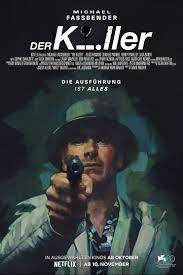
The Killer - 2023 film review


I must admit my heart sank a little when, having opted to watch a recent film directed by the estimable David Fincher, I realised that The Killer was based on a graphic novel, which isn't necessarily a recipe for a story of any depth. My doubts were compounded when the film began very slowly indeed - clearly a deliberate decision on Fincher's part, but I felt he overdid it. Fortunately, things began to improve and, although the story is oddly episodic, several of the set-piece scenes were truly gripping.

The film opens with an assassin philosophising in a room in Paris as he prepares to shoot a target. There's nothing terribly original about his various mantras ('Trust no-one' etc) and things drag strangely before finally he shoots - and misses his intended victim. Perhaps the philosophising distracted him, who knows? He makes a hasty getaway and is next scene in the Dominican republic, where it turns out he has a hideaway. Unfortunately someone has been there and tortured his girlfriend, who somehow manages to survive.

The rest of the film sees the assassin pursuing vengeance against the people responsible. So it's a pretty straightforward story, but it has some very interesting moments, for instance in an encounter with a corrupt lawyer and his secretary. The assassin uses an ever-changing variety of aliases (using the names of characters from American sitcoms) and there's a fight scene against the background of an episode of Antiques Roadshow, starring Fiona Bruce. These sporadic touches of humour offer some relief from the bleakness of the protagonist's worldview and meticulous execution of his plans. I also very much liked his encounter in a restaurant with a woman known as 'the Expert', played by Tilda Swinton; a cameo part, yes, but she does a great job. The ending of the film is surprisingly ordinary, but somehow (and I don't say this as a criticism) that's in keeping with the mood of the lead character.

Michael Fassbender makes a very good assassin, conveying the right level of believable menace and attention to detail. I don't think The Killer is as compelling as Fincher's best films, but after that iffy start it certainly kept me interested.    

Monday, 26 August 2024

The Guest - 2014 film review


The storyline of The Guest is a mash-up of home invasion thriller, conspiracy thriller, and Halloween thriller. There is plenty of violence and some points in the plot aren't entirely clear (apparently there was more explanation in the original version, but this was cut after preview audiences felt it was long-winded). Really, it should be a mess. But although it has trashy elements, it's surprisingly watchable.

This is in part due to the fact that the protagonist is played by Dan Stevens, who is quietly-spoken and charming, but with a faint undercurrent of menace. One day he turns up out of the blue at the home in New Mexico of a grieving family, the Petersons. He explains to Laura Peterson (Sheila Kelley) that his name is David Collins and that he was the best friend of Caleb, the Petersons' son, a soldier who died recently in the Middle East. She invites him to stay for a while and he meets her husband Spencer (Leland Orsler), their gay son Luke (Brendan Meyer) and their daughter Anna (Maika Monroe). At first Spence and Anna are hostile towards him, but he gradually wins everyone's confidence.

But it's clear almost from the start that David is not as nice as he seems. In particular, he has an extreme propensity for serious violence and a disturbing talent for manipulating people. I thought the film was heading in a fairly conventional direction, but then came a significant plot development which changed my perception of what was going on. But it would still have been good to know why David really went to the Petersons' house, and what exactly made him behave the way he did. By cutting down the explanation, I think the director threw the baby out with the bath water.

Even so, I found this film fairly gripping, in a sort of guilty-pleasures way. A twist right at the end of the movie left the door open for a sequel, which was apparently contemplated, but never actually made. Don't expect anything too sophisticated from The Guest, but there's a reason why it was well reviewed. It's well-paced and a perfectly good time-passer.

Sunday, 25 August 2024

New Books


I'm excited to say that the coming days will see the publication of three of my books (plus a fourth in America), with my fifth and latest Rachel Savernake novel, Hemlock Bay, leading the way. I really enjoyed taking Rachel and Jacob Flint to the seaside in this mystery, and I'm very much hoping that readers will delight in one of my most intricate stories, which is published by Head of Zeus under the Aries imprint. There's a Cluefinder, as in earlier Rachel Savernake books, and this one contains no fewer than forty-seven clues - see how many you can spot before Rachel reveals all!


The previous book in the series is just being published by Sourcebooks in the United States. This is The House on Graveyard Lane, known in the UK as Sepulchre Street. As part of the celebrations around the launch, I took part in an interview with Barbara Peters of the legendary Poisoned Pen bookstore and it can be found here   


Returning to England, September 10 sees the publication of my latest anthology in the British Library's Crime Classics series. This is Metropolitan Mysteries, subtitled A Casebook of London's Detectives, and it features stories by luminaries such as Henry Wade, Dorothy L. Sayers, and John Dickson Carr, as well as some unfamiliar names, including Malcolm Gair. I aim to include both familiar and deeply obscure stories in these themed collections and there are some genuine rarities here.


Last but by no means least comes Midsummer Mysteries, which I have edited on behalf of the Crime Writers' Association. The publishers, Flame Tree Press, have come up with a quite gorgeous volume. In stark contrast to the British Library book, this is a collection of brand new stories and more than half of them are written by people who have never previously had a short story in a CWA anthology, which I find quite remarkable. Among those stories is one of my own, 'The Widow, which is set in Berwick-upon-Tweed, and was partly inspired by my visit to the Berwick Festival last year. But the story is set in the Sixties and concerns an idea which has interested me for a very long time..

Friday, 23 August 2024

Forgotten Book - The Five Red Herrings


After my visit to Galloway, it seems only right to devote today's retrospective to Dorothy L. Sayers' The Five Red Herrings, although it is very far from a forgotten book. Indeed, I doubt it has ever been out of print. The book was originally called Suspicious Characters in the US and sometimes the definite article is omitted from UK editions, as it was when the story was adapted for television by Anthony Steven almost half a century ago.  

Sayers agonised over the title - quite rightly, she cared about her titles and hers were usually memorable. She wanted to call this book Six Suspects, but someone beat her to it (long before Vikas Swarup wrote his bestseller with that title). In fact, I think she finished up with a very good title, whether or not you include the definite article. 

Her intention was to write a puzzle plot story, a whodunit with strong leanings towards the Freeman Wills Crofts style of mystery. While she was working on the book, she was in touch with Crofts - a fellow founder member of the Detection Club - and learned to her dismay that he was working on a book set partly in the same area of Scotland. This was Sir John Magill's Last Journey, which I reviewed here way back in 2010. The two stories are very different, however, and Sayers was determined to ensure that her publisher gave her a better map of the area than appeared in the Crofts title. She got her way, naturally.

The great strength of this novel lies in its evocation of the artists' colony and the way of life in what is still a relatively traditional community. Sayers took pains over the construction of her puzzle, as she took pains over all her creative endeavours, but I'm afraid it's not a compelling mystery. Constructing a whodunit wasn't her forte - she was a very, very different writer from her friend Agatha Christie. The TV version is in many respects an improvement on the book. Nevertheless, the story offers a wonderful illustration of her ability to conjure up a believable and compelling setting.  

Wednesday, 21 August 2024

On the Trail of The Five Red Herrings


During my recent trip to Scotland, I was keen to trace some of the locations which crop up in Dorothy L. Sayers' 1931 novel, The Five Red Herrings. Set in Galloway, this book is a love letter to the area and the prefatory note (addressed to Joe Dignam, landlord of the Anwoth Hotel in Gatehouse in Fleet, to whom the book is dedicated) spells out her commitment to writing about real places. 


The main focus of my pilgrimage was Kirkcudbright. As Sayers says in the book, in this part of the world one either fishes or paints, and painting is at the heart of the novel. What I found very interesting is that Kirkcudbright was a mecca for artists long before Sayers and her husband Mac Fleming (an Orcadian who loved painting) arrived there on holiday. And that tradition continues. In the twenty-first century, when you drive in, there is a sign which proclaims the fact that you are entering an 'Artists' Town'.


Galleries abound, and I enjoyed looking at the exhibition devoted to the portrait painter Sir Henry Raeburn at Kirkcudbright Galleries, an impressive space which has plenty of other interesting material on permanent display. There's another nice little gallery at the Harbour Cottage, while it was fun to walk down High Street and pass the door of the No. 14a, which Mac Fleming rented for ten years up to the start of the Second World War. A stone's throw away is Broughton House, once owned by the artist E.A. Hornel and now in the care of the National Trust of Scotland. The house featured in the 1975 TV version of Five Red Herrings, as did a number of other places in the town.


From Kirkcudbright, it's not far to Gatehouse of Fleet, where Dorothy and Mac stayed at the Anwoth Hotel, now called The Ship Inn (below). This is another attractive town which benefits from a waterside setting and as I wandered around the area, it was good to picture Sayers roaming about, in search of inspirations for her story. She found plenty of good material, that's for sure. 


Monday, 19 August 2024

On The Trail of The Wicker Man


I'm just back from a shortish but enjoyable break in the south west of Scotland, mainly devoted to visiting an old friend from my school days, but incorporating plenty of fun trips and making the most of lovely weather - other than one very wet morning spent in the delightful book town of Wigtown! And even that damp day was made extremely pleasurable by the experience of wandering around the shops. Wigtown is a pleasant place, make all the pleasanter by the presence of thousands of books. I'd like to give special mention to Well Read Books, run by Ruth Anderson K.C. (not a bad career move for a top barrister to start up a great bookshop!) who was most welcoming. The shop has an eclectic stock, with some marvellous - and very uncommon - old crime titles as well as new books. I snaffled a John Rhode paperback that I'd never even seen before, and I'll definitely be back.


The first stop, though, was the seaside town of Ayr, which has lovely beaches and plenty of history. From there it was a short drive to Culzean Castle, which I last visited more than thirty years ago. It's a place that has stayed in my memory for various reasons, including the fact that in the film of The Wicker Man, it was the home of Lord Summerisle, also known as the great Christopher Lee. 


Culzean is a National Trust property, an impressive house in splendid grounds overlooking the sea. In the film, of course, it is located on the verdant island of Summerisle. The film was shot in a variety of locations in the south west of Scotland, and I enjoyed wandering around the area and seeing a number of them.The monster in the Swan Pool seen below is not connected with the film, nor is the horse shown at the end of this post, but I liked them a lot...


In the pretty little town of Kirkcudbright, the tourist information shop (situated close to the woven horse shown below) even sells pamphlets which show several of the locations used in the film. The harbour cottage now houses an art gallery and the whole area is picturesque. One evening, we dined in the Creebridge House Hotel, where members of the film crew stayed during the shoot. On a gorgeous day, it's hard to imagine that this area is the setting for one of the finest horror movies ever made. But of course, it's that contrast between light and dark that makes for such powerful artistic effects. 


Friday, 16 August 2024

Forgotten Book - Fearful Symmetry


I've mentioned Morag Joss a couple of times over the years. First, in relation to her excellent novel Half Broken Things (which gets a name-check in The Life of Crime) and the enjoyable TV adaptation of it and second when reviewing another of her novels of psychological suspense, The Night Following. As a writer, she is a class act. I've never met her, so I can't be sure of this, but my guess is that she finds writing crime fiction slightly constricting. And this may help to explain why she is far from prolific in the genre, despite having achieved considerable success.

I've now read her second novel about the cellist Sara Selkirk, Fearful Symmetry. It seems rather characteristic of Morag Joss's somewhat off-beat approach that her protagonist is a cellist and also that she opted for a title which is intriguing but unusual. This is definitely a crime novel, and Sara does plenty of amateur detecting (with mixed results) as well as collaborating with a policeman, Andrew, who just happens to be in love with her. I felt that in some respects Sara and Andrew were rather irritating, but in a sense that just illustrates the fact that they are well-rounded characters. As are most of the other key players in the story.

One of the great strengths of this novel is its wit - sometimes seasoned with irony. There's also some poignant writing. One character is on the autistic spectrum, a subject in which I've become very interested, and the presentation of autism is well handled, especially when one bears in mind that the book was published 25 years ago, when this complex condition was less well understood.

The opening scene is devastating. We are introduced to a single, retired woman called Imogen Bevan. She is respectable but unpleasant (and in fact she is quite harshly presented) and her unkind nosiness has truly shocking consequences. The investigation, led by Andrew, meanders for a long time, especially given that the reader knows something that the police don't know, and in the meantime we're introduced to Sara and an assorted bunch of people who become involved in a community opera project. A successful but vain composer is portrayed with biting satire, as is another, rather less renowned composer. And eventually a second shocking death occurs. Again the inquiry is handled in a rather desultory way but the finale is gripping and memorable. 

This was Morag Joss's second crime novel and it isn't without flaws. The digressions are wonderfully written, but there are a lot of them, and the balance between story development, characterisation, and discussion of music, is uneven, which affects the pace adversely. But even though some aspects of life have changed a lot in the quarter-century since this book first appeared, it remains true that good writing is good writing. And there is a plenty of that in Fearful Symmetry, as well as a story that I think will linger in my mind.