Monday, 2 December 2024

Playing the Game


Puzzles are much in vogue at present, and this fashion is reflected in contemporary crime writing. In many ways, it seems to me that the public enthusiasm for puzzles such as Wordle and Murdle is comparable to the 'play fever' which swept the western world after the First World War and the influenza pandemic. This is the zeitgeist, I think. People want to have fun, and who can blame them?


Not me, that's for sure, because I've always been a puzzle fan. Bethan, my lovely editor at Head of Zeus introduced me to a mystery game called Cryptic Killers about a year ago, and I've enjoyed several games of that. Back in May, I took part in a Murdle game hosted by the creator, G.T. Karber. Ten days ago I was chatting with my editor at HarperCollins about this trend and last week (after an encouraging lunch meeting with the British Library folk and then a coffee with Bethan and the Head of Zeus and their publicist) I rounded the day off in style, as I had the pleasure of participating in an interactive mystery game hosted by my agent James Wills and his company Watson, Little.


This was a game devised by Jury Games and it took place at the Theatre Deli in London. The literary agents were joined by a group of their clients, all of whom are crime writers. A very convivial bunch of jurors, and we had a lot of fun trying to figure out what was going on. How did we do? Ah, that would be telling...


Just as enjoyable were the conversations in a local pub after the game was over. I had the pleasure of chatting with a group of lovely people, including Alex Marwood, Ajay Choudray, Victoria Dowd, Luke Chilton, and Alex Pavesi. I've often made the point that the life of a writer has plenty of downs as well as ups, but that was one of those days when I was acutely aware that overall it's a hugely pleasurable existence.

Friday, 29 November 2024

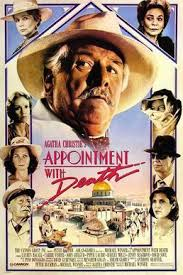
Appointment with Death - 1988 film review


Until recently I'd avoided Michael Winner's 1988 movie version of Agatha Christie's Appointment with Death for two reasons. First, I'm not keen on the book. I recall that when I first read it as a teenager I felt it might have been called Disappointment with Death. For me, the characters didn't really come to life and I didn't believe in the criminal motivation, which was not, I felt, adequately foreshadowed. Second, I've never been a big fan of Winner, and the memoirs of Anthony Shaffer, who co-wrote the screenplay, were very negative about the film.

However, I decided to give it a go on realising that Peter Buckman also had a hand in writing the screenplay. Peter and his wife were very kind to me a couple of years back when I narrowly missed my own appointment with death. While en route to have lunch with them in Oxfordshire, my car was involved in a hit and run with a motorbike, a pretty terrifying experience. These days Peter is primarily a literary agent, but he's also a good writer. And the screenplay does have some rather nice touches.

There is a starry cast. Peter Ustinov plays Poirot in a very Ustinov way, as usual, while John Gielgud is the official detective, Colonel Carbury. The appalling Mrs Boynton, now the matriarch of a dysfunctional American family, is played by Piper Laurie, while Lauren Bacall is cast as the almost equally unappealing Lady Westholme. Winner cast his partner Jenny Seagrove as the young Dr King and David Soul as the lawyer Jefferson Cope. The two Boynton sons are played, rather underwhelmingly, by less well-known actors, but it's still quite a roster.

The story is significantly changed from the book, but here that's arguably a positive, given the flaws in the original. However, it's a shame that filming was done in Israel rather than Petra, which made a notable backdrop for the novel. Overall, it's not a brilliant movie, but it's competent: by no means as bad as some critics have suggested, and far superior (for instance) to The Alphabet Murders.


Forgotten Book - Not to be Taken aka A Puzzle in Poison


When I first read Anthony Berkeley's 1938 stand-alone novel Not to be Taken, many moons ago, I recall that I was slightly underwhelmed for most of the book, even though it was agreeably written. And then the later developments in the story enabled me to understand what Berkeley had been trying to do, and I ended up by being very satisfied. I thought I'd take another look at the book to see if I still felt as positive about it.

The answer is yes. This is a quietly told village mystery, set in rural Dorset. The narrator, Douglas Sewell, is a fruit farmer. Berkeley went to school in Dorset and he understood country life pretty well. His observations about gossip are spot on, and he also uses a scene with a local gossip-monger to impart key information relevant to the plot. It's quite a subtle piece of writing.

What I didn't know when I first read this novel was that it was originally a serial, published by instalments in the very popular magazine John O'London's Weekly. The magazine used it to set a competition for readers, with a total of £350 in prizes - no mean sum back in 1938. When the book became a novel, it incorporated a Challenge to the Reader, very much in the Ellery Queen tradition. 

The novel's subtitle, which became the actual title in the US edition, was A Puzzle in Poison. And this is a mystery which does exactly what it says on the label. There's little obvious detection - Roger Sheringham does not feature - but the apparently low-key storytelling is deceptive. In fact, this is a pretty ingenious mystery, and I'm not really surprised that none of the entrants in the competition came up with the complete solution. A pleasing read. The cover image, by the way, comes from the website o a London book dealer, Stephen Foster. If you want this copy, alas, it will set you back £1250. (And there are two costlier copies on Abebooks as I write). Berkeley is a very collectible author and his first editions don't come cheap.

Forgotten Book - Parting Breath


Catherine Aird is someone I've known and admired for a long time, both as a writer and as a delightful companion. In the course of her exceptionally long writing career she has won the Gold Handcuffs award (a forerunner of the Dagger in the Library) and the Diamond Dagger, and she has entertained her readers royally. I've collected signed and inscribed copies of her books over the years and acquired a number of her older titles recently. These included a signed copy of Parting Breath, published in 1977, which I hadn't read previously.

The story is set in the University of Calleshire and since I was a student myself in 1977, I was greatly amused by Catherine's portrayal of academic and student politics - a sit-in plays an important part in the story. One of the features of her writing is its sheer cunning. Yet this is far from obvious, because the style is so low-key and agreeable. She lures you in with her comfortable and amusing descriptions and dialogue and you tend not to realise that she's also supplying you with information vital to the solution of the puzzle.

The title Parting Breath (which turns out to be taken from the work of Robert Burns) is a crafty reference to the fact that this story features our old friend The Dying Message Clue. And it's a cryptic one. The relevant phrase uttered by the first murder victim is 'twenty six minutes'. I confess that I didn't manage to figure out its relevance to the story.

As usual, the detection is undertaken by Sloan and Crosby, an amusingly contrasted pair of sleuths. There are some fascinating literary references, with a plot strand concerning literary detection; the mystery is one I wasn't familiar with (it concerns Jane Austen) but I found it interesting. All in all, this is a good example of Catherine Aird's quietly accomplished crime writing. 


Wednesday, 27 November 2024

Person Unknown - 1967 Anglia TV review

Thanks to YouTube, I've just watched Person Unknown, an ITV 'play of the week' made by Anglia TV back in 1967 which was previously unknown to me. The script was written by David Butler and adapted from a play called A Person Unknown by Olive Chase and Stanley Clayton. I know nothing about the writers, but it seems that Chase and Clayton wrote a number of crime-themed stage plays together.

This is a reasonably good whodunit set in a modern university, around a women's hall of residence. The stage origin of the story are abundantly clear from the way almost all the action takes place in the office and home of Jane Canning, who is in charge of the place. Low-budget, yes, but definitely not without merit.

The strength of the show comes from the quality of the cast. One of the minor roles, that of the student Beth Gray, is played by Felicity Kendal; it must have been one of her earliest TV parts. She and her friend Margo (Wendy Varnals, whose career didn't last nearly as long) become concerned when a fellow student goes missing. They report her absence to Jane Canning (Elizabeth Sellars) - see the above photo. Jane just happens to be romantically involved with a detective superintendent, played by the super-reliable John Gregson. Soon a body is found...

Suspicion falls on Jane's brother Gilbert, who is played by John Wood with characteristic nervous energy. Wood was an eminent thespian, though on occasion here perhaps his performance, although arresting (no pun intended), lacks subtlety; maybe that can be blamed on the script. But there are one or two nice twists before all is finally revealed. I enjoyed this one, even if it showed its age in terms of production values.


Monday, 25 November 2024

The Mysterious Case of the Victorian Female Detective by Sara Lodge


Yale University Press have published some interesting books of late - one that I hope to get round to before long is about 'murders in blackout London' - and I recently had the pleasure of reading The Mysterious Case of the Victorian Female Detective by Sara Lodge. Sara Lodge is an academic, but she belongs to that growing band of academic writers in the crime field who write engagingly with a view to sharing their erudition and the fruits of their research with a wide readership. This is a trend that I find very appealing.

In her introduction, Sara Lodge explains that her interest in her subject was stirred in 2012 at the British Library, when she read those intriguing books The Female Detective and Revelations of a Lady Detective. That must have been about the time that the British Library's Publications Department started to delve into its vaults for historic crime titles, for both books were republished, with characteristically excellent intros by Mike Ashley. In those early days, sales of these titles (and also The Notting Hill Mystery, which is in many ways even more interesting) were modest and this prompted the Publications Department to move on to the Golden Age, reviving three novels by Mavis Doriel Hay (two with intros by Stephen Booth) before Rob Davies had the brilliant idea of using railway artwork posters for the cover art, and the rest is history.

Anyway, I digress. There is a wealth of material about women in Victorian times who undertook various forms of detective work. I learned a good deal. You can get some idea of the author's wit from the title of chapter 4: 'Sex and the Female Dick: The Secrets of the Private Enquiry Agency'. This contains some fascinating stories and plenty of information that would provide good background for fiction set in the period, as well as insights into social attitudes of the time. Only occasionally does the author lapse, unnecessarily I thought, into academic-speak like 'I will argue...' and 'I will be examining two cases in detail', but on the whole the text is very readable, and this is an important plus.

There is some excellent discussion of Victorian detective fiction in which female detectives appear. There is more of this than you might think, and Sara Lodge discusses, interestingly, a couple of authors about whom I knew little, Elizabeth Burgoyne Corbett and Florence Marryat (daughter of Captain Marryat, once a popular author himself). She made me want to explore their work in some depth. I also think that the illustrations are well chosen - for instance, there's a map of detective agencies, publishers and newspaper offices in Victorian London which helps to underline a rather important point made in the text, about the close relationship between journalism and detection. The inclusion of this map is just one nice, imaginative touch in a book which has them in abundance. Recommended reading and surely a contender for the CWA Gold Dagger for Non-Fiction.


Friday, 22 November 2024

Forgotten Book - The Mystery of the Peacock's Eye


Over the past few years, Dean Street Press have reprinted the work of a wide range of relatively obscure detective novelists. I wrote introductions for books written by Sir Basil Thomson and Winifred Peck, and one of the other revived authors, Peter Drax, also strikes me as very interesting. But I think that probably the best 'find' of all in the extensive DSP catalogue is Brian Flynn. His revival owes everything to the doughty advocacy of Steve Barge, who blogs as The Puzzle Doctor.

Flynn was a writer with plenty of good ideas and he was adept at weaving complicated and sometimes unusual plots. These strengths are on display in The Mystery of the Peacock's Eye, the third in the long series of Anthony Bathurst novels, dating from 1928. This is the first Flynn book that Steve read and, as he explains in his introduction, it's the story which caused him to become a Flynn obsessive. (His intros, by the way, are crisp and informative).

Steve describes it as a 'long-lost classic', and the first thing I must say about the book is that the solution came as a complete surprise to me. I appreciate the cleverness with which I was led up the garden path. I was also amused by the way in which Flynn, who had a weakness for purple prose and a tendency to write in a verbose and old-fashioned way, turned one example of pedantic dialogue into a rather nice clue.

I also rather liked the way in which Flynn used a couple of the most tedious tropes in Golden Age detective fiction - a fabulous jewel taken from India, and a crown prince from one of those Ruritanian countries - and did something unusual with them. Nor is Bathurst as irritating here as in some of the other books by Flynn that I've read. The characterisation is mostly thin, it must be said, and as a result it's not easy to keep some of the characters distinct in one's mind. But this is an enjoyable mystery and well worth reading. 


Wednesday, 20 November 2024

Against the Grain by Peter Lovesey - review


Against the Grain
by Peter Lovesey is billed as the last Peter Diamond novel. I've followed Diamond's rollercoaster crime-solving career right from the start, so reading the book was in a sense a bitter-sweet experience, but I'm delighted to say that this story shows Diamond at his best. The sense of fun that Peter Lovesey must have had in writing this novel is palpable.

Here, for the first time, the gruff Bath cop investigates a village mystery. The book opens with a memorable scene, when a man climbs into a grain silo with disastrous results. We then move forward in time to find Diamond and his partner Paloma invited to stay in the country with his former sidekick, Julie Hargreaves. Julie, it turns out, wants him to do some investigating. Was what happened to the man in the grain silo manslaughter? Or even murder? Naturally, Diamond can't resist the challenge.

The text is peppered with crime fiction references - Sherlock Holmes, Poirot, Miss Marple, Columbo, Jack Reacher - as Diamond engages in all kinds of antics in his attempt to find the truth. He even helps to deliver a new-born calf and participates in a country hoe-down. There are some good jokes and we find out what Peter Lovesey thinks about a certain theory concerning the identity of Jack the Ripper (suffice to say, I agree with him).

Writing a series that runs to twenty-two novels is an impressive feat. What is much more impressive is the sheer variety of the Diamond books. It is their range and constant inventiveness that makes them stand out. It's so easy for a long series to become formulaic, and we can all think of examples, but that has never been the case with the Diamond stories. Even if Peter Lovesey had written nothing else - and of course, he's written many wonderful novels and short stories outside this particular series - this would stand as an admirable achievement.

I'm rather proud that a quote from me features on the rear of the dust jacket. I described Peter as 'a master of tales of the unexpected' and Against the Grain, which is full of surprises, certainly bears out the truth of that statement. No wonder this book gained a starred review from Publishers Weekly. This is great entertainment, strongly recommended.


Monday, 18 November 2024

Hemlock Bay...and what comes next?


I'm feeling slightly liberated just at the moment, for a number of reasons. First, I'm very pleased with the reaction of critics and readers to Hemlock Bay. This is a novel I felt very confident about when I was writing it - not something that happens very often, to be perfectly frank - and so I was hopeful that others would like it just as much as my editor Bethan and my agent James did. But you can never be too sure about these things. And no sensible author is ever complacent.

I was lucky to get a great review in the Daily Mail earlier this month; as a bonus, there was also a nice review of Dramatic Murder, the latest Crime Classic to which I've supplied an introduction. This is a real boost to morale, given that it's extremely difficult (unless you're a big bestseller) to get any coverage in the national newspapers for the fifth book in a series. I've previously mentioned Jeremy Black's nice review in The Critic, and some of the best bloggers around have been extremely supportive too. All this is very motivating when one is toiling away on a work-in-progress.

Second, what about that work-in-progress? Well, I'm glad to say that I have just sent off the manuscript for my latest novel. I can't say too much about it yet, but I can say that it's a stand-alone and it is significantly different from my other crime novels (though it's very much in the detective genre, and yes, there is a Cluefinder!) Writing this book has been quite demanding, but once again I'm very pleased with the very enthusiastic response of my editor and agent, and that is a big positive. Believe me, it isn't a given that discerning editors and agents will like everything that their authors produce, and I don't take their support for granted. More news about this book before too long.

So now I'm turning my mind to future projects. There are a number of them, including two novels. One of those novels is another break from my usual type of crime writing (although it's still a detective story, but again one with a difference and wholly distinct from the book I've just finished). The other is the next Rachel Savernake book. As regards the latter, I'm playing around with various plot ideas at the moment, which I find a lot of fun. In my early days as a crime novelist, I found it quite intimidating to try to think up something fresh (and even when writing a series, I like each book to be distinctive) but I'm glad to say I find it a bit easier nowadays. 

I've been asked many times over the course of this year when (or if) I'm going to return to the Lake District Mysteries. The short answer is that I do intend to do so, but again I'm toying with ideas about some degree of reinvention of the series. So nobody should hold their breath, but I do believe there is a lot of mileage in this series, and I do love writing books set in the Lakes. Which is why Rachel Savernake will go to the Lakes in her new adventure...

Friday, 15 November 2024

Forgotten Book - Licensed for Murder


Plenty of crime writers like a drink, but I doubt any of us over the years has been quite as fixated on featuring pubs in our stories as John Rhode. He really did love them, and quite possibly they brought out the best in him as a writer. Licensed for Murder certainly suggests this; it was published towards the end of his long career, in 1958, but it isn't a tired effort by any means. In fact, I'd say it's one of the Rhodes I've most enjoyed travelling (forgive the pun, but I did read it on my recent trip to Spain...)

The opening of the story is by no means dramatic. The bombshell that greets the managing director of a brewery is merely that the veteran tenant of a pub called the Knappers' Arms has decided to retire. The snag is that the pub, in a remote village that was a hub of the flint-knapping trade (which, I admit, I'd never even heard of, though apparently it was a big thing in the south of England at one time), is no longer an attractive proposition to a new tenant. 

Unexpectedly, however, a couple agree to take over the running of the pub, following a short interregnum. But they then discover a body on the premises, charred beyond recognition. Who is the deceased and how did their remains come to be there? An interesting conundrum. Scotland Yard, in the person of Jimmy Waghorn, is called in, but soon finds himself at a loss. Naturally, he consults old Dr Priestley, who is as astute as he is grumpy...

There are some nice plot twists in the story, along with a shoal of red herrings. One small piece of factual information given early on made me suspicious, although the reason why it was suspicious was impossible to figure out until towards the end of the novel. I found this one very readable, with an authentic background that Rhode evokes well.