Wednesday, 29 April 2020

Maj Sjowall


Författaren Maj Sjöwall död - DN.SE

I was sorry to hear of the death earlier today of Maj Sjowall, at the age of 84. I've been a fan of her work for decades, and it was a pleasure to meet her in person at a CrimeFest gala dinner almost exactly five years ago. She graciously autographed a menu card for me. A treasured signature, I can tell you.

When Adrian Muller and I put together an anthology to celebrate the 10th anniversary of CrimeFest, we were very keen to include a story by Maj. She'd written just a handful of stories that might fit, and in the end we were delighted that she agreed to contribute "Long Time, No See" to Ten Year Stretch. She also agreed that the new English translation could be made by my daughter Catherine, who is based in Stockholm.

Maj's name is, of course, forever associated with that of Per Wahloo (1926-1975). Their ten-book series about Martin Beck blazed the trail for Scandi-noir long before the days of Henning Mankell and Stieg Larsson. The novels are police stories, and were designed to make a point about society from a Marxist perspective. But because the political stuff was carefully handled, the literary results were much more compelling than most fiction written from a strong political standpoint.

The books remain highly readable, but after Wahloo's early death, Maj didn't write crime novels of her own. She preferred to work as a translator, and left the Communist party; in later years she was content to describe herself as a "socialist". Wahloo had written several interesting books of his own before their relationship and collaboration began, and I'm not entirely clear how their writing partnership worked. But their joint productions were far more significant than anything either of them wrote on their own. I'm sad that's she gone, but her achievements will live on. And I'm glad I got the chance to say hello to her. 

The Jigsaw Man - 1983 film review

The Jigsaw Man is a spy thriller, and a pretty strange one. The ingredients are, in many ways, highly impressive. Take the cast, for a start. Not just Michael Caine, but Laurence Olivier, Charles Gray, Susan George, and Robert Powell. Wow! The director was Terence Young, whose CV included several early James Bond films and Wait Until Dark. The screenplay is by Jo Eisinger, whose credits included that excellent film noir Gilda. And there's even a song by Dionne Warwick - 'Only You and I', though it has to be said that it's so obscure that even I, a lifelong Dionne fan, had never heard of it.

How could you possibly go wrong? Especially when Young was directing a film based on a novel written by his wife, Dorothea Bennett (whom he'd given a tiny role in From Russia With Love) and published in 1977, which drew inspiration from the case of Kim Philby.

The film begins with Kimberley, a senior British politician who has defected to Russia, having his death faked. He undergoes plastic surgery and then an intensive physical training regime which makes him look very much like Michael Caine. He returns to the UK to recover some vital information for his paymasters, but promptly defects - so that the KGB, as well as the British police and secret services are after his blood.

It's a good set-up, but the film is a mess. The script is wordy and keeps shifting focus so that, although one would expect Caine to be the key character, he is off-screen for long spells as the story wanders down assorted sidetracks and descends into silliness more than once. I found it impossible to care about what happened to the characters. Dionne's song isn't one of her most memorable, but it was probably the best thing about this odd movie.   


The Perfect Host - 2010 film review

The Perfect Host is a psychological thriller that seems to be following a familiar pattern, only to take new life as a result of a couple of pretty good plot twists. My expectations when I sat down to watch this film weren't especially high, but there is a mood of black humour right from the start as John, an injured young man (Clayne Crawford), evidently a criminal, gets embroiled in a hold-up from which he is lucky to escape alive. He is desperately seeking sanctuary and seems to find it at the house of a pleasant, rather effete man called Warwick (David Hyde Pierce). John pretends to be a friend of a friend of Warwick's, and although his lies are transparent, Warwick treats him generously.

Warwick reveals that he's about to host a dinner party. He plies John with wine, and invites him to join his guests. John, in a panic, threatens him and instructs him to call the guests and cancel the meal. But soon it becomes clear that all is not as it seems...

At this stage, the story was moving along familiar lines, although with verve. But it starts to take an interesting turn as we learn more about Warwick and the reach of his imagination. There's a cameo role for Helen  Reddy as Warwick's nosey neighbour. Yes, that Helen Reddy, who had chart hits with the excellent and mysterious "Angie Baby" and "I am Woman" back in the day. A very good singer who makes the most of a small part here.

We also see the detectives closing in on John, who proves to have robbed a bank. One of the cops is played by Nathaniel Parker, another unexpected piece of casting, and at first this strand of the story seems insignificant, just like the flashbacks to John's plans to commit the crime, in collaboration with his girlfriend Simone. But really, nothing as it seems.

I liked this film a lot. It's well-written and well-acted, and definitely a cut above the average psychological thriller movies.

Monday, 27 April 2020

One Deadly Summer - 1983 film review

Four years ago I extolled Sebastien Japrisot's novel One Deadly Summer on this blog, mentioning the film version, which dates from 1983 and benefits from a script co-written by Japrisot, along with the director Jean Becker. The film was a huge hit in France in its day and I've finally caught up with a sub-titled version.

The film came out a couple of years after Lawrence Kasdan's brilliant updating of the film noir, Body Heat and this movie has been called an example of "pastoral noir". Certainly, the French countryside, lovingly presented, is bathed in sunshine, but after a while the darkness of the story and the central character's motivations begins to dominate.

The book is subtly written and can't have been easy to film, but Japrisot's involvement means that the movie is a good one. It also has one massive plus, the casting of Isabelle Adjani as Eliane, or Elle, the young woman who seduces the amiable but naive fireman Pin-Pon (Alain Souchon). She's as much a femme fatale as the women in Double Indemnity and The Postman Always Rings Twice, but her motivations are subtle and the demons that possess her are, for a long time, difficult to identify.

Adjani captures Elle's beauty and wilfulness, as well as the complexity of her nature. I imagine that the nude scenes in which she appears did no harm to the film's viewing figures and I do wonder if the movie would be shot in quite the same way today. On the whole, though, the sexual content is appropriate to the storyline. It's a long film, and at times I felt it moved too slowly. But the power of the story is such that it's definitely worth waiting for the calamitous events to unfold, leading to a shocking finale. It's a very different film from Body Heat, but quite compelling.

Saturday, 25 April 2020

Sheila Quigley R.I.P.


Author Sheila Quigley

I was so very sorry to hear yesterday that Sheila Quigley has died quite suddenly at the age of 72. The newspaper report I've read indicates that although her health declined very rapidly in a matter of a few days, this was not a virus-related tragedy. She was such a vibrant personality that it is hard to believe she is no longer with us.

Sheila's life story was remarkable. A straight-talking former factory worker, she secured a £300k deal for her first two books when she was in her 50s, a brilliant achievement that understandably gained national attention. I got to know her through meetings of the northern chapter of the Crime Writers' Association.

I wrote a blog post about her back in 2009, and I always enjoyed her company. She was a much more outgoing person than me and very different from me as a writer (not least in having secured such a massive deal!). Perhaps because of this, I found that appearing with her at events seemed to work really well. On one occasion she dropped me a line about her delight over a new publishing deal she'd secured, observing that "there are so many broken-hearted authors around.", which remains truer than many on the outside might think.
The last time I was with her was at a bookshop event in Merseyside. She'd travelled, with members of her family, all the way from her home in the north east for that one event. It was an illustration of her commitment to her writing. We had a good time together that evening as always. I shall remember her not only with affection but with admiration.


Friday, 24 April 2020

Forgotten Book - The Case of the Calabar Bean

There's something very Golden Age about a title like The Case of the Calabar Bean. You simply don't get book titles like that these days. The author was Cecil M. Wills and the novel was published right at the end of the Golden Age, in 1939. The publishers were Hodder & Stoughton - Wills had moved to this prestigious imprint a year or two before, having earlier been published by a less notable house. At the time, he seems to have been moving up in the crime writing world. He never quite made it to the Premier League, but he is a good writer of the second division.

My own copy bears a pleasing authorial inscription: "To...to regale scanty house of leisure- or to put him to sleep," and certainly this story has an amiability about it that suggests Wills, about whom I don't know much, was an amiable fellow. So is his series detective, Chief Inspector Boscobell of Scotland Yard, generally referred to in the text as Geoffrey rather than by his surname.

An interesting feature of the book is the "prologue", which is actually half a dozen short first person accounts of life in Molton Priory, the scene of the crime - a scene which benefits from two floor plans, on the front and rear endpapers of the book. We are then plunged into the murder case - Rex Farradale is found dead and his wife Myrtle is seriously ill. They have evidently been poisoned. So who is responsible?

The book is presented as a challenge to the reader, although I must say I found it easy to figure out the culprit's identity. This is because there are too few credible suspects. I suspect that Wills came across one very interesting piece of information which he felt he could build a plot around. It is indeed interesting, but I think he could have made better use of it, perhaps by introducing more plot complications. As it is, the story seems over-long. What's more, it seems almost inevitable to me that the culprit's cunning plan would have gone awry. Yet despite these flaws, I rather enjoyed this one. Wills writes agreeably and although he can be a bit long-winded, he was a capable entertainer. I'm definitely interested in reading more of his work. 


Forgotten Book - The Wench is Dead

The title of today's Forgotten Book comes from Christopher Marlowe's play The Jew of Malta, which has been referenced several times in crime fiction. The author of this novel was Fredric Brown, and it was published in 1955. I'm intrigued by my copy, which he inscribed to his ex-wife Helen. Whether it was because their relationship was amicable, or he was wanting to make some kind of macabre joke, I don't know, but I suspect and hope it was the former.

I've heaped praise on Brown several times in this blog. He was a terrific writer, but one of those who - despite the admiration he received during his lifetime - seems to me never to have been appreciated quite as extensively deserved. Although he wrote a series of books about Ed and Am Hunter, most of his finest novels were stand-alones. And this one has received praise from various good judges.

I have to say, though, that it's not one of my favourites. This is partly because the plot is relatively straightforward, and lacks the brilliance of Brown's best work. Another reason is because it's a story in which Brown's interest in alcohol and alcoholics is very much to the fore. Much as I like a drink, I find reading about drunks rather tedious.

The protagonist is Howie Perry, who plans to take a degree in sociology, and is gearing up for this by posing as a wino and working as a dishwasher. His pose becomes something of a reality as he starts drinking to excess and gets involved with a gorgeous prostitute called Billie. But things get tricky when a woman he's called on is murdered. Soon, it seems, he is the number one suspect. I didn't find myself as involved with his fate as with the misadventures of other Brown protagonists. The Wench is Dead is a satisfactory quick read, but not one of his masterpieces.

Wednesday, 22 April 2020

Quiz - ITV review

Quiz, which ran for three episodes on consecutive nights last week, was perfect lockdown televiewing. A family entertainment show about family entertainment, with an ingenious crime and a bit of courtroom drama. Fittingly, for a show about quizzes, it posed a tricky question. Did Major Charles Ingram and his wife Diana conspire with Tecwen Whittock in 2001 in an attempt to cheat a million pounds out of the show Who Wants to Be a Millionaire?

I was a big fan of Millionaire in its early years. I've always enjoyed quizzes and the TV show I watch most regularly is University Challenge, where the contestants play for glory rather than cash. A lot of the popular quiz-type shows with big cash prizes leave me cold, but Millionaire fascinated me until it became too samey. Quiz showed how Millionaire began before showing how the Ingrams, and Diana's brother became obsessed with the possibility of winning a million. In short, the issue was whether strategic coughing by Whittock was what tipped Ingram off about the right answers.

Quiz boasted impeccable credentials, with a script by James Graham and direction by Stephen Frears. The Major was played by the always appealing Matthew Macfadyen and Diana by Sian Clifford, who was excellent in Fleabag. Especially brilliant - but when is he not? - was Michael Sheen, with an extraordinarily convincing performance as quiz master Chris Tarrant. The third episode was cunningly written so as to strike quite a good balance between the competing arguments - in effect, the allegation of fraudulent conspiracy versus the defence of innocence and eccentricity.

History relates that the Ingrams and Whittock were convicted of the crime. But they have always maintained that the conviction was unjust. I thought that Quiz was not only extremely watchable but also extremely fair to the accused. It didn't, for instance, highlight the fact that two years after they avoided prison in this case, Ingram was convicted of an unrelated insurance fraud.

Monday, 20 April 2020

The Coffin Trail and the Lake District Mysteries


The Coffin Trail: You can never bury the past... (Lake District ...

The Coffin Trail is available today as an Amazon Kindle Daily Deal for a modest 98p - a price which I hope will tempt you if you haven't already read it! (The offer isn't available in the US, I'm afraid.) And this reminds me that I ought to give an update on progress with the Lake District Mysteries. In case you're wondering - I'm writing a new one right now!

The Coffin Trail is the first book in the series and when I went back to it to refresh my memory about a number of details, I was startled to realise that I wrote it seventeen years ago; it was then published in 2004 and shortlisted for the Theakston's Prize for best crime novel of the year. Since the other shortlisted novels were by Ian Rankin, Val McDermid, Susan Hill, Stephen Booth, and Lindsey Ashford, it was a truly memorable experience.

When I wrote The Coffin Trail, I intended that it should be the first in a series. That said, I didn't anticipate the direction my career would take in the ensuing years; if you'd told me what would happen, I doubt I'd have believed you. But because I write for the long term, there were ingredients of that first story which I intended would gain greater significance in subsequent books.

The first of those ingredients concerned the garden of Tarn Cottage, which becomes relevant in the second book in the series, The Cipher Garden. The second ingredient - well, I'll leave you to figure it out. Suffice to say that, at long last, I've picked up those early threads in the new book, The Crooked Shore. And readers will therefore encounter the resolution of a mystery they might not even be aware was bubbling under the surface...

I'm hoping that within a week or so, I will have completed the first draft, with a view to the book being published next year. It's been fascinating to return to the Lakes, after a break of several years while I've focused on Gallows Court and Mortmain Hall, among other projects. And I hope that today's deal will introduce a few more readers to the delights of the Lakes as well as the tangled lives of the lead characters, Hannah Scarlett and Daniel Kind. 

Friday, 17 April 2020

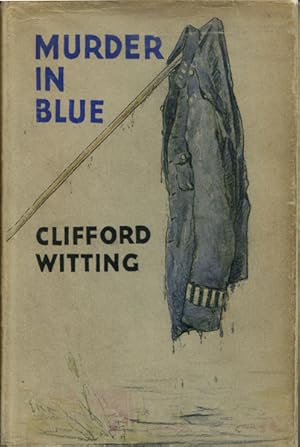
Forgotten Book - Murder in Blue


clifford witting - murder in blue - AbeBooks

Murder in Blue, published in 1937 by Hodder & Stoughton, was the first detective novel of Clifford Witting. It was an auspicious debut, proclaimed by Hodder as "a first-class detective story...about the murder of a policeman". It's interesting to compare the first edition of this book with first editions written by debut authors today. Now, readers are always presented with information about the author. Publishers are keen, almost to the point of obsession sometimes, to focus on an author's "platform", i.e. the means by which, it's thought, he or she can attract readers. It was very different in 1937. We are not told a word about Witting.

So who was he? I don't possess a lot of biographical information but I do know that Clifford Witting (1907-68) was educated at Eltham College and worked for many years for Lloyds Bank. He enjoyed a long career as a crime novelist, spanning 27 years, but was much less prolific than many others who started during the Golden Age. In that time he published sixteen novels. Quite possibly, like Cyril Hare for instance, his day job reduced his literary output. But lack of productivity is no bad thing if it is matched by a corresponding increase in quality. He wrote accomplished traditional mysteries and in 1958 he was elected to membership of the Detection Club, a sign of the esteem in which he was held by fellow practitioners.

Nick Fuller writes about Witting on the excellent gadetection site, and asks why he is so obscure, given the engrossing nature of his stories. It's a good question. I missed out on Witting for many years and it was only because of the advocacy of Nigel Moss, an excellent judge, that I sampled him. I'm glad I did, because all the books of his that I've read have merit.

Narrated by a likeable bookseller, John Rutherford, and set in a thinly disguised Sussex, Murder in Blue introduced Detective Inspector  Charlton, who was to become a series character. There's more focus on characterisation and setting than you find in, say, most of the Freeman Wills Crofts books, and definitely more humour. Witting was witty! The story begins extremely well thanks to Witting's smooth narrative style, although I felt it sagged in the later stages. Overall, however, a decent start to a career of under-valued accomplishment.