Monday, 30 September 2024

Richmond and the first Peter Robinson Memorial Lecture


I've had an exciting week, with a memorable trip to Oxford followed by two extremely enjoyable festivals. The first of these is the subject of today's blog post. I was invited to the Richmond Walking and Books Festival and it was a great honour to be asked to give the inaugural Peter Robinson Memorial Lecture. Peter was a patron of the festival for many years and some years ago he invited me along, only for a conflicting commitment to make it impossible. We agreed that the event should take the form of a conversation between me and James Gravenor of the Festival committee, with introductory remarks by Peter's friend Alexe and a slide show of Peter over the years.


Richmond is a charming market town in north Yorkshire and we decided to turn the visit into a trip with plenty of sightseeing. This is definitely my preferred approach with festivals and conventions, when the opportunity arises. And we were very lucky with the weather. So there were stops in Sedbergh, Hawes, and Leyburn, all of them pleasant towns, as well as a walk to see the impressive Aysgarth Falls.


The organisers arranged for accommodation at Millgate House, which has been described as 'arguably the finest guest house in the country'. I thought this was a bit over the top until I arrived there to find an incredible house with an equally fantastic, award-winning garden. The historic Georgian house is full of clocks, antiques, paintings, and books. The garden, on a slope going towards the River Swale, is terrific, even at this time of year. I've never stayed anywhere quite like it. Here's a video about the garden which gives a good idea of its quality There are also some great shots of the house, interior and exterior.

I enjoyed listening to a great talk by Nicholas Royle about book collecting and was glad to have a chat with Nick, whom I hadn't previously met, and to buy his latest book Shadow Lines, which looks great. We discovered a shared enthusiasm for the work of Derek Marlowe and Nick was kind enough to send me a Marlowe novel that I've never come across before.


The next day was also fine, and there was a great guided tour conducted by a former mayor dressed as Richmond's first policeman, who ended up being murdered by navvies who were in town to build the (now abandoned) railway. The station is now a very impressive community hub, and there's a lovely looping walk along the Swale to Easby Abbey.


It was fun to chat to James, Alexe, and others, and a privilege to launch the Peter Robinson Memorial Lectures - I hope it's a series that continues for a long time. As for Richmond, although I'd visited the town, and looked round the castle in the past, there really is a great deal to see, more than I'd realised. A lovely part of the world.


Friday, 27 September 2024

Forgotten Book - The Ten Teacups


The Ten Teacups is the UK title of The Peacock Feather Murders, and it was first published in 1937. The author was Carter Dickson, the pen-name under which John Dickson Carr wrote over twenty novels featuring Sir Henry Merrivale. This is one of the most widely acclaimed.  Indeed, back in 1981, it made tenth place in a list of all-time classic locked room mysteries voted for by a panel convened by Edward D. Hoch at the time he compiled his locked room anthology All But Impossible...

The Ten Teacups is a very good ‘impossible crime’ mystery, written when Carr was at his peak. There are two distinct and equally baffling puzzles to solve. The first concerns a death by shooting in a locked and guarded room. The second involves murder by stabbing, committed by an invisible murderer. But there's more to the book than these teasing and ingenious situations.

In particular, the opening premise of the story is one that strikes me as quite wonderful. Masters, the CID detective who serves, in effect, as Merrivale's sidekick, is aghast to receive an anonymous message which reads: 'There will be ten teacups at number 4, Berwick Terrace, W. 8, on Wednesday, July 31, at 5 p.m. precisely. The presence of the Metropolitan Police is respectfully requested.’ It seems absurd, but two years earlier, the arrival of a very similar message had presaged an extraordinary murder that had Scotland Yard baffled. And guess what? This message is also followed by a murder, despite the presence of a reliable detective outside the locked room in which the crime takes place. When shots are heard, the policeman breaks in, only to find a dead man and a gun - but no murderer...

A tantalising beginning, so marvellous that I imagine Carr found it rather hard to keep up the same standard throughout the book. I wouldn't say this is Carr's masterpiece, because the middle section is just a touch ponderous (this was one of his failings as a novelist, I must admit, and illustrates the challenge posed by writing a full-length locked room mystery novel) while the solution to the main crime does require suspension of disbelief on a heroic scale. There are some excellent discussions online, especially - albeit inevitably with spoilers - on Jim Noy's Invisible Event blog. But there is a lot here to enjoy nonetheless - including an excellent cluefinder in the form of more than thirty footnotes!

Tuesday, 24 September 2024

Memory Lane

I had a marvellous weekend back in Oxford, at a college reunion organised by the Balliol Society. Not for the first time, it struck me that, had I known when I first arrived there what the future held in store, I would have been amazed and incredulous. In a good way, I hasten to add. The surreal aspects of the return were heightened by the fact that I had long conversations with two guys who were on either side of me when the College matriculation photo was taken, Matthew Reisz (son of the great film-maker Karel) and John Foley. And three of my fellow law students, Neil, Tim, and Robin, were there among the crowd as well, it was marvellous to catch up with them.


The college library had arranged a very interesting exhibition of items from its archive relating to the interwar years at Balliol. The archive is held in the striking surrounds of the St Cross Church, which is partly but not entirely deconsecrated. There were some great items on show, including a letter from Mahatma Gandhi to the then Master of Balliol. Great credit goes to those who organised this informative display. If you want to take a look for yourself, the details are here.

I had a vivid flashback to that long ago day when I arrived in Oxford for my scholarship interview at the college. I recall being overwhelmed by anxiety, by a sense that my life was about to change in an unknowable way, from the comfortable routine that I was familiar with, and all of a sudden I felt I could not cope with it. I stayed for about three quarters of an hour at the station, trying to compose myself before I got up the nerve to move. That was the day I first met Neil and we've been friends ever since. A number of us reflected on the values of the friendships gained, as well as the many other pleasures of student life. That life had its difficult moments, of course, but overall the experience was overwhelmingly positive and it is great to go back.

John Foley has shared with me an excellent film he made recently which I think captures the nature of Oxford life very well - it's a very good watch and can be seen here. And while I was in the city I took the opportunity to look at the Kafka exhibition (excellent) and sign a few books of mine at Waterstones. When I was a student I dreamed of a day when I'd see my own novels on the bookshelves of Oxford. It seemed a remote prospect at best, but sometimes even impossible dreams come true. 

Monday, 23 September 2024

Eye of the Needle - 1981 film review


What a terrific actor the late Donald Sutherland was. Such an enjoyable performer, full of verve, and extremely versatile. My favourite Sutherland movie is Don't Look Now, but I was impressed by his handling of a very different role, as a baddie in The Eye of the Needle, based on the bestselling thriller written by Ken Follett when he was still in his twenties. I've never read a Follett novel, but this film is so good that I feel I should give him a go.

At first I wasn't entirely sure about Sutherland's interpretation of Henry Faber, a German spy masquerading as a pukka Englishman, but he soon won me over. At first he's characterised quite simply as a ruthless assassin ('the Needle') but eventually we get hints of a more rounded individual. When he is given a message to travel to remote Storm Island, in the north of Scotland, with a view to making a getaway from England by U-boat, the scene is set for a chase sequence very much in the tradition of The Thirty-Nine Steps.

The chase is exciting, but it proves to be merely the prelude for the story at the heart of the film, an unlikely romance between Faber and the wife of a disabled former Spitfire pilot. David Rose lost the use of his legs in a car crash on his wedding day, and the horrific experience has soured him. He and his wife Lucy live with their young son on a sheep farm on remote Storm Island (Storm Island was the original title of the novel), which is Faber's destination.

Kate Nelligan, as Lucy, gives an outstanding performance. She was once nominated for an Oscar for another film role, and she really manages to capture the emotional nuances of the part. Christopher Cazenove plays David, while the very impressive cast includes Ian Bannen, John Grieve, Faith Brook, and such notable actors as Bill Fraser, Sam Kydd, Bill Nighy, and Rik Mayall in small parts. A very entertaining, action-packed film, warmly recommended. 


Friday, 20 September 2024

Forgotten Book - The Great Hotel Murder


I'd never read a novel by Vincent Starrett until I was offered the chance to acquire an inscribed copy of The Great Hotel Murder (1935), which was an expansion of a magazine story called Recipe for Murder and was subsequently filmed. Hotel settings are, to my mind, a pleasing Golden Age trope, and I couldn't resist the chance to buy the book. Now I've read it, I'm glad I did.

A man is found dead in a locked hotel room (although it should be said that the 'locked room' element of the plot is not really significant). It soon turns out that he persuaded one Dr Trample to change rooms with him. Curious. Why did he do that, and what was the reason for his death? Soon Riley Blackwood, journalist and breezy man about town, is on the case.

The great strength of this story is that it is very readable. Starrett favours dialogue and he is good at writing it, so things move along at a smart pace from start to finish. This is important, because it helps to maintain interest even though some of the plot ingredients are commonplace. I didn't know quite what to expect from Starrett as a novelist, but this novel is enjoyable enough to make me feel I'd like to read more of his work.

There is interesting discussion of this book online: although I don't entirely share his views about the book, I commend Jim Noy's blog post about it which itself contains links to further useful posts by Aidan Brack and Kate Jackson. Otto Penzler, who does very good work in reviving long-lost titles, reprinted this book not so long ago, so it's easy to find. And in my opinion, it's worth finding, a sound example of American Golden Age fiction.


Wednesday, 18 September 2024

E.C.R. Lorac Commemorated - With a Blue Plaque!


With my latest novel Hemlock Bay published last week, plus two anthologies - Metropolitan Mysteries (a British Library Crime Classic) and Midsummer Mysteries (for the CWA) - not to mention the appearance of The House on Graveyard Lane in the States and various urgent writing deadlines plus travels to Nashville, London, and Yorkshire for David Stuart Davies's funeral, I've not had chance until now to talk about a fantastic occasion that took place just a month ago, on 19 August.


This was the official unveiling of a blue plaque celebrating E.C.R. Lorac (aka Carol Carnac, real name Carol Rivett) and her life in Lunesdale, her adopted home for the last decade and a half or so of her life. This was a wonderful event and I was thrilled to be part of it. The plaque is to be found on Newbanks Cottage in Aughton, Lancashire, which was Carol Rivett's home; in those days, it was known simply as Newbanks.


Newbanks Cottage is currently the home of Rachael Horay and she had worked with Lancaster Civic Vision for some time to organise the plaque. There is a piece here about it, with some more photos. The unveiling of the plaque was performed by Lena Whiteley, which was wonderfully appropriate, given that Lena knew Lorac and actually featured in one of her novels. In a marvellous touch, Lena covered the plaque with a gorgeous scarf that belonged to, and I think was designed by, the author herself, seen in the photo above. 


Rachael kindly provided refreshments and allowed us to look around the house, which is highly atmospheric and retains many of the period features that Lorac would have known so well. This gave us a real sense of the life she lived. Ten years ago, Lorac was forgotten and such an occasion would have been unimaginable. I'm thrilled to have played a part in ensuring that this talented and interesting woman, whose books my parents loved, is now so widely read and - especially with the new plaque! - properly remembered.  


Monday, 16 September 2024

Jude Tindall R.I.P.


I mentioned in last Monday's post about David Stuart Davies that he received the Red Herring award at the CWA Daggers Dinner in 2018. That was a truly memorable night for me, as I was not only host for the evening, but I received the CWA Dagger in the Library. And something else that made the occasion special and one that I won't forget was that I had the delightful company of the highly successful TV writer Jude Tindall, the guest speaker, who attended along with her sister, and shared a table with my wife Helena and me.

Whereas I knew David for so many years, that was the only time I ever met Jude, but she did make a great impression on me as a vivacious personality. So it was a tremendous shock to read her obituary in the newspaper the other day - she has died at the young age of 60.

Jude achieved fame and fortune as a result of writing light television mysteries - Father Brown, Shakespeare and Hathaway and the Sister Boniface Mysteries were her most famous shows. I found it interesting to talk to her about television and the differences between writing for the screen and writing novels. I asked her if she fancied writing a novel, but it didn't seem to be on her agenda. She was doing very well as she was.

Jude was great fun. She told me she was nervous about her speech - something I only took seriously when she confessed that she'd never made an after-dinner speech before. There certainly was a kind of stream of consciousness feel about things when she did take the stage and start talking, but the audience loved her. Gary Stratmann's photo below captures the magical moment when I was announced as the Dagger in the Library winner. Jude is in the foreground, her sister just behind.


Friday, 13 September 2024

Forgotten Book - Silence for the Murderer


Silence for the Murderer first appeared in 1949, the year in which Freeman Wills Crofts celebrated his 70th birthday, and it's been little discussed in comparison to some of his other books. I've had a copy for ages, but I must admit I assumed that the critical neglect meant that it was a minor work. Having recently read it, I have to say I was very pleasantly surprised, and also reminded yet again that it's a mistake to make assumptions about books one hasn't read.

What is really interesting about this book is the structure, which represents a development of some storytelling techniques that Crofts had used previously. I don't want to give too much away, but I think it's permissible to say that it's a story which masquerades as an inverted detective novel. Crofts had used this technique in earlier books such as The 12.30 from Croydon and Antidote to Venom, but here he tackles things somewhat differently.

The bulk of the story is devoted to the relationship of a young woman called Dulcie, who hopes to marry Frank Roscoe. The events described take place shortly after the Second World War, and Dulcie hasn't seen Frank for six years. She finds him almost broken by his experiences, but with her help he finds his feet. Unfortunately, he also leads her into a life of crime...

I found the presentation of the couple's downward spiral to be quite engaging. Crofts was clearly attempting to develop his skills in characterisation and achieves at least some success in this respect. However, he also came up with a tricky plot and he was bold enough to introduce a 'challenge to the reader' on page 115 of a 208 page book (in my paperback edition), long before Superintendent French has even appeared on the scene! I've never seen such an early challenge to the reader in any detective novel. 

French's detective work is pretty sound, but then there's an intriguing twist. I anticipated it (despite not having figured out the technicalities behind the murder method) because Crofts' very attempt to provide greater depth in characterisation meant that he couldn't entirely disguise what he was trying to do. I suspect he may have become slightly frustrated by this, because although the build-up of the story is quite leisurely, the final stages are unduly rushed. As a result, a book which could have been truly excellent is somewhat diminished. Even so, it's a good read and I admire Crofts' willingness to try to do something fresh at a late stage in his career.  


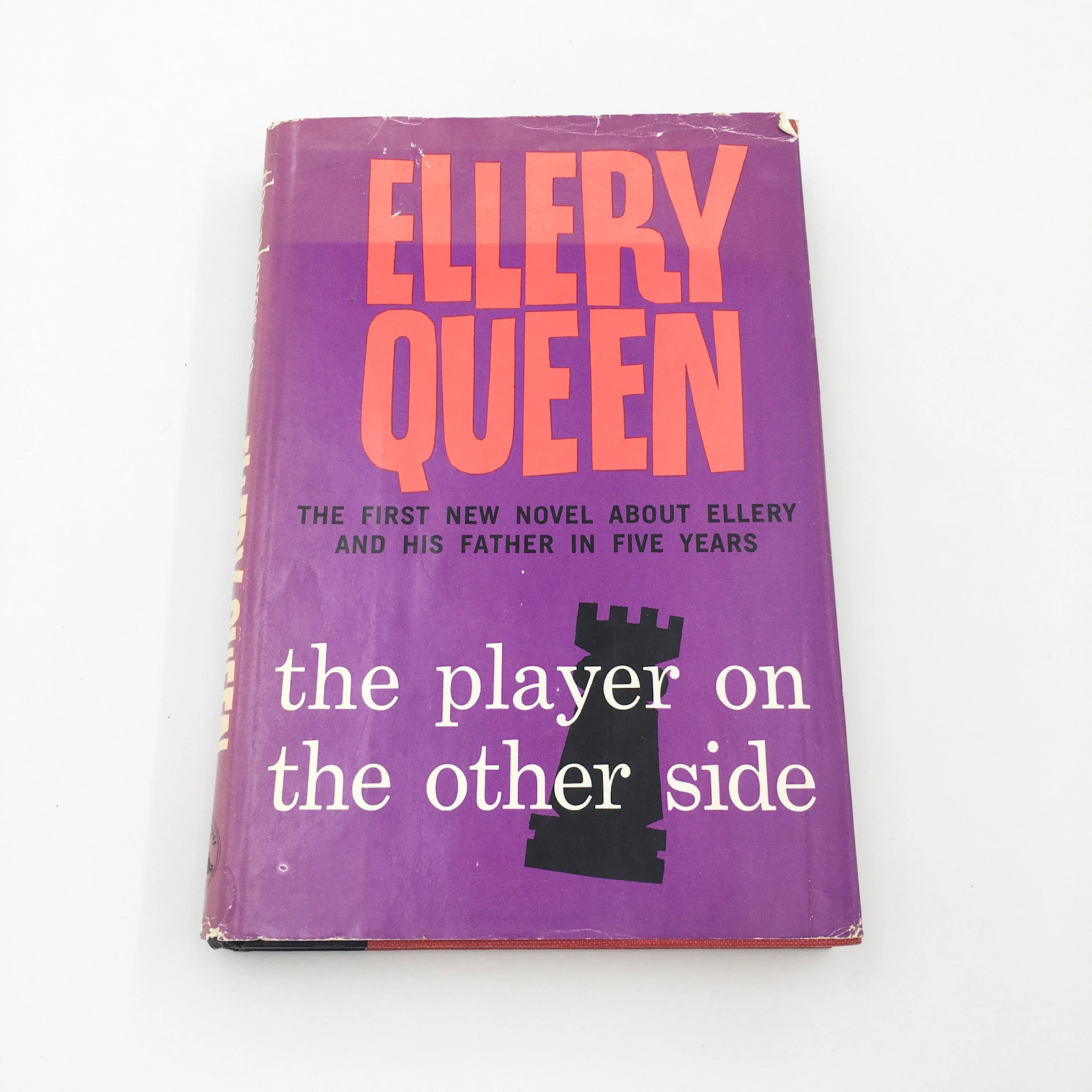
Forgotten Book - The Player on the Other Side

A while ago, I was fortunate to acquire a first edition of Ellery Queen's The Player on the Other Side (1963). It's signed by Theodore Sturgeon, together with a small illusration - a letter Q, with an arrow through it. This is a veiled reference to the fact that the novel was in fact written, not by the cousins Dannay and Lee who wrote as Ellery Queen, but by Sturgeon, who was better known as a sci-fi writer. However, the story was based on an outline by Fred Dannay and significantly edited by Manfred Lee.

This novel is widely regarded as the best of the ghost-written Ellery Queens and I certainly preferred it to a couple of those that I've read. The plot is ingenious and definitely in the classic vein. One of the tropes of the genre that is used is a family tontine, although this plays only a background part in the story. There's a plan of the four houses occupied by members of the York family who are beneficiaries of the tontine.

A seemingly simple-minded handyman called Walt, who works for the Yorks, receives an anonymous message which proves to be the precursor to a number of similar messages instructing him to carry out the sender's wishes. Walt becomes, in effect, the instrument of a murderer. Small cards bearing a single letter sent to potential victims add to the sense of doom and foreboding. It's up to Ellery Queen (and his long-suffering father, Inspector Queen) to solve the puzzle.

This is a cleverly contrived mystery and I can see why it is well-regarded. The central puzzle is ingenious and there are several nice touches, including an extended metaphor involving the game of chess. The story is pacy, despite the occasionally baroque writing style. However, I found myself wishing that I liked the characters (including Ellery, to be honest) rather more. But I'm very pleased to have the copy Sturgeon signed. And I did like the fact that, when first introduced, Ellery is bemoaning the fact that modern technology has made the old-fashioned delights of classic detection impossible. He spoke too soon!


Wednesday, 11 September 2024

Hemlock Bay - the first review


Hemlock Bay is published tomorrow, the fifth in the Rachel Savernake series and probably my favourite to date. And I'm delighted to say that the first review in a major print publication has already appeared. Jeremy Black in The Critic has this to say:

'Set in 1931, Hemlock Bay (Head of Zeus, 2024, £22.00), the latest of Martin Edwards’ impressive Rachel Savernake series, begins in the mind of Basil Palmer, a buttoned-up chartered accountant, as he sets out to track down a victim he feels deserves murder. We move to Hemlock Bay, a new resort on the Lancastrian coast (not the most encouraging of ideas), where potential murderer, destined victim, and the Savernake household converge with a lively cast including a dodgy fortune teller, an ex-housemaid married to wealth, and, eventually a corpse. Some of the writing is arresting – ‘The Roses were bending under the weight of water. They looked as miserable as bullied children … even a surrealist is presumably observant … No murderer wants to rely on the English climate…’– but it is the plot that carries us along.' 

Meanwhile, Crime Fiction Lover says: 'it’s perfect for anyone who loves a puzzle mystery created in the Golden Age tradition' and the initial reaction on Goodreads is great. One particularly gratifying review from CPE shows a lot of understanding of what I'm trying to do; 'There is an element of humour...and if you have read the other books, you will know one doesn’t trifle with Rachel Savernake. These are the antithesis of cosy mysteries. These are highly crafted, carefully wrought, mysteries that have taken a long time to write. There is banter between the characters; there is humour; but there are no laughs. “Bleak” is the word that springs to mind, yet brilliantly written. If you want to read the best mystery writing of the 2020s, read Martin Edwards’s Rachel Savernake books – just don’t expect to feel cosy.'

One consistent thread of the reviews, even from those who don't quite 'get' Rachel, maybe because they haven't read Gallows Court (although each book is designed to be read independently, of course there is quite a lot of character backstory) concerns the quality of the writing. This is something I've always striven for. And I'm very happy when it seems to work out well. 

Fingers crossed that forthcoming reviews will be equally kind!