Showing posts with label Anthony Horowitz. Show all posts

Monday, 14 February 2022

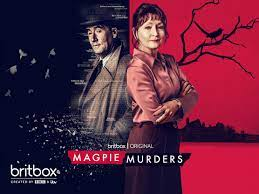
Magpie Murders - Britbox TV review


I read and enjoyed Anthony Horowitz's Magpie Murders not long after its original publication. I was even more taken with the follow-up title, Moonflower Murders, which is quite excellent. So I was looking forward to the TV version of the first book in the 'Susan Ryeland' series, anticipation enhanced when I discovered that Horowitz himself was taking responsibility for the adaptation.

I certainly wasn't disappointed. On the contrary, I enjoyed the TV version even more than the book. Although the same man wrote both versions of the story, I felt that his use of the flexibility of television worked to the story's advantage. It also helps that Horowitz is even more experienced in the field of screenplay writing than he is as a detective novelist. Here he is on the top of his game. There is a slight dipping of tension in the fifth of the six episodes, as the pieces of plot are manoeuvred around the chessboard, but everything comes together quite triumphantly in the final instalment.

Horowitz benefits from a first-rate cast and the sort of high production values that ensured the long-term success of Inspector Morse thirty-five years ago. Susan, for instance, is played by Lesley Manville, who does a very good job. Michael Maloney is also good as her publisher boss. Lately I've been watching old episodes of that great comedy series The Brittas Empire, so I was very pleased to see Pippa Haywood, who played Gordon Brittas' wife Helen, taking on not one role here but two.

The novel features a 'book within a book' but in the screenplay, the two stories are intertwined, a method that works extremely well, with some of the same actors appearing in both. It's all very clever, but because Horowitz is such a skilled craftsman, the cerebral plotting never becomes turgid. The location filming in lovely parts of Suffolk is the icing on the cake.  


Monday, 24 August 2020

Events of a new kind

We all know that lockdown has been nightmarish for many people and organisations, including those trying to organise events and festivals. But these strange times have brought out the best in many of them. There's been a great deal of innovative thinking, and much hard work has gone in to trying to connect readers and writers.

Podcasts have been gaining rapidly in popularity and Shedunnit is a very good example. Run by Caroline Crampton, it's a good example of the marriage of enthusiasm, expertise, and enterprise. I was glad to accept her invitation to talk about the Detection Club recently, and the result has just been aired: https://shedunnitshow.com/detectionclub/ 

Last week I was busy recording two videos which will be released later. I must say that I much prefer pre-recorded videos to live ones, even though the 'live' element can have real benefits. The difficulty is that, if you have four or five people taking part in a live video event, there is every chance of a technological glitch, and although these can never be ruled out, I think that - where possible - it's less stressful to pre-record, and allow for editing.

There was a bittersweet aspect to the first video. Last year I was invited to the Sacramento Bouchercon to interview Anthony Horowitz, and I was very much looking forward to the trip for a host of reasons. Alas, it was not to be. Undaunted, the organisers set up a recorded video; I was based in England, while Anthony was speaking from Crete. It was fun to do, and will be made available in October, to coincide with the period when Bouchercon would have been taking place.

The second video was part of Slaughterfest, set up by HarperCollins to celebrate Karin Slaughter's work. I was honoured to be asked to chair a panel to discuss classic crime fiction. The panelists were four bestselling novelists, Lucy Foley, Kate Weinberg, Sophie Hannah, and Ruth Ware, and the conversation proved very enjoyable. Again, the discussion was pre-recorded, and it will be made available soon.

I'm now in discussions about various other virtual events. A couple of these will involved conversations with Ann Cleeves, while others will focus more generally on crime fiction past and present. To say that I'm grateful to those who do the hard work of making these events happen is an under-statement.

Monday, 30 July 2018

The Word is Murder by Anthony Horowitz - review

The Word of Murder, Anthony Horowitz's latest bestseller, is to my mind even more fascinating than Magpie Murders, his take on the Golden Age detective story. In this book, set just a few years ago, he introduces a new character in the tradition of the Great Detective, a former cop called Daniel Hawthorne. And Hawthorne has his very own Watson figure to admire and record for posterity the brilliance of his deductions - and this happens to be none other than Horowitz himself.

It's a bold step, to introduce oneself as a major character in a novel of one's own, and I can't imagine that I'd ever attempt it. At first, I thought that I wasn't going to like the device. But to my surprise and pleasure, Horowitz proved once again that he is such a smooth and appealing storyteller that he can get away with murder (and no, that's not a plot spoiler!)

The opening premise is terrific. A woman called Diana Cowper goes into a funeral parlour, and arranges her own funeral. Six hours later, she is dead, strangled in her own home The police call in Hawthorne as a consultant, and he in turn persuades Horowitz to write up the story. The results I found fascinating - not least Horowitz's musings on the narrowness of public debate in modern society.

This is a fair play mystery, with a clever red herring which I dutifully swallowed. Yes, Horowitz outsmarted me. And I'm glad. I always found with Agatha Christie that my favourites among her books were those when I was led up the garden path, as I was here. There are twists a-plenty, and although one element of the plot didn't strike me as totally convincing, I was more than willing to suspend disbelief throughout. Great fun.

Wednesday, 2 August 2017

Magpie Murders by Anthony Horowitz

Any Golden Age fan is bound to be drawn to Anthony Horowitz's recent novel, Magpie Murders. It's an example of metaficiton, in which Horowitz combines a capable pastiche of a Christie-style whodunit with a contemporary mystery, and a dollop of satire about the publishing business. There are plenty of jokes (the last Horowitz novel I read, The Killing Joke, also gave his wit a pleasing showcase) and there's ingenuity in abundance.

The first half of the book comprises a novel set in the year Horowitz was born, 1955. A cleaner has died in rather mysterious circumstances, and soon her employer, Sir Magnus Pye, is brutally murdered. There is no shortage of motives or suspects - but shortly before the climax, the story comes to a sudden halt. We are then transported to the present, and the publishing. Alan Conway, author of the story, has died, having apparently committed suicide - and the last two chapters of his novel seem to be missing.

Most of the rest of the story is narrated by Conway's editor, Susan, who begins to suspect that in fact Conway was murdered. Once again, she discovers a variety of people with good cause to wish that the author was dead. But which of them is guilty? There's a "least likely person" explanation that is pleasing, even if the motivation is thin. And then, at the end of the story, we are given the solution to the mystery in Conway's novel - and, once more, a suitably unlikely culprit is unmasked..

I like Horowitz's writing very much. He has a real gift for entertainment, as evidenced by his many successes with TV screenplays (which earn more than one mention in the book; I see this not as showing off, but rather as an illustration of his teasing sense of humour) as well as by his fiction. The first half of the book is, at times, rather slow-moving, but this is explained by the need to plant a range of pleasing clues. It's all very cleverly and agreeably handled. An interestingly original take on classic crime fiction which I was very glad to read.

Monday, 26 October 2015

Following in the Footsteps of the Great...

Reports that Sophie Hannah has been commissioned to write a second Hercule Poirot novel have provoked plenty of interest and comment. There are conflicting views on whether "continuation novels", where present day writers produce new stories featuring long-established characters, are a Good Thing, so I thought I'd contribute a few observations to the debate.

The first thing to say is that there's  nothing new about the idea of continuation stories. People other than Conan Doyle started writing about Sherlock Holmes a very long time ago. But it's fair to say that continuation novels have become much more popular, and common, in recent years. So we have new James Bond stories, written by a variety of very distinguished writers, new Hercule Poirot stories from Sophie, new Wimsey stories from Jill Paton Walsh, new Albert Campion stories by Mike Ripley, and so on.

Some readers take the view that they want to stick with the original stories by the original authors, and that is, of course, a perfectly understandable and reasonable choice. It is also occasionally suggested that there's something inappropriate about present day writers writing new stories about characters created by others. This is a viewpoint I understand, but do not share.

There's nothing at all wrong, in my opinion, in writers - regardless of whether or not they are already bestsellers- being paid to produce stories that people want to read. Those writers still produce books about their own characters, but I am pretty sure that their attitude towards writing about other characters is much the same as mine, when I wrote the stories in The New Mysteries of Sherlock Holmes: there is something very pleasurable about soaking oneself in a fine writer's work, and seeking to give it new life. It's a challenge to one's professional skills as an author. My guess is that this, coupled with the sheer fun of it, is why the likes of Jeffrey Deaver, William Boyd, Sebastian Faulks, Anthony Horowitz, Sophie, Mike, Jill, and company relish tackling continuation fiction.

For me, the real issue - as with any piece of writing - is whether the story is well done. A poor continuation novel is at least as disappointing as any other poor novel. There are, for instance, some rather laboured Sherlockian pastiches around, though there are many good ones. But some continuation stories are highly enjoyable. The fact that continuations are becoming more commonplace suggests that there is a significant demand for such books, and if this trend continues, I wouldn't be surprised if more detectives from the past are given a fresh incarnation in the 21st century.


Wednesday, 4 September 2013

Sophie Hannah, Hercule Poirot, and following in Agatha Christie's Footsteps

News that Sophie Hannah is to write a brand new novel featuring Agatha Christie's legendary Belgian detective Hercule Poirot has attracted a great deal of attention today. And this is no surprise, for 120 years after her birth, Christie remains a writer popular the world over, her books held in affectionate regard by people of every class,culture and creed. So what are we to make of the prospect of a new Poirot story?

The first thing to say is that, if you accept that reviving Poirot is a good idea, then in my opinion, Sophie Hannah is an excellent choice. She has been quoted speaking admiringly of Christie, and I can testify that this is not in any way a recent or cynical conversion prompted by the temptation of a high profile contract. The very first time I met Sophie was some years ago, shortly after the publication of her highly successful debut, Little Face. We were both taking part in a literary event at the Brindley in Runcorn, and someone asked panel members who our favourite crime writers were. I opted for one deceased writer, and one contemporary novelist - Christie and Ruth Rendell. And Sophie said that I'd taken the words out of her mouth, as they were also her favourites.

So I am confident that Sophie Hannah will bring to the task a genuine love of and respect for Christie's story-telling, as well as a great deal of craft. Sophie, like Christie, started out as a poet, though I think it's fair to say that her poetry is more successful than Christie's. Her crime novels are elaborately plotted,and this respect for plot is vital in anyone trying to emulate Christie.

But it won't be easy. I enjoy writing Sherlockian pastiches, but part of the appeal is the rich and evocative nature of Conan Doyle's prose and Watson's narrative voice. With Christie, the style is much plainer. And that can be a trap in itself. Charles Osborne, a man steeped in Christie's work, wrote novelisations of some of her plays a few years ago, but I'm afraid that even though he had all the raw material from Christie, ther results seemed to me to be curiously flat and lifeless - in a way that Christie's best books emphatically are not, whatever her detractors say.

How does a talented writer restrain the impulse to indulge in a few nice but unChristie-like literary flourishes? Should she do so? Well, my personal feeling is that, with a project like this, it's prudent not to deviate too far from the original style and approach. Because if you do, what is the point?

Some may also ask, what is the point of the new book(s) in any case? Of course, it's all about commercialism, and "refreshing the brand". It's been done with the Anthony Horowitz take on Sherlock, and with Sebastian Faulks and others writing James Bond. Whilst some purists may shudder, I don't. I think it's worth remembering that crime fiction is a genre where commerciality and entertainment have always been important and for my part, I'm very much looking forward to seeing how Sophie Hannah rises to this new challenge. And more than that, I find the prospect of a high quality new Poirot novel really rather exciting.

Wednesday, 26 September 2012

The House of Silk


I’ve loved the Sherlock Holmes stories ever since I first saw the Basil Rathbone films when I was eight or nine years old, and, not long after that, devoured first the short stories and then the (generally less satisfactory) longer stories. The Hound of the Baskervilles is the only one of the novels that really worked for me, and even that is structurally flawed. Among other things, it’s far too easy to spot the culprit.

Why did Conan Doyle find it more difficult to write longer stories about Holmes? I think that the answer is, at least in part, due to the fact that many of the elements of Holmesiana that so appeal to us work most effectively in the context of a short story. We don’t worry too much about depth of characterisation; what counts is a dazzling set-up, and the atmospheric quest for a solution to the mystery, with Watson always lagging several steps behind the Master.

The House of Silk, by Anthony Horowitz, is therefore an ambitious venture – an attempt, approved by the Conan Doyle estate, to put Holmes in a novel that is true to the original, but compelling and well-structured from start to finish. Horowitz is a very talented writer, and his way of solving the problems that defeated Conan Doyle is to weld together two very different stories. One concerns a threat to an art dealer who has recently been mixed up with a criminal gang in America, the other involves the killing of a young recruit to the Baker Street Irregulars.

I found this book a fast and agreeable read. Watson’s style of writing is always appealing, and I enjoy trying to imitate it myself. The Sherlockian pastiches I write from time to time are always a lot of fun, though I’ve never been brave enough to try my hand at a Holmes novel. There are, inevitably, a few quibbles (would Watson use the phrase “at the end of the day?”, would Moriarty really have acted as he did?) and one impersonation stunt did stretch my credulity to breaking point. At least one reviewer has argued that this is a mixture of a detective story with inadequate clues and a thriller with a easily foreseeable outcome, and there is some truth in this, although I should also add that most reviews have been hugely positive. Overall, I was left with the feeling that Horowitz had enjoyed writing the story as much as I enjoyed reading it – that is, a great deal.


Friday, 10 June 2011

Injustice review - is it really the end?


Injustice finished tonight after five episodes shown on consecutive nights. I don't want to say too much about the story-line, lest I spoil the enjoyment for those who haven't seen it. Suffice to say that there were a couple of twists I didn't see coming, and one I did. Also, I would not be surprised to see another season of Injustice shows one of these days. The script seemed to leave open this possibility.

James Purefoy and Nathaniel Parker were both very good as lawyer and client. Charlie Creed-Miles was a truly unpleasant cop, a character I felt bordered on cliche. And there were some moments in Anthony Horowitz's screenplay which seemed a bit recycled. On the whole, however, the story was a good one, and it had sufficient originality to stand out from most shows.

Justice is a key theme of many crime stories, and of course the concept has a pleasing ambiguity that offers a huge amount of scope for any writer. Two of Agatha Christie's very best novels are really about justice. This show was very different from Christie, but it did have in common with her work a liveliness and grip that held my interest from start to finish.

Tuesday, 7 June 2011

Injustice - review


Injustice, created and written by the estimable Anthony Horowitz, is a five-part drama playing on ITV this week, and I've just watched the first two episodes. Suffice to say that, hot on the heels of Vera, Scott and Bailey, and Case Histories, this is another telly crime series of merit. Each of those shows has strengths and limitations, but they are a varied bunch, and as a result I've been glued to the screen lately a bit more than usual.

James Purefoy plays a barrister who is a brilliant defender but who has suffered a mental breakdown a while back, for reasons not yet clear. He's developed an aversion to taking on murder cases. But his resolve weakens when an old Cambridge chum calls on him for help. The chum is played by Nathaniel Parker, accused of killing his pretty young secretary, with whom he was having an affair. We are told the evidence against him is strong - so much so that his solicitor says she would have pleaded guilty if she were in his shoes - but I have to say I'm not convinced.

Meanwhile, a rather unpleasant cop is investigating a brutal execution style shooting in a remote East Anglian cottage. The victim is a mysterious fellow who had been living under an assumed name. But a flashback tells us that his killer was Purefoy. Intriguing. One assumes the motive is something to do with meting out rough justice, but much is unclear at present.

I enjoyed both of the first two episodes, which I watched back to back. As ever, the portrayal of the legal world on TV is a bit different from the legal world as I know and experience it, but that's fiction for you. What matters most is whether the story is any good, and it has begun well.