Showing posts with label Agatha Chrisite. Show all posts

Monday, 11 September 2023

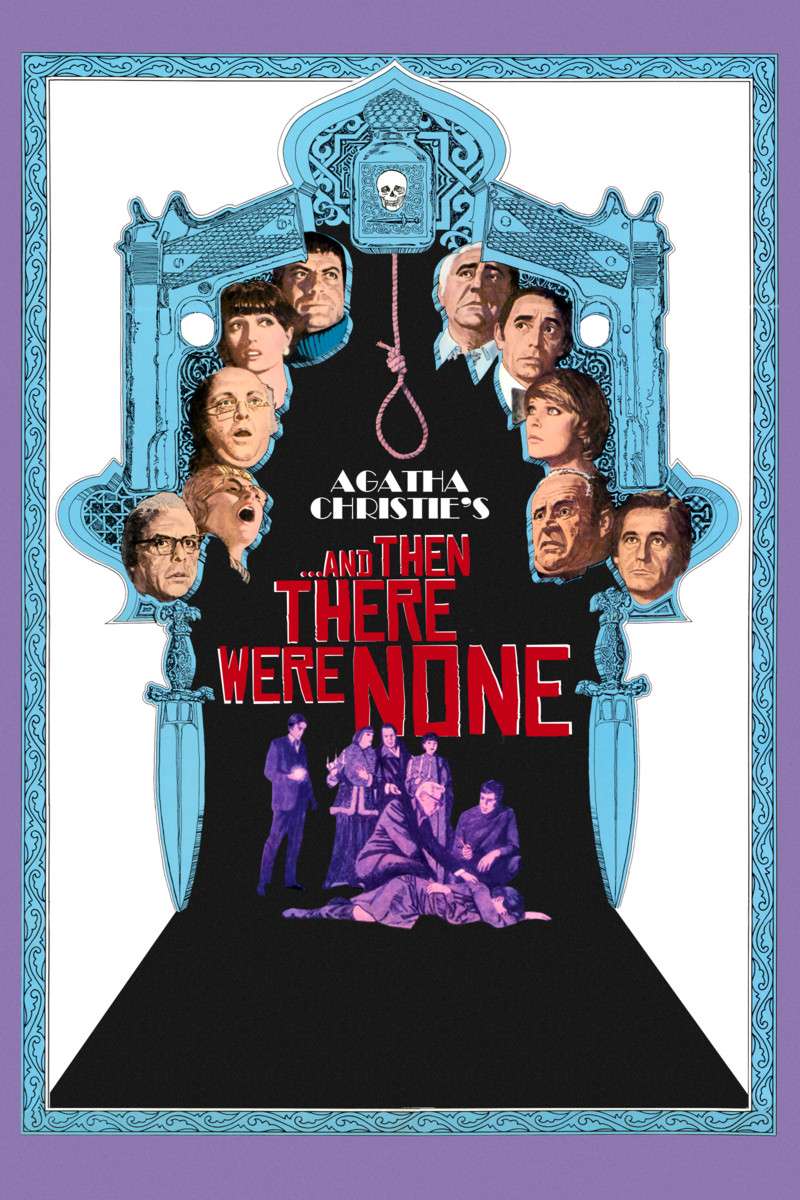
And Then There Were None - 1974 film review


I enjoy many Golden Age detective novels, but if you press me for it (as happened on one of the panels at San Diego a few days ago), my absolute favourite has to be And Then There Were None by Agatha Christie, not only an enduring global bestseller and hugely influential on crime writers to this day (how many homages to this book have been published in the last decade? I've lost count). The story is a superb combination of whodunit and psychological suspense. No surprise, then, that there have been plenty of screen versions.

One that has escaped me until now is the 1974 film directed by Peter Collinson. This movie has an indifferent reputation, but I decided I ought to check it out for myself. Collinson was capable of excellent work - he directed the original version of The Italian Job, a great piece of entertainment - and the cast is impressive. The producer was Harry Alan Towers, whose own reputation has not worn well at all, and he also wrote the script, under the pen-name of Peter Welbeck. He makes several changes to the Christie original, and although some are interesting, overall I don't think they work well.

The setting is weird - an abandoned luxury hotel in the middle of the desert in the Iran. So, effectively it's as cut-off as the island in the original story. There are some visual pleasures to be had from this change of scene, but too much is left unexplained. The climax isn't badly done, but the build-up lacks the necessary tension.

This lack of suspense is partly due to the fact that even the notable actors in the cast seem to be affected by a languor, possibly induced by the indifferent quality of the screenplay. Elke Sommer is beautiful and does her best with her part, but Oliver Reed seems to sleep-walk through his. Even Richard Attenborough and Herbert Lom are below their considerable best. The two ex-Bond villains, Gert Frobe and Adolfo Celi, make little impression, and why Orson Welles did the mysterious recorded message from U.N. Owen remained unclear to me. It's not a complete disaster as a film, but overall a waste of talent and of fantastic source material.     

Monday, 20 November 2017

Agatha Christie's Very Secret Notebook


Agatha Christie's secret notebooks - the private journals in which she jotted down her ideas for stories, shot to fame some years ago, when Harper Collins published John Curran's fascinating book about them. What nobody seems to have realised at the time was that there was another notebook out there which was in private hands. It was sold at auction many years ago to an American collector for the princely sum of £240 plus commission. It's now come to light again, having been acquired by James Hallgate of Lucius Books in York,

There are some very delightful book dealers around, both here and in the US, and in recent years I've had the pleasure of getting to know quite a few of them. I have to be careful, because naturally they are inclined to lure me into making fresh purchases for my collection! But I find their company very enjoyable, and not only because they supply me with books, information, and background material for my portrayal of Marc Amos and his second hand bookshop in the Lake District Mysteries (though Marc definitely isn't based on anyone in real life!)


James Hallgate very kindly gave me the opportunity, some time ago, to look at the Christie journal shortly after he'd acquired it, and before he put it on the market. I must say it was a great thrill as well as a great privilege to pore over this fascinating item. Christie jotted her thoughts down casually and, seemingly, carelessly, but if one reads her (not very easy to decipher) handwriting, it's possible to discern her thought processes as she develops her storylines. This journal focuses on one of her finest post-war novels, A Murder is Announced, and it features one of her most cunning clues. There are also extensive notes about the play Spider's Web and other Christie works of the period.


I'm really grateful to James for giving me this memorable experience, and I readily agreed not to write about it until he was ready to market the journal. That time has now come, and I'm also appreciative of the photos that he's supplied to adorn this post. If you want to start saving up for a very special present for that Christie fan in your life, I'm afraid you will have to dig very deep indeed. The price of the journal, housed in a bespoke case, is a mere £45,000. Bargain! Alas, I won't be in the market on this occasion, but others definitely will be,and let's face it, it's a snip compared to a Leonardo. I hope very much the notebook finds a suitable home and that it doesn't altogether disappear from public view for years to come. Like the other Christie journals,it provides a wonderful insight into the workings of the mind of one of the genre's most innovative superstars.


Wednesday, 4 September 2013

Sophie Hannah, Hercule Poirot, and following in Agatha Christie's Footsteps

News that Sophie Hannah is to write a brand new novel featuring Agatha Christie's legendary Belgian detective Hercule Poirot has attracted a great deal of attention today. And this is no surprise, for 120 years after her birth, Christie remains a writer popular the world over, her books held in affectionate regard by people of every class,culture and creed. So what are we to make of the prospect of a new Poirot story?

The first thing to say is that, if you accept that reviving Poirot is a good idea, then in my opinion, Sophie Hannah is an excellent choice. She has been quoted speaking admiringly of Christie, and I can testify that this is not in any way a recent or cynical conversion prompted by the temptation of a high profile contract. The very first time I met Sophie was some years ago, shortly after the publication of her highly successful debut, Little Face. We were both taking part in a literary event at the Brindley in Runcorn, and someone asked panel members who our favourite crime writers were. I opted for one deceased writer, and one contemporary novelist - Christie and Ruth Rendell. And Sophie said that I'd taken the words out of her mouth, as they were also her favourites.

So I am confident that Sophie Hannah will bring to the task a genuine love of and respect for Christie's story-telling, as well as a great deal of craft. Sophie, like Christie, started out as a poet, though I think it's fair to say that her poetry is more successful than Christie's. Her crime novels are elaborately plotted,and this respect for plot is vital in anyone trying to emulate Christie.

But it won't be easy. I enjoy writing Sherlockian pastiches, but part of the appeal is the rich and evocative nature of Conan Doyle's prose and Watson's narrative voice. With Christie, the style is much plainer. And that can be a trap in itself. Charles Osborne, a man steeped in Christie's work, wrote novelisations of some of her plays a few years ago, but I'm afraid that even though he had all the raw material from Christie, ther results seemed to me to be curiously flat and lifeless - in a way that Christie's best books emphatically are not, whatever her detractors say.

How does a talented writer restrain the impulse to indulge in a few nice but unChristie-like literary flourishes? Should she do so? Well, my personal feeling is that, with a project like this, it's prudent not to deviate too far from the original style and approach. Because if you do, what is the point?

Some may also ask, what is the point of the new book(s) in any case? Of course, it's all about commercialism, and "refreshing the brand". It's been done with the Anthony Horowitz take on Sherlock, and with Sebastian Faulks and others writing James Bond. Whilst some purists may shudder, I don't. I think it's worth remembering that crime fiction is a genre where commerciality and entertainment have always been important and for my part, I'm very much looking forward to seeing how Sophie Hannah rises to this new challenge. And more than that, I find the prospect of a high quality new Poirot novel really rather exciting.

Sunday, 21 April 2013

Endeavour, Broadchurch, and does murder go on forever?

Endeavour continued this evening with another episode from the reliable Russell Lewis. A special feature of Fugue was the inclusion in the cast of Abigail Thaw in a small part as a journalist, a nice touch, given the many memorable performances of her father John in Inspector Morse Another enjoyable Oxford whodunit, the plot a serial killer story with a bundle of classic, and indeed classical music, ingredients. I gather that the first episode had very good ratings, and they were well deserved.

Then, tomorrow evening, comes the final episode of Broadchurch. I'm away, so it may be a few days before I catch up with whodunit. However, just before I set off, I'm scheduled to do an interview on Radio Cumbria's breakfast show, to discuss not only Broadchurch but also, more generally, the eternal appeal of the whodunit.

I touched on this very subject on this blog last week, and for all the changes in society and styles of writing, I see no end in sight for the whodunit. Millions of people still enjoy the form, and I'm tempted to say that it's as popular as it's ever been. This would not have surprised Agatha Christie, even though, as a modest woman, it's clear that she didn't expect her own books to last (why else would she, in some of them, have given away the solutions to earlier puzzles?)

I have in my collection a book that Christie signed for a friend of hers at the height of the Second World War. It must have been a very frightening time. Yet, as she said in her inscription, "Wars may come and wars may go, but murder goes on for ever!" It's true in real life, sadly, but much more happily, I think it's also true of fiction. The whodunit mystery has real staying power, and the number of TV whodunits I've reviewed since New Year's Day rather bears that out.

By the way, I'm still not quite sure about Arne Dahl. I watched the new story, Bad Blood, last night, but I rather feel the writers are struggling for effect, unlike Russell Lewis.

Finally, my trip has a detective fiction connection, of which more in a few days. Meanwhile, a review of Peter Lovesey's new book will appear while I'm away from home.


Thursday, 8 December 2011

Devil - film review


Whilst on holiday recently, I had the opportunity to watch the recent movie Devil and I found I enjoyed it immensely. It’s a modern film, and yet it has some distinctly classic elements. So when, after watching it, I read about the film on the internet, I wasn’t surprised to learn that M. Night Shamaylan, one o the team behind the film, and famous for the spookiness of his work, acknowledged that the story involved a nod to Agatha Christie.

More than a single nod, in fact. The main story is a riff on And Then There Were None, but in the dialogue there is also a hint of the plot-line from The ABC Murders. Suffice to say that I thought the film-makers used the Christie inspiration pretty well.

The story is taut (the film only lasts 80 minutes, and the brevity of the film helps to ensure that the intensity of the narrative is maintained) and compelling. An elevator in a skyscraper gets stuck and it seems that Satan is in there along with the five passengers. One by one, they meet grisly ends.

None of the actors was familiar to me, but they all did a decent job, and I felt that the film was well done, and the story presented in compelling way. The claustrophobic environment of the elevator in particular is beautifully conveyed. Devil is a world away from Fatal Descent, an elevator based novel I discussed here recently. But it’s much better than the Golden Age book by John Rhode and Carter Dickson, and, despite the lurid nature of the plot, it is strangely more credible.

Saturday, 15 October 2011

Curtain and Take My Breath Away


Kerrie Smith, of Mysteries in Paradise, whom I was so pleased to meet at Crimefest, suggested I contribute to the celebrations of the anniversary of Agatha Christie's birth 121 years ago, and I'm very glad to do so.

Curtain, the last Hercule Poirot novel, boasts a fascinating modus operandi. Agatha Christie explicitly gives a nod of gratitude to a play by Shakespeare and another by the rather less celebrated St John Ervine. In both plays, the same pattern of murderous behaviour is deployed. She had briefly toyed with the idea earlier, in the excellent Peril at End House. Its sheer cleverness has always appealed to me, but I agree with Robert Barnard’s verdict on Curtain. ‘For a long-cherished idea…this is oddly perfunctory in execution’. In particular, the murdererer’s character, crucial to the whole concept, is inadequately portrayed.

For years, I thought about reviving the idea. But how to do it? In the end, I decided that the secret lay in a combination of a law firm setting and a dose of political satire. The result was Take My Breath Away, published in the UK some years ago but only just now published in the US by Five Star. It marked a complete departure from my earlier books about the lawyer-detective Harry Devlin. Given that I was building upon foundations laid by Christie and the Bard, I am ashamed to say that it took me two and a half years, and endless re-writing, to produce the book. But I like to think that at least the effort was worth it.

And an odd thing happened while I was writing the novel; I received a book which featured Ellery Queen’s plot outline for a novel never actually published, The Tragedy of Errors. It boasts the same central concept. Like Christie and like me, Ellery Queen makes due acknowledgment to the inspiration that he drew from the Bard. As I understand it, Curtain was written before, but not published until after, The Tragedy of Errors plot was concocted. Great criminal minds thinking alike? I'm sure it wasn't plagiarism on Queen's part.

Friday, 1 July 2011

Forgotten Book - Poison in the Parish


My choice for today's Forgotten Book is another novel by the unjustly neglected Millward Kennedy – this one is Poison in the Parish, which was first published in 1935. It opens with a rather aggressive dedication to an un-named person who has complained that Kennedy peoples his work with unpleasant characters. Here, Kennedy says, is something rather different. The suspects are all relatively agreeable people.

The book then begins with an extract from a letter which is tantalisingly described as a "prologue or epilogue" before the story proper gets underway. Following gossip in a small village, the police have exhumed the body of a rather nasty old lady who turns out to have been poisoned with arsenic. In order to get a handle on life and relationships within the village, the police – rather improbably, it must be said – call upon a wealthy invalid to assist their enquiries.

The invalid is called Francis Anthony, and I am as sure as I can be that Kennedy chose the name deliberately as a tribute to his friend and colleague by taking the first names of his two most famous pseudonyms, Anthony Berkeley and Francis Iles. The book is in many ways a homage to Iles, especially in its ironic flavour, and one of its main features is a very unusual murder motive which later found its way (in the context of a very different storyline) into Anthony Berkeley novel.

I figured out what was going on in the story at an early stage, partly because aspects of the narrative reminded me of a book that Agatha Christie wrote early in her career. But this did not spoil my enjoyment of the mystery, which is pleasingly put together. I'd say this is one of Kennedy's most entertaining novels, and a reminder of his talent. It's strange to think that he produced only a handful of novels after this one. Perhaps his disastrous experience with the law courts over a libel claim, which I discussed in this blog recently, provides the explanation.

Wednesday, 22 June 2011

Three Great Endings to Detective Stories


I was gratified by the interest shown in my last post, on detective story endings, and I thought I'd keep the pot boiling by mentioning a few of my fave endings.

First, a real classic - the closing lines of And Then There Were None, by Agatha Christie. Dame Agatha was a dab hand at great endings, but this one, which I read when young, has always stuck in my mind.

Second, an ending that gave me an idea for a very different book of my own - Yesterday's Papers. The great ending was in Margaret Millar's A Stranger in My Grave. What I borrowed from this marvellous book was a structural device, and I was really pleased with the result. Yesterday's Papers remains a personal favourite among my own titles I wish it was still in print.

Third, a bitter remark made by Francis Pettigrew at the end of Tragedy At Law by Cyril Hare. Totally original, and quite marvellous - especially for a lawyer!

If you don't know the Hare or the Millar, I heartily recommend them both.

Thursday, 14 April 2011

The Detection Club Archivist


I'm proud to say that the Detection Club has appointed me as its archivist. Given that I have been fascinated by the history of the crime fiction genre for more years than I care to remember, this is not only an honour, but a role that I'm sure I will find rewarding.

Appropriately enough, a good deal of detective work is bound to be required. Although many crime writers are fascinated by history, only a minority take an interest in the details of the evolution of their genre, and information about the early days of the Club in particular is very hard to come by. To a large extent, this is perhaps understandable for a social group whose main objective has always been simply to have a few convivial dinners each year. Looking back, however, it would be fascinating to know more about the discussions and relationships between people like Agatha Christie, Dorothy L. Sayers, G.K. Chesterton, Anthony Berkeley and Hugh Walpole.

To this day, there is continuing uncertainty in many quarters about when the Detection Club actually came into existence. For example, the club's own list of members suggests that it started up in 1932, but that cannot be right, since it published The Floating Admiral in 1931. In fact, I'm pretty sure that it began "officially" in 1930.

I'm keen to gather material for the archives, and if any readers of this blog can help, I'd be delighted to hear from them.


Saturday, 5 March 2011

The Unbreakable Alibi


I’ve watched another in the 1982 TV series of Agatha Christie’s Partners in Crime, starring Francesca Annis and James Warwick as Tommy and Tuppence Beresford. This story was The Unbreakable Alibi, and really it is a skit on the work of Freeman Wills Crofts, the alibi king, whose patient cop Inspector French tirelessly unravelled the most complex alibis. You tend to wonder why criminals in the French era bothered with such elaborate plans when the great man had his train timetable ready to consult at every opportunity.

The story was light but agreeable, with a bit more substance in terms of plot than some of the others I’ve seen in this series. As ever, Annis’ vivacious performance keeps it all going pretty well.

It did make me wonder about the emphasis that crime writers place on alibis. The high water mark was surely in the Golden Age, when Crofts was at his peak, in the 20s and 30s. Writers did rather depend on the trains running to time. After J.J. Connington wrote The Two Tickets Puzzle, Dorothy L. Sayers doffed her cap to him and his book when elaborating upon his idea a year or so later in Five Red Herrings.

Today, alibis still play a part in a good many books - although the same tends not to be true of train timetables! Alibis crop up occasionally in my own work, but I haven’t tended to devote a lot of space to them, preferring to concentrate on other ‘techniques of misdirection’ when putting together a whodunit-style plot. But one of these days, perhaps, I’ll try to create an ‘unbreakable’ alibi for one of my own culprits....

Sunday, 26 December 2010

Agatha Christie's Poirot: Murder on the Orient Express - review


Murder on the Orient Express, starring David Suchet, the latest Agatha Christie’s Poirot to hit the TV screen, was my choice for Christmas Day viewing. And I’m glad I watched it, since it was one of the best of all the screen versions of any Christie story. Better, certainly, than the film version of the book starring Albert Finney as Poirot, even though the film is not at all bad.

Why was this version so good? The answer lies in the focus on the precise nature of the motive for the crime and the proper response to it. I guess that most readers of this blog are familiar with the central gimmick, but I’m not going to give it away. However, the key theme of the book – as with And Then There Were None – is the idea of doing justice, and in particular the doing of justice in circumstances where conventional legal systems fail to achieve the ‘right’ result.

This is a powerful, perhaps eternal, issue, one that is apt to crop up in all societies, at all times. And Christie’s willingness to take on such issues, in the context of an elaborately and innovatively plotted classic detective story, is one of the reasons for her enduring success. The screenplay homed in on Poirot’s battle with his conscience, and I thought that Suchet’s performance was superb.

The supporting cast, including Eileen Atkins and David Morrissey, was very strong without being over-burdened by star names. The script by Stewart Harcourt was first class, creating a consistently sinister atmosphere. Anyone expecting an entirely cosy experience from watching this version will have been surprised. But also, I hope, impressed.

Friday, 29 October 2010

Forgotten Book - Six Dead Men


Xavier Lechard, a great expert on Golden Age detective fiction, alerted me to the book which I have chosen to feature today in Patti Abbott’s Forgotten Books series. It is certainly forgotten – in fact, I’d never even heard of it. The title is Six Dead Men, and the author Andre Steeman.

The author was Belgian; he was born in Liege, and he was only 23 when this novel was published in 1931. It won the Prix du Roman d’Aventures that year, and was promptly translated by Rosemary Benet and published in the US. The blurb hails Steeman as ‘the Continental Edgar Wallace’. He never became as prolific, but research on the internet suggests he was pretty successful, and several of his books were the subject of screen adaptations.

The premise is appealing. Six young men have agreed to spend five years seeking their fortunes all over the world, before returning to Paris to share equally their gains. But one by one, they are murdered. Who will be next?

Does this remind you of And Then There Were None? I don’t know whether Agatha Christie read this book, but suffice to say that apart from a few similarities, the books are very different in mood and theme. I enjoyed Steeman’s pacy story, and the tension is built up very well. The plot is full of twists and cleverly done. Of course, there is much that is implausible, but it’s a book that deserves to be much better known. Arguably a real landmark in the genre.

Monday, 4 October 2010

Abney and Agatha


English Heritage week-end saw Abney Hall’s interior opened for visitors, a rare event that attracted crime writer Kate Ellis and her husband Roger, who live nearby, and who invited us over to have a look at this fascinating place. The trip was, in fact, a few weeks back, but it's taken me an age to get used to downloading photos from my new camera!!

I’ve mentioned Abney before. It was once the home of Agatha Christie’s sister. She married into a very wealthy Mancunian business family, the Watts, and Agatha was a frequent visitor. The house made a huge impression on her – she featured a fictionalised version in stories like ‘The Adventure of the Christmas Pudding’ – and one can see why. Even though the building was until recently occupied by a computer firm, which has now moved out, giving it a rather bare feeling, it remains impressive.

There is plenty of stained glass window, and many fascinating features of decor – the fact it’s so noteworthy is perhaps not surprising when one knows that A.W. Pugin was primarily responsible for the design. One can easily see how Agatha’s imagination was fired by the excitement of staying in such a place.

Out in the garden is a tree under which Agatha is said to have sat for hours, dreaming up stories. Needless to say, Kate and I paid due homage to the great tree. We are both huge Christie fans, and you never know – the magic might rub off!

Monday, 6 September 2010

Solving Mysteries


The world of mystery readers divides into two broad categories – those who like to try to solve the mystery themselves, before the solution is revealed, and those who simply enjoy the story and make no serious effort to work out what is going on. Many people I know, including some crime writers, are in the latter camp, but I’m firmly in the former group.

In the Golden Age of complicated plots and ingenious if unlikely solutions, I suppose many readers liked to figure out the answer to the puzzle, and this was why Ellery Queen introduced the Challenge to the Reader in his early books – an idea taken up, as I have mentioned recently, by Rupert Penny in The Talkative Policeman and some of his later mysteries. Agatha Christie set her challenges less explicitly, though she usually managed to ‘play fair’ with the reader by giving a variety of clues to the answer. Her great gift in this respect was a matchless ability to disguise her clues. Information is supplied so surreptitiously that you may not notice you are receiving it. Her ability to misdirect truly matched any conjuror’s.

Penny couched his Challenge like this: ‘At this point the intelligent reader, if he has not already done so, should be able to attempt the solution of the problem with every prospect of success by taking thought, eked out where necessary with a guess or two...The less intelligent reader may perhaps be allowed to guess first and think afterwards, always provided that he does not shirk the thinking...nothing can too strongly express condemnation of those who use guesswork alone....’

Plainly, he had his tongue in his cheek when he wrote this, and generally, there’s a sense of fun about Penny’s writing that gives it an enduring appeal. For my part, as an author, I do like to set an implied challenge to readers who want a puzzle to solve, by offering clues to motivation and hidden secrets during the course of the narrative. Of course, plenty of my readers aren’t interested in this aspect of the stories, preferring to focus on the characterisation, setting and evocation of a particular society at a particular point in time, but that is fine by me. A writer of mysteries is in the business of entertainment, and it’s possible to entertain on a number of different levels. Rupert Penny and some of his contemporaries focused too heavily on things like train timetables for the taste of modern readers. But the fact that the genre has moved on doesn’t mean that there isn’t much pleasure to be had, both for writers and readers, in plots with fairly clued puzzles .

Thursday, 18 March 2010

The Man Behind Masquerade


As a lover of puzzles, I was fascinated recently to watch The Man Behind Masquerade, the story of Kit Williams and his best-selling treasure hunt book, Masquerade. It is 30 years since the book was published, and as I watched the programme, I found myself wondering why I had never got round to reading it. But then, there are so many marvellous books that I haven’t read that even to contemplate them is a bit daunting….

Williams is a gifted artist. He is also a very practical man, with a highly ingenious turn of mind – should he ever turn to detective fiction, it would be fascinating. His work includes, for instance, the Wishing Fish Clock in the Regent Arcade shopping mall in Cheltenham (which I first discovered, incidentally, during a lovely weekend spent at a CWA conference in that elegant spa town some years ago.)

Masquerade is a beautiful book, with complex clues pointing to the place where Williams, with Bamber Gascoigne as a witness, buried the golden hare that Williams designed and made Countless people tried and failed to unravel the mystery, but the solution was attended by intrigue. The winner was later discovered to have relied on information as to the hare’s whereabouts supplied by someone who knew Williams, rather than pure deduction. The hare was sold at auction and is now owned by an unnamed family in a distant land. However, the programme saw Williams reunited with the hare for the first time – an emotional moment for this remarkable man.

This all set me wondering how many detective novels have featured treasure hunts. I can’t think of many off-hand, although Christie’s Dead Man’s Folly makes clever use of a ‘murder hunt’.

Saturday, 9 January 2010

The Economy and Crime Fiction


To what extent is there a link between prevailing economic conditions and the type of crime fiction that people want to write and to read? It’s an interesting question, although I’m not confident that I know the answer.

The 1920s, for instance, was a time of great economic difficulty, and it coincided – certainly in Great Britain – with the rise of escapist puzzle-fiction, the whodunits of Agatha Christie, Freeman Wills Crofts, Dorothy L. Sayers, Anthony Berkeley and so on. One might argue that the light, entertaining mysteries offered people an escape from often grim personal circumstances, as well as the aftermath of war. There were similar books written in the US, by the likes of S.S. Van Dine and Ellery Queen, but this period also saw the growth of the pulps and the arrival on the scene of writers like Dashiell Hammett.

We have, in recent years, had a period of economic prosperity on both sides of the Atlantic, and perhaps this (in part) supplies an answer to the question I posed a while back, as to why modern crime fiction has, in many cases, become so much more gruesome. Possibly, a prosperous society that feels relatively safe looks to fiction to provide it with danger and excitement.

But things are changing for the worse in economic terms, certainly in the UK, and if the forecasters are to be believed, once the general election is out of the way, the next few years are going to be tough for many people, though of course there will be exceptions to the general rule, as there always are. Does this mean that there will be a renewed appetite for lighter, escapist fiction? I’m unsure, but I’d be interested to learn the views of others.

Wednesday, 11 November 2009

John Curran


I’ve been reading the recently published Agatha Christie’s Secret Notebooks (‘Fifty Years of Mysteries in the Making’) by John Curran. It’s an extraordinarily interesting book, and I will post a variety of thoughts about some of the material it contains in the coming days and weeks.

But first I want to express my admiration for the work of John Curran in ensuring that this material has seen the light of day. I don’t know John Curran personally, but I do know of him as someone with a great love of the work of Christie, and that enthusiasm is apparent in every page of this book.

Curran got to know Mathew Prichard, Christie’s grandson, and became a regular visitor to Christie’s old home, Greenway, in Devon. There he became immersed in the handwritten notes that Christie had crammed, over many years, into no fewer than 73 cheap exercise books. He deciphered her handwriting with painstaking care – a task that could only be accomplished efficiently by someone who knew the novels and stories intimately and could thus understand the many obscure references. According to Prichard’s foreword, ‘had to be prised out for meals, sometimes spending 12 hours a day immersed in the history of Agatha Christie’s work.’

This truly has been a labour of love. To uncover and interpret such a treasure trove of material – which I am sure must, in its scope and range, be unique in the history of crime fiction, given Christie’s fame, productivity, and mastery of plot – is an extraordinary achievement. Curran must have felt like a child put in charge of sweet shop. A wonderful experience, and he is a lucky chap to have had it. But he deserves that luck, and the gratitude of all Christie fans, for he has done a magnificent job. I have found his book absolutely enthralling – not only as a lifelong admirer of Christie myself, but as a crime writer fascinated by plot and puzzle. I can heartily recommend Agatha Christie’s Secret Notebooks to anyone who loves traditional mysteries and would like to learn more about the creative process.

Tuesday, 23 June 2009

Marie Belloc Lowndes


Mrs Belloc Lowndes (1868 – 1947) was a prolific novelist who came from a famous and socially well-connected family – her brother was Hilaire Belloc and Joseph Priestley was an ancestor. She is remembered today, however, for just one book. The Lodger (1913) is a fictionalised account of the Jack the Ripper murders, which was filmed by Alfred Hitchcock, and then on no fewer than three further occasions.

I thought it would be interesting to pick up a copy of a book I saw in a catalogue from Jamie Sturgeon, compiled by her daughter Susan (and including a selection of her letters from 1911 to the year of her death. Very few crime writes have had collections of their letters published. The only name that springs to mind is Dorothy L. Sayers – no fewer than five collections of her letters have been published; she must have spent a fortune in stamps.

What is striking about the Belloc Lowndes letters is how little reference is made to crime writing.and crime writers. Christie and Sayers don’t get a mention. She wasn’t a member of the Detection Club, and she seems to have spent more time mixing with politicians and ‘the great and the good’. But is clear from the letters I’ve read so far that she was a fascinating and sociable woman with an inquiring mind.

Lowndes, by the way, created a detective called Hercules Popeau. Some people say that he was the inspiration for Hercule Poirot, and they certainly have some things in common, not least their vanity. But just to illustrate how unreliable some information is, I’ve seen at least one suggestion in print that Popeau was conceived as a parody of Poirot. But this suggestion seems to do a disservice to the originality of Lowndes’ creation..

Wednesday, 17 June 2009

Original Sinners


I’ve started work on the paper that I will be delivering at the St Hilda’s Crime and Mystery Weekend in August. It’s an event I’m really looking forward to – a chance to revisit old haunts in Oxford and to meet up with old (all right, yet fairly young!) friends. It’s a few years since I last spoke at St Hilda’s, and the last time I attended the week-end I had the delightful experience of meeting up with John Prest, who was a history don at Balliol when I was a student. John has given me help during the intervening years with the character and work of Daniel Kind, the historian in my Lake District Mysteries.

The theme of the weekend is The Wages of Sin. I’ve received a flyer telling me that speakers have been chosen to match the topic, which says something not entirely flattering about my reputation, but I’m in sinfully good company, with such marvellous writers as Robert Barnard, Kate Charles, Christine Poulson, and Andrew Taylor. I’m proud to count them all as friends. Cilla Masters, another good mate, is one of the after-dinner speakers.

I’ve decided that my paper will focus on sinful victims. I can think of quite a few characters who meet that description – for instance in Agatha Christie’s And Then There Were None. But any suggestions from more modern books or authors will be gratefully received!

Sunday, 31 May 2009

New Life in New Brighton


In the 1980s, I lived for eight years on the Wirral peninsula, not far from the seaside resort of New Brighton, which faces Liverpool across the River Mersey. Now it has to be said that New Brighton’s heyday as a tourist haven was about a hundred years ago, and in the 80s, it had a rather decayed feel. I tried to capture that in the opening chapter of my second Harry Devlin book, Suspicious Minds, but when the novel was at proof stage, I took the precaution of making a return visit to find that the place was being spruced up, and so I hastily modified what I had said about it.

Fast forward seventeen years, and I have just given a talk on Dr Crippen at the brand new Floral Pavilion. The idea was to have a couple of crime fiction events (by Margaret Murphy and me) to coincide with a week-long performance in the theatre of Agatha Christie’s play Spider’s Web, which has played to large and appreciative audiences.(The list of forthcoming attractions also impressed me – ambitious and interesting.)

I must say I was enormously impressed by the Floral Pavilion and by the ongoing regeneration of New Brighton. Of course, I was seeing them on a beautiful day, but even so it was great to see people on the beach at Fort Perch Rock a hundred yards or so from the Pavilion. I’m not saying New Brighton will ever replace Majorca as a sun-seeker’s paradise, but the past-it atmosphere that struck me twenty-odd years ago is now itself clearly out of date.

Incidentally, Crippen had a connection with New Brighton. Apparently he gave a lecture there in 1907 about one of his supposed medical cures. Maybe they ought to put up a plaque to record the historic association. But on second thoughts…..