I Wake Up Screaming is a pulpy crime novel by Steve Fisher, set in Hollywood and first published in 1941. It was turned into a film noir which was also known as Hot Spot, and later remade as Vicki. Unusually, Fisher updated the story for later editions. He had crammed the novel with topical allusions, and sought to modernise them to retain a contemporary feel.
In classic noir fashion, this story, narrated by a Hollywood writer, involves a man trapped in a nightmarish situation. The protagonist falls for a studio secretary, Vicki Lynn, who is aiming to become a film star, although he also finds himself attracted to her sister, a torch singer, Jill. Just as Vicki's dreams are starting to come true, she is murdered. And our hero is a prime suspect.
The unusual feature of the story is the obsessive pursuit of the protagonist by a detective, a dying man called Ed Cornell. Cornell was based in part on Cornell Woolrich, who can hardly have felt flattered. Cornell is a gifted detective, but he seems uninterested in any other suspect, although several other people might have had a motive to kill Vicki.
Fisher references Raffles, and crime writers ranging from Dorothy L. Sayers to Horace McCoy, whose They Shoot Horses, Don't They? seems to me a much more powerful novel of crime in Tinseltown than this one. It's a book I'd been after for years, and it's certainly pacy. Overall, however, I was rather disappointed. I was expecting something more than simply a workmanlike effort. The story didn't grip me, I'm afraid. Woolrich did this sort of thing much better.
Showing posts with label Dorothy L. Sayers. Show all posts
Showing posts with label Dorothy L. Sayers. Show all posts
Friday, 21 February 2020

Wednesday, 8 January 2020
Square Haunting by Francesca Wade
Square Haunting by Francesca Wade is published by Faber and it's a rather lovely hardback. There isn't so much a dust jacket as a large wraparound half-jacket which reveals the attractive design of the cover - representing the eponymous square, Mecklenburgh Square in London. The sub-title of the book is: Five Women, Freedom and London Between the Wars. A niche subject? Well, yes and no.
Francesca Wade, a Londoner, explains that she came across the Square by chance in 2013 and was astonished to learn that five women writers lived in the Square at roughly the same time in the early part of the twentieth century. She set out to discover what drew them there, and her findings became the raw material for this book. And the women? They were: H.D., a modernist poet, Jane Ellen Harrison, a translator, Eileen Power, a historian, Virginia Woolf, and Dorothy L. Sayers. I freely admit that I was only familiar with Woolf and Sayers before coming across this book.
The author and I came into contact when she was researching Sayers and I was at once impressed with her thoughtful approach and the care with which she investigated her subject. As she mentions in a note at the end of the book, we met when she accepted my invitation to attend as a guest at a Detection Club dinner. I'm pleased to say that, having read this book, it lived up to my hopes and expectations. It's very well written and it's interested me in people of whom I was previously unaware.
As it happens, I've come across the Square myself in recent years, since it's not far from my son's flat, and very close to the Foundlings Hospital where I undertook some of my own research for Gallows Court. It's quite an impressive place, with a garden that isn't open to the public, and its history is fascinating. Francesca Wade has done an excellent job in tracing the unlikely connections between a quintet of women of distinction.
Francesca Wade, a Londoner, explains that she came across the Square by chance in 2013 and was astonished to learn that five women writers lived in the Square at roughly the same time in the early part of the twentieth century. She set out to discover what drew them there, and her findings became the raw material for this book. And the women? They were: H.D., a modernist poet, Jane Ellen Harrison, a translator, Eileen Power, a historian, Virginia Woolf, and Dorothy L. Sayers. I freely admit that I was only familiar with Woolf and Sayers before coming across this book.
The author and I came into contact when she was researching Sayers and I was at once impressed with her thoughtful approach and the care with which she investigated her subject. As she mentions in a note at the end of the book, we met when she accepted my invitation to attend as a guest at a Detection Club dinner. I'm pleased to say that, having read this book, it lived up to my hopes and expectations. It's very well written and it's interested me in people of whom I was previously unaware.
As it happens, I've come across the Square myself in recent years, since it's not far from my son's flat, and very close to the Foundlings Hospital where I undertook some of my own research for Gallows Court. It's quite an impressive place, with a garden that isn't open to the public, and its history is fascinating. Francesca Wade has done an excellent job in tracing the unlikely connections between a quintet of women of distinction.
Friday, 1 November 2019
Forgotten Book - Skin for Skin
Skin for Skin by Winifred Duke was published by Gollancz in 1935, and it earned a rave review from another Gollancz author, no less an authority than Dorothy L. Sayers. Duke was an expert in true crime who also wrote fiction, and this novel is based very, very closely on the Wallace case. The names have been changed - Wallace becomes Bruce, Liverpool becomes Salchester, and so on - but Duke didn't deny that she was fictionalising very recent events. Wallace was convicted of murdering his wife in 1931, but the conviction was quashed on appeal. He did not, however, enjoy his freedom for long.
In this story, it is made clear from the outset that Bruce deliberately set about planning to murder his wife. Duke was at pains to emphasise that she was not suggesting that this meant she thought Wallace guilty (and thus "lucky to get away with it"), although it's hard to believe she'd have written this book in this way if she believed he was innocent. Her argument, in effect, was that she was trying to imagine what would have motivated him if he had indeed been guilty. This argument does raise ethical questions, although I think it's a legitimate piece of work. Indeed, as the title (taken from the Book of Job) suggests, this is a book with a moral.
The writing is plain, but very readable, and I raced through the story. Even though I'm very familiar with the Wallace case, I found myself gripped by Bruce's story. I have some reservations about the book, but I can see why Sayers admired it. It's a very lucid piece of work. Faction, you might call it.
My greatest reservations concern not Duke's writing, but her fictional premise. I struggle to believe that Wallace was guilty. This is a case which I've had the pleasure of discussing with two considerable authorities, P.D. James (who thought he was guilty, though previously she'd thought him innocent) and Roger Wilkes (who wrote an important book seeking to establish his innocence). Sayers also wrote about the case in detail, and I share her view that Wallace's psychological profile was not that of a murderer. Duke does a good job, in creative fiction terms, of trying to explain his motivation, on the premise that he did decide to kill his wife. But even though I enjoyed reading the book, and can recommend it, I'm still not convinced. I think Wallace was a wretchedly unlucky man, who suffered a terrible injustice.
In this story, it is made clear from the outset that Bruce deliberately set about planning to murder his wife. Duke was at pains to emphasise that she was not suggesting that this meant she thought Wallace guilty (and thus "lucky to get away with it"), although it's hard to believe she'd have written this book in this way if she believed he was innocent. Her argument, in effect, was that she was trying to imagine what would have motivated him if he had indeed been guilty. This argument does raise ethical questions, although I think it's a legitimate piece of work. Indeed, as the title (taken from the Book of Job) suggests, this is a book with a moral.
The writing is plain, but very readable, and I raced through the story. Even though I'm very familiar with the Wallace case, I found myself gripped by Bruce's story. I have some reservations about the book, but I can see why Sayers admired it. It's a very lucid piece of work. Faction, you might call it.
My greatest reservations concern not Duke's writing, but her fictional premise. I struggle to believe that Wallace was guilty. This is a case which I've had the pleasure of discussing with two considerable authorities, P.D. James (who thought he was guilty, though previously she'd thought him innocent) and Roger Wilkes (who wrote an important book seeking to establish his innocence). Sayers also wrote about the case in detail, and I share her view that Wallace's psychological profile was not that of a murderer. Duke does a good job, in creative fiction terms, of trying to explain his motivation, on the premise that he did decide to kill his wife. But even though I enjoyed reading the book, and can recommend it, I'm still not convinced. I think Wallace was a wretchedly unlucky man, who suffered a terrible injustice.
Friday, 3 May 2019
Forgotten Book - Shock!
Shock!, a novel by Virgil Markham, was first published by Collins Crime Club in 1930. The title is exuberantly melodramatic; in the US, the book was called The Black Door. But the splendid sub-title is as prolix as the title is concise, and reads: "The Mystery of the Fate of Sir Anthony Veryan's Heirs in Kestrel's Eyrie Castle near the Coast of Wales". A sub-sub title adds: "Now set down from information supplied by the principal surviving actors, and witnesses". Wow!
One delightful feature of my copy is that it contains a massive pull-out folded family tree of the descendants of Horace Veryan. Some addenda to the tree, although printed, appear to be handwritten, bringing the toll of fatalities in the family up to date. And there is more! A map of the local area, featuring St David's and Ramsey Island, is included. And there are plans of the ground and first floors of Kestrel's Eyrie.
The viewpoint character is Tom Stapleton, an American (as was Markham) who is a member of the seemingly cursed Veryan family, and who is in Wales, hoping to see Sir Anthony Veryan, recently incapacitated following a murderous attack. He finds himself embroiled in a complicated mystery in the finest Golden Age tradition. Markham has a nice plot twist up his sleeve, although I anticipated what he was planning to reveal, despite finding myself bogged down by the minutiae of the story.
This is an enjoyable vintage mystery, not as good as Markham's first book (also set in Wales), Death in the Dusk, but quite entertaining as long as one reads it quickly, and doesn't pause to quibble about details. My copy once belonged to Dorothy L. Sayers, who obligingly signed it. It came from the late Bob Adey's collection, and although it's by no means a masterpiece, it has fired my interest in Ramsey Island. I've visited St David's, long ago, but not Ramsey. It's an omission I really must repair.
One delightful feature of my copy is that it contains a massive pull-out folded family tree of the descendants of Horace Veryan. Some addenda to the tree, although printed, appear to be handwritten, bringing the toll of fatalities in the family up to date. And there is more! A map of the local area, featuring St David's and Ramsey Island, is included. And there are plans of the ground and first floors of Kestrel's Eyrie.
The viewpoint character is Tom Stapleton, an American (as was Markham) who is a member of the seemingly cursed Veryan family, and who is in Wales, hoping to see Sir Anthony Veryan, recently incapacitated following a murderous attack. He finds himself embroiled in a complicated mystery in the finest Golden Age tradition. Markham has a nice plot twist up his sleeve, although I anticipated what he was planning to reveal, despite finding myself bogged down by the minutiae of the story.
This is an enjoyable vintage mystery, not as good as Markham's first book (also set in Wales), Death in the Dusk, but quite entertaining as long as one reads it quickly, and doesn't pause to quibble about details. My copy once belonged to Dorothy L. Sayers, who obligingly signed it. It came from the late Bob Adey's collection, and although it's by no means a masterpiece, it has fired my interest in Ramsey Island. I've visited St David's, long ago, but not Ramsey. It's an omission I really must repair.
Monday, 18 February 2019
George Locke R.I.P.
I was sorry to learn of the death earlier this month of George Locke, a bookseller whom I got to know slightly some years ago. George was a well-known figure in the book trade, and he did some writing himself, as well as some publishing. He was particularly prominent in the field of sci-fi and fantasy fiction, and his imprint was called Ferret Fantasy, but our encounters concerned detective fiction.
Almost a quarter of a century ago, George published The Roger Sheringham Stories, a limited edition of 100 copies of tales about Anthony Berkeley's Golden Age sleuth. This book is now very hard to find - my copy once belonged to the late Edward D. Hoch - but George recognised Berkeley's merits at a time when his work had fallen out of favour and out of print.
He also produced The Anthony Berkeley Cox Files: notes towards a bibliography, in 1993, under the pen-name Ayresome Johns, which contains a good deal of interesting information about the enigmatic ABC. Again, this is a rare publication; at present there are two copies on Abebooks, the cheaper retailing at $350.
I bought a few items from George - not many, because his prices were high and my funds were limited - but his stock was always interesting. Two purchases in particular have brought me considerable pleasure. The first is Dorothy L. Sayers' typescript for the first chapter of "The Scoop", an expansion of the published version, which she intended to form part of a full-length novel, a Detection Club project that proved abortive. The second was Sayers' annotated copy of The Trial of Constance Kent, which I discussed in The Golden Age of Murder - utterly fascinating.
George tormented me from time to time over the years by talking rather vaguely about obscure Detection Club material which he thought he might have in his shed at home, but which he could never actually lay his hands on. Aaaaagh! He was also very deaf when I knew him, but although conversations were tricky, he was a fascinating character, and I was very sorry to hear the news. I'm remember him with affection.
Almost a quarter of a century ago, George published The Roger Sheringham Stories, a limited edition of 100 copies of tales about Anthony Berkeley's Golden Age sleuth. This book is now very hard to find - my copy once belonged to the late Edward D. Hoch - but George recognised Berkeley's merits at a time when his work had fallen out of favour and out of print.
He also produced The Anthony Berkeley Cox Files: notes towards a bibliography, in 1993, under the pen-name Ayresome Johns, which contains a good deal of interesting information about the enigmatic ABC. Again, this is a rare publication; at present there are two copies on Abebooks, the cheaper retailing at $350.
I bought a few items from George - not many, because his prices were high and my funds were limited - but his stock was always interesting. Two purchases in particular have brought me considerable pleasure. The first is Dorothy L. Sayers' typescript for the first chapter of "The Scoop", an expansion of the published version, which she intended to form part of a full-length novel, a Detection Club project that proved abortive. The second was Sayers' annotated copy of The Trial of Constance Kent, which I discussed in The Golden Age of Murder - utterly fascinating.
George tormented me from time to time over the years by talking rather vaguely about obscure Detection Club material which he thought he might have in his shed at home, but which he could never actually lay his hands on. Aaaaagh! He was also very deaf when I knew him, but although conversations were tricky, he was a fascinating character, and I was very sorry to hear the news. I'm remember him with affection.
Monday, 22 October 2018
Salisbury Literary Festival

I've returned from a thoroughly enjoyable trip to Wiltshire, which arose from an invitation to take part in the Salisbury Literary Festival, which is in its second year. As the world knows, a terrible crime was perpetrated in this lovely cathedral city earlier this year, and it's had an adverse effect on trade which is continuing. So I was especially glad to show my support, not only for an excellent festival, but also for Salisbury itself. The city is definitely open for business, and it's a great destination. The unlikely crime scene (or at least, the place where the Skripals were taken ill) is shown in the photo below. On a lighter note, I was amused by Fudgehenge!




I was interviewed by Tom Bromley, the Festival Director, at the Salisbury Playhouse, a very good venue which attracted a splendid audience (who were also able to see a panel of four leading female crime writers after my session). The main subject was Dorothy L. Sayers, who was educated at the Godolphin School in Salisbury, and the interview was fun. For me, certainly, and I hope also the audience. A special pleasure was the chance to stay at Sarum College in the Cathedral Close (above), with a view of the famous cathedral spire, which really was stunning. The great novelist William Golding once lived a few doors away.


When travelling such a distance, I usually like - if possible - to fit in some sightseeing, if not other events, so as to make best use of the time. On the way down, therefore, I stopped off at Cirencester, a town I've visited before, and at Malmesbury, which was new to me and quite delightful: the old abbey is the resting place of King Athelstan, and the whole town brims with history. There was also a trip to Mottisfont Abbey, an excellent National Trust property (as is Mompesson House in Salisbury's cathedral close, which proved well worth a visit).


I broke up the long drive back to Cheshire by stopping at Marlborough, and seizing the chance to call in at the White Horse Bookshop (excellent) and sign Gallows Court and British Library anthologies. Then it was on to Silbury Hill (the largest prehistoric mound in Europe!) and the incredible Avebury stone circle. I've never been to Avebury before, but the combination of wonderful sunny weather and first class sights made the visit truly memorable. It's a World Heritage Site, and for good reason. If you've never been there, I can thoroughly recommend it.


Monday, 6 August 2018
The Dorothy L. Sayers Society Annual Conference
I had a fleeting trip to Lancaster this week-end, to the Dorothy L. Sayers Society's Annual Conference. I've been a member of the Society for quite some time, and six years ago, gave their Annual Lecture at Witham in Essex, on the subject of DLS' true crime writing. More recently I worked with them on the publication of Sayers' collected crime reviews, for which I wrote a long commentary: Taking Detective Stories Seriously is a book I'm rather proud to be associated with. This time, I'd been invited to be guest of honour at the conference banquet on Saturday evening.
When the invitation first arrived, my plan was to make the most of the trip by attending the whole conference. Writing commitments made that impossible, alas; a real shame because it was clear from what I heard while I was there that delegates had been treated to several fascinating talks. The venue, incidentally, was Lancaster University, and I was intrigued by the campus, the geography of which seems to a stranger to be rather Kafkaesque. Bemused, I stopped at a map at one point, to be joined by a taxi driver, who said, "I've been coming here thirty years, mate,and I still get lost."
Anyway, I eventually found my way around, and met up with the Society members. The banquet was really enjoyable, and I was especially interested to meet someone who once corresponded with Paul McGuire, a relatively obscure but highly capable Australian detective novelist of the Golden Age, whom Sayers - among others - reviewed warmly. And once I'd given my speech at the conclusion of the banquet, I was able to relax over a drink or two. All very agreeable.
The Society does a great job in engaging with Sayers fans all around the world, and is well worth joining if you're a fan. My thanks to Seona Ford, Chair of the Society, for making my trip such an enjoyable one.
When the invitation first arrived, my plan was to make the most of the trip by attending the whole conference. Writing commitments made that impossible, alas; a real shame because it was clear from what I heard while I was there that delegates had been treated to several fascinating talks. The venue, incidentally, was Lancaster University, and I was intrigued by the campus, the geography of which seems to a stranger to be rather Kafkaesque. Bemused, I stopped at a map at one point, to be joined by a taxi driver, who said, "I've been coming here thirty years, mate,and I still get lost."
Anyway, I eventually found my way around, and met up with the Society members. The banquet was really enjoyable, and I was especially interested to meet someone who once corresponded with Paul McGuire, a relatively obscure but highly capable Australian detective novelist of the Golden Age, whom Sayers - among others - reviewed warmly. And once I'd given my speech at the conclusion of the banquet, I was able to relax over a drink or two. All very agreeable.
The Society does a great job in engaging with Sayers fans all around the world, and is well worth joining if you're a fan. My thanks to Seona Ford, Chair of the Society, for making my trip such an enjoyable one.
Friday, 3 November 2017
Forgotten Book - The Gold Star Line
The Gold Star Line, first published in 1899, is a collection of six stories written in collaboration by L.T. Meade and Robert Eustace. Their names appear together on the title page, though only Meade's name appears on the front cover and the spine.I don't know if the book ever had a dust jacket. My copy is one that I managed to acquire from a dealer, and its great point of interest is that it has the Detection Club bookplate, and a label pasted into it indicating that Eustace presented it to the Club's library in October 1933. (The library was auctioned off years ago, before I was involved with the Club.)
So Eustace was evidently pleased to be associated with the book, and I'm as sure as I can be that his role was as ideas man. There are at least two stories in the book which have plots turning on points involving medical or scientific expertise, and it's a safe assumption that these were contributed by Eustace. I'd imagine that Meade did all the writing; she was a big name in her day, and a prolific and versatile novelist.
The stories are all narrated by George Conway, purser employed by the Gold Star Line. Conway recounts a series of adventures in which he played a part; much, but by no means all, of the action takes place either on board ship or while the ship has landed somewhere in the course of a voyage. The range of international locations gives the book a cosmopolitan feel, which would have been a good selling point at the time.
Conway is a likeable fellow, but we learn very little about his personal life. For Meade and Eustace, the action is the thing. I found the stories agreeable light (very light) entertainment, and the scientific plot twists in "The Rice-Paper Chart" and "The Yellow Flag" were quite clever. They offer a pleasing glimpse into a vanished world, as well as an example of lively crime fiction at the end of the nineteenth century. Eustace would, of course, go on to further collaborative success more than twenty years later, on that famous short story "The Tea Leaf" (with Edgar Jepson) and on The Documents in the Case with Dorothy L. Sayers.
So Eustace was evidently pleased to be associated with the book, and I'm as sure as I can be that his role was as ideas man. There are at least two stories in the book which have plots turning on points involving medical or scientific expertise, and it's a safe assumption that these were contributed by Eustace. I'd imagine that Meade did all the writing; she was a big name in her day, and a prolific and versatile novelist.
The stories are all narrated by George Conway, purser employed by the Gold Star Line. Conway recounts a series of adventures in which he played a part; much, but by no means all, of the action takes place either on board ship or while the ship has landed somewhere in the course of a voyage. The range of international locations gives the book a cosmopolitan feel, which would have been a good selling point at the time.
Conway is a likeable fellow, but we learn very little about his personal life. For Meade and Eustace, the action is the thing. I found the stories agreeable light (very light) entertainment, and the scientific plot twists in "The Rice-Paper Chart" and "The Yellow Flag" were quite clever. They offer a pleasing glimpse into a vanished world, as well as an example of lively crime fiction at the end of the nineteenth century. Eustace would, of course, go on to further collaborative success more than twenty years later, on that famous short story "The Tea Leaf" (with Edgar Jepson) and on The Documents in the Case with Dorothy L. Sayers.
Sunday, 7 May 2017
Taking Detective Stories Seriously

The launch of the book marks the culmination of a long journey, so long that it's taken several years to get to this point. After becoming fascinated by Sayers' reviews in the Sunday Times in the mid-30s, I suggested to the Society that they deserved to be published. This was agreed, and in the end, I would up introducing the book (there is also a foreword by Simon Brett) and writing a lengthy commentary. Putting the whole enterprise together was quite a task, but thanks to Sarah McIntosh, who painstakingly transcribed the original reviews, Seona Ford, and a number of other people connected with the Society, it has finally come to fruition.
I'm excited about it, because I think the reviews are a wonderfully informative resource for mystery fiction fans. What's more, they read very well, despite the fact that Sayers put them together under great pressure of time. She was, arguably, at the peak of her powers when she wrote them, and even if you aren't a huge fan of Sayers, I think that if you like classic crime ficition, you'll find plenty here to fascinate you.
Reaction to the book has already been very positive - here's a lengthy review by Kate Jackson which I was delighted to see. Even if you can't make it to the launch, you may well find the lure of the book hard to resist. I hope so.
Friday, 17 June 2016
Forgotten Book - Enter Sir John
Enter Sir John was the first joint novel authored by two friends, the playwright Clemence Dane, and Helen Simpson. A brief foreword credits the publisher C.S. Evans for coming up with the idea of the collaboration and the story, which introduces the egocentric but appealing actor-manager Sir John Samaurez (real name Johnnie Simmonds). He appeared in two later novels by the pair before their literary partnership came to an end.
The story is set in the theatrical world that both authors, and in particular Dane, knew very well. Martella Baring is accused of murdering her unpleasant colleague Magda Druce, and the evidence against her seems to be damning. She is tried, found guilty, and sentenced to death, having done nothing to help herself when appearing in the witness box.
Sir John, who had previously met Martella and taken a shine to her, attends the trial and becomes convinced of her innocence. She continues to be reluctant to co-operate, in the gallant yet infuriating way of so many Golden Age suspects. But Sir John is undaunted, and eventually uncovers the truth. it has to be said that, as a detective story, this one is nothing special; the puzzle is perfunctory. The writing and characterisation (by the standards of the time) are what lift it out of the ordinary. The question of racism is also addressed,in a way that - again by the standards of 1929 - is quite thought-provoking.
The story was vivid enough to appeal to Hitchcock, who filmed it as Murder!, a movie I reviewed here more than four years ago. There are also elements which, as Liz Gilbey noted in a an excellent article for CADS a while back, anticipate a much better known book by a friend and Detection Club colleague of the authors - Dorothy L. Sayers, whose Strong Poison offers a cunning howdunit puzzle. Enter Sir John isn't as good as the Sayers novel, but it's interesting, nonetheless.
The story is set in the theatrical world that both authors, and in particular Dane, knew very well. Martella Baring is accused of murdering her unpleasant colleague Magda Druce, and the evidence against her seems to be damning. She is tried, found guilty, and sentenced to death, having done nothing to help herself when appearing in the witness box.
Sir John, who had previously met Martella and taken a shine to her, attends the trial and becomes convinced of her innocence. She continues to be reluctant to co-operate, in the gallant yet infuriating way of so many Golden Age suspects. But Sir John is undaunted, and eventually uncovers the truth. it has to be said that, as a detective story, this one is nothing special; the puzzle is perfunctory. The writing and characterisation (by the standards of the time) are what lift it out of the ordinary. The question of racism is also addressed,in a way that - again by the standards of 1929 - is quite thought-provoking.
The story was vivid enough to appeal to Hitchcock, who filmed it as Murder!, a movie I reviewed here more than four years ago. There are also elements which, as Liz Gilbey noted in a an excellent article for CADS a while back, anticipate a much better known book by a friend and Detection Club colleague of the authors - Dorothy L. Sayers, whose Strong Poison offers a cunning howdunit puzzle. Enter Sir John isn't as good as the Sayers novel, but it's interesting, nonetheless.
Friday, 1 April 2016
Forgotten Book - The Organ Speaks

When The Organ Speaks was first published in 1935, Dorothy L.Sayers wrote a rhapsodic review in The Sunday Times, saying that it had an aesthetic value she hadn't previously found in the work of E.C.R. Lorac. She said the story was "highly original, highly ingenious, and remarkable for atmospheric writing and convincing development of character".
High praise, which makes it surprising that the book has disappeared so completely from sight. When copies do surface on the internet or in an auction, they tend to go for high prices. It's taken me a long time, consequently, to track the story down, and see whether it appealed to me as much as it did to Sayers. Now I've read the book, I can see why she liked it, though in my opinion it's not as successful as the slightly later Bats in the Belfry.
The opening is dramatic. The body of a man called Loudon is founded in a music pavilion in Regent's Park. He has been playing the organ, but has died in the most mysterious circumstances. The cause of death is soon revealed, though. (This is not one of those stories of the type favoured by the likes of John Rhode, where the discovery of a complex murder method comes at the climax.) The challenge for Inspector Macdonald is to find whodunit.
I agree that it's a well-written book, and highly readable. If I were, like Sayers, very knowledgeable about classical music, I might have admired it even more. For me, the whodunit mystery is not particularly impressive, and I'm not sure Lorac played entirely fair in terms of enabling us to deduce the motive. Sayers was less interested in the whodunit aspect of a story than, say, Agatha Christie (or me) and that may be why she valued it so highly. That said, it's definitely worth reading - if you are lucky enough to find a copy.
Friday, 23 October 2015
Forgotten Book - Henbane
Henbane, by Catherine Meadows, published in the US as Doctor Moon, is a long-forgotten book dating from 1934, which I have wanted to track down for ages. There were two reasons for my curiosity. First, it's a fictionalisation of the Crippen case, which has fascinated me for decades. Having been responsible for my own take on Crippen in Dancing for the Hangman, I'm always keen to see what other writers make of the story. Second, Dorothy L. Sayers lavished praise on the book in one of her reviews for the Sunday Times, and she was no mean judge.
I wasn't disappointed. This is a very readable and capably written novel, and it's all the more surprising that Meadows, so far as I know, published only one other novel. That was Friday Market,another book inspired by a real life crime, namely the Armstrong case. I do wonder if Meadows was a pen-name for someone else,but I've not found any evidence of this. If anyone knows the answer,or has more information about the mysterious Ms Meadows, I'd be glad to learn it.
Meadows sticks fairly closely to the established facts of the Crippen case,but makes some amendments - more, I think, than Sayers realised. Caspar Moon, who stands in for Crippen, is very sympathetically presented, and so too is his secretary and lover, based on Ethel Le Neve. It follows that his wife Cora (called Flora in the novel) is presented vividly but negatively, as a man-chasing and utterly selfish domestic tyrant. Sayers said: "the book is not merely a costume-piece, still less a study in morbid psychology; it is a fine novel of human passion and suffering."
I haven't kept a statistical record, but it's my very strong impression that the Crippen case is referenced more frequently in Golden Age fiction than any other real life case - including such notable cases as Maybrick and Wallace. The story was sensational in its day, and remains absolutely full of interest - so much so that I enjoyed writing Dancing for the Hangman as much as any other novel I've ever written. As with Maybrick and Wallace, there 's room to debate what actually happened. I don't go along with the theory advanced a few years ago,based on claims relating to DNA, that Crippen's wife survived, and I think it very likely (as, I believe, did Agatha Christie) that Ethel was not quite the dewy-eyed innocent portrayed by Meadows. But Meadows' story, though told at a pace that is very leisurely by today's standards, remains enjoyable, and it's baffling that a writer of such accomplishment should have vanished seemingly without trace. .
I wasn't disappointed. This is a very readable and capably written novel, and it's all the more surprising that Meadows, so far as I know, published only one other novel. That was Friday Market,another book inspired by a real life crime, namely the Armstrong case. I do wonder if Meadows was a pen-name for someone else,but I've not found any evidence of this. If anyone knows the answer,or has more information about the mysterious Ms Meadows, I'd be glad to learn it.
Meadows sticks fairly closely to the established facts of the Crippen case,but makes some amendments - more, I think, than Sayers realised. Caspar Moon, who stands in for Crippen, is very sympathetically presented, and so too is his secretary and lover, based on Ethel Le Neve. It follows that his wife Cora (called Flora in the novel) is presented vividly but negatively, as a man-chasing and utterly selfish domestic tyrant. Sayers said: "the book is not merely a costume-piece, still less a study in morbid psychology; it is a fine novel of human passion and suffering."
I haven't kept a statistical record, but it's my very strong impression that the Crippen case is referenced more frequently in Golden Age fiction than any other real life case - including such notable cases as Maybrick and Wallace. The story was sensational in its day, and remains absolutely full of interest - so much so that I enjoyed writing Dancing for the Hangman as much as any other novel I've ever written. As with Maybrick and Wallace, there 's room to debate what actually happened. I don't go along with the theory advanced a few years ago,based on claims relating to DNA, that Crippen's wife survived, and I think it very likely (as, I believe, did Agatha Christie) that Ethel was not quite the dewy-eyed innocent portrayed by Meadows. But Meadows' story, though told at a pace that is very leisurely by today's standards, remains enjoyable, and it's baffling that a writer of such accomplishment should have vanished seemingly without trace. .
Friday, 14 August 2015
Forgotten Book - The Documents in the Case
The Documents in the Case, first published in 1930, is in many ways an unusual book. It's the only novel that Dorothy L. Sayers wrote in collaboration - with Robert Eustace. It's her only novel which does not feature Lord Peter Wimsey. And it's a novel that offers not only an interesting and unorthodox "howdunit" mystery, but also a fictionalised version of the Thompson-Bywaters case that fascinated a good many Golden Age novelists, not least Anthony Berkeley and E. M. Delafield.
Sayers is not by any stretch of the imagination a forgotten writer, but this is the one novel of hers that seems to me to have been generally under-valued. Perhaps it's the absence of Wimsey that accounts for the generally lukewarm critical reaction over the years (though I should add that a number of good judges have also praised the book.) Each time I read it, I find my appreciation of Sayers' skill increasing, even though, in the immediate aftermath of completing the book, she felt that she had failed to do justice to the clever idea at its heart.
In telling the story, she borrowed from Wilkie Collins' The Moonstone. Collins was a writer she greatly admired, and she was at the time she wrote the novel working on a biography of him that she never managed to complete. The events are seen from the point of view of characters in the story, and told in the form of letters. It's a very good device, when used well, and Sayers captures the different voices of the characters splendidly.
It's in the later part of the story, where the scientific material central to the plot is debated, that the narrative flags somewhat. Eustace contributed the scientific ingenuity here, as he did to stories by other writers such as L.T. Meade and Edgar Jepson, but Sayers did the writing. The method she chooses for conveying this material results in a rather abrupt ending, The problem with this section of the book is one of story structure, and I sense that she rushed those final pages, when with a slightly different approach she might have produced a book that would have been more widely acclaimed as an innovative masterpiece. Nevertheless, it's a novel of considerable interest and distinction, and if you aren't familiar with it, then it's definitely worth a read. There's a fascinating chapter about how the book was written, incidentally, in the late Barbara Reynolds' excellent biography of Sayers.
Sayers is not by any stretch of the imagination a forgotten writer, but this is the one novel of hers that seems to me to have been generally under-valued. Perhaps it's the absence of Wimsey that accounts for the generally lukewarm critical reaction over the years (though I should add that a number of good judges have also praised the book.) Each time I read it, I find my appreciation of Sayers' skill increasing, even though, in the immediate aftermath of completing the book, she felt that she had failed to do justice to the clever idea at its heart.
In telling the story, she borrowed from Wilkie Collins' The Moonstone. Collins was a writer she greatly admired, and she was at the time she wrote the novel working on a biography of him that she never managed to complete. The events are seen from the point of view of characters in the story, and told in the form of letters. It's a very good device, when used well, and Sayers captures the different voices of the characters splendidly.
It's in the later part of the story, where the scientific material central to the plot is debated, that the narrative flags somewhat. Eustace contributed the scientific ingenuity here, as he did to stories by other writers such as L.T. Meade and Edgar Jepson, but Sayers did the writing. The method she chooses for conveying this material results in a rather abrupt ending, The problem with this section of the book is one of story structure, and I sense that she rushed those final pages, when with a slightly different approach she might have produced a book that would have been more widely acclaimed as an innovative masterpiece. Nevertheless, it's a novel of considerable interest and distinction, and if you aren't familiar with it, then it's definitely worth a read. There's a fascinating chapter about how the book was written, incidentally, in the late Barbara Reynolds' excellent biography of Sayers.
Monday, 8 December 2014
Ringing the Changes


Anyone who has ever read and enjoyed Dorothy L. Sayers' famous detective novel The Nine Tailors is likely to be intrigued by campanology, and I'm certainly no exception. After her first few novels, Sayers set about testing the boundaries of the crime genre,and The Nine Tailors integrates plot, setting and theme with considerable subtlety. She was very good on background description, and ahead of her time in this respect, because the background is not superfluous, but relevant to the storyline.
I re-read the book when I was working on The Golden Age of Murder, and was impressed all over again with Sayers' skill. It really is a shame that she only wrote a couple of detective novels after that before turning her attention elsewhere. Had she maintained her zest for the form (and for writing about true crime) she would have left an even more remarkable legacy. Incidentally, I recently read the text of a talk by Professor B.J. Rahn about The Nine Tailors, and when it is published in due course, it will represent a worthy addition to scholarship concerning Sayers's splendid book. Speaking of which, if all goes to plan, I'll be discussing the subject of writing about the genre on this blog both tomorrow and on Wednesday.
Despite Sayers having fired my interest, I have never actually tried my hand at bell-ringing -not until Saturday, that is. A visit to Cheadle Hulme, and Kate Ellis and her husband Roger was arranged to coincide with the local Victorian day. Our own village of Lymm has had a Dickensian Day in December for many years, and it's a very good way for a community to come together in the run-up to Christmas.
Now Kate and Roger are very experienced and accomplished bell-ringers, and they spent some time demonstrating the knack of bell-ringing to visitors, whilst attired suitably in Victorian dress. Of course, I had to have a go myself. Very enjoyable, too. As in so many areas of life, I didn't quite match up to Lord Peter Wimsey's instinctive prowess, but it is fascinating to hear the bells ring as one pulls on the rope. And I managed to avoid strangling myself with the rope, which apparently is an occupational hazard....

Saturday, 1 November 2014
Blood Swept Lands and Seas of Red

The centenary of the start of the First World War has prompted countless people to reflect on war, and the part it has played in our history, and the lives of people we know. I'm among them. I still have vivid memories of an uncle of mine, a popular and likeable man, and (like many members of my family) a passionate fan of our local football club, whose life was forever blighted when, having run off to join the army while under age, he was gassed while in the trenches.
When I was researching for my paper at the St Hilda's crime conference, which this year took war as its theme, I was struck by the way in which war had impacted on Golden Age fiction. So far as the First World War was concerned, few detective novelists were left unscathed by it. Anthony Berkeley was gassed, and like my uncle, suffered life-long consequences. Henry Wade was haunted by the war, and you can see that in many of his excellent and under-rated mysteries. Agatha Christie was affected in a different way; the war caused her to rush into her unfortunate first marriage to Archie Christie, while he was serving in France, and it also had disatrous effects on her brother Monty. Dorothy L. Sayers' husband Mac Fleming was also profoundly damaged by his war-time experiences. And you can see in The Unpleasantness at the Bellona Club in particular that Sayers was all too well aware of the horror of war.

Against that background, I thought I would join the millions who have made a pilgrimage to the Tower of London to see the extraordinary display of ceramic poppies known as Blood Swept Lands and Seas of Red. I went there yesterday - which happened to be the warmest Hallowe'en in Britain since records began. The good weather perhaps contributed to the huge crowds, and at one point the nearest Tube station had tobe closed for safety reasons. Later, I heard that people were being encouraged to come another day, such were the queues and crowds.

I went on my own, and spent a while there, struggling eventually through to the barrier to get a good view of a dramatic scene. What struck me in particular was not just the magnificence of the spectacle, but the engagement of the spectators. Young and old, and of many different races and nationalities. And, I would imagine, from a very wide spectrum of society - in terms of prosperity, religion, politics and so on. The sense of communal bonding, and the collective sense of awe, was extremely powerful and also poignant. I've never experienced anything quite like it.

Sunday, 3 August 2014
This and That
I'm still in the process of getting accustomed to a life that does not revolve mainly around office work and interminable commutes, but so far, so good. I'm trying to fit in a mix of experiences as well as getting some writing done. The current (seventh) Lake District Mystery is not too far from completion, after various interruptions. I hope to complete the first draft this month, though there will be some revision after that. But it's feeling good at the moment, which isn't always the case at this stage of a new book.
I'm grateful to Christine Poulson for interviewing me on her blog, and I certainly endorse what she says about the convivial nature of people in the crime writing world. On that subject, I enjoyed a barbecue yesterday with a mutual friend of Chrissie and myself, Kate Ellis. The weather was dreadful, but we all had a really good time.
I've rarely tackled the subject of art in my books, but it does fascinate me, and the other day I had a look at the Piet Mondrian exhibition in the Tate, Liverpool, and can recommend it. Various exhibits from the Liverpool Biennial are also on display at the Tate: more of a mixed bag than the Mondrian, perhaps, but certainly interesting. Music is something I enjoy even more than art, and on Saturday evening, I had what may be my last chance to watch Burt Bacharach live in concert, and he was, as ever, superb. This review gives a flavour of a truly memorable evening. Finally, a few days ago, I was thrilled to take part in a memorable event with appeal from both a family and historic perspective. More of this tomorrow.
Apart from these fun activities, I'm also heavily engaged at present on a range of other crime writing projects. More details about these soon. At this stage, I can say that one relates to Dorothy L. Sayers, author of one of the top ten favourite Golden Age books I mentioned the other day. As Daniel's comment on my post indicates, her wriitng can provoke strong reactions, both positive and negative. Overall, though, I'm very much an admirer of her work. She was very self-critical, and it's true that most of her books display flaws, as she realised herself. But she was trying to do something bold and different with the detective story, and I think her influence on the genre remains evident, and positive, to this day.
I'm grateful to Christine Poulson for interviewing me on her blog, and I certainly endorse what she says about the convivial nature of people in the crime writing world. On that subject, I enjoyed a barbecue yesterday with a mutual friend of Chrissie and myself, Kate Ellis. The weather was dreadful, but we all had a really good time.
I've rarely tackled the subject of art in my books, but it does fascinate me, and the other day I had a look at the Piet Mondrian exhibition in the Tate, Liverpool, and can recommend it. Various exhibits from the Liverpool Biennial are also on display at the Tate: more of a mixed bag than the Mondrian, perhaps, but certainly interesting. Music is something I enjoy even more than art, and on Saturday evening, I had what may be my last chance to watch Burt Bacharach live in concert, and he was, as ever, superb. This review gives a flavour of a truly memorable evening. Finally, a few days ago, I was thrilled to take part in a memorable event with appeal from both a family and historic perspective. More of this tomorrow.
Apart from these fun activities, I'm also heavily engaged at present on a range of other crime writing projects. More details about these soon. At this stage, I can say that one relates to Dorothy L. Sayers, author of one of the top ten favourite Golden Age books I mentioned the other day. As Daniel's comment on my post indicates, her wriitng can provoke strong reactions, both positive and negative. Overall, though, I'm very much an admirer of her work. She was very self-critical, and it's true that most of her books display flaws, as she realised herself. But she was trying to do something bold and different with the detective story, and I think her influence on the genre remains evident, and positive, to this day.
Friday, 2 May 2014
Forgotten Book - Diabolic Candelabra
Diabolic Candelabra is surely one of the oddest titles of a Golden Age novel written by a leading author. This book was first published in 1941, and was the work of E.R. Punshon, a pillar of the Detection Club and one of Dorothy L. Sayers' favourite detective novelists. It certainly fair to call it a Forgotten Book, but I'm pleased to say that Ramble House (a truly commendable small press) have made affordable copies available again, while one or two glowing reviews of the book have appeared on the internet in recent times, with a particularly detailed and positive review from John Norris on his excellent blog Pretty Sinister Books.
This is another case for Punshon's policeman Bobby Owen, who is now an inspector, married to Olive, and working in the countryside rather than London, where he began his career in Information Received. As usual with Punshon, the storyline is discursive, and the mystery has a number of ingredients, several of them unusual. Punshon's characteristic wit is much in evidence, and I thought I detected a sly and subtle dig at Anthony Berkeley.
The story is set in the early days of the Second World War, and Punshon gives an interesting idea of the extent to which war did and did not affect rural England - despite all the anxiety, people at home still got on with their lives. The mystery of an appealing and unfamiliar flavouring for chocolate kick-starts the book - an odd beginning, perhaps, but somehow typical of Punshon's off-beat approach. The plot thickens rapidly, and various story-lines enmesh a strange hermit who lives in hovel in a wood, a strange young girl, an unpleasant doctor, one or two odd tradesman, and an aristocratic family whose heirlooks may or may not include works by El Greco and some valuable candle-sticks.
When murder is done, there are no fewer than twelve suspects, although I managed to spot the villain at a fairly early stage, partly because Punshon's over-elaborate story construction perhaps yields more clues than he intended. I always have mixed feelings about his books, because they invariably contain pleasing elements, and equally often seem (to me, but not to good judges including Sayers) rather self-indulgent. But he contrives a dramatic finale and one or two genuinely memorable passages. An interesting writer, certainly, who definitely does not deserve to be forgotten. If you haven't sampled him before, Diabolic Candelabra is not a bad place to start.
This is another case for Punshon's policeman Bobby Owen, who is now an inspector, married to Olive, and working in the countryside rather than London, where he began his career in Information Received. As usual with Punshon, the storyline is discursive, and the mystery has a number of ingredients, several of them unusual. Punshon's characteristic wit is much in evidence, and I thought I detected a sly and subtle dig at Anthony Berkeley.
The story is set in the early days of the Second World War, and Punshon gives an interesting idea of the extent to which war did and did not affect rural England - despite all the anxiety, people at home still got on with their lives. The mystery of an appealing and unfamiliar flavouring for chocolate kick-starts the book - an odd beginning, perhaps, but somehow typical of Punshon's off-beat approach. The plot thickens rapidly, and various story-lines enmesh a strange hermit who lives in hovel in a wood, a strange young girl, an unpleasant doctor, one or two odd tradesman, and an aristocratic family whose heirlooks may or may not include works by El Greco and some valuable candle-sticks.
When murder is done, there are no fewer than twelve suspects, although I managed to spot the villain at a fairly early stage, partly because Punshon's over-elaborate story construction perhaps yields more clues than he intended. I always have mixed feelings about his books, because they invariably contain pleasing elements, and equally often seem (to me, but not to good judges including Sayers) rather self-indulgent. But he contrives a dramatic finale and one or two genuinely memorable passages. An interesting writer, certainly, who definitely does not deserve to be forgotten. If you haven't sampled him before, Diabolic Candelabra is not a bad place to start.
Friday, 31 January 2014
Forgotten Book - Information Received
I've mentioned E.R. Punshon several times in this blog. There's not much doubt he's a forgotten writer, and the first time I read a book by him,I wasn't especially sympathetic to his rediscovery. However, I knew that Dorothy L. Sayers, among others, rated him highly, and I felt I should give him another try. I've now read a number of his books, which were better than the first, and a kind friend recently lent me Information Reeeived, which really is very good indeed.
Information Received was the book that introduced Bobby Owen, who developed over the years into Punshon's most renowned series character. In his debut, he is a young constable, an Oxford graduate with a poor degree who, because of the economic slump, is not able to find a job other than at the lowest entry level in the police. But he's a keen and likeable guy, although interestingly he doesn't really "solve" the mystery here in the manner of a great detective.
The starting point is that a wealthy and unpleasant man decides to make substantial changes to his will. As with any character in a Golden Age detective novel, this is akin to signing his own death warrant.Within hours, he is found dead at home. Who has killed him? He has a daughter and step-daughter, and both women have keen suitors, while the cast of characters also includes a rascally solicitor (tut, tut) and a mysterious chap spotted near the scene of the crime.
There are some nice clues, especially involving theatre tickets, plus a number of very interesting plot complications. I was also struck by the nature of the social comment. Punshon was on the political left, and this comes across clearly. Anyone who tells you that Golden Age books were only written by a bunch of conservatives doesn't know what they are talking about. Sayers, whose politics were on the right, loved this book, although the American commentators Barzun and Taylor disliked it - I don't really know why. What I can say is that this is by far the best Punshon I've read to date, and I can recommend it.
Information Received was the book that introduced Bobby Owen, who developed over the years into Punshon's most renowned series character. In his debut, he is a young constable, an Oxford graduate with a poor degree who, because of the economic slump, is not able to find a job other than at the lowest entry level in the police. But he's a keen and likeable guy, although interestingly he doesn't really "solve" the mystery here in the manner of a great detective.
The starting point is that a wealthy and unpleasant man decides to make substantial changes to his will. As with any character in a Golden Age detective novel, this is akin to signing his own death warrant.Within hours, he is found dead at home. Who has killed him? He has a daughter and step-daughter, and both women have keen suitors, while the cast of characters also includes a rascally solicitor (tut, tut) and a mysterious chap spotted near the scene of the crime.
There are some nice clues, especially involving theatre tickets, plus a number of very interesting plot complications. I was also struck by the nature of the social comment. Punshon was on the political left, and this comes across clearly. Anyone who tells you that Golden Age books were only written by a bunch of conservatives doesn't know what they are talking about. Sayers, whose politics were on the right, loved this book, although the American commentators Barzun and Taylor disliked it - I don't really know why. What I can say is that this is by far the best Punshon I've read to date, and I can recommend it.
Wednesday, 6 November 2013
The Death Cap by R.T. Campbell
There's a good deal of exciting contemporary crime fiction being written these days, but I'm equally excited by the way that advances in publishing, including but not limited to the digital revolution, have made a great many wonderful books from the past available for 21st century readers. A splendid new example is The Death Cap, by R.T. Campbell, just published by Lomax Press,a very interesting independent publisher based in one of my favourite places in Scotland, namely Stirling.
The title, a play on the judge's black cap, and a form of deadly mushroom, is one that was considered by Robert Eustace and Dorothy L. Sayers for their joint novel, a few years earlier. They rejected it in favour of The Documents in the Case, but I think The Death Cap is a better title. This book has an introduction by Peter Main and extensive annotations. It's beautifully produced with great jacket artwork, and is available in a limited edition of 300 copies. My copy arrived just today, and I'm really looking forward to reading it.
The title, a play on the judge's black cap, and a form of deadly mushroom, is one that was considered by Robert Eustace and Dorothy L. Sayers for their joint novel, a few years earlier. They rejected it in favour of The Documents in the Case, but I think The Death Cap is a better title. This book has an introduction by Peter Main and extensive annotations. It's beautifully produced with great jacket artwork, and is available in a limited edition of 300 copies. My copy arrived just today, and I'm really looking forward to reading it.
Thursday, 10 October 2013
Italy and Crime Fiction

Like so many lovely places, Italy is a popular setting for crime stories, and I suppose the leading exponent of Italian detective fiction currently known to British readers is Andrea Camilleri, creator of Inspector Montalbano. As the years pass, I draw some comfort from the fact that he did not create his most successful character until he was nearly 70! Like Ellis Peters, he achieved international fame late in life,but it is well deserved. Camilleri comes from Sicily, a gorgeous island I've enjoyed visiting twice, but during my recent holiday I concentrated on exploring the north of the country, and spent a day with Italian friends in Florence.


Florence is the setting for the books by the late Magdalen Nabb, possibly my favourite British author of crime novels set in Italy.The fabulous Duomo also earns a thought-provoking mention in Harlan Coben's Stay Close, which I'm reading in the moment, though that book is firmly set in the US. Flroentine daggers were popular murder weapons during the Golden Age in particular, but I resisted any temptation to invest in one of my own whilst I was in the city.
My visit reminded me that it's a long time since I read any of the Zen novels by the late Michael Dibdin. One I never read was Back to Bologna, but that's now zoomed up the to-read list. I can't recall if he set any of his stories in any of the smaller, but quite breathfaking, places within easy reach of Bologna. Modena, for instance, is famous for its cathedral, and I was also struck by the nearby 'haranguing stone', an elevated slab in the piazza on which wrongdoers were placed to face public opprobrium.


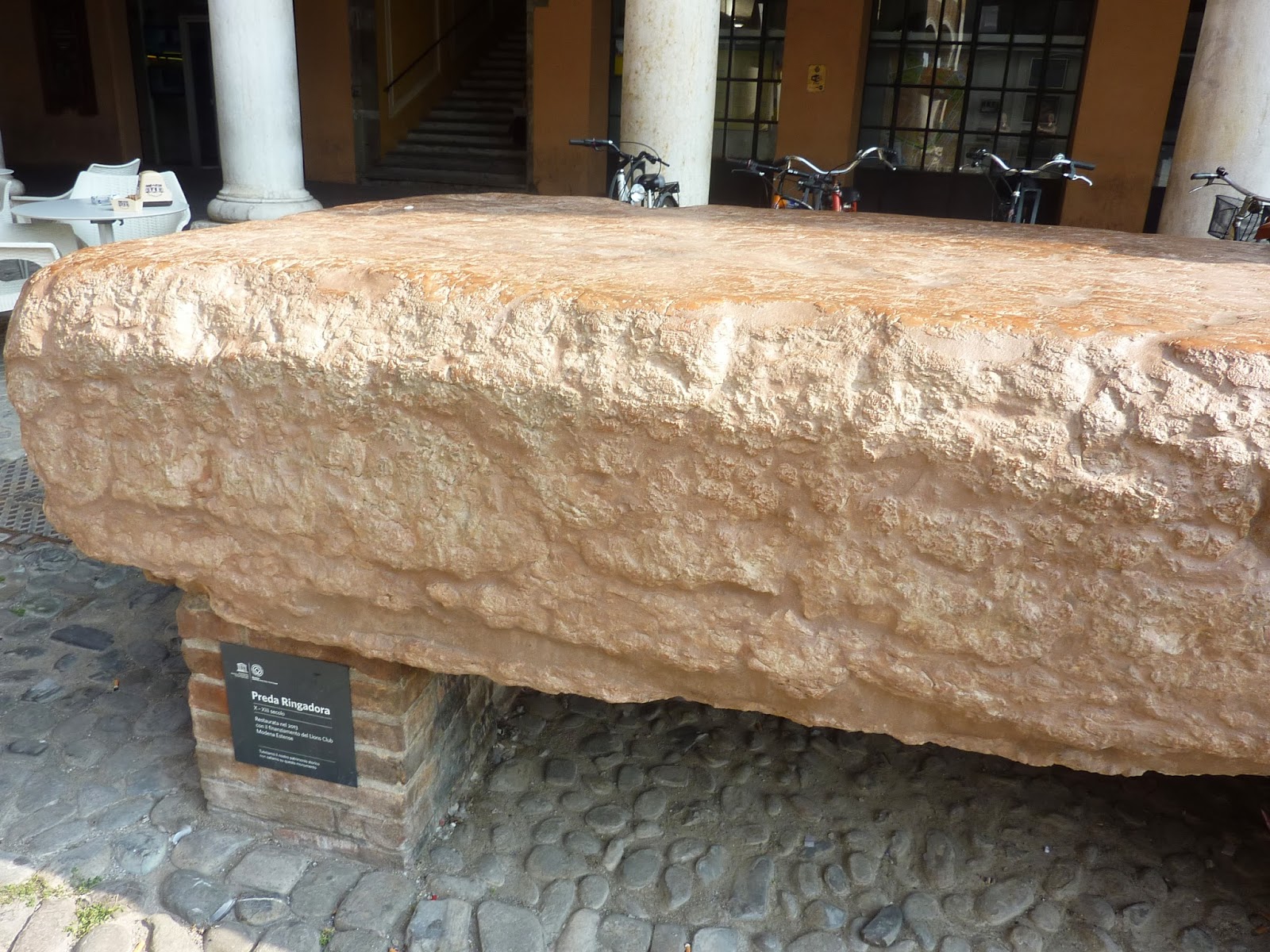
Ferrara is, to my mind, even more impressive, with its terrific moated castle,grassed ramparts and a host of wonderful sights. As I was walking round, the idea for one of the two short stories I mentioned in my blog post yesterday came to mind.


Finally, Ravenna. It's famous for its mosaics, and these really are dazzling. The old mausoleum and the archaeological museum, with its ivory throne, are among countless sights packed in to a small area, easily walkable. You can also find Dante;'s grave and an interesting exhibition, which gave me a much better understanding of his work (perhaps I should read Dan Brown's Inferno too?) Dorothy L. Sayers translated and admired Dante, but I don't know if she ever visited Ravenna. If so, I'm sure she was impressed. Like Ferrara, it would make a terrific setting for a detective novel, and I'm sure that some writers have already made good use of it. I look forward to tracking down one or two examples.


Subscribe to:
Posts (Atom)