Showing posts with label E.C.R. Lorac. Show all posts

Friday, 2 December 2022

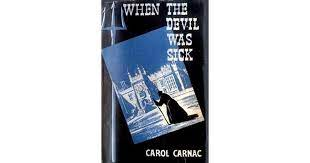
Forgotten Book - When the Devil Was Sick


Until a few years ago, as a reader I focused on the books that Carol Rivett wrote under her most prominent pen-name, E.C.R. Lorac, rather than those which appeared under the name Carol Carnac. One of the reasons was that the Carnac books tend to be very elusive. However, I was lucky enough to acquire an inscribed dedication copy of Crossed Skis and, although I'm not interested in ski-ing, I enjoyed the novel.

Some time later, I was delighted when the British Library agreed to publish Crossed Skis as a Crime Classic and positive reader reaction duly followed. Of course, this author was highly prolific under both names and not all the books can appear as Crime Classics, but excellent sales figures mean that it's likely that Lorac/Carnac titles will continue to be reprinted. Meanwhile, I've been reading a shelf-full of them.

Among them is an obscure Carnac mystery - the fifth to appear under that name - with the odd title When the Devil Was Sick. (The title comes, it seems, from an old phrase that I must admit I hadn't encountered before). It's a country house mystery, but with quite a bit of the atmospheric description of rural settings that was a hallmark of this writer. The detection is done by Inspector Charles Ryvett (a surname obviously based on Carol's own real name, suggesting that she had quite a high level of identification with this particular character).

Strange events on Lammas Night culminate in the murder of a mysterious man dressed up as monk. Is he a member of the family in whose mansion he is discovered? The butler is among those who knows more than he is willing to reveal to Ryvett. A very unusual feature of this novel, especially for one written in the Golden Age by a woman, is that amateur boxing plays a part in the storyline. Ryvett is an appealing character and this interesting story is one of a number of Carnac titles which I think deserve a new life in the twenty-first century.

Friday, 28 October 2022

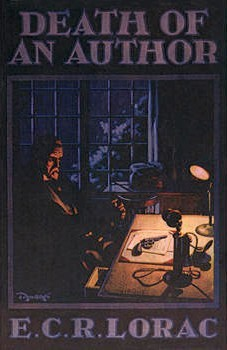
Forgotten Book - Death of an Author


The revival of E.C.R. Lorac's reputation as a detective novelist during the past few years has given me a great deal of pleasure. As I've said in the past, I was introduced to her work by my parents, and I often think that they'd be amused and gratified to see that a writer they both enjoyed has found an extensive new readership in the twenty-first century, not only in the UK but also in the US.

Death of an Author was one of her early books, written before she moved up to Lunesdale. It was the last novel of hers published by Sampson Low before she was taken on by Collins Crime Club. An unusual feature of the novel is that Inspector Macdonald doesn't appear. Here she introduces us to a likeable pair of cops called Warner and Bond.

The early chapters are absolutely excellent. We meet a publisher called Marriott and one of his top authors, a man called Ashe. The conversation turns to a bestseller by a mysterious author called Vivian Lestrange. Ashe is fascinated by book and author and persuades Marriott to arrange a dinner at which he can meet the reclusive writer. But then he is thunderstruck to be introduced to an attractive young woman...

It's difficult to discuss this book without giving too many spoilers. Suffice to say that we are given a fascinating picture of the literary world as well as an intriguing and unorthodox mystery. I really enjoyed it and I'm pleased to say that the British Library are also keen. This is a book that is extremely rare, but it won't be for long. Next year, all being well, it will appear as a Crime Classic. 

Friday, 16 September 2022

Forgotten Book - The Devil and the C.I.D.


E.C. R. Lorac published The Devil and the C.I.D. in 1938, the year after her election to membership of the Detection Club, and at a point in her career where her confidence was high. Her two previous books, Bats in the Belfry and These Names Make Clues, are among her best. The Devil and the C.I.D. is, I think, a great title and the opening of the story is truly memorable.

Our old chum Inspector Macdonald is driving through central London in a 'pea-soup' fog, atmospherically described. He leaves his car briefly to help a woman in distress and unwisely leaves his car unlocked. When he gets back, there is a corpse in the back of the car. What is more, the deceased is dressed up as Mephistopheles, and has been murdered. Poor old Macdonald is embarrassed into solving the crime.

This isn't an entirely orthodox detective mystery and I don't want to say too much about the sequence of events that unfolds. There's an interesting mix of characters and this is one of those Lorac books where we are given a clear insight into Macdonald's essential humanity. He is a pleasing creation, and by no means as anonymous or humdrum as a number of other Scotland Yard men from the Golden Age, even if he's neither an Alleyn nor an Appleby.

One of the reasons I find Lorac's books appealing is that she was equally good at conveying urban and rural settings. She doesn't over-indulge in description, but we get a picture of London in this book, as well as in several others she wrote in the mid to late 30s. A few years later, she was writing quite lyrically about Lunesdale in Lancashire, a very different part of the world, with equal authority.  


Friday, 29 July 2022

Forgotten Book - Impact of Evidence


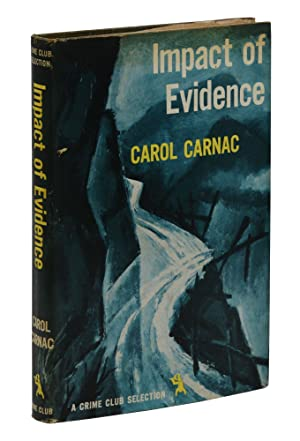
Impact of Evidence is a novel by Carol Carnac (better known as E.C.R. Lorac) which was published in 1954, towards the end of her life. Beyond doubt, it can safely be described as a forgotten book. I've never read a review of the novel and at the time of writing, only one copy is for sale anywhere in the world - for the less than modest cost of £650 for an American first edition (pictured). One wonders what price a UK first in a jacket would command. As far as I know, there was never a paperback edition.

Does the novel deserve such obscurity? My answer is an emphatic 'no'. This is a novel typical of the Lorac stories that she wrote from the 1940s onwards, after moving to live in Lunesdale. But it's not set in Lunesdale. The action takes place on the English-Welsh border (towards the southern end of that border; towns such as Hereford are mentioned in passing). Yet in many ways, the setting is strongly reminiscent of Lunesdale. I suspect the main reason that it wasn't set there was that the author was trying to differentiate her two series (which did have a great deal in common).

Lorac was a keen driver, as readers of Two-Way Murder will appreciate. This Carnac title again reflects her interest in motor cars and centres around an accident in the snow that involves two vehicles, one of them driven by elderly, infirm Dr Robinson, who dies in the crash. But when people look inside his car, a second body is discovered. The deceased is not a local, and he died before the accident. What on earth has been going on?

This is a pretty good premise for a traditional detective story and Inspector Julian Rivers of Scotland Yard turns up to conduct the investigation. We learn that he spent some of his early days on a farm in Norfolk and it's clear that, like Inspector Macdonald in the Lorac books, his burgeoning interest in the countryside and the challenges of farming life reflects his creator's enthusiasms. As so often with these books, the evocation of rural Britain is the strongest point, but I'd add that the plot is very soundly constructed. If you're a fan of traditional mysteries, this is a most enjoyable read.

Friday, 25 March 2022

Forgotten Book - Crook O'Lune aka Shepherd's Crook


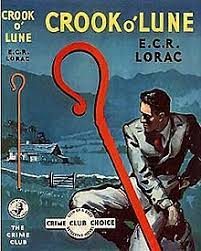
E.C.R. Lorac has become of the most popular authors in the British Library's Crime Classics series, something which causes me considerable pleasure. I am a fan, but it's also true to say that because she was so productive I still have a lot of entertaining reading ahead of me. The latest book I've devoured is Crook O'Lune, published in 1953. It is a good one, and what's more, as I explained on Monday, it prompted a very enjoyable trip to Lorac country last weekend.

At first, though, I wasn't sure if I was going to love the story. It begins slowly -very slowly. Gilbert Woolfall arrives at Kirkholm Station (based on the real-life Hornby station, which no longer exists) and enjoys an exhilarating walk through fell country. He has inherited a house at High Gimmerdale - which is a fictional version of Roeburndale. In the first three chapters, Lorac presents us with a lot of background information, and although it is relevant, it does mean that the pace and mood are rather low-key. I'm surprised she didn't try to integrate the factual material into the story in a more exciting way.

That said, things begin to warm up once Chief Inspector Macdonald arrives on the scene. He is on holiday - and is thinking of buying a farm in the area - but we all know what happens when fictional detectives go on holiday, don't we? Soon there are stories about sheep-stealing and before long there is a case of arson which has fatal consequences.

From then on, we have Lorac at her best. The characters are well-drawn and presented, for the most part, with compassion as well as insight. The setting is especially well evoked and you can tell how much she loved the area in which she lived. The story, too, turns out to be a pretty good one. All in all, it's well worth hunting for this mystery.

Sunday, 20 March 2022

A pilgrimage to Lorac country

I'm back from a short but exhilarating trip to the countryside E.C.R. Lorac knew so well in and around the north of Lancashire and the Lune valley. The inspiration for this little pilgrimage was Crook O'Lune, her novel of 1953, which is set in the fictitious environs of High Gimmerdale. I'll write about the book in a future Forgotten Books post, but for now I'll concentrate on the visit.

I was lucky to have as my guides on Saturday afternoon Lena and David Whiteley, who have given me a great deal of help in my researches into Lorac's life and work. Lena knew Carol Rivett, who wrote as Lorac and as Carol Carnac, and has very warm memories of her. She and David know the area like the back of their hands and they kindly took me to Roeburndale, which was the real-life model for the setting of the story.


This is sheep farming country (the US title for the book was Shepherd's Crook). The Trough of Bowland is in one of the least densely populated parts of England and it was fascinating to explore the area - our route was eventually blocked by a gate. Two bikers managed to get through, on their way to Slaidburn, which was my next destination. The sat nav, however, took me the long way round. It was a delightful journey as the sun set over the quiet fells.

Lorac often disguises her settings, but in the novel, Chief Inspector Macdonald goes to the Hark to Bounty pub in Slaidburn and enjoys a dinner there. I was pleased to discover that not only is the Hark to Bounty a real pub, they have accommodation too. So we emulated Macdonald (a first-rate steak and ale pie was my choice, not sure what the detective ate!) and went one better, by staying the night as well. It seems from what we were told that Lorac too may have stayed at the Hark to Bounty, I think she must have been impressed, since in truth there was no obvious need for Macdonald to go there; I suspect she just wanted to give them a plug - and why not? Slaidburn is a lovely village and it was good to explore it on a beautiful Sunday morning after a filling breakfast which leaves me needing to lose weight! All in all, a great trip. And an enjoyable book, too.   


Friday, 8 October 2021

Forgotten Book - Post after Post-Mortem


I'm working my way slowly through the books of E.C.R. Lorac (and those published under the name Carol Carnac) and continuing to enjoy her work. I don't claim that she's a match for Christie, Sayers, Berkeley, or Wade, but to me she is a sound detective author of the second rank. I also keep musing about the precise reasons for her resurgence in popularity following the appearance of several of her novels as British Library Crime Classics (the most recent being These Names Make Clues - a really good one!) 

Often she focuses on setting, but she doesn't neglect character. As a generalisation, she takes more interest in her people than, say, John Rhode or Freeman Wills Crofts, but she is also adept at the mechanics of mystification. Post after Post-Mortem illustrates these virtues. The book was first published in the Collins Crime Club in 1936, but copies are very elusive and I've certainly never seen one in a dust jacket. Definitely a forgotten book, then, but one well worth a look.

The main setting this time is Oxfordshire - Stow and Moreton receive several mentions. In the first chapter, set in Upwood, a country house in that part of the world, we are introduced to the Surray family, whose lives appear to be idyllic. Young Naomi has just earned herself a First in Greats, while other members of the family include Ruth, an attractive but enigmatic figure who has established a successful career as a literary novelist. And literary matters play an interesting part in the storyline.

But then Ruth is found dead. At first, all the indications are that she has taken her own life as a result of a bout of depression. But then a misdirected letter that she sent to her brother Richard immediately prior to her demise comes belatedly to light and casts serious doubt on the inquest verdict. Richard consults Inspector MacDonald and the Scotland Yard man sets about unravelling a complex puzzle. This is one of the best Loracs I've read.   

Friday, 28 August 2020

Forgotten Book - These Names Make Clues


Image 1 of 1 for undefined

Earlier this year, I was fortunate enough to lay my hands on an inscribed copy of E.C.R. Lorac's These Names Make Clues, an uncommon Collins Crime Club title from 1937; no dust jacket (the one in pictured is an image from Mark Terry's fascinating site of facsimile wrappers), but still a treasured possession. All the more so because the story is an enjoyable one. In fact I'd rate this as one of the more interesting Loracs.

A key reason for my enthusiasm is that this book is more in the realm of the classic "closed circle" puzzle mystery than some of the author's other work. Inspector Macdonald is invited to a Treasure Hunt evening convened by a publisher called Graham Coombe, who shares a big house in London with his sister Susan. His fellow guests are mystery writers, but part of the fun is for their identities to be concealed under pseudonyms.

The seasoned crime fan won't be surprised to learn that this pleasant idea backfires when a death takes place during the treasure hunt. The deceased was an author called Andrew Gardien, and the suspects are the Coombes and the novelists. Complications ensue when Gardien's literary agent is also found dead. Were either of the deaths murder? Macdonald investigates, abetted by a breezy young journalist called Vernon.

What fascinates me particularly about this novel, published in the year that Lorac was elected to membership of the Detection Club, is that there are strong reasons to infer that her initial experience of the Club supplied the inspiration for the story and some of the characters. Coombe may be Billy Collins, but I'm fairly sure that Gardien was inspired (albeit not in terms of his personality) by John Rhode.

I also suspect that Rhode influenced (maybe even suggested to her; he was a generous man) Lorac's choice of m.o. in relation to the two deaths. Other characters seem to me to bear traces of Douglas and Margaret Cole, and Baroness Orczy. As for the plot, it boasts variety and ingenious touches aplenty, though to my mind it's not really a "fair play" whodunit, given that a key fact is revealed rather late on. Definitely a book that deserves better than the obscurity which has been its fate since the 1930s.

Thursday, 9 April 2020

Forgotten Book - Crossed Skis


Crossed Skis by Carol Carnac, Martin Edwards | Waterstones

I've discussed my interest in the detective novels of E.C.R. Lorac often enough on this blog, but I've not had much to say about the work of her alter ego, Carol Carnac, which features a Scotland Yard cop called Julian Rivers. This is simply because I've not read many Carnacs. However, a while ago I was offered the chance to acquire an inscribed copy of the Carnac novel Crossed Skis, and I jumped at it.

The book was published in 1952, and is dedicated to Lorac's fifteen fellow members of a ski-ing party that travelled from England to Lech in Austria: "with thanks for their help and advice and happy memories of their charming company". My copy was inscribed to a member of the party, and I wonder what he made of it. I'm pretty sure he'd have been fascinated, since the story is all about - guess what? - a party of sixteen English people who go ski-ing to Lech...

This is an interesting and fairly unusual detective story, and I'm delighted that the British Library has decided to publish it in the Crime Classics series. There are two narrative strands. The ski-ing party set off for the continent, with some of its members unknown to each other. I did worry that Lorac had made a mistake by introducing too many characters, and personally I think a party of four men and four women would have been viable in this story, but I can see why she thought her plot called for more people.

The second strand of the story begins with a fire in a London house. Is it an insurance scam, is it an accident, or is something more sinister happening? Rivers takes charge of the investigation, and soon finds himself on the trail of a ruthless killer. As the two strands come together, the tension mounts. This is an enjoyable book, even for someone like me, who would rather do almost anything than ski!


Monday, 14 October 2019

The Hooded Gunman by John Curran - review

John Curran is renowned as an expert on Agatha Christie, and his research into her private notebooks broke fresh ground in terms of the analysis of how detective novelists devise their stories. I've referred to his books many times, and I've no doubt that I'll be referring frequently to his latest book, The Hooded Gunman, just published by HarperCollins. It's a detailed assessment of that splendid, and much-missed imprint, the Collins Crime Club. I should disclose that I'm one of those thanked in the acknowledgements at the front of the book, but regardless of that, I can recommend this book unreservedly to all serious students of the genre.

The Hooded Gunman is a beautifully presented book, crammed with full colour illustrations of dust jackets as well as many photographs of great interest to the crime fan. It's the most gorgeous book about the crime genre I've seen since It's All One Case, a superb book about Ross Macdonald's work published three years ago which deserves to be much better known. Terence Caven's design work is admirable.

In one sense The Hooded Gunman is a coffee table book, because of the heavy focus on quality illustrations. But it's much more than that. I'm not quite sure if John has read every single book published under the Crime Club imprint, but I wouldn't be surprised. He's certainly done a huge amount of research, and as a result, the text is more interesting and valuable than is usually the case with coffee table books (something else it has in common with It's All One Case). A large section of the book is devoted to reprinting jacket blurbs which will be a very useful tool for readers who want to consider seeking out particular titles. 

There are also several short but informative sections, for instance about Crime Club card games and the dons' detective novel competition judged by Agatha Christie among others. John makes the point that E.C.R. Lorac was particularly well-served by the artists who produced dust jackets for her books, and there's evidence here to substantiate this claim. I've enjoyed reading John's text and I've also had a lot of pleasure simply leafing through this handsome volume, admiring the illustrations. A joy for book lovers, and a very good Christmas present for the detective fan in your life.

Monday, 23 September 2019

Researching Lunesdale and the Lake District


Friday was a beautiful day, and the weather was ideal for a trip with two research objectives in mind. First, I aimed to gather more material for a forthcoming introduction to a novel in the British Library Crime Classics series by Carol Rivett, better known as E.C.R. Lorac (although the book in question will be one of those she wrote under another name, Carol Carnac). I was lucky enough to talk to someone who actually knew Carol Rivett in the years up to the author's death in 1958. It was a fascinating conversation. What's more, I've acquired an original manuscript by the author for the Detection Club's archives, held at Gladstone's Library. Developing the archives is a very long-term project, but one which I believe is hugely worthwhile. It's so easy for writers and their work, even fine writers and great books, to disappear from the public consciousness. The aim of the archives is to preserve a wide range of items of crime fiction heritage, and to make them accessible to members of the public.


My kind and generous hosts also made me a present of two works of art from their Rivett inheritance, as well as showing me a number of fascinating items in their possession. Carol was a gifted artist, and above is an example of a Christmas card, depicting an interior scene from her home in Aughton, which she designed and sent in 1956.


We met in the small village of Gressingham in picturesque Lunesdale, close to Aughton, where Carol Rivett lived for the last fifteen or sixteen years of her life. The next leg of my journey took me to Ulverston. I've been researching the next Lake District Mystery for some time, and I wanted to absorb myself again in some of the countryside (just outside the national park in this case) which provides part of the background for the book.


Earlier this year, while taking part in a talk at Ulverston Library, I met a fellow crime writer, Zosia Wand, who lives in the town. Zosia is the author of Trust Me and The Accusation, and is also a successful writer for radio, coach of writers, and playwright. She's lived in Ulverston for some years, and kindly took me on a tour which encompassed both the Hoad Monument (a lighthouse-like tower on top of a hill) and Conishead Priory (above photo), now a charming Buddhist retreat, with woodland walks to the shore. The views of Morecambe Bay were absolutely magnificent.


I was so inspired by these sights that instead of setting off home straight away, I made the most of the sunshine by driving further along the coast, as far as Roa Island on the tip of the Furness peninsula, with views of Piel Island, which I visited four years ago - yes, I've been thinking about this new novel for four years! And whilst roaming, I came upon the ideal setting for the opening scenes. All in all, truly rewarding trip.


Wednesday, 3 July 2019

Exploring Lorac Country


Last week I spent a fascinating day exploring the area where Carol Rivett, alias E.C.R. Lorac and Carol Carnac, lived for the last fifteen years or so of her life. This is Lunesdale in north Lancashire, an area that is - in comparison at least to the much-visited hot spots of the Lake District - somewhat off the beaten track, yet a very appealing area of the English countryside. The photo above is of Crook O'Lune - which supplied the title for one of Lorac's novels.


My guide was someone who actually knew Carol Rivett well, and who features as a minor character in one of her books. I learned a great deal from her, not least that Carol was a strong-minded woman with many talents. I had the chance to admire some of her artwork, embroidery, and calligraphy; she was also an accomplished musician, who taught the piano prior to the Second World War. I also learned something I hadn't realised before, that her output included a novel for children called Island Spell.


Carol moved to Lunesdale during the war, in the early 1940s, to be close to her sister Maud and her brother-in-law. The family was very close; there was a third sister, Gladys, and although she lived in London, all three sisters are buried in  the churchyard at Aughton (pronounced "Afton", and not to be confused with Aughton near Ormskirk) where Carol lived. We went on a pilgrimage there, and also to the neighbouring houses where Carol and her in-laws lived.


Whilst walking around the area - some of the narrow and bumpy rural lanes are not ideal for driving! - by chance we bumped into someone who lives in another house nearby which features in one of the Lorac books. She put a lot of her experiences (and people she knew) into her books, and it was a pleasure to be able to see them for myself. It's a lovely part of the world, and I can see why she was happy to live there. And I wondered what she would have made of the enthusiasm which has greeted the British Library's recent reprints of her work - with another title, Fell Murder, which is set in Lunesdale, due out next month.


Monday, 1 July 2019

Bodies from the Library 2019


I doubt I was the only person who was surprised to be reminded that Saturday's Bodies from the Library conference was the fifth to be held. What a five years it has been for lovers of classic crime fiction! How vividly I still recall my first chat over coffee with Rob Davies (a welcome attendee on  Saturday, even though he has now left the BL) and his suggestion that I write a couple of intros for forthcoming novels by John Bude, as well as my telling him that I was just about to conclude work on a manuscript about "the golden age of murder".....

The programme for the day was packed but well-organised and as ever I'd like to congratulate all those who worked so hard to make the day a success. I was on a flying visit to London, but Moira Redmond of the Clothes in Books blog had invited me to join a small gathering for tea at the Wallace Collection, and this proved a convivial occasion, at which I had the pleasure of meeting Brad Friedman, a blogger based in San Francisco, who was over in the UK for a few days. (Moira took the photo above, of Christine Poulson, Kate Jackson, Brad and me). We even did a bit of book shopping in Charing Cross Road before heading over to Euston for a meal with the Bodies team, David Brawn of HarperCollins, and a number of other friends.

Because it's such a busy day, there's never as much time to socialise as would be ideal, but it was good to see the likes of Nigel Moss, Barry Pike, and Geoff Bradley during the breaks. I enjoyed listening to the various talks, including one by Sarah Ward about E.C.R. Lorac which was very timely given that earlier in the week I'd been on a trip to Lorac's country - about which, more another day.

There was a live performance of "Sweet Death", a radio play by Christianna Brand, which worked very well, and I was interested to learn more about June Wright, an author about whom I knew nothing, from Kate Jackson. I was interviewed by Christine Poulson about Cyril Hare, and there was also an enjoyable session at the end of the day when the speakers answered questions posed by audience members. Great fun.


Wednesday, 6 March 2019

Forthcoming Crime Classics


The British Library has just issued its catalogue of publications for the second half of this year, and there are many good things in store. And of course that includes the forthcoming Crime Classics. Among notable features of the list is another novel written by E.C.R. Lorac, whose work has proved extremely popular with fans. This is Fell Murder, set in Lunesdale, where she made her home. It is a lovely part of the world, and this is a book with an exceptionally strong sense of place, and a sense of the intimacy of the rural community.

I'm especially thrilled that the series will, for the first time, include a novel by John Dickson Carr. This is It Walks By Night, which was his very first novel, set in Paris and featuring his first major series detective, Henri Bencolin. I've been hoping for some years that it would be possible to include Carr in the series, but it has proved tricky, because the rights position is extremely complicated. But the Library team has done great work in finally overcoming the obstacles and achieving success. Although Carr was American, his work seems to make a very natural fit with the series; he was an Anglophile who lived in England for many years and was Secretary of the Detection Club and a gifted practitioner of the "fair play" whodunit. This book also includes a Bencolin short story.

Anne Meredith's Portrait of a Murderer was a very successful book the Christmas before last, and Lucy Malleson who wrote under the Meredith name returns to the series with a book written under her best-known pen-name, Anthony Gilbert. This is Death in Fancy Dress, a country house mystery very much in the classic tradition. The book will also include a couple of Gilbert short stories.

Talking of short stories, there will be another anthology, The Measure of Malice, which is a collection of tales of scientific detection that I've put together. I'm delighted that the British Library anthologies have done so well in terms of sales and reviews, and I can also commend their "weird tales" collections, some more of which will be forthcoming (I like the sound of a collection of "killer tales of the botanical Gothic"!)

Other crime titles include another novel by George Bellairs, who is back by popular demand, Mary Kelly's The Christmas Egg, and a second Pocket Detective puzzle book by Kate Jackson. Something for everyone, in other words! And I can assure you that plans for 2020 are already making good progress. At least one more Carr title is on the way... 

Friday, 18 January 2019

Forgotten Book - Fell Murder


Image result for fell murder lorac


In Britain, female Golden Age writers have remained in print more often than their male counterpart. Christie, Sayers, Tey, Allingham, and Mitchell in particular have enjoyed enduring popularity with the general reader, in contrast (at least, until recently) to the fate of Hull, Rolls, Postgate, Bude, and Rhode. But not so long ago, the name of E.C.R. Lorac was only known to enthusiasts, since almost all of her books had been unavailable for many years. Even when you did turn them up, they were sometimes unaffordable. And right now, one of her rarest books, a signed copy of Tryst for a Tragedy, can be bought for a mere £5,250. A snip!

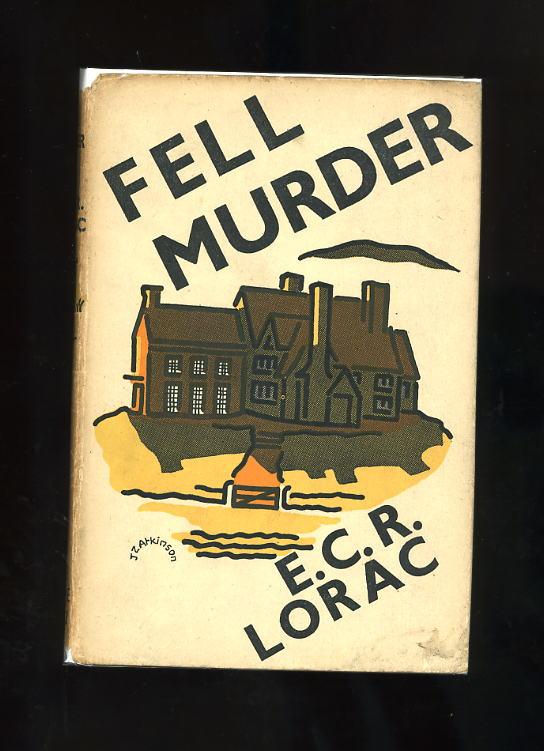
I'm glad that the British Library has played a big part in reviving Lorac. And my researches into her work have led me to a quite a number of books that are definitely worth reading. An excellent example is Fell Murder, first published in 1944. This was the first of a number of books which took Macdonald of the Yard to Lunesdale, a part of the country Lorac loved, and which became her home.

The description of the countryside, and of farming life, is quite lyrical. As so often, Lorac paints the scene with great care before murder intrudes. We're introduced to a tyrannical patriarch, Robert Garth, and the family members and local residents who have motives to wish him ill. But it's typical of Lorac that the portrayal of the victim is quite nuanced. The old man behaves badly, but he also has his good points.

The plot is one of of the best that I've found in Lorac's work so far. She is not in Christie's league when it comes to plotting, perhaps because her love of character prevents her from treating her people as pawns in a game. But the storyline is nicely done. Macdonald comes into the story at the mid-point of the novel. The local superintendent has failed to get anywhere with the tactiturn villages. But he, too, is by no means a cipher, and Macdonald appreciates his strengths. But it's left to the Scotland Yard man to solve the puzzle, and he does so with his customary calm efficiency.

Friday, 20 July 2018

Forgotten Book - The Theft of the Iron Dogs

The Theft of the Iron Dogs is one of the more intriguing titles for a crime novel. The book was written by E.C.R. Lorac, and first published by Collins Crime Club in 1946. It's one of a number of her novels set in the north west of England - Lunesdale. This is an area to which she relocated, and where spent most of her later years. Her love of the area comes through very strongly in the narrative.

The period atmosphere is equally strong. The book opens in September, and the early paragraphs begin with a description of harvesting time in the dairy farming district, where "the war effort had not been concerned with the nervous energy required by resistance to bombs or doodles or rockets; it had been the strain of sustained physical effort."

We are introduced to a farmer called Giles Hoggett, of Wenningby, and one rainy day he decides to go fishing. He takes a look at a summer cottage, only to find that two iron dogs are missing from the fireplace, as well as a complete reel of salmon line, a strong chain and hook, a clothes-line - and a large sack. It doesn't take much of a detective's instinct to figure out that someone has set about sinking something in the river Lune. And the experienced detective fan will have no doubt about what that something might be...

Yes, it's another murder mystery case for Chief Inspector Robert Macdonald of Scotland Yard. Madonald has already developed a love of the Lunesdale landscape and lifestyle, and he sets about untangling a neatly contrived mystery. Lorac's writing is characteristically under-stated, and so is her detective. I imagine that this reflects her own personality. In her quiet way, she was a highly professional writer, and although those who crave melodrama should probably look elsewhere, this book is another example of her capable mystery-making. I'm so glad that, thanks to the British Library's Crime Classic series, she has come back into public view. 


Monday, 26 February 2018

Fire in the Thatch - Lorac is back again!

Fire in The Thatch: A Devon Mystery (British Library Crime Classics) by [Lorac, E. C. R. ]

Just over a month ago, I was delighted to report the republication, the first for many a long year, of E.C.R. Lorac's Bats in the Belfry. I've been very glad to learn from the British Library that the book has sold really well, and has already been reprinted. Quite something. And this more than vindicates the decision the Library took last year to acquire the rights to a second Lorac title, which has also now been published.

Fire in the Thatch has a rural setting, and so is very different in that respect, as well as in terms of plot, from Bats in the Belfry. In the early years of her career, Lorac often set her books in London, whereas later on, especially after she relocated to the Lune Valley, her main focus was on life (and death) in the countryside. The cover artwork of this particular edition strikes me as delightful, and very much in keeping with many readers' impression of Golden Age fiction.

There's no doubt that setting does influence the way one writes a novel. My first eight books all had urban backgrounds, seven in Liverpool, one in London, and when my new editor said he'd like me to consider a new series with a rural setting, I wasn't sure about it. In fact, I'm really glad I took up the challenge, and I'm sure that Lorac also enjoyed a change of scene for her crime stories. I don't want to give any spoilers in relation to Fire in the Thatch, but if you read it, you'll see that it is structured rather differently from Bats in the Belfry. Lorac was a more versatile writer than many people realise.

It will be interesting to see how Fire in the Thatch is received. My hope is that more Loracs will be republished, and there are certainly plenty of titles to choose from. The enthusiasm of readers for vintage crime stories seems, if anything, to be growing. The good news is that there are still plenty of titles out there waiting for someone to publish them...

Monday, 22 January 2018

Bats in the Belfry


Image result for "e c r lorac" "bats in the belfry"

I'm excited about this year's programme for the Crime Classics series published by the British Library. The mix of titles that will appear this year is extremely varied. There should be something, I hope, for everyone who enjoys classic crime. My belief is that variety in a series such as this is essential, just as it is in an anthology. Yes, it means that not everyone will enjoy every story equally. But overall, that scarcely matters, because it also means that readers have the chance to sample writers and styles of writing that are unfamiliar to them, which has to be a good thing. And one of several exciting developments is that 2018 will see the reappearance in mass market paperback of two novels by E.C.R. Lorac.

I was first told about Lorac by my parents, when I was young. Both of them liked the books in particular because some of them were set in a part of the country, north west England, which they knew very well. My Dad was a real fan, although I'm not sure he ever cottoned on to the fact that the Lorac pen-name concealed the identity of a woman, Edith Caroline Rivett. But the books were out of print, something my Mum and Dad mourned. So when I started working, and haunting second hand bookshops, I snapped up every Lorac title that I could find, and presented it to my parents. (I did the same with quite a few other authors they liked; I'll say more about those books, some other time.) After their deaths, the books came back to me, and I've slowly been working my way through them, as well as adding some more titles to the collection.

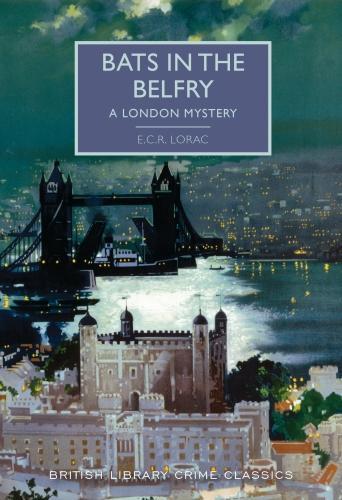
One of the additions I made a couple of years ago was Bats in the Belfry, which is set in central London. I happened to be on holiday in, of all places, the Atacama Desert, when I checked a favourite dealer's site (as you do) and discovered that an inscribed copy was for sale. I nabbed it while still in Chile, on the assumption that I'd never get another chance, even though the book lacked a jacket. And when I read the book, I was delighted, not just by the inscription (to Lorac's mother) but by the story, which struck me as entertaining and atmospheric. Yes, I did guess whodunit, but I felt that the plot overall was pleasing enough for this not to be a problem.

Even before I bought that book, I'd been keen for the British Library to bring Lorac's books back into the public eye. But it proved very difficult to trace the rights holders. Finally, thanks to the sterling efforts of Rob Davies's department at the Library, the deed was done, and now Lorac is back in print. Bats in the Belfry was published last week, and another title, Fire in the Thatch, will come out before too long. I'm really pleased about this, and I hope that if you sample Lorac for yourself, you'll find her work enjoyable too.


Monday, 6 November 2017

Crime Classics in 2018


The British Library recently published its catalogue for the first six months of next year, and this gives me a chance to talk about some of the titles in the Classic Crime series that will be coming the way of fans of Golden Age fiction before very long. It's an eclectic mix, and one that personally, I'm very pleased with.

I've already mentioned on this blog that I've compiled a new anthology of classic railway mysteries, called Blood on the Tracks. In the past there have been a few railway-themed short story collections, but I've managed to track down some stories that I'm fairly sure will be unfamiliar to the overwhelming majority of readers, as well as some that may be known to aficionados, but deserve a fresh life.

Then there's the republication of Richard Hull. I've talked about Hull's work both on this blog and in The Golden Age of Murder (and, come to that, in The Story of Classic Crime - I guess you could call me a fan!) He was a disciple of Francis Iles, and a very interesting writer indeed. Two of his best books will appear next year: The Murder of My Aunt and Excellent Intentions. I'm pleased to say that, thanks to members of his family, the introductions will contain quite a bit of fresh info about the life of this most creative of crime-writing accountant.

I'm also delighted to say that there will be two books from another writer whom I've championed, E.C. R. Lorac - Bats in the Belfry and Fire in the Thatch. I was introduced to Lorac's work by my parents, who were enthusiastic about her later work, set in Lunedale. These two books were written earlier. Bats in the Belfry has a great setting in London, while Fire in the Thatch, as you might guess, is a rural mystery

Among the authors whose novels are republished in the Classic Crime series are quite a few whom I've long hoped to revive - Anthony Berkeley, Raymond Postgate, Christopher St John Sprigg, Anne Meredith, and Freeman Wills Crofts among them. Hull and Lorac are two more authors whom I really enjoy, and I am optimistic that these reissues will find a highly appreciative new readership.

Saturday, 1 July 2017

Agatha Christie's Lost Plays

I've very much enjoyed listening to a two-CD set of Agatha Christie's Lost Plays. This comprises two pretty obscure radio plays, Butter in a Lordly Dish and Personal Call, and a radio adaptation of the Poirot short story Murder in the Mews. The plays are supplemented by rare radio recordings of Christie, and also an interview with the actor who plays a boy in Murder in the Mews and went on to win an Oscar as a set designer.

All three plays make for very good light entertainment, and Butter in a Lordly Dish I found especially impressive. It's a very good example of the way in which the nature of justice and retribution regularly plays a part in her work, a feature that critics have often under-estimated. I was also interested in that it was one of six plays written by members of the Detection Club shortly after the Second World War in an attempt to raise funds.

It was first broadcast on 13 January 1948, and it was followed by:

  • The Murder at Warbeck Hall by Cyril Hare
  • A Nice Cup of Tea by Anthony Gilbert
  • Sweet Death by Christianna Brand
  • Bubble, Bubble, Toil and Trouble by E. C. R. Lorac
  • Where Do We Go From Here? by Dorothy L. Sayers


A good list, huh? Hare's play formed the basis for his entertaining later novel An English Murder.

Personal Call is a neat story with a faint touch of the supernatural, while Murder in the Mews is a story with a cleverly contrived plot that, like so much of Christie's work, plays games with the listener's expectations. All in all, this is an excellent CD, with first class bonus extras. Recommended.