Showing posts with label Detection Club. Show all posts

Wednesday, 22 June 2022

Howdunit - the paperback edition


2022 has been a very busy year for me in terms of publications. The appearance of The Life of Crime was always going to be a major event in my writing life, and I'm also looking forward eagerly to the publication of Blackstone Fell, my third 'Golden Age gothic' mystery, in September. Not to mention a total of three anthologies and the paperback edition of The Crooked Shore (as well as the publication of that novel's American incarnation, The Girl They All Forgot); let alone individual titles in the Crime Classics series.

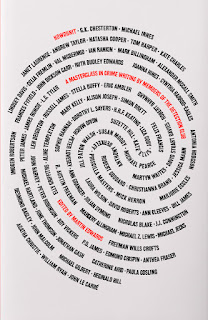
But this week I'm celebrating something else - the paperback edition of Howdunit, the book I edited on behalf of the Detection Club, which the publishers HarperCollins describe as 'a masterclass in the art and graft of crime writing'. The idea was to celebrate the 90th birthday of the Club in 2020, and although the pandemic got in the way, the book earned no fewer than five award nominations, and won the H.R.F. Keating Prize, much to my delight.

Howdunit is a book I'm proud of for several reasons. It was wonderful to receive so much generous contribution from major writers. Not one of the 90 people (or estates, in the case of deceased contributors) received a penny in payment for their contributions; nor did I. Instead, all proceeds went to the Detection Club, in line with the Club's traditions.

I also think that the book provides a great deal of invaluable information and advice for anyone who wants to write crime fiction, or simply to understand it better. Working on the book also inspired me to create the online crime writing course Crafting Crime, in conjunction with the editorial consultancy Fiction Feedback. So I'm delighted to see the book in chunky paperback form and I hope this will make the wit and wisdom of the admirable contributors available to even more fans of the genre and aspiring mystery writers.


Wednesday, 3 November 2021

A piece of Detection Club history - guest blog by Tina Hodgkinson

I'm always glad to learn more about the history of crime fiction in general and the Detection Club in particular, so I was delighted when Tina Hodgkinson,came up with some original research and kindly agreed to contribute the following guest post:

'When I was recently preparing a talk for the Agatha Christie Festival, I contacted Martin about the Detection Club’s premises in Kingly Street, Soho which was briefly mentioned in his very informative The Golden Age of Murder. Kingly Street is the parallel road in between Regent Street and Carnaby Street. Given the redevelopment of the area, I was going to have to explore historical documents to see if they could provide a clue to the location. I’m very fortunate to work at the London Metropolitan Archives, so thanks to Mark Arnold, from the Public Services Team, for pointing me in the direction of the 1934-1940 London ordnance survey maps. On the map I found St Thomas's Church on Kingly Street, and as this looked promising, I booked a visit to the Westminster Archives, to view all the documents they had pertaining to the church, which included drainage plans and a correspondence file from the 1960s. Thank you to Cecilia and Hillary for all their assistance. Here’s a brief summary of what I found.


St Thomas's Church originally stood on the corner of Kingly Street and Tenison Court, previously known as Chapel Court. Today it’s been replaced with shops and offices. At one point the church fronted onto Regent Street and became known as St Thomas's Church Regent Street. The first church had opened in 1668, and was later rebuilt in 1702, and it is this latter church that the members of the Detection Club would have known. The church was demolished in the early 1970s.

Opposite the site of the former church, was St Thomas’s Vicarage at 12-13 Kingly Court. The Vicarage was a striking, substantial, red brick and sandstone building with a decorative, gabled attic and a basement. It dated from 1887 and was designed by Lansdown and Harris. From 1932, the top floor and the attic were converted into a self-contained flat for the vicar, while the remainder of the building was leased out for business purposes. The lower floors were used as offices, workshops and showrooms. By the late 1950s, the basement and the second floor were each rented as entire floors to two separate businesses. However, the office space on the ground floor was split into a two room and a one room rental, and the first floor as three single rooms. The correspondence I saw from the 1960s, listed the business tenants at the time, but there was no reference to the Detection Club or any of its members. However, based on the information we have, I think it is highly probable that the Detection Club met in St Thomas’s Vicarage. The best bit of all is that the Vicarage still survives. It is now a restaurant called Dirty Bones. Goodness knows what Eric will make of that!

P.S. If you want to visit Dirty Bones, there is a step free route from Carnaby Street to their Kingly Courtentrance. Staff informed me there is also an accessible toilet.'


Friday, 28 August 2020

Forgotten Book - These Names Make Clues


Image 1 of 1 for undefined

Earlier this year, I was fortunate enough to lay my hands on an inscribed copy of E.C.R. Lorac's These Names Make Clues, an uncommon Collins Crime Club title from 1937; no dust jacket (the one in pictured is an image from Mark Terry's fascinating site of facsimile wrappers), but still a treasured possession. All the more so because the story is an enjoyable one. In fact I'd rate this as one of the more interesting Loracs.

A key reason for my enthusiasm is that this book is more in the realm of the classic "closed circle" puzzle mystery than some of the author's other work. Inspector Macdonald is invited to a Treasure Hunt evening convened by a publisher called Graham Coombe, who shares a big house in London with his sister Susan. His fellow guests are mystery writers, but part of the fun is for their identities to be concealed under pseudonyms.

The seasoned crime fan won't be surprised to learn that this pleasant idea backfires when a death takes place during the treasure hunt. The deceased was an author called Andrew Gardien, and the suspects are the Coombes and the novelists. Complications ensue when Gardien's literary agent is also found dead. Were either of the deaths murder? Macdonald investigates, abetted by a breezy young journalist called Vernon.

What fascinates me particularly about this novel, published in the year that Lorac was elected to membership of the Detection Club, is that there are strong reasons to infer that her initial experience of the Club supplied the inspiration for the story and some of the characters. Coombe may be Billy Collins, but I'm fairly sure that Gardien was inspired (albeit not in terms of his personality) by John Rhode.

I also suspect that Rhode influenced (maybe even suggested to her; he was a generous man) Lorac's choice of m.o. in relation to the two deaths. Other characters seem to me to bear traces of Douglas and Margaret Cole, and Baroness Orczy. As for the plot, it boasts variety and ingenious touches aplenty, though to my mind it's not really a "fair play" whodunit, given that a key fact is revealed rather late on. Definitely a book that deserves better than the obscurity which has been its fate since the 1930s.

Wednesday, 4 March 2020

Howdunit - the cover reveal, and more


Phew! Work on Howdunit is now more or less complete. At times I find it hard to believe that it's only twelve months since the Detection Club members decided, at the 2019 AGM, to proceed with a volume about the art and craft of crime writing. Since then, we've found a publisher and put together a book that runs to close on 160,000 words - plus illustrations and even cartoons, courtesy of the members.

I've never had a writing or editing experience like it. And I love the jacket artwork that HarperCollins have come up with. Has any crime book ever featured so many author names on the cover, we wonder? There are ninety-one in all. In other words, excluding myself, there are essays from one Detection Club member for each of the 90 years of the Club's existence.

All but one or two of the Club's living members have contributed, something I never dreamed would be possible when setting out on this project. In addition, thanks to the support of estates and agents, we've been able to include essays by a range of distinguished deceased members, from Agatha Christie and Dorothy L. Sayers to P.D. James and Jessica Mann.

One other point is well worth making. All these notable authors (and their estates) have donated their contributions for the benefit of Club funds. Remarkable generosity, and I'm hugely grateful. As for the detailed contents, I'll say more in due course. But there is some absolutely fascinating material here. Whether you want to write crime yourself, or whether you're simply interested in the way crime writers work and live, you will, I'm sure, find so much here to keep you royally entertained.

Monday, 21 October 2019

Announcing 'Howdunit'


Image result for ian rankin

Front page news on The Bookseller on Friday was the announcement of a deal to publish an exciting new book written by members of the Detection Club. Howdunit, which I've compiled and edited, is about the art and craft of crime writing and it will be published by HarperCollins in June next year.

The contributors will include almost all the current members of the Detection Club, including Ian Rankin, Val McDermid, Ann Cleeves, Mick Herron, James Runcie, Peter James, Sophie Hannah, Peter Robinson, Felix Francis, Elly Griffiths, Peter Lovesey, Mark Billingham, and Len Deighton, to whom the book is dedicated - given that this year, Len celebrates 50 years as an enthusiastic member of the Club. They will offer a marvellous range of insights into the writing life, including personal reminiscences, practical tips for aspiring writers, and an insight into the realities of being a writer - there are terrific pieces, for instance, about "imposter syndrome" and "improvisation techniques" as well as thoughts on social media, writing for radio, and the experience of having your work adapted for TV and film.

And that's not all. The book will also include shorter pieces by a number of illustrious Detection Club members of the past, from G.K. Chesterton onwards. So readers will have a chance to compare the approaches of luminaries of the Golden Age, for instance, with those of their present day successors. It will, I think, be quite a book. I've been working hard on it for much of this year - since Club members decided at our AGM in February that they wanted to put together a book to raise funds for the Club.

And that's another remarkable and highly gratifying feature of this book - the lovely people who are contributing to it are donating all the proceeds to Club funds, to ensure that as it celebrates its 90th anniversary next year, it continues to thrive for the foreseeable future. I'm enormously grateful to each and every one of them for their wholehearted support, as well as for the wonderful pieces they are contributing.

More about this book before long. But in the meantime, there's still work to be done... 

Friday, 23 August 2019

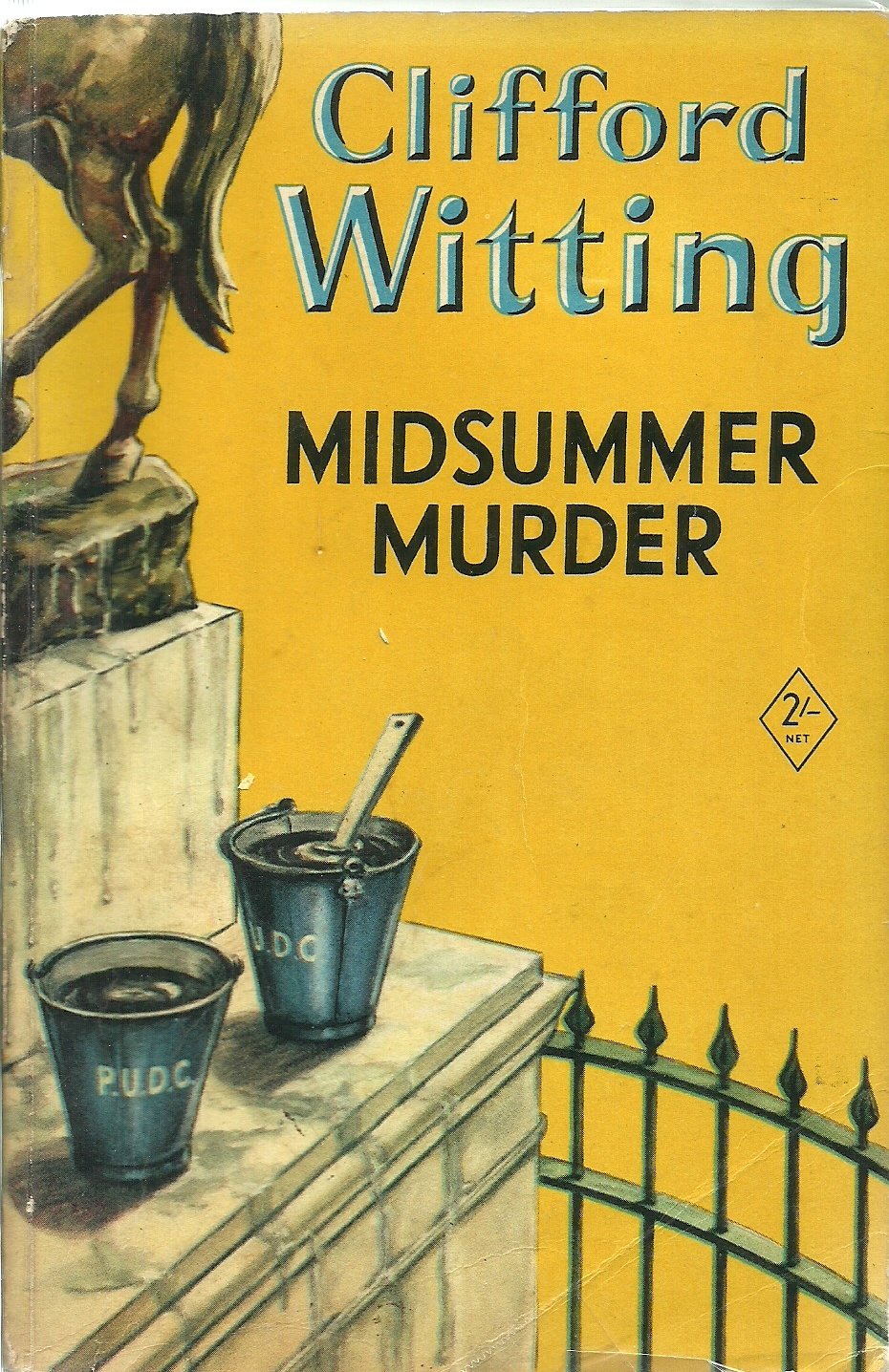
Forgotten Book - Midsummer Murder


Image result for clifford witting midsummer murder

I've read a couple of books by Clifford Witting, which I'd rank as very competent Golden Age stories, towards the top end of the second division. And now I've devoured Midsummer Murder, his second novel, which I found extremely enjoyable. It's a story about a series of sniper killings in a small town, and it comes complete with map of the crime scene and an ironic reference to the Detection Club in the very last sentence.

Witting was a witty writer, and occasionally he overdoes the facetiousness. There's also a bit too much authorial  intervention for modern tastes (although that amusing final sentence makes up for it, in my opinion). But I'd say that he is a writer whose work is likely to appeal to anyone who is a fan of George Bellairs. And on the basis of what I've read, I'd add that he's the superior crime novelist. Indeed, twenty years after his jokey reference to the Detection Club, he was elected to become a member.

The story begins, I was pleased to note, on my birthday, in July, in the tranquil setting of Paulsfield, soon to be tranquil  no more. A workman is shot while cleaning a statue in the town square, an extraordinary crime which is apparently motiveless. For a long time I wondered if we were looking at a riff on The ABC Murders. I don't think it's a spoiler to say that this is not a book of that kind, and although (I choose my words with care) some readers will quibble about the slenderness of the connecting link between the deaths that plague Paulsfield, that didn't spoil my enjoyment.

Indeed, a great pleasure of this book is the characterisation, which is consistently amusing and appealing. Among the cast is a widow whose voluminous card index system contains masses of information about the local inhabitants. Inspector Charlton and Sergeant Martin make a likeable investigating duo, and although the book is perhaps a little longer than it needed to be, it held my interest from start to finish. Recommended.

Wednesday, 20 July 2016

Motives for Murder - a new Detection Club book


I'm delighted to announce that the Detection Club will publish in November a brand new collection of short stories, Motives for Murder. The idea is to celebrate the 80th birthday this year of one of the Club's most distinguished members, Peter Lovesey. The book will be published in Britain as a paperback original by Little, Brown, Peter's publishers, and in the US (with a limited hardback edition as well) by Crippen & Landru, a small press run by Peter's good friend Doug Greene.

Setting the wheels in motion for this book was my first act as President of the Detection Club. I wanted to honour Peter, who has given so much to the Club over many years (and has, incidentally, been a great source of information about its past) and I also wanted to showcase the short story writing talents of our wonderful members. The Club's membership is relatively small, and the deadline was exceptionally tight, but more than a third of those members offered to contribute to the book, which delighted me. The result is a very substantial anthology indeed;.

The book benefits from a foreword by the legendary Len Deighton. Len has published very little over the past twenty years, so I was thrilled when he agreed to get things rolling, and there is also a fascinating afterword by Peter himself, which includes many stories about his early days in the Detection Club back in the 70s.

Each of the twenty stories (well, nineteen stories and one sonnet!) was written specially for the book, and each is prefaced by a few words from the author about Peter's contribution to the genre. There are some wonderful things in this book, written by leading crime writers such as Ann Cleeves, Andrew Taylor, Len Tyler, Michael Ridpath, Liza Cody and...well, the list goes on. I'm thrlled that we've put together such a special book in  a very short space of time and hope that crime fans everywhere will find something in it to delight and entertain

Monday, 16 November 2015

A Night to Remember


Last Thursday evening was for me very special. The highpoint of my crime writing life, no less. For Thursday was when, during a wonderful occasion as the Dorchester Hotel, I became President of the Detection Club. Since 1930, there have only been seven previous Presidents, plus a co-president, Lord Gorell, who acted as a public speaker during the early years of Agatha Christie's nineteen year reign as President. My immediate predecessor was Simon Brett, who has served with distinction for the past fourteen years.

The first President, from 1930, was G.K. Chesterton - Sir Arthur Conan  Doyle was approached, but too infirm in the months before his death to accept. Chesterton was followed by E.C. Bentley, author of the book that really inaugurated the Golden Age of detective fiction, Trent's Last Case. Next came Dorothy L. Sayers, and when she died, Agatha Christie took over. After her death, Julian Symons became President; he was followed by another leading crime novelist and critic H.R.F.Keating, and then Harry handed over to Simon. As I said at the close of the installation ceremony, those are big shoes to fill. And there's a big presidential robe to fill, too! It was clearly designed, as Simon noted, to accommodate the well-upholstered Chesterton

A very happy feature of the evening was that we had the largest turn-out for a Detection Club event for many years. Those attending included Harry's widow Sheila, Jessica Mann (who was the Club Secretary for several years), the eminent journalist Katherine Whitehorn, and a host of distinguished novelists including Andrew Taylor and N.J. Cooper. The guest speaker was Mark Lawson, himself a novelist of note, as well as a leading cultural critic and commentator. He spoke movingly and well about a trio of recently departed crime writers, P.D. James, Ruth Rendell, and Henning Mankell, and we also had a chat about The Golden Age of Murder, which he reviewed very generously some months ago.

The Detection Club is a private, London-based dining club, no more, no less. But it has the distinction of being the first major social network for crime writers, and it played a significant part in the genre's development and its cultural heritage. And next year will see the publication of the first Detection Club novel for decades. This is The Sinking Admiral, a book which we thoroughly enjoyed putting together. I'm very glad to be part of the Club, and naturally I'm thrilled that the members have honoured me by asking me to take over from Simon. It's not something I ever anticipated, but I'm very, very glad that it's happened.


Friday, 25 September 2015

Forgotten Book - The Man Who Killed Himself

Starting in 1967, Julian Symons wrote three books with title beginning "The Man Who..." The first two, certainly, rank among his finest work, and it's no coincidence that when the Detection Club marked his 80th birthday with a collection of short stories in his honour, it was called The Man Who.., and each story had a title containing that phrase. The three books were not a trilogy, and are entirely distinct from each other. There are no common characters, although a strong sense of irony, and a sharp sense of humour, are common features.

The Man Who Killed Himself was the first of the three novels, and it features meek, unhappily married Arthur Brownjohn, a character who closely resembles Dr Bickleigh in Francis Iles' Malice Aforethought. This is not the only parallel between the two stories, and I've no doubt that Symons was consciously trying to take elements from the work of Iles (whom he admired, as I do) and fashion them into a contemporary mystery. He does so with great success. This is quite a short book, but it's genuinely gripping.

Arthur is leading a double life. He finds an outlet for the more, shall we say, outgoing aspects of his character by creating Major Easonby Mellon, a dodgy chap who runs a very dodgy matrimonial bureau. Mellon is married to a nice but unintelligent woman whom he has persuaded that he is actually a secret agent. The early scenes are very funny, but then the plot thickens - and it becomes progressively darker. Arthur, like the other 'Men Who...' is essentially a weak man, whose personality flaws make him a potential murderer.

Ultimately, this book is a study of a man's psychological disintegration. Symons had tackled this subject before, notably in The 31st of February, his first significant crime novel, and he would revisit it subsequently, but never with such zest as in this book. The combination of a clever plot and ironic prose is a real delight. I recommend it unreservedly.

Monday, 22 June 2015

The Detection Club Presidency


I've returned home after an exhilarating few days in London, with a number of highlights, including Saturday's superbly organised and hugely successful Bodies from the Library conference. More about that in a day or so, but today I'll focus on an item of news that I've kept under my hat for several months, but which became public knowledge over the week-end.

One of the events at the conference saw Simon Brett and I talking about the Detection Club. Simon has been President of the Club for fourteen years, and as he mentioned on Saturday, he made it clear a while ago that he was aiming to retire from office - an office which he has held with much distinction throughout that time. The plan is that he will retire at the next annual dinner of the Club, to be held in November. And the news he announced is that he will be succeeded by.... me.

To say that I am thrilled by this is an under-statement. As far as I'm concerned, in the course of an often very fortunate writing career, it really is the greatest highlight, given my undying enthusiasm for the history and heritage of the crime fiction genre, as well as for its present and its future. Back in February, when a number of members approached me with the suggestion that I become President, I was somewhat astonished as well as very flattered.

Once I had time to take it in, I was also extremely touched and grateful, and among several lovely things that have happened since the members made their decision is that the great Len Deighton, a member of the Club since 1969, generously took me out for a long and hugely enjoyable lunch in London, an occasion which I shall never forget.

Since the Club came into being in 1930, there have only been eight Presidents, one of whom was appointed as a co-President only:

G.K. Chesterton   1930-36
E. C. Bentley        1936-49
Dorothy L. Sayers 1949-57
Agatha Christie     1957-76
Lord Gorell            1957-63 (as co-President, because Christie disliked public speaking)
Julian Symons       1976-85
H.R.F. Keating      1985-2000
Simon Brett           2000 to date


When one looks at that list of very illustrious names, my pleasure is self-explanatory. Yes, you may think that quality control has slipped all of a sudden, but I couldn't possibly comment! My friends and fellow Club members have done me a great honour. Now my first aim is to try to avoid falling under a bus between now and mid-November...

(The photo shows Simon and me at a Detection Club dinner a while ago and was taken by Kate Charles the night she was initiated as a member of the Club.)


Friday, 6 September 2013

Forgotten Book - The Missing Link

The Missing Link, the first of three detective novels published by Katharine Farrer, was one of the books I covered in my Oxford literary tour last week. First published in 1952, it was reissued a few years back by the admirable Rue Morgue Press, and Tom and Enid Schantz of Rue Morgue included a very informative introduction. Farrer was the wife of an eminent theologian, Austin Farrer,and the couple were friendly with the likes of C.S. Lewis and Dorothy L. Sayers.

They lived in Oxford,where this book is set. Katharine fell for Austin while she was a student at St Anne's College, and almost inevitably she made her Detective Inspector, Richard Ringwood, an Oxford graduate. He's from the school of gentlemanly cops, and we first encounter him at the Mitre (a pub that holds a special place in my own affections), talking to his fiancee Claire Liddicote. He's not happy to be disturbed by a call to investigate the apparent abduction of a small baby, brought up (in a rather weird way) by a couple called the Links. Hence the title, which is capable of no fewer than three interpretations - rather clever.

Katharine Farrer was elected to the Detection Club on the strength of just three books, and to be honest, it has crossed my mind that she may have owed this honour almost as much to personal connections as to the quality of her detective fiction, since after her election, she never wrote another mystery. Her life, like her literary career, seems to have faded in sad fashion. The Schanttzes explain that she was very highly strung, and turned to drink and drugs. There's no hint of such failings in this novel, but I must say that I felt it was a genuine curiosity rather than any sort of a masterpiece.

Ringwood is human and likeable, and there is a very powerful and entirely original climax to the story. The culprit's motive is, I am sure, unique in the genre, and I do love unusual motives. These are great strengths, but frankly they would have combined to make a brilliant short story. For a novel, they are not quite enough. The culprit is fairly obvious from the start, and the storyline meanders rather tediously. I became disillusioned long before the dramatic and unorthodox finale. I found the humour so-so and the treatment of social issues well-meant but very dated..I'm glad I read this odd baby-theft story,but I would like to think that Farrer's other two novels are more gripping than this one.


Friday, 30 March 2012

Forgotten Book: Crime on the Coast and No Flowers by Request

Crime on the Coast and No Flowers By Request are two round-robin novellas that have been published in hardback and paperback in a single volume which is my Forgotten Book for today. They are often assumed to be Detection Club productions, but in fact Crime on the Coast was put together by a group which included non-Club members.

No Flowers by Request first appeared in 1953 as a serial in The Daily Sketch. It’s a domestic poisoning mystery, with two chapters written by each of the five contributors. The story is kicked off by Dorothy L. Sayers, and I suspect this may have been her last published foray into detective fiction – though I stand to be corrected. She introduces the story in characteristically assured fashion, with a first person narration by a widow who decides to become a cook-housekeeper. When reading her contribution, I thought what a pity it was that, effectively, she gave up writing mysteries before the start of the Second World War. Her talent was undimmed more than a decade later, even in this fragment.

Later chapters are supplied by E.C. R. Lorac, Gladys Mitchell, Anthony Gilbert and Christianna Brand. An all-female line-up of writers (Gilbert’s real name was Lucy Malleson) and perhaps that is why a domestic setting was chosen. It is certainly well portrayed, and the mystery isn’t bad.

Crime on the Coast was serialised a year later in The News Chronicle. This time the story begins, in typically atmospheric fashion, with John Dickson Carr describing a strange encounter at a slightly macabre seaside fun fair. Later chapers are supplied by Valerie White, Laurence Meynell, Joan Fleming, Michael Cronin and Elizabeth Ferrars. I must admit I’ve never heard of White or Cronin, but their sections aren’t at all bad. However, as is often the case with round-robin mysteries, the story-line becomes increasingly unlikely as events move on. This is partly because of the need to provide cliffhanger chapter endings for the serialisation in the newspaper.

All in all, these are minor pieces of work, but I enjoyed reading them. They rank as curiosities, but collaborative writing is extremely interesting, both in theory and in practice, and the stories are, therefore, worth a look, especially for fans of Carr and Sayers. No Gideon Fell or Peter Wimsey, though!

Friday, 20 January 2012

Forgotten Book - Dorothy and Agatha

My Forgotten Book for today dates back just 20 years. It is an American mystery, Dorothy and Agatha, and the author is Gaylord Larsen. The eponymous ladies are, needless to add, Sayers and Christie, and the supporting cast includes various prominent members of the Detection Club.

Regular readers of this blog can probably guess at my delight when I learned of and tracked down this novel. Larsen’s lovely idea of setting a story around the Club offers terrific potential, and I wish I’d been the first to think of it. But of course, an idea is one thing. Executing it successfully is something very different.

The story opens with the discovery of a dead man at Dorothy’s home in Essex. He is found slumped over a typewriter, and there is with him an apparent suicide note. Was he a distraught lover? No, it turns out that murder has been done, and Sayers and in particular Agatha Christie are the ideal people to solve it.

The dust jacket claims that Larsen “has rendered every detail of character and place with uncanny accuracy”. Unfortunately, this is so far off the mark as to be hilarious. Take for instance the author’s apparent belief that Chester (where Agatha watches a soccer match...) is located in the Lake District, and is a shortish drive away from Essex. Now, I wouldn’t want to be excessively pedantic about the countless factual errors and historical and chronological anachronisms. When writing about a foreign country and different era, mistakes are almost inevitable, and I’m as likely to get things wrong as most other writers. But here there are just too many howlers, page after page, and most could have been avoided by elementary care. The bizarre portrayal of Oxford life, for instance, might be forgivable, but the repeated references to “Summerville College” and the suggestion that Anthony Berkeley was president of the Detection Club are just lazy. Whatever happened to fact-checking and the editorial process?

And then there is the dialogue. Where do I begin? Dorothy saying to Agatha, “We’re a couple of stodgy, middle-aged storytelling dames.”? Agatha saying to E.C. Bentley , “Edmund, I’m sorry. I’ve gotten you out of bed?” You get the picture.

In defence of Gaylord Larsen, he can write agreeably, and the pages turn quickly. He deserves genuine praise for coming up with a concept of real interest and exciting potential. What is more, his “least likely person” plot isn’t at all bad. These positive points do need to be made, not least because I don't care much for reviews that are wholly negative. It's not right to overlook redeeming features. But I'm afraid that, overall, Dorothy and Agatha has to rank as, to put it kindly, a missed opportunity.

Monday, 3 October 2011

CADS 61


I've written before in praise of Geoff Bradley's marvellous magazine CADS, and the recent arrival of the latest issue is cause for celebration, as usual. Its appearance may be irregular, but the high standard of the contents is very regular indeed.

We have another nice mix of material again this time, with pieces from a range of excellent familiar contributors such as Liz Gilbey and Philip Scowcroft - the latter writes interestingly about the John Dickson Carr book I featured a while back, The Problem of the Green Capsule.

The highlight is the lead article, by Peter Lovesey, a very informative piece on the Detection Club. I had the pleasure of seeing a draft of this article, which Peter prepared for a lecture, and it's characteristically enjoyable. Peter's lecture, by the way, was the annual lecture for the Dorothy L. Sayers Society last March. I was asked to speak there myself, but had to pull out because of the day job. However, I'm glad to say that I've been invited to give the annual Sayers lecture next year, and I'm really looking forward to it.

Finally, Curt Evans has unearthed some fascinating correspondence involving J.J. Connington. I haven't yet read all of his article, since he kindly includes spoilers about revealing the solutions to a couple of Connington books I have yet to read. But as ever his research is intriguing and welcome.

Monday, 19 September 2011

Simon Brett


It must be 25 years or more since I first came across the crime fiction of Simon Brett. I enjoyed a number of his very witty novels about the actor and amateur detective Charles Paris before moving on to his second string sleuth, Mrs Pargeter. More recently, he has enjoyed good deal of success with his Fethering novels.

But this very prolific writer has, quite apart from his work for radio and television and some non-fiction, which includes an admirable anthology of parodies, also written successful stand-alone novels of psychological suspense. Not long ago, I posted a review of A Shock to the System, the film based on one of those books, and I can also recommend Dead Romantic, one of his strongest novels.

He is as witty and urbane in person as in print, and many years ago, I heard him give a highly entertaining talk at a writers' festival. I have to confess that I was too shy to introduce myself as a fan, but it did give me great pleasure to meet him at last some time later. More recently, I was quite thrilled to receive a letter from him, out of the blue, telling me I'd been elected to membership of the Detection Club, of which he is President.

A couple of times, I've had the happy experience of including Simon Brett stories in anthologies that I've edited - most recently, a new Charles Paris story for Original Sins. He is a first rate short story writer, and his collected crime stories, in a couple of volumes, are definitely worth seeking out. As the title of one of hose books, A Box of Tricks, implies, he is very good on plot and twists, but he is also keen to keep trying something new - he's even written crime fiction in verse. I saw Simon fleetingly at the recent Crimefest, and here's a photo of the two of us during the CWA Dagger shortlist event. My thanks, as ever, to Ali Karim, for allowing me to reproduce it.


Wednesday, 1 June 2011

John Curran


When you attend a crime fiction convention, there is a pleasurable dilemma about how you spend your time. Do you go to as many panels as possible? Do you network avidly? Or do you try to carve out some time for longer conversations, especially with people whom you seldom have the chance to meet? Of course, there isn't a definitive right answer, but in recent years I've done a bit less manic flitting about, and spent more time indulging in a range of fascinating conversations with some of the very interesting people whom I've encountered.

At the recent Crimefest convention in Bristol, I had the pleasure of talking to a number of people for quite a while, among them the Irish writer and researcher John Curran. John is best known as the author of Agatha Christie's Secret Notebooks, a wonderful book which has a follow-up volume due out later this year. He is currently researching detective fiction written in the period between 1930 1950, and his knowledge of the genre is encyclopaedic. Not surprisingly, he was one of the contestants in this year's Crimefest Mastermind.

On the Saturday of the convention, John and I had lunch together and talked endlessly about Golden Age detective fiction, a subject close to both our hearts. So endlessly, in fact, that when the cafeteria at Bristol Cathedral closed, we continued our conversation in the delightful Cathedral garden, where I took this photo of John. And when the garden closed, we carried on the discussion, walking along the very pleasant Bristol waterfront in the sunshine.

John has been researching the Golden Age in the copyright library at Trinity College, Dublin, and has come across all manner of rare books. He told me, for instance, about an Australian book called Murder Pie which was inspired by the Detection Club's The Floating Admiral, and which I'm tempted to try to track down. Because of work commitments, I wasn't able to join the party which John took around Agatha Christie's former home Greenway, much to my regret. Next year, perhaps! In the meantime, the chance to spend a few hours with a fellow enthusiast for long forgotten detective fiction (as well as for the unforgettable Agatha Christie) remains one of the memories I'll take away from this year's Crimefest.

Friday, 6 May 2011

Forgotten Book – The Dangerfield Talisman


My choice for today's Forgotten Book is a novel published in 1926. That year saw the first appearance of The Murder of Roger Ackroyd – suffice to say that The Dangerfield Talisman by J.J. Connington was rather less ground-breaking. All the same, it is readable example of an early Golden Age mystery by one of the first members of the Detection Club

The setting is a country house packed with the obligatory party of suspects. But this is a mystery story, rather than necessarily a murder mystery, although one character does disappear in strange circumstances. The eponymous Talisman is a family heirloom, valued at £50,000 "and the price of diamonds had gone up a good deal since then". Surprise, surprise – it goes missing.

We are provided at the outset with a chess problem that provides an enigmatic clue to the riddles surrounding the Dangerfield family, and the problem is ultimately solved in classic Golden Age fashion. The story is rather low-key, but offers agreeable entertainment in the game-playing tradition of its time.

J.J. Connington was an interesting writer, a prominent professor of chemistry who wrote a leading textbook on his subject, as well as a goodly number of nicely constructed mysteries. He went on to improve upon this early effort, and having enjoyed a few of his books, I'm certainly interested in reading more.

Friday, 29 April 2011

Forgotten Book - Those Days


Edmund Clerihew Bentley remains known today as the inventor of the clerihew, a light verse form, and above all as the author of that classic novel of detection, Trent's Last Case. My choice for today's Forgotten Book is his memoir, published in 1940, Those Days.

One of the facts about Bentley's life that struck me as extraordinary was that he went to the same school as G.K. Chesterton, whom he met at the age of twelve, and with whom he formed a lifelong friendship. He admired Chesterton greatly, and it is interesting to read a contemporary's insights into the extraordinary personality of the creator of Father Brown. It is also intriguing to bear in mind that Bentley succeeded Chesterton as President of the Detection Club.

Bentley gives a detailed account of how he came to write Trent's Last Case, although I think it is true to say that he gave slightly different accounts on different occasions. However, unfortunately, he has more or less nothing else to say about his other crime fiction, giving Trent's Own Case no more than a passing mention (some people might unkindly say that is about all that particular book deserves!)

Bentley has a good deal to say about politics (he was a staunch Liberal) and quite a bit about journalism (his day job for many years) but to my regret he does not talk about the detective fiction genre in general, nor about the Detection Club. All in all, Those Days is quite interesting from a historical perspective, and that to my mind means that it certainly doesn't deserve to be forgotten. But those seeking information about the Golden Age of detective fiction won't find too much new material here.

Thursday, 14 April 2011

The Detection Club Archivist


I'm proud to say that the Detection Club has appointed me as its archivist. Given that I have been fascinated by the history of the crime fiction genre for more years than I care to remember, this is not only an honour, but a role that I'm sure I will find rewarding.

Appropriately enough, a good deal of detective work is bound to be required. Although many crime writers are fascinated by history, only a minority take an interest in the details of the evolution of their genre, and information about the early days of the Club in particular is very hard to come by. To a large extent, this is perhaps understandable for a social group whose main objective has always been simply to have a few convivial dinners each year. Looking back, however, it would be fascinating to know more about the discussions and relationships between people like Agatha Christie, Dorothy L. Sayers, G.K. Chesterton, Anthony Berkeley and Hugh Walpole.

To this day, there is continuing uncertainty in many quarters about when the Detection Club actually came into existence. For example, the club's own list of members suggests that it started up in 1932, but that cannot be right, since it published The Floating Admiral in 1931. In fact, I'm pretty sure that it began "officially" in 1930.

I'm keen to gather material for the archives, and if any readers of this blog can help, I'd be delighted to hear from them.


Friday, 25 March 2011

Forgotten Book - The Poisoned Chocolates Case


P.G. Wodehouse wrote a number of stories with a crime element, and admired Agatha Christie. She liked his work, too, and it’s a pity the two of them never collaborated. Had they done so, they might have come up with a book as good as The Poisoned Chocolates Case, by Anthony Berkeley.

This whodunit is a classic of the genre, which I first read many years ago. I decided to take another look at it, and found it was at least as good as I remembered - which is saying something. It’s clever and witty and quite unique.

Its genesis was a short story called ‘The Avenging Chance’. In the novel, written in 1929, Berkeley has the six members of the Crimes Circle (based, no doubt, on the then embryonic Detection Club) come up with different solutions to the puzzle of who killed Joan Bendix. Roger Sheringham’s solution derives from the short story – but here it isn’t the right answer to the puzzle. There are, in fact, two more twists in store.

In 1979 Christianna Brand came up with yet another solution. All this makes Berkeley’s point, that the solutions to a fictional mystery are potentially endless. I love the way he keeps shifting the kaleidoscope in this story. It deserves its status as a masterpiece of the Golden Age.