Showing posts with label Peter Lovesey. Show all posts

Wednesday, 15 March 2023

Showstopper by Peter Lovesey - review


Peter Lovesey is the only writer living in Britain who has received the two top crime writing awards - the CWA Diamond Dagger and MWA Grand Master award. Showstopper, his latest Peter Diamond novel shows that he remains in fine form. We all know that when a series has been running for a long time, the books can become repetitive. But that isn't a trap that Lovesey has ever fallen into. This is another unorthodox story, very different in style and content from Diamond's last outing, Diamond and the Eye, and as entertaining as it is devilishly readable.

At the start of the book, Daisy Summerfield, a veteran member of the cast of the successful TV series Swift, goes home and is confronted by a burglar. Daisy dies and this is the latest in a long series of misfortunes plaguing the series - there have been accidents, people have gone missing, and so on, over a period of years.

Diamond investigates at a time when he's wondering if he should bring the curtain down on his crime-solving career. At first he is sceptical about the so-called jinx on Swift, but when his colleague Paul Gilbert witnesses another serious mishap, he begins to revise his opinion.

Lovesey cleverly blends traditional elements with up-to-date material (dashcam footage plays an important part in the storyline) and manages to keep the reader guessing about what is really going on. When you take risks, as Lovesey does so admirably, and keep trying something different, there's always the chance that the occasional book will misfire (and if it happens, I think it's a matter for commiseration, not complaint.) But it's not something to worry about here. Showstopper is a highly enjoyable mystery that reminds us that very few British crime writers have ever maintained such high standards for as long as Peter Lovesey. 


Monday, 4 April 2022

Reader, I Buried Them by Peter Lovesey - review


I had an advantage when coming to review Peter Lovesey's new collection of short stories, Reader, I Buried Them. A number of the stories included appeared previously in anthologies that I've edited over the years. It's always a great joy to receive a submission from Peter. The quality is high - that's a given - but what I love particularly is the sheer variety and the consistent enjoyability of his writing. There are plenty of fine examples in this book.

Peter is a brilliant ideas man. Fresh concepts spring to his fertile imagination with astonishing consistency. In a pleasing introduction to the book, he tells a good story about his first published short story, 'The Bathroom', which earned the admiration of Ruth Rendell and her encouragement to continue with the short form as well as his novels. The story is included, and so is a splendid companion piece of non-fiction, 'The Tale of Three Tubs', which I featured in my CWA collection of essays about real life crimes, Truly Criminal

Some of the clever ideas may, I suspect, have sprung from a great idea for a title - such as 'A Three-Pie Problem', featuring Peter Diamond, and also the title story of the book. There are nods to Patrick Hamilton in 'Gaslighting' and to Edgar Allan Poe and Agatha Christie in other stories. The stories vary in length as well in style and one of the very shortest, 'Agony Column' is appealingly jokey. There's an amusing monologue at the end of the book and a comprehensive checklist that will be invaluable for Peter's many fans.

Need I add that I found this book highly entertaining from start to finish? And there was a little bonus when I looked at the back cover. There were three well-deserved encomia. One from Ruth Rendell herself. One from Val McDermid. And one from me. Great company to be in - a company of long-term Peter Lovesey fans.  

Wednesday, 29 July 2020

The Finisher by Peter Lovesey - review


The Finisher (Peter Diamond Mystery) by [Peter Lovesey]

The Finisher is not merely the 19th novel in Peter Lovesey's highly successful series about Bath cop Peter Diamond. Its appearance marks the 50th anniversary of the publication of Peter's award-winning debut novel Wobble to Death. And very cleverly, Peter has returned to a key theme from that first novel and given it a fresh spin. The 'wobble' was a Victorian race, and The Finisher deals with present day half-marathon running. It's a great way to celebrate a literary career of sustained achievement.

The storyline is constructed with such cunning that I don't want to say too much about it, for fear of giving too much away. I was hooked right from the first two sentences: "The city of Bath isn't all about Roman plumbing and Georgian architecture. It offers unrivalled facilities for getting rid of unwanted corpses."

We're promptly introduced to a ruthless killer known as the Finisher (and "finishing" is a concept used astutely throughout the story) but then events move forward in quite a discursive way, as Lovesey constantly teases us with different possibilities about what might happen next. Not just who is the killer, but who might be killed. I have a particular, if inexplicable, enthusiasm for crime novels with underground scenes, and there is plenty in this book to satisfy that taste - there's even a "tunnel of death". There's much else to enjoy, including a good deal of humour, with a lovely, sly P.G. Wodehouse joke.

This is a story firmly set in the present day (or at least the immediate pre-pandemic present day!) but Peter Lovesey's storytelling skills, and certainly his gift for constructing a fair play puzzle, match those of the finest exponents of Golden Age fiction. As a bonus, there is a delightful map in the classic tradition. Even though I've followed Peter's career closely since my student days, I found the afterword, "Running into Writing", informative and enlightening. I won't pretend that I share Peter's enthusiasm for running, any more than I shared Dick Francis's devotion to horse racing. The gift of both men is an ability to write about their passions in a way that attracts even sceptics like me.

I often think of Peter in connection with two writers born in the same year, Reginald Hill and Robert Barnard. Three delightful men, three outstanding crime novelists (and equally accomplished writers of short stories and non-fiction). Three superb entertainers, in short. Now, alas, there aren't any new novels by Reg or Bob to look forward to, so there is all the more reason to appreciate the consistent excellence of Peter Lovesey's work. He is more than entitled to rest on his laurels after such a career but I find it thrilling that he continues to write so inventively and with such panache. Long may he continue to do so.


Monday, 26 August 2019

Killing with Confetti by Peter Lovesey (2019) - review


Image result for peter lovesey killing with confetti

A new novel by Peter Lovesey is always an event to be savoured. Readers can be assured of first-rate entertainment, but not only that, they can be confident that he won't be content to repeat his successes of the past. This willingness on his part to keep trying fresh approaches to the crime genre is an enduring strength, and it is a key reason, in addition to the sheer quality of his writing, why his work will last and continue to entertain future generations of readers with a taste for well-crafted stories.

His latest, Killing with Confetti, is another in the long series featuring that rather anarchic cop from Bath, Peter Diamond. The first book in the series appeared as long ago as 1991, but there is no question of Diamond or Lovesey becoming stale. Here we have a story which is structured in an unexpected way and develops quite differently from his other Diamond novels.

In fact, Diamond doesn't even make an appearance until chapter 11. The first ten chapters are set in a prison, where a jail break is being planned, although one of the inmates, whose release date is fast approaching, is reluctant to get involved. As canny readers we suspect that the events that unfold must have an important bearing on what follows, and we're right, but it is far from easy to figure out what is really going on, not least when Diamond receives an unusual request - to look after security at a forthcoming wedding which involves an unlikely alliance between the son of a senior police officer and the daughter of a hardened criminal.

It's all a long way from the conventional whodunit scenario. And I don't want to say too much about what happens next, for fear of giving spoilers. But I think it's fair to say that, in breathtaking manner, Lovesey turns the story around so that we finish up with a highly entertaining puzzle involving an impossible crime and a reconstruction of what actually happened that results in a brilliant plot twist. This is an unexpected book by a master of tales of the unexpected.

Monday, 11 June 2018

Alibis in the Archives 2018


I'm back from Alibis in the Archives at Gladstone's Library, the second week-end event celebrating the British Crime Writing Archives which are held there. As archivist of the CWA and of the Detection Club, I set up the BCW Archives, and as a result found myself organising Alibis, in conjunction with the Library's wonderful team, brilliantly led by Louisa Yates.

The week-end was, like last year, a sell-out. The plan is for Alibis to take place again next year, from 22-24 June, and I encourage you to make a note of those dates in your diary!

This year's programme kicked off on Friday evening with "Bannocks and Blood", a murder mystery written by Ann Cleeves which was good fun. Then on Saturday morning, Simon Brett got everyone in the right mood with his extremely witty Golden Age murder mystery - in verse. Andrew Taylor talked about three real life cases in which he has a personal interest and then interviewed me about collecting crime fiction. To illustrate some of my themes during the conversation, I brought along various books, correspondence, and ephemera from my own collection, and there was a chance for members of the audience to have a look at these before Sarah Ward talked about crime in Derbyshire.

After lunch, Ruth Dudley Edwards talked about subversive crime writing, and Mike Jecks about historical mysteries. Then there was a special treat - Professor James Grieve, the leading Scottish forensic pathologist, discussing some famous cases. The day's formal programme ended with a crime writers' panel - see the photo, taken from The Puzzle Doctor's blog about the weekend.

Yesterday began with Jessica Mann talking about female crime writing, and I discussed the BCW Archives with Peter Lovesey and Sheila Mitchell (widow of H.R.F. Keating) before Peter Lovesey closed the show with a very witty account of the calamitous crime writing of James Corbett. By the end of it all, I was just a little tired, but also exhilarated as a result of the enthusiasm of the delegates (and indeed my fellow speakers) which really did make all the work and the planning worthwhile.


Monday, 23 April 2018

Peter Lovesey - Grand Master

Image result for "martin edwards" "peter lovesey"

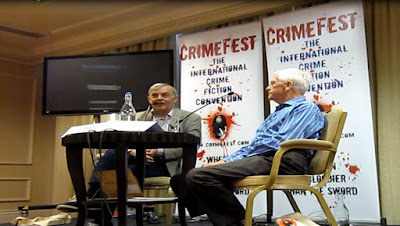
At last year's CrimeFest, I had the easiest and most pleasurable of tasks, that of interviewing Peter Lovesey about his remarkable career, and a week ago, we had the chance to get together again during the CWA's annual conference, and the book-signing that followed it. (Peter is a former CWA Chair, and his continuing commitment to the CWA is something his fellow members greatly appreciate). Right now, he's in the US, and later this week at the Mystery Writers of America Edgars awards ceremony, he will be honoured as an MWA Grand Master.

The array of awards that Peter has received, over an astonishing span of almost half a century, is quite breathtaking. Right from the start, he made an impact on the genre, winning the Macmillan/Panther First Crime Novel prize for his debut Wobble to Death. He won the CWA Gold Dagger for that marvellous mystery The False Inspector Dew, and he's also picked up a couple of CWA Silver Daggers. He won the CWA Diamond Dagger in 2000, And there are many others. Take a look at the long list on his website.

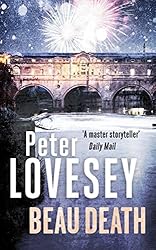
His latest novel, Beau Death, is an excellent illustration of his versatility. There's a freshness of approach in his work, a refusal to be constrained by formula, that keeps his books as engaging today as when he first started writing. The quiet humour of his work is another important ingredient in his novels, and I should also say that he is unquestionably one of the finest short mystery writers to have emerged in the past fifty years. If you'd like to see the videos of my CrimeFest interview with Peter  that Ali Karim kindly allowed me to post on my Youtube channel, take a look here.

But there's much more to Peter Lovesey than wonderful writing. His kindness and modesty are admired by those who know him. You have only to look at the many tributes paid to him by his fellow Detection Club members in Motives for Murder, the short story collection I edited in celebration of his 80th birthday eighteen months ago, to see that. I'm truly delighted that he's agreed to give a talk about his classic and contemporary crime fiction at Alibis in the Archives in June (and there are a few non-residential places still available if you're in the UK then). In the meantime, warmest congratulations on becoming a Grand Master, Peter. You are the worthiest of recipients.

Wednesday, 21 February 2018

Peter Lovesey - Beau Death - book review

Beau Death (Peter Diamond Mystery Book 17)
Peter Lovesey is one of those writers - his friends Reginald Hill and Robert Barnard were among the others - whose crime novels I read and enjoyed long before meeting the author in person. I've followed his career closely for a long time, and although I've not read everything he's written, there aren't many gaps. He's a wonderful entertainer, and it was a pleasure as well as a privilege to interview him about his long career at Crimefest last year.

All this is by way of preamble to the news that he recently published his latest novel, another entry in the very popular Peter Diamond series. It's called Beau Death, and given that the Diamond series is set in Bath, you don't have to be a detective to figure out that the fascinating historical character of Beau Nash plays a significant part in the story, even though it is very much an up-to-the-minute contemporary mystery. There's even a scene set at an infinity pool.

The story opens with a dramatic discovery during the course of a house demolition. A skeleton is found, seated on a chair and in 18th century dress. Peter Diamond finds himself investigating the potentially the coldest of cases, and we learn a great deal about Nash, someone about whom I'd previously known very little. As well as supplying a reminder of the author's fascination with history, it's all very interesting. Of all British crime writers at work at present, I doubt if any supply more background information than Peter Lovesey, with the possible exception of Stephen Booth, and I'm pretty sure that for some of their fans, that is an important part of their books' appeal.

For me, Peter Lovesey's characterisation, humour, and plotting are key, and I'm glad to report that these elements are here in abundance. It's quite a long book, and one of the reasons for this is that the plot is deceptively elaborate, so that one never quite knows what is coming next. I have to admit that I was fooled by the final twist, and not for the first time by this admirable writer. And I should also add that there are plenty of incidental delights, including a witness who has a thing about the Royal Family, and a host of amusing set-pieces.

Monday, 14 November 2016

Motives for Murder

On Thursday evening I had the pleasure of presiding over an unforgettable evening at the Dorchester Hotel. It was the Detection Club's November dinner, which proved to be a sell-out, with a speech from distinguished former crime fiction editor Hilary Hale and the induction of two new members - James Runcie and Mick Herron. Guests included visitors from the US and members of the family of Ronald Knox, one of the Club's founders.

We also celebrated the recent 80th birthday of that wonderful writer Peter Lovesey, who has been a member of the Club for over 40 years. I admired Peter's books long before I met him, more than a quarter of a century ago, and when I suggested to Club members that we celebrate him in a practical way by producing a book in his honour, the response was overwhelmingly positive. And the result has just been published - a book called Motives for Murder.

The UK edition, published by Sphere (front cover above), was presented to Peter by David Shelley, once my own editor (and now J K Rowling's!) and the man who first commissioned my Lake District series. The US edition, published by Crippen and Landru (front cover below), was presented to Peter by Doug Greene whose own contribution to the genre includes a splendid biography of John Dickson Carr.

Len Deighton has written a foreword to the book, and Peter himself has supplied a fascinating afterword, detailing his memories of his early years in the Detection Club. Ann Cleeves, Len Tyler, Kate Charles, Ruth Dudley Edwards, Susan Moody, Andrew Taylor and Liza Cody are among the galaxy of talented writers who have written brand new stories for the book - while Simon Brett contributed a sonnet. An added twist is that the stories (and the sonnet) are connected to Peter's life and work in one way or another. The result is one of the most satisfying anthologies I've been concerned with, and a fitting tribute to one of life's good guys (who treated us on Thursday night to a wonderful rendition of his witty poem about autopsies...) It was a truly memorable occasion.

Wednesday, 7 September 2016

Another One Goes Tonight by Peter Lovesey

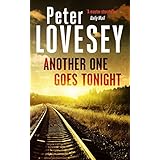
Product DetailsAnother One Goes Tonight, published by Little,Brown, is the latest entry in Peter Lovesey's long-running series featuring Bath cop Peter Diamond. And the first thing to say about it is that it's a hugely enjoyable read with a discursive but ingenious plot, in which a whole bunch of inter-related strands are brought together quite splendidly at the end.  .

The story begins with a brief extract from a mysterious journal which begins "Another one goes tonight." Clearly, we are reading the words of a serial killer, but although this device is familiar enough, it's put to very good use here, as Lovesey shows a Christie-like mastery of the art of misdirection. After this opening, we move swiftly into a strange encounter involving an apparent traffic offence, followed by a police car crash with tragic consequences.

That crash brings Peter Diamond into the story, and when he finds an elderly man on the point of death at the scene, to whom he gives the kiss of life, he is plunged into perhaps the most baffling enquiry of his career - a case whose disparate elements include a group of railway enthusiasts, an imaginary cat, a debt owed to a gangster, and an ever-lengthening list of apparent murders.

This novel is an example of Peter Lovesey at his best, and I recommend it highly. This week, incredibly, he will be celebrating his 80th birthday while on a trip to the US. His friends and colleagues in the Detection Club will also be marking this milestone with the publication in November of Motives for Murder, a gathering of brand new stories with an intro by Len Deighton and an afterword by Peter himself, in which he tells the story of his early days in the Club. The collection will be published in the UK by Little, Brown, and in the US by Crippen & Landru. I like to think that, as with his latest novel, this is a book not to be missed.

Friday, 2 September 2016

Forgotten Book - Murder with Relish

Murder with Relish was the first novel written by C.Lindsay Taylor, and the only one to appear under that name. Constance Lindsay Taylor subsequently adopted the pen-name Guy Cullingford, and earned considerable admiration for a small number of books written with some distinction, the most famous of which by far is Post Mortem, a novel which counts Peter Lovesey (and me) among its numerous admirers.

Murder with Relish appeared in 1948, when its author was already in her mid-forties; she'd started out with journalism and poetry, but marriage and raising a family seems to have kept her fully occupied for some years before she tried her hand at a novel. Alternatively, the fact that the story is set in the mid-Thirties may suggest that she started work on it long before the publication date.

The story concerns a cook, Mrs Bonnet (who has never actually been married; those were the days when it was thought to be courteous to confer honorary marital status on a senior member of domestic staff) who has served the Everard family for many years. Her world is turned upside down when her employer, a widow, dies after a family meal .Mrs Bonnet suspects murder (though nobody else does) and turns detective with a view to achieving justice for her late employer.

This is a witty and unusual story, which affords considerable insight into the class divide in British society at the time. Even though it's a first novel, you can tell that the author is a novelist of genuine talent. I really enjoyed this story, and can recommend it. As for Taylor/Cullingford, she eventually earned election to the Detection Club, and Peter Lovesey recalls appreciating her company at Club dinners. She was born in 1903, and died as recently as 2000. An interesting writer, who deserves to be better known.

Wednesday, 20 July 2016

Motives for Murder - a new Detection Club book


I'm delighted to announce that the Detection Club will publish in November a brand new collection of short stories, Motives for Murder. The idea is to celebrate the 80th birthday this year of one of the Club's most distinguished members, Peter Lovesey. The book will be published in Britain as a paperback original by Little, Brown, Peter's publishers, and in the US (with a limited hardback edition as well) by Crippen & Landru, a small press run by Peter's good friend Doug Greene.

Setting the wheels in motion for this book was my first act as President of the Detection Club. I wanted to honour Peter, who has given so much to the Club over many years (and has, incidentally, been a great source of information about its past) and I also wanted to showcase the short story writing talents of our wonderful members. The Club's membership is relatively small, and the deadline was exceptionally tight, but more than a third of those members offered to contribute to the book, which delighted me. The result is a very substantial anthology indeed;.

The book benefits from a foreword by the legendary Len Deighton. Len has published very little over the past twenty years, so I was thrilled when he agreed to get things rolling, and there is also a fascinating afterword by Peter himself, which includes many stories about his early days in the Detection Club back in the 70s.

Each of the twenty stories (well, nineteen stories and one sonnet!) was written specially for the book, and each is prefaced by a few words from the author about Peter's contribution to the genre. There are some wonderful things in this book, written by leading crime writers such as Ann Cleeves, Andrew Taylor, Len Tyler, Michael Ridpath, Liza Cody and...well, the list goes on. I'm thrlled that we've put together such a special book in  a very short space of time and hope that crime fans everywhere will find something in it to delight and entertain

Monday, 2 November 2015

Down Among the Dead Men by Peter Lovesey - review

The publication of a new book by Peter Lovesey is always a cause for pleasure. I've been a fan of his work since I came across his Victorian mysteries when I was a student, and since then I've followed his career with a mixture of admiration and delight. There are so many highlights in his backlist that it's hard to pick favourites, but mine include the much-lauded The False Inspector Dew, On the Edge, Bertie and the Seven Bodies, and The Secret Hangman. A very varied group  of books, and I haven't even mentioned his brilliant short stories...

The Secret Hangman is an entry in the consistently excellent Peter Diamond series, and so is Peter's latest, Down Among the Dead Men, in which Diamond is reunited with an old acquaintance, Hen Mallin. One of the reasons why this long-running series remains so fresh is that Lovesey is constantly varying his approach. You never quite know what to expect, even though Diamond is a reassuring and likeable presence, and the blend of originality and familiarity works a treat. This is a strong entry in the series.

The first chapter is set seven years in the past. A car thief gets more than he bargained for when he nicks someone's motor, and something unexpected is found in the boot. We move rapidly to the present day, and a group of A Level students are introduced to their new art teacher, whom they instantly fancy. But what happened to his predecessor, who disappeared suddenly and without explanation?

The plot thickens as Diamond and his boss Georgina Dalloway are called in to investigate apparent serious misconduct on the part of a senior officer in another force. The case causes Diamond anguish for more than one reason, and in due course he and Georgina find themselves drawn into the mystery of the missing teacher. What's more, other people have been going missing as well...

Peter Lovesey possesses many talents as a writer, but to my mind one of his great gifts is that freshness of approach. It's easy, when writing traditional fiction, to remain in the comfort zone of formula, but Peter, like his good friends and contemporaries, the much-missed Reg Hill and Bob Barnard, has remained determined to keep trying something a little different, while making sure that his army of fans are supplied with enough ingredients to keep them satisfied, and hungry for his next story, whatever it may be.

Tuesday, 14 October 2014

Guests from Germany


I'm fascinated by the global reach of crime fiction, and in recent years I've found it a real joy to get to know a host of fellow writers and enthusiasts from different parts of the world. It's a little over a year since I took part in the AEIP international crime writers' conference held in Oxford, and I've just received a very pleasing reminder of that terrific event. It takes the form of my copy of a nicely produced German language anthology, Mit Schirm, Charme and Pistole, to which I was invited to contribute after the conference, along with three British writers whom I much admire. My story, "Consuming Passion", was set in Oxford itself, and translated by the editors, Hughes Schlueter and Eva Lirot. They are pictured above, and I invited them to contribute a guest blog about the book. Here it is:


"With Umbrella, Charme and Coke
Sounds odd? Well, it really does. Those of you familiar with classic British shows on telly and their foreign titles might recognize mid sixties “The Avengers” starring Diana Rigg and Patrick Macnee. “Mit Schirm, Charme und Melone”, so the German title, where “Melone” (yep, the fruit) refers to Steed’s bowler hat.

By the slight variant and allusion “Mit Schirm, Chame und Pistole” runs a new anthology of 26 crime short stories, we, Eva Lirot & Hughes Schlueter, had the definite and indefinite pleasure to edit. To capture and to render original soundtrack and flavour, we asked beneath our German colleagues four born and bred brits to contribute: Janet Laurence, Susan Moody, Peter Lovesey and the operator of your favourite blog, Martin Edwards.

In order not to miss anything our fellow countrymen might expect from Albion shores and cockney corners we set up a matrix of topics/settings and writers in which we co-ordinated feathers and ink in order not to have a plethora of witty little old ladies poisoning handsome but not-so-witty marriage impostors and a shortcoming of Cotswolds beauty. Finally we came out with gorgeous and very unhealthy arrangements that we hope will entertain the audience at its best: among others we feature stylish and weird dinners in Oxford, Scottish ghosts, the prime minister’s dog, a guideline to distinguished contract assassination, a fashion shoot, a witty little old lady NOT poisoning her environment, a Victorian Christmas affair, a butler from Ivor Spencer, a Loch Ness mystery and a killer exercising murder with wax figures at London’s Madame Tussauds.

Introduced at Frankfurt bookfair just some hours ago, we have received a very warm welcome and can’t wait to present book and texts in readings. You see, we Germans love British attitude and appreciate your “stiff upper lip” even in case of utmost danger. Like the society lady we met over tea, telling us that she and her husband actually “help police with enquiries” and we instantly took for granted that their cottage has been washed inside out and poor hubby remands in custody.

Like in Last night of the proms, we save the best for last: Patrick Macnee himself has sent his personal greetings to all readers and such a nice photograph of himself to print in the book! We couldn’t get a better foreword."

It's an enterprising project, and there is even a video trailer for the book on Youtube, although so far my attempts to link to it via this post have failed. Worth seeking out, though. When, as a boy, I watched The Avengers avidly during the Sixties, I never imagined that one day I'd contribute to a book inspired by the show. But I'm really glad it's happened - thanks to Hughes, Eva and Ralf of the publishers KBV. 

Saturday, 6 September 2014

The Stone Wife by Peter Lovesey

For many years, I used to look forward to the latest novel by those gifted friends and contemporaries Reginald Hill, Robert Barnard, and Peter Lovesey, always confident that entertainment and interest were guaranteed. They were authors I admired long before I was fortunate enough to get to know them personally. Sadly, Reg and Bob are no longer with us, but Peter's powers are absolutely undimmed, and so it was with much pleasure that I received a copy of his latest book about Peter Diamond, The Stone Wife.

I read it with great pleasure, too, and there are a couple of reasons for that. First, Peter Lovesey is such a smoothly accomplished craftsman that anything he writes is enjoyable. In this respect, he reminds me of another highly skilled writer, the late Michael Gilbert. He also resembles Gilbert in terms of his versatility as a writer and his determination to keep trying something different - even though he writes more series novels than Gilbert did. And this brings me to the second point about Peter Lovesey -he is not content to repeat a formula, and is well aware of the constraints and drawbacks (as well as the various advantages) of using series characters. If you study the Diamond series, you will, I think, be struck by how he has managed to ring the changes and keep his writing fresh.

This is certainly the case with The Stone Wife, which in some respects is rather different from earlier books in the series. The story opens with a raid on an auction, which ends with the fatal shooting of a man who was bidding for the eponymous stone wife - a sculpture with Chaucerian connections. When Diamond investigates, we are treated to a lot of information about Chaucer, and although this is fascinating stuff, some readers may feel there is a little too much of it. But Peter Lovesey is a smart writer, and in fact he smuggles some vital plot information into these passages. I must say that he managed to misdirect me completely, even though I was paying attention.

Two different gangsters play a part in the story, and there's a sub-plot which involves DS Ingeborg Smith going undercover and getting herself kidnapped. This thriller-style material is unusual in a Lovesey novel, and it's a good illustration of his willingness to keep trying something different. Would the police really act in this way? I simply don't know, but this is a writer who is one of the best at making sure his readers suspend their disbelief. One or two aspects of the story are not fully resolved (the fate of the gangster's wife springs to mind) and I wonder if these will be picked up in a future novel, about Diamond, or perhaps focusing on Ingeborg, who is an appealing character. At the end, someone I'd never suspected proves to be the culprit.. When I re-read earlier parts of the book, I realised how carefully Lovesey had set up the finale - and yet, for all the detective novels I've read over the years, I never anticipated what was coming.


Wednesday, 16 April 2014

Guilty Parties


I'm pleased to announce the publication this month by Severn House of the latest anthology of the Crime Writers' Association, Guilty Parties. I've been editing the CWA anthology since the mid-Nineties, and it's always a joy to receive so many original stories. The only downside is that not all of the stories I enjoy can be included, for reasons of space, and that was especially the case this year, when I was flooded with submissions that were very varied and entertaining.

The book contains an intro from me, a short foreword by Alison Joseph, chair of the CWA, and author bios, but the meat, of course, is in the stories themselves. Because several entries were very short, I did manage to find space for more stories than usual - 24 in all. And they are all brand new. My own entry, "A Glimpse of Hell", was inspired by the wonderful time I had last year on the small island of Grand Cayman in the Caribbean. Definitely one of the bonuses from my travels in recent years.

There are some very distinguished names on the contributor list. They include Peter Lovesey, doyen of classic detection, and also his son Phil, who is himself a splendid writer and past winner of the CWA Short Story Dagger. Laura Wilson, Aline Templeton and N.J. Cooper are there, and so too John Harvey -  creator of Charlie Resnick- Christopher Fowler, and Paul Johnston. There are also writers from overseas, including Ragnar Jonasson.

Among the other contributors are Chrissie Poulson (whose thoughtful blog is always worth reading), Frances Brody, Kate Rhodes and Chris Simms. Different readers will have different preferences among the stories, and regular readers of CWA anthologies will note that a number of the contributors, including some relative newcomers to the genre, have never before featured in the anthology. In choosing stories, my criteria include variety, which I do think is an important aspect of a book like this. As far as I'm concerned, it's both a pleasure and a privilege to have had the chance to put Guilty Parties together.

Tuesday, 24 September 2013

Robert Barnard - A Talent to Entertain

The response to my blog post last week-end about the death of Robert Barnard really shows how popular were both the man and his books. I'm not sure how many of you read the comments on blog posts, but among the numerous very welcome comment, I'd particularly like to highlight the little anecdote told by Bob's old friend Peter Lovesey. It really captures the man and his sense of humour perfectly.

The last time I saw Bob, he presented me with copies of his two final books, as well as a very interesting article about his writing. This prompted me to write a piece about him for Mystery Scene, and Bob's fans might like to know that I've now had it uploaded on to my website.

I also thought I'd share a memory of an occasion in Bob's company more than twenty years ago. The Northern Chapter of the CWA agreed that we would produce an anthology of our crime writing (including one or two pieces of true crime) and everybody offered to chip in. It was decided that I would edit the book - a touching demonstration of faith, given that I'd never edited a book in my life at that point.

Several of us gathered, as I remember, at Ann and Tim Cleeves' house in Whitley Bay. Those also present were Bob, Val McDermid and Chaz Brenchley, as I recall. We debated issues like the book's title, and mulled over the choice of artwork offered by the publishers (ah, those were the days!) And I recall Bob entertaining us with a very good story about his late father's battles with the taxman. He was great company, and I think it says a lot that, as a very well established author at that time, he was willing to put in time and effort to a project that was enjoyable but certainly never made us any money. The book that resulted was called Northern Blood, and Bob's contribution was an entertaining story called "A Sure-Fire Speculation". From the first paragraph, which introduces us to a member of the Young Conservatives (not an organisation Bob admired greatly, it's fair to say), you knew that you were in for some fun, and so it proved.

And thanks to the efforts of people like Bob, Val, Ann and Reg Hill, Northern Blood started me off on my strange but very satisfying career as a crime anthologist. Tweny-one anthologies later, I remain grateful to them.

Monday, 13 May 2013

History and Mystery

Last week I rhapsodised over Andrew Taylor's wonderful new novel The Scent of Death, and I'm tempted to place him at the head of the list of my favourite writers of historical mysteries, given that Peter Lovesey, whom I also admire greatly, has been focusing on contemporary crime for quite a few years now. There's no doubt that history-mysteries are hugely popular, and with good reason (and no, I don't mean just because forensics were easier for writers to deal with in the past!)

The History Press, as the name suggests, has a particular niche in this area, although they have sometimes branched out, for instance with the Murder Squad anthology Best Eaten Cold and other stories. They have recently published two books by fellow CWA members whom I've known for a number of years.

Joan Lock was once a police officer, and she is very strong on non-fiction. Her publications include two very interesting books dealing with aspects of the history of Scotland Yard. But Joan has also developed a distinct reputation as a novelist,and The History Press have been reprinting some titles which appeared a few years ago. The latest is Dead Born, which features her character Detective Sergeant Best. The focus of the story is on the grim subject of baby farming, One of the appealing features of this book is that it's short and very crisply written. Well worth a look.

Linda Stratmann is another novelist who first made her name with non-fiction. She wrote a fascinating book about chloroform, and a recent study of the Marquess of Queensbury won rave reviews. When it comes to novels, her series character is Frances Doughty, who makes her third appearance in A Case of Doubtful Death. As with Joan Lock's novel, the setting is Victorian London and the story concerns the death of a doctor and the disappearance of one of his staff. Again, the research that has gone into the story strikes me as dependable, but there is not an excess of it. I'm certainly hoping that The History Press, a small firm that does produce attractive books, will continue to produce entertaining and attractive novels as well as non-fiction.

Wednesday, 24 April 2013

The Tooth Tattoo by Peter Lovesey

The Tooth Tattoo is the latest book set in Bath and featuring the likeable if sometimes curmudgeonly Peter Diamond. The gruff cop shares his first name with his creator, Peter Lovesey., Regular readers of this blog will know how much I relish Peter's books. I first came across them when he was writing about the Victorian cop Sergeant Cribb and I've read every novel he's ever written, as well as the vast majority of his short stories. As well as reading his books, I collect them, and I finally got my hands on a dust jacketed first edition of his debut novel  recently. You could say I'm a fan.

Is his latest, published by Little, Brown up to standard? Absolutely. In fact, one of its strengths is the way you can never be sure where the story is heading. It's a twisty tale, full of unexpected developments. I was also surprised to discover that music is at the heart of the book, as Peter does not normally feature music very heavily in his fiction. But here there is a great deal about classical music and string quartets, and the unusual nature of the relationships between members of a quartet.

The strange deaths of two young Japanese women, one in Vienna, one in Bath, seem to be connected. The corpse found in a Bath canal had a musical note tattooed on one of her teeth. Apparently this is a popular, if to my mind weird, custom in Japan. Diamond's investigations run alongside a series of chapters focusing on a violist called Mel, who may or may not have something to hide.

I really enjoyed this one. Mind you, it was just as well, as I'd already agreed to interview Peter for that terrific US magazine Mystery Scene. As always, he was graciousness itself when answering my questions, and I like to think that there will be some things in the interview that even diehard Lovesey fans won't have come across before. The magazine in question, incidentally, will be in the book bags of all delegates to Bouchercon in the autumn. I would like to be there in New York myself, as Bouchercon is a lot of fun, but at present it doesn't seem likely. Next year, perhaps!

Monday, 16 July 2012

Harry Devlin is back!


I’m truly thrilled to say that my early Harry Devlin books, set in Liverpool, are now enjoying a new life. They are available as ebooks, in new editions with some very special features that I hope readers will find fascinating. For me, it’s all very exciting. And the books are also being made available again, for those who prefer hard copies, in paperback editions.

Andrews UK, who specialise in ebooks and print on demand editions, have now produced six of the eight titles in this way – the whole series, that is, with the exception at present of Eve of Destruction and the much more recent Waterloo Sunset.

The most notable of the special features is that each book benefits from a brand new introduction by a leading crime writer. I’ve been extraordinarily lucky here – this original material, only available in these editions, comes from some of the most gifted and renowned of modern British writers.

CWA Gold Dagger Winner Frances Fyfield introduces my debut novel, All the Lonely People. Frances reviewed my earliest work in legal magazines (she and I, like Harry, are solicitors) and I have long felt an enormous debt of gratitude to her for her encouragement.

The same is true of Val McDermid, the CWA Diamond Dagger winner who has written a new introduction to the second book in the series, Suspicious Minds. Val reviewed one or two of the early Devlins very favourably, and her generous remarks in this new edition made me glow with pride.

I Remember You, the third book in the series, has an introduction from Margaret Murphy – the current joint winner of the CWA Short Story Dagger. Margaret is not only an old friend, but someone who knows Harry Devlin’s Liverpool  better than most.

Yesterday’s Papers, perhaps my favourite Devlin book, has an introduction from another CWA Diamond Dagger winner, Peter Lovesey. Again, Peter is a superstar of the genre who has supported me generously for many years. He and I share an enthusiasm for classic, twisty plots, and it seemed to me appropriate that this particularly elaborate mystery should include an intro from such a master of the genre.

A third CWA Diamond Dagger winner, Andrew Taylor, kindly wrote the introduction to The Devil in Disguise. This was a book I really enjoyed writing, though I remember being mortified when my original publisher didn’t care for it. As a result, I moved to Hodder, with increased sales as a result. Andrew was a Hodder author too, and we launched this book, and one of his Lydmouth titles, at the same enjoyable event in the late lamented Mysterious Press bookshop in London.

Finally, there is First Cut is the Deepest, with an introduction from Kate Ellis, twice shortlisted for the CWA Short Story Dagger.  This was the last Devlin story I wrote before taking a ten-year break, and it is also the longest and perhaps the most complex entry in the series. Kate, like Margaret, is a Liverpudlian with a deep love for Harry’s home city.

For each book, I have written a detailed new “Making of” feature, along the lines that you find in DVDs. There is also a biographical note, and an appreciation of my work which has most generously been contributed by former CWA Chair, Michael Jecks.

Each book includes a “preview chapter” for the next book in the sequence, a device that I hope will encourage people who dip into the series for the first time to return to it.

As we all know, the world of publishing is changing rapidly. With all change, there are advantages and drawbacks. But I am very optimistic that for writers like myself, who do not have massive publicity teams or budgets at their disposal, that digital publishing will help to make the books available to a new and wider readership. We shall see. One thing is for sure: it’s enormously gratifying to see these early books given a fresh life.

I can’t close this post without expressing my profound gratitude to Frances, Val, Margaret, Peter, Andrew, Kate and Michael, all of whom offered their contributions without the slightest degree of arm-twisting! (The same is true of CWA Gold Dagger winner Ann Cleeves, whose introduction to Eve of Destruction is at present unfortunately unavailable because of the frustrating and unhelpful attitude of the rights owner.) Generous people, as well as terrific writers, and I am proud to call them friends.


Wednesday, 16 May 2012

Cop to Corpse by Peter Lovesey


What is the biggest writing challenge facing an established crime writer? (There are various challenges not directly linked to writing, such as the state of the market, relationships with publishers and so on, but that’s a topic for another day.) My answer to the question I’ve posed is this: the challenge of ensuring that one’s work remains fresh and varied, and that the dictates of formula don’t have a deadening effect.

It’s perhaps a challenge that is faced most acutely by established and highly successful authors. They have succeeded by writing a particular kind of story, so there is a temptation to keep writing it. The temptation is all the greater when a series enjoys commercial success. Those novelists whom I admire most are those who have the courage to keep trying something new, even within the apparent strait-jacket of a series with continuing characters.

Peter Lovesey is one writer who rises to the challenge time and again. I’m tempted to say he does so effortlessly, but I’m sure that the smooth readability of his books (like those of another superb entertainer, the late Michael Gilbert whose work I also enjoy enormously) disguises a great deal of effort and hard work.

His latest novel, Cop to Corpse, is an excellent example of his ability to ring the changes. This is another in his long-running series featuring Peter Diamond, the Bath-based cop, but it is rather darker in tone than many of the earlier books in the series, even though police office politics does provide some light relief. The structure is unusual.  The first couple of chapters are told in the present tense, and the main narrative is interspersed with lengthy blog posts written by a youngish woman.

The plot, which involves the killing of three policemen, and an attack on a fourth (plus an attack on Diamond) is extremely elaborate. As a result, the book is longer than some of Lovesey’s earlier books, but the quality of writing remains high. The story may be unorthodox, but it is certainly entertaining, and proof – were it needed – that one of Britain’s most distinguished mystery novelists is still as good at keeping us guessing as ever. Long may he continue to entertain his many fans.


(Please note, the comments contain a spoiler about the previous book in the series.)