Showing posts with label Robert Barnard. Show all posts

Friday, 24 February 2023

Forgotten Book - To Die Like a Gentleman


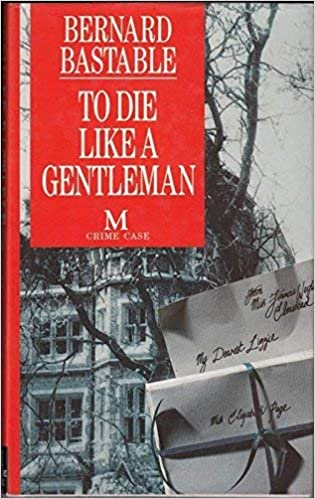
When Robert Barnard published To Die Like Gentleman in 1993, he did so under the pen-name Bernard Bastable, and so he inscribed a copy to me: 'The start of a new life!' He'd moved to a different publisher (Macmillan) for this one, and he'd also moved into the early Victorian era - the events of the story take place in 1842. So he was seeking to differentiate this book from his other work, although naturally it displays his trademark wit and crisp, economical characterisation. There's even a good joke involving Charlotte Bronte - and Bob was a lifelong devotee of the Brontes.

In fact, his new life as Bastable wasn't particularly extensive. As far as I know this book never made it into paperback.The next Bastable title was published by Little, Brown and featured Mozart as a detective, and although there was a follow-up Mozart title, the books didn't make a huge impression. The fourth Bastable, A Mansion and its Murders, was another historical mystery, at first published only in the US. I believe it was turned down by Little, Brown. Some years later, when Bob had moved to Allison & Busby, they published the book, but I think by then that he'd become frustrated - understandably - at the relative lack of interest in the Bastable titles. This just goes to show that even a leading writer can find the going tough at times.

I enjoyed reading To Die Like a Gentleman the first time around and did so again on a second reading, having forgotten the story completely after a thirty year gap. Bob may have been trying to emulate Julian Symons' Victorian mysteries and he adopts the epistolary style, with letters and documents supplementing a multiple-viewpoint narrative. A homage to Wilkie Collins was perhaps in his mind, though this book is a fraction of the length of The Moonstone and The Woman in White.

This is a readable and entertaining piece of fiction. So why didn't it make an impact? I think there are two connected reasons. First, like all Bob's novels, it's short (very short, in fact) and snappy, but although the characters and situations are interesting, the mystery element is relatively thin. Bob didn't like to over-complicate his books - 'second murders are always vulgar', he liked to say, not that I agree! - and so he didn't manage to match Agatha Christie, whom he admired so much, in terms of ingenuity, even though clever ideas abound in his work. And second, in this book, the ending is far too abrupt - almost as if he'd passed a deadline and needed to wrap everything up sharpish. This doesn't do justice to the leisurely build-up. But his books are fun and I was glad to read this one again. 


Monday, 28 February 2022

Back to Boroughbridge


On Saturday I made a nostalgic pilgrimage to Boroughbridge. The Crown Hotel in the centre of the town was the precise destination. Matthew Booth, convenor of the northern chapter of the CWA had taken the very good decision to hold a lunch for members at the venue of the very first meeting of the northern chapter, way back in 1987. There have been many enjoyable lunches at the Crown since then, but it was my first visit for about five years.

That inaugural lunch meeting of 1987 was truly memorable as far as I was concerned. It was the first time I'd attended a social event with crime writers. I'd only recently joined the CWA, on the strength of my reviews and writing about the genre, and at the time I was working on my first novel. The chapter was the brainchild of Peter N. Walker, a former policeman who would later become famous as the creator of the stories which formed the basis of TV's Heartbeat.  

That day, I met Peter and his wife Rhoda, Reginald and Pat Hill, Robert and Louise Barnard, and Peter and Margaret Lewis. They were very welcoming to me and my fiancee and they all become much-loved friends. Never in my wildest dreams, though, did I anticipate the good fortune that lay ahead for me in connection with the CWA.

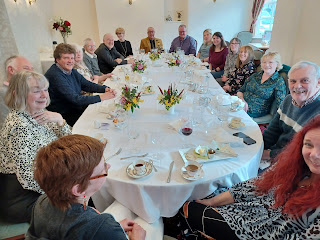
Thirty-five years is a long time and Mrs Edwards and I were the only people at Saturday's lunch who were there at the first meeting, but I must say that the current members are equally convivial and it was great to catch up with old friends again. Kate Ellis had proposed that some of us make a weekend of it and this proved a great success - we all had a lovely evening in the company of Peter's successor as convenor, Roger Forsdyke and his wife Penny, staying at a nearby gastro-pub. The gorgeous weather made the whole weekend memorable in its own right and it was good to explore parts of the area I've never seen before, including the mysterious Devil's Arrows - neolithic monuments in fields quite close to the main road. Interesting. It was so good to be back!


Friday, 14 January 2022

Forgotten Book - The Man with the Cane


The late Robert Barnard was a discerning reader of crime fiction as well as an entertaining novelist, and he was a fan of the American writer Jean Potts; it's thanks to his influence that I've become a fan of hers too. I have a couple of Penguin paperback editions of her books that used to belong to him. One of them is The Man with the Cane, which dates from 1957, illustrates her considerable strengths as well as one or two of her limitations. 

Potts was a low-key writer whose particular specialism was the study of domestic relationships. In this novel, the main protagonist is Val Bryant, a likeable ordinary guy. He is divorced from the high-achieving Doris, who has married a successful businessman called Monroe, and finds himself attracted to Barbara, who is herself recently divorced from Doris's brother Clyde. Val remains on good terms with Doris's mother Maudie and is also friendly with a neighbour, Helen, who is always known as Hen. Val and Doris had a young daughter, Annabelle, and when Val is reunited with the little girl after a long time apart, she tells him some tall stories, including one about a man she calls Cane.

These are the players in a tightly-knit drama. The plot thickens when Val and Hen discover the body of a man with a cane. He has been murdered and it soon becomes clear to Val that someone in his circle is responsible for the crime. I was pretty sure from early on who that someone would be, but the precise motive (one I found interesting) came as a surprise.

The strengths I mentioned include a sharp yet compassionate eye for character. Her insights into psychology are convincing, and in this book she makes subtle use of the hackneyed trope of poison pen letters. As for the limitations, I have a quibble about the regular shifts of viewpoint in this novel, which seem to me to reduce rather than to increase suspense. On the whole I think it's fair to say that Potts isn't the most exciting of writers. This is a good story, and not excessively long, but even so it does drag in the middle, with a good deal of time devoted to family squabbles that didn't set my pulse racing. Potts is sometimes compared to Margaret Millar and Helen McCloy, but I think they manage dramatic action more effectively than her. But if you're looking for a well-made, thoughtful mystery with a sound portrayal of human nature, you won't go far wrong with Jean Potts.   

Monday, 10 August 2020

Vintage Crime


Vintage Crime: from the Crime Writers' Association (Fiction Without Frontiers) by [Crime Writers' Association, Martin Edwards]

Vintage Crime is published tomorrow. It's my latest anthology to be edited on behalf of the Crime Writers' Association, and it differs from its predecessors in a couple of respects. First, we have a new publisher, Flame Tree Press, with whom I've worked in the past. They are lovely people to work with, and the care they devote to their publications is admirable. The production values on Vintage Crime are terrific.

Second, this is not a collection of newly written stories, but rather a book that is designed to showcase the evolution of the crime short story throughout the existence of the CWA. The CWA was founded back in 1953, and its first anthology appeared in 1956. Since then the CWA has been a major supporter of crime short stories, and many award-winning stories made their first appearance in a CWA collection.

In essence, I've mined the CWA archives to put together a book of stories which have appeared in previous CWA anthologies but which seem to me to deserve a new life. I've chosen stories dating back to the 1950s, written by a range of writers whose names are mostly well-known, including the brilliant Mick Herron and the equally gifted Andrew Taylor, two of the finest authors working in the genre today.

There are some terrific names here, including Robert Barnard (whose "Sins of Scarlet" won a Dagger), Frances Fyfield, Celia Fremlin, Peter Lovesey, Liza Cody - and John Dickson Carr. Yes, the king of the locked room mystery was a CWA member. The contributors have, between them, won enough awards to fill a locked room, and I'm hopeful that many readers will enjoy devouring these mysteries from the (sometimes quite recent) past.

Wednesday, 29 July 2020

The Finisher by Peter Lovesey - review


The Finisher (Peter Diamond Mystery) by [Peter Lovesey]

The Finisher is not merely the 19th novel in Peter Lovesey's highly successful series about Bath cop Peter Diamond. Its appearance marks the 50th anniversary of the publication of Peter's award-winning debut novel Wobble to Death. And very cleverly, Peter has returned to a key theme from that first novel and given it a fresh spin. The 'wobble' was a Victorian race, and The Finisher deals with present day half-marathon running. It's a great way to celebrate a literary career of sustained achievement.

The storyline is constructed with such cunning that I don't want to say too much about it, for fear of giving too much away. I was hooked right from the first two sentences: "The city of Bath isn't all about Roman plumbing and Georgian architecture. It offers unrivalled facilities for getting rid of unwanted corpses."

We're promptly introduced to a ruthless killer known as the Finisher (and "finishing" is a concept used astutely throughout the story) but then events move forward in quite a discursive way, as Lovesey constantly teases us with different possibilities about what might happen next. Not just who is the killer, but who might be killed. I have a particular, if inexplicable, enthusiasm for crime novels with underground scenes, and there is plenty in this book to satisfy that taste - there's even a "tunnel of death". There's much else to enjoy, including a good deal of humour, with a lovely, sly P.G. Wodehouse joke.

This is a story firmly set in the present day (or at least the immediate pre-pandemic present day!) but Peter Lovesey's storytelling skills, and certainly his gift for constructing a fair play puzzle, match those of the finest exponents of Golden Age fiction. As a bonus, there is a delightful map in the classic tradition. Even though I've followed Peter's career closely since my student days, I found the afterword, "Running into Writing", informative and enlightening. I won't pretend that I share Peter's enthusiasm for running, any more than I shared Dick Francis's devotion to horse racing. The gift of both men is an ability to write about their passions in a way that attracts even sceptics like me.

I often think of Peter in connection with two writers born in the same year, Reginald Hill and Robert Barnard. Three delightful men, three outstanding crime novelists (and equally accomplished writers of short stories and non-fiction). Three superb entertainers, in short. Now, alas, there aren't any new novels by Reg or Bob to look forward to, so there is all the more reason to appreciate the consistent excellence of Peter Lovesey's work. He is more than entitled to rest on his laurels after such a career but I find it thrilling that he continues to write so inventively and with such panache. Long may he continue to do so.


Monday, 11 March 2019

Elizabeth Gaskell and Elizabeth Gaskell's House in Manchester


Image result for gaskell house manchester

The Victorian novelist, biographer (of Charlotte Bronte) and short story writer Elizabeth Gaskell has fascinated me for many years. The original connection arose through her association with Knutsford in Cheshire, which was the setting for her marvellous novel Cranford; and I was born in Cranford Lodge in the town. In the 1990s, I organised a northern crime writers' week-end in the town. The likes of Reginald Hill, Caroline (Midsomer Murders) Graham and Robert Barnard came along, and a talk by a Gaskell expert was one of the highlights. And later, I wrote a story in which Elizabeth does a bit of detective work.

Now I've been commissioned to write a short story for an interesting-sounding anthology, of which more another day, and I've taken the opportunity to write about a different aspect of Elizabeth's life. This story is set in 1839, when she was living in Manchester - her husband was a Unitarian minister in the city.

As part of my research, yesterday I paid a visit to Elizabeth Gaskell's House in Plymouth Grove, Manchester, where she and her family lived from 1850 onwards. The house has been lovingly and rather splendidly restored in recent years. At one point it was at risk from the developers, but it offers an important insight into our literary heritage, and I'm so glad that it's been preserved.

Walking round the rooms, I did my best to try to soak myself in the experience of the Gaskells' lives. This task was made easier because Elizabeth was such a down-to-earth, engaging woman. I can imagine that she was very popular, and her circle included not only Dickens, Bronte, and Ruskin but also Halle, founder of the orchestra. Even though she was not living in the house at the time of my story, I was able to pick up some valuable information about her lifestyle which I hope will give my short story a touch of authenticity. We'll see...

Friday, 22 June 2018

Forgotten Book - Go, Lovely Rose

The late Robert Barnard was a great admirer of Jean Potts' novels. As well as being a novelist of renown, Bob was a savvy critic; over the years, he recommended quite a few writers to me, and I don't think any of them have ever disappointed. But it's taken me a long time to get round to reading Jean Potts. When I did, I decided to start with her debut novel, Go, Lovely Rose.

The novel was first published in 1954, but it's a very mature piece of writing for a beginner; no doubt this is due to the fact that Potts had served a literary apprenticeship as a writer of short stories before trying her hand at a full-length story. It proved to be a good move: Go, Lovely Rose won an Edgar Allan Poe award from the Mystery Writers of America.

Rachel Buckmaster returns to the small town of Coreyville, where she and her brother Hartley grew up, following the death of Rose Henshaw. Rose had been living in Rachel's family home, thanks to a mystifying provision in the will of Rachel's late father. Mystifying because Rose was a nasty piece of work. Rachel had been glad to escape her influence, and she fears that Rose's spiteful nature may have driven Hartley to pushing the old woman down the cellar stairs. For Rose's death means that the siblings can now cash in by selling the house.

Soon it becomes apparent that Hartley was not the only person with good cause to wish Rose ill. Rachel finds herself caught up in a teasing mystery, and Potts builds the suspense with an expertise remarkable in a first time novelist. When she died in 1999, Ed Hoch (who was, like Bob Barnard, a very perceptive judge of these things) praised her gifts of characterisation, and her ability to evoke authentic small-town middle-America settings. These qualities are on display in her impressive debut novel. I'm not sure if she ever surpassed it in her later work, but I have more of her books, and I enjoyed this one enough to be determined to give them a try.


Monday, 20 June 2016

Robert Barnard is Back


Less than three years after we lost that fine crime writer Robert Barnard, it's good to see that Bello are making a bit of a splash with his extensive backlist. In particular, they have reissued two of this books in attractive paperback editions, which have some of the nostalgic feel associated with the cover artwork of the British Library's Crime Classics series.

There's no doubt that the success of the British Library series has been enormously influential -it's the reason why you will again see plenty of crime books with seasonal covers this year, as you did last, and why so many traditional mysteries are now being reissued with lovely covers that cater for a touch of nostalgia among readers.

Bob was a witty exponent of the traditional mystery, and had strong views about it. "Second murders are always vulgar", he once said, with tongue perhaps slightly in cheek. He deplored formulaic writing, and although he did have series characters, such as Perry Trethowan and Charlie Peace, they were not as memorable as, say, Dalziel and Pascoe, but really represented a convenient way of tackling the business of solving a  murder puzzle.

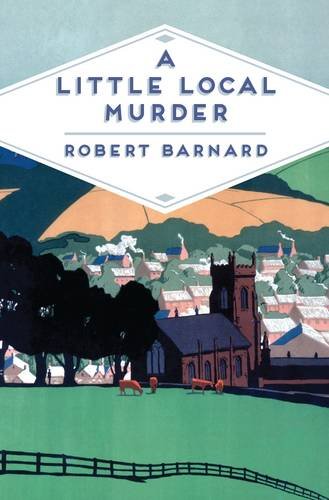
A Little Local Murder, one of the two new paperbacks, is characteristically clever, not least because Bob toys with his reader's expectations. It seems to be predictable who will be murdered - but he turns the tables on us very neatly. This is a village mystery somewhat in the Christie vein (and Bob was a great admirer of Christie; I heard him give two excellent talks about her, and his book A Talent to Deceive remains an excellent study of her work) but with a character of its own.

I'm sure that Bob, mischievous as he was, would be greatly amused to see that The Case of the Missing Bronte is also being highlighted in the new edition. He once told me it was his worst book, and then relented slightly when inscribing a copy to me - describing it as "my second worst book". He was a harsh judge of his own work, but I must admit it's not one of his best. This is so despite the fact that he was a great expert on the Brontes, and once led a fascinating tour for fellow crime writers around Haworth Parsonage: a memorable afternoon indeed. So which Barnard title is my favourite? I'd probably plump for A Scandal in Belgravia.

Saturday, 6 September 2014

The Stone Wife by Peter Lovesey

For many years, I used to look forward to the latest novel by those gifted friends and contemporaries Reginald Hill, Robert Barnard, and Peter Lovesey, always confident that entertainment and interest were guaranteed. They were authors I admired long before I was fortunate enough to get to know them personally. Sadly, Reg and Bob are no longer with us, but Peter's powers are absolutely undimmed, and so it was with much pleasure that I received a copy of his latest book about Peter Diamond, The Stone Wife.

I read it with great pleasure, too, and there are a couple of reasons for that. First, Peter Lovesey is such a smoothly accomplished craftsman that anything he writes is enjoyable. In this respect, he reminds me of another highly skilled writer, the late Michael Gilbert. He also resembles Gilbert in terms of his versatility as a writer and his determination to keep trying something different - even though he writes more series novels than Gilbert did. And this brings me to the second point about Peter Lovesey -he is not content to repeat a formula, and is well aware of the constraints and drawbacks (as well as the various advantages) of using series characters. If you study the Diamond series, you will, I think, be struck by how he has managed to ring the changes and keep his writing fresh.

This is certainly the case with The Stone Wife, which in some respects is rather different from earlier books in the series. The story opens with a raid on an auction, which ends with the fatal shooting of a man who was bidding for the eponymous stone wife - a sculpture with Chaucerian connections. When Diamond investigates, we are treated to a lot of information about Chaucer, and although this is fascinating stuff, some readers may feel there is a little too much of it. But Peter Lovesey is a smart writer, and in fact he smuggles some vital plot information into these passages. I must say that he managed to misdirect me completely, even though I was paying attention.

Two different gangsters play a part in the story, and there's a sub-plot which involves DS Ingeborg Smith going undercover and getting herself kidnapped. This thriller-style material is unusual in a Lovesey novel, and it's a good illustration of his willingness to keep trying something different. Would the police really act in this way? I simply don't know, but this is a writer who is one of the best at making sure his readers suspend their disbelief. One or two aspects of the story are not fully resolved (the fate of the gangster's wife springs to mind) and I wonder if these will be picked up in a future novel, about Diamond, or perhaps focusing on Ingeborg, who is an appealing character. At the end, someone I'd never suspected proves to be the culprit.. When I re-read earlier parts of the book, I realised how carefully Lovesey had set up the finale - and yet, for all the detective novels I've read over the years, I never anticipated what was coming.


Friday, 21 March 2014

Forgotten Books - Dover and the Unkindest Cut of All

One of the late Robert Barnard's favourite humorous crime novels was Joyce Porter's Dover and the Unkindest Cut of All. I read the Bello ebook edition on holiday recently, and it's my choice for today's Forgotten Book. This was her third book featuring DCI Wilfred Dover of Scotland Yard, and was first published in 1967. I really enjoyed it, and felt it lived up to Bob's praise.

I first encountered the character of Dover, improbably, on television. In the Sixties, the BBC had a show called Detective, which I came across as a teenager some years after it began. The series introduced me to some fascinating detectives and writers, and it's a matter for great regret that there are no DVD versions available. In fact, I gather that many of the original shows have been wiped, although one hopes that bootleg copies may exist somewhere, and will eventually resurface. Even if the production values would now seem dated, this was a series of real quality.

The point about Dover is that he is an anti-hero, fat, lazy and rude. The story opens when he and his long-suffering wife are on their way for a seaside holiday.a trip interrupted when someone commits suicide in front of their eyes, throwing himself into the sea. The dead man proves to be a young police officer, Dover is, much to his disgust, dragged into the inquiry into what caused the young chap to kill himself.

Comic crime is very difficult to write. It's much easier to make a mess of it than a success. And because humour is subjective, it's extremely difficult to write a comic mystery that will have widespread appeal. Yet after nearly half a century, this story struck me as entertaining and genuinely funny. A quick, easy read, with plenty of enjoyable scenes. I don't know much about Joyce Porter (though I do know she came from Marple in Cheshire, a nice place where contemporary crime writers Chris Simms and Michael Walters live) but at her best, she was a fun writer, and though I don't know of anyone who knew her personally, I suspect she was a fun person as well.

Monday, 3 March 2014

Death in a Cold Climate


I returned last week from a short but amazing trip to the Arctic Circle, of all places, and have now just about thawed out enough to blog about it. The plan was to fly to Tromso in northern Norway, and then take a short cruise on a ship delightfully called the Trollfjord in search of the often elusive Northern Lights and the special character of places like the North Cape.

All I really knew about Tromso before I arrived was that it is home to a major university at which my much-missed friend Bob Barnard was professor of English literature for a number of years. Bob wrote a book set in Tromso, and I dug out the paperback copy of Death in a Cold Climate that he inscribed for me a good many years ago, and re-read it. With great enjoyment, I may add. It's a crisp story, told with the economy of style that I discussed here a couple of weeks ago. The plot, concerning Inspector Fagermo's hunt for the killer of a mysterious young Englishman, is quite different from Nordic noir, but there are a number of scenes, notably the final one, that pack a punch. Bob hit on a very clever way of concealing the culprit. And there is plenty of that trademark Barnard humour, especially in his portrayal of a disreputable English professor...


As for Tromso, it was bathed in sunshine when the plane touched down. The city occupies an island, and I found the landscape quite magical. A windy walk on a long bridge took me to the modern and architecturally dramatic Arctic Cathedral, which is mentioned in Bob's book, and then to the cable car which reaches up to the top of the snowy mountain overlooking the city. Standing outside at the top in a gale did take some doing (but was preferable to the alternative of plunging a few hundred feet) but was made worthwhile by some stunning vistas.


It's more than twenty years since I was last in Norway, and then I kept to the south, places like Bergen, Oslo and some of the fjords. But I was impressed with Tromso and could see why Bob and Louise enjoyed their time there. The atmosphere of the frozen North is quite inspirational, and although unlike Bob I won't be writing a Norwegian novel, I did come up with an idea for a short story influenced by something I came across during my visit to the "gateway to the Arctic". Just need to find time to write it...

Tuesday, 24 September 2013

Robert Barnard - A Talent to Entertain

The response to my blog post last week-end about the death of Robert Barnard really shows how popular were both the man and his books. I'm not sure how many of you read the comments on blog posts, but among the numerous very welcome comment, I'd particularly like to highlight the little anecdote told by Bob's old friend Peter Lovesey. It really captures the man and his sense of humour perfectly.

The last time I saw Bob, he presented me with copies of his two final books, as well as a very interesting article about his writing. This prompted me to write a piece about him for Mystery Scene, and Bob's fans might like to know that I've now had it uploaded on to my website.

I also thought I'd share a memory of an occasion in Bob's company more than twenty years ago. The Northern Chapter of the CWA agreed that we would produce an anthology of our crime writing (including one or two pieces of true crime) and everybody offered to chip in. It was decided that I would edit the book - a touching demonstration of faith, given that I'd never edited a book in my life at that point.

Several of us gathered, as I remember, at Ann and Tim Cleeves' house in Whitley Bay. Those also present were Bob, Val McDermid and Chaz Brenchley, as I recall. We debated issues like the book's title, and mulled over the choice of artwork offered by the publishers (ah, those were the days!) And I recall Bob entertaining us with a very good story about his late father's battles with the taxman. He was great company, and I think it says a lot that, as a very well established author at that time, he was willing to put in time and effort to a project that was enjoyable but certainly never made us any money. The book that resulted was called Northern Blood, and Bob's contribution was an entertaining story called "A Sure-Fire Speculation". From the first paragraph, which introduces us to a member of the Young Conservatives (not an organisation Bob admired greatly, it's fair to say), you knew that you were in for some fun, and so it proved.

And thanks to the efforts of people like Bob, Val, Ann and Reg Hill, Northern Blood started me off on my strange but very satisfying career as a crime anthologist. Tweny-one anthologies later, I remain grateful to them.

Saturday, 21 September 2013

Robert Barnard R.I.P.

I am very sorry to break the news that Robert Barnard, one of the most notable British detective novelists of the past forty years, has died at the age of 76. He was a winner of numerous awards, most notably the CWA Cartier Diamond Dagger, in recognition of the sustained excellence of his crime writing. He was a distinguished academic, a former worker for the Fabian Society, an expert on the Bronte family and their writings, a passionate opera fan, and the author of a definitive study of Agatha Christie's crime writing, A Talent to Deceive.

Bob Barnard was also one of the first friends I made in the crime writing world. When I attended the inaugural meeting of the northern chapter of the Crime Writers' Association, I was an unknown, whereas people like Bob, Reg Hill and Peter Walker were very well established authors. But from our very first lunch together, those three men (and their lovely wives, Louise, Pat and Rhoda) made me feel welcome and part of the crime writing fraternity. They became good friends, and I owe them a great deal.

I've written about Bob's work on a number of occasions (for instance, I wrote an article about him for that fine American magazine Mystery Scene - his books were enormously popular in the US), but in this short post I'd like to focus on Bob the man - and above all his sharp and mischievous sense of humour. His wit was as evident in his writing as in his conversation, and he was unfailingly entertaining company. A good many years ago (in the mid-nineties, as I recall) someone suggested he had died, a story which he found highly amusing, as he was in perfectly good health. How this bizarre mistake arose, I simply don't know.

I also found Bob personally very generous. It was typical of him that he took me as his guest to a Detection Club dinner at the Savoy nearly twenty years ago, a memorable occasion at a time when I never dreamed that one day I'd become a member of the same Club. He did me this kindness simply because he knew how much I would love the occasion. I will never forget it.

In fact, one of the last times I saw him was at the Detection Club's annual dinner in the Temple. By this time, he was becoming troubled by memory problems. For an intellectual whose memory had always been fantastic, this was a dreadful blow,and he felt unable to continue with his public speaking, something in which he excelled. I went to visit him and Louise at their home in Leeds last year, and we had a pleasant time together, but his health began to deteriorate, and this year the decline had been steep.  For Louise, who has coped with great courage during the past difficult months, the loss is profound.

As I write these words, I feel very sad indeed that he and I will not be teasing each other again -our views diverged on a handful of issues (not least pop music!), but this never mattered a bit, as it never should in any genuine friendship; in fact, I tend to think that friendships are often all the stronger when they are between people with contrasting outlooks and personalities. Mind you, amongst many other things, we shared a great admiration for Christie, and I heard him speak with considerable insight about her work at crime conferences on a couple of occasions. I also recall a fascinating tour of the Bronte House in Haworth, led by Bob during a CWA annual conference. Above all, it was a great privilege as well as a pleasure to have known Bob, and to have been lucky enough to enjoy his company on countless occasions. He has left me many memories to treasure, and I'm sure the same is true of his many other friends.

I thought I'd illustrate this blog post with a photo that reminds me of a happy occasion we shared. It was taken at the 20th anniversary lunch of the Northern Chapter. It shows Bob in conversation with Meg Elizabeth Atkins, another friend who attended that inaugual lunch, and who also died recently, and Kate Ellis's husband Roger. Both Meg and Bob were in great form that Sunday. In fact,whenever I met either of them over the past quarter of a century, they seemed to be in great form. Bob, like Meg, will be very much missed.


Friday, 12 April 2013

Forgotten Book - Still Dead

Still Dead, by Ronald Knox, was published in 1934 and features Knox's regular sleuth, the insurance investigator Miles Bredon. The setting is Scotland, and the mystery is one of those vanishing-body puzzles. Colin Reiver's corpse was spotted, apparently, on a Monday, but then disappeared before turning up on the Wednesday. He seemed to have died of exposure - but had he been murdered, and if so, when and by whom?

The set-up is very good, and the unravelling of it so complicated that many readers will be glad of the footnotes Knox helpfully supplies to point out where relevant clues appeared earlier in the text. I did, however, feel that here -as in an earlier Knox book, The Footsteps at the Lock - my interest faltered because of the lack of sufficient incident after the initial flurry of activity. My old friend Robert Barnard often used to say that second murders in books are "vulgar", but a further killing here would, quite frankly,have livened up the second half of the story.

Colin is not someone for whom we feel much sympathy. He has killed a child in a road accident, although the criminal justice system didn't pin the blame on him. To get away from it all, he is sent by his family on a cruise to Madeira and the Med, but his death occurs as soon as he returns to the family estate in Scotland.

Although I was not greatly enamoured of the plot, I enjoyed some of Knox's little touches, touches which suggested to me that, had he taken the detective genre as seriously as, say, Dorothy L. Sayers, he could have made a more notable contribution to it as a novelist. In fact, he is now better remembered for a few good short stories, and his 'Decalogue', a tongue-in-cheek set of rules for writing detective fiction. But there are moments of genuine passion here, notably in his scathing words about a doctor who is a eugenicist - and eugenics were popular with many people until the horrors of their practical application in Nazi Germany became apparent. I could have done with more of this real feeling in the book, and a bit less of the almost interminable debate about what had actually happened to Colin's body. Not a masterpiece, then, but one with a number of points of genuine distinction which make Still Dead still worth reading.

Friday, 15 March 2013

Forgotten Book - Murder at Cambridge

Murder at the 'Varsity, written by Q. Patrick, and first published in 1933, is also known as Murder at Cambridge. And it has recently been republished under that latter title by that splendid small press, Ostara, in its attractively produced Cambridge Crime series. It's a very welcome reissue, but the fact that the story is set in Cambridge, England, might raise an eyebrow. For was not Q. Patrick (later, Patrick Quentin) an American writer?

The answer is no, not in this particular case. The Patrick/Quentin names concealed, over the years, the identities of no fewer than four different writers, two men and two women. As I understand it, this particular book is the only one that was written by Richard Webb alone. And Webb was an Englishman, and was an undergraduate at Cambridge before moving to the US. It is clear from reading the book that he had a close understanding of Cambridge university life - there is a whiff of authenticity that does not suggest research from a distance.

The story is a pretty good one, too. The narrator, Hilary Fenton, is a native of Philadelphia (where Webb worked after emigrating) and a fellow student who is murdered comes from South Africa (where Webb had worked before moving to the US.) Fenton's attempts to get involved in the sleuthing are compromised by the fact that he has fallen in love with a pretty student who was lurking around the murder scene. Rather foolishly, he does not tell the police all he knows about the victim, and complications ensue.

I thought I'd solved the puzzle, but no - the author had a neat twist up his sleeve. The culprit was genuinely unexpected, and overall I thought Webb got away rather well with some rather unlikely plot manoeuvres. He was a clever writer, as was the better known Hugh Wheeler,with whom he soon began to collaborate. This solo effort does, however, show that Webb was an accomplished detective novelist in his own right. This is an entertaining Golden Age story, on a par with the better known books set in Oxford during the same era.


Monday, 8 October 2012

CWA Northern Chapter - Silver Jubilee Week-end


I had a memorable week-end attending the Silver Jubilee celebration of the Northern Chapter of the Crime Writers' Association in Pickering, North Yorkshire. Our convenor, recently retired former DI Roger Forsdyke, didn't allow a torn achilles tendon to interrupt his arrangements for what began as a celebratory lunch and turned into a rather longer and thoroughly enjoyable celebration that was blessed with excellent weather.


I attended the first meeting of the Northern Chapter back in 1987 - along with my then fiancee, now my long-suffering wife. That meeting was set up by our first convenor, another ex-cop, Peter Walker, who is most famous as author of the books on which the enormously successful TV series Heartbeat was based. And it was great to see Peter, along with his wife Rhoda, this week-end. The idea that partners of writers should be made welcome was Peter's original concept, and a very good one too. It has helped to enhance the social aspect of the Chapter, and has generated many long-lasting friendships.

Peter and Margaret Lewis, two authors and also publishers, were also at that first meeting and not only did they become great friends, a few years ago they actually published one of my books - Dancing for the Hangman. Meg Elizabeth Atkins and her husband Percy Moss were also founder members of the chapter, and it was lovely to see Peter, Margaret, Meg and Percy once again. Sadly, Robert and Louise Barnard, whom again I met that first time 25 years ago were unable to attend due to Bob's poor health, but Bob did write to Roger.to wish all his friends well - sentiments that were very warmly reciprocated. We also remembered the great Reginald Hill, who with his wife Pat was another founder member.


A highlight of the week-end (in addition to the excellent hospitality of the White Swan Inn) was a superb talk about an extraordinary double murder case by Detective Superintendent Steve Smith from North Yorkshire Police, who is pictured at the top of this post along with Roger. Special thanks to Roger and his wife Penny, as well as their son Toby, another police officer, for arranging such a tremendously enjoyable event. Amongst many others, it was great to catch up with Stuart Pawson, Lesley Horton and Sherlock expert David Stuart Davies. We look forward to the next 25 years!


Monday, 12 March 2012

Rogue's Gallery

One of the finest writers of short mystery stories is Robert Barnard, who recently published Rogue’s Gallery, the third collection of his short stories to have appeared over the years. Single-author story collections are rare, and it’s a real tribute to both author and publisher (Allison & Busby) that this enjoyable gathering has made it into hard covers.

In these stories, Bob pokes fun at some of his favourite targets – Tory politicians, members of the Royal Family (with special reference here to the marriage of Charles and Diana) and religion. “Sins of Scarlet”, a story set in the Vatican, won the CWA Short Story Dagger in 2006, a source of particular pleasure to me, as it had originally featured in a CWA anthology that I edited.

A couple of the other stories here also featured in CWA collections, although Bob’s most recent story, “Just Popped In”, which appears in Guilty Consciences, was not available. One of the most interesting stories, “The New Slavery”, deals with an important yet under-discussed topic – the way grandparents may be exploited as no-cost child-minders by their own children. It’s clear from the story what Bob’s own views are.

I’m a long-time admirer of Bob Barnard’s work, and a few weeks ago I had the pleasure of visiting him, and his wife Louise, at their home in Armley, Leeds. One of the outcomes will be an article about his career for the US magazine “Mystery Scene”. He’s one of the wittiest of writers, and if you are a Christie fan, I can also recommend his excellent study of the Queen of Crime, A Talent to Deceive.

Sunday, 1 January 2012

Sherlock: A Scandal in Belgravia: review

Sherlock returned to the screens this evening for a very welcome second series with A Scandal in Belgravia. The title is, of course, a play on the title of the first Holmes short story, 'A Scandal in Bohemia', but I wonder if the scriptwriter, Steven Moffat, is aware that it is also the title of a very good book by Robert Barnard? In fact, it might just be my favourite of Bob Barnard's many entertaining novels.

Back to Sherlock. Benedict Cumberbatch is splendidly cast as the great detective brought up to date for the 21st century, while Martin Freeman is a likeable Watson. If you buy into the basic concept - and I do - then there's much to enjoy in these shows, given that the scriptwriters have a real feel for detective fiction and an evident respect for Conan Doyle's achievements. Moffat has also done great work on Doctor Who, but there's a danger, as one or two episodes of Doctor Who have shown in the last couple of years, that the demands of filling an extended time slot can lead to some narrative padding. Happily, that wasn't a problem in this episode, even though it lasted for 90 minutes. It was very well crafted.

There were plenty of witty lines (I enjoyed "The Geek Interpreter", for instance), but the story was also strong, with seemingly random jokes at the start of the story turning out to form a part of quite an intricate plot which avoided tedious over-elaboration. It involved Irene Adler as a dominatrix, in possession of compromising material kept on her mobile phone. Sherlock got hold of the phone - but what was the password to unlock it? The solution to this particular puzzle was very neat.

The supporting cast was strong. Mrs Hudson is given a distinctive personality by Una Stubbs, while Mycroft Holmes is played in suitably aloof fashion by Mark Gatiss, co-creator of this series, and a succesful detective novelist himself (I haven't read his books yet, but this is a gap in my reading I must fill). And Lara Pulver was suitably glamorous as Irene Adler. You could see why Sherlock thought she was the woman.

Wednesday, 23 November 2011

Guilty Consciences


I have finally received my copy of the brand-new Crime Writers Association anthology that I have edited. Guilty Consciences is published by Severn House, who have built up a very impressive crime list, and I must say that the dust jacket artwork is very much appeals to me. (Sorry I haven't been able to expand the image to make it more easily viewed - I'm still failing to get to grips with various aspect of posting on the updated Blogger system, as will be all too evident to those of you who have no doubt spotted a few glitches in the past couple of months....)

The book boasts a foreword by the bestselling novelist Peter James, who also contributes a brand-new story. Peter is the current chair of the CWA, and I was delighted to be able to include a story by one of his most distinguished predecessors, the late Harry Keating. Harry edited a couple of CWA anthologies, and as a tribute to him, I wanted to include one of his stories. Happily, his widow Sheila Mitchell was generous enough to locate and provide an obscure but very agreeable story about Inspector Ghote which had previously only been published in India.

There are a number of other delights in the book. We have, for instance, a story by that very distinguished writer Robert Barnard, and also a terrific story by Ann Cleeves featuring Vera Stanhope. But one of the great pleasures for me about editing these anthologies is the chance to include work by very good writers who are either not especially well known (yet) or who have not in the past focused on short stories.

A number of the contributors were persuaded to take a break from their novels to make submissions to the anthology, and they included Claire Seeber, Len Tyler, Sarah Rayne and Dan Waddell. I hadn't read short stories by any of them previously, but I was really delighted to read, and include, their contributions. The result, I very much hope, is a book which lives up to the high standards of the anthology over the past half-century, whilst giving it a fresh and distinctive identity of its own.


Wednesday, 19 May 2010

Authenticity


We all want our books to be, and to seem, authentic – don’t we? – but there is plenty of room for debate about what that really means. Robert Barnard tells a story about an American critic who praised his deep understanding of the backstage world of opera, when in fact Robert had no first hand knowledge of that milieu at all. But he wrote well enough to persuade the critic that he did.

A book or film that makes obvious mistakes of fact will tend to be panned, but a common experience is that people with specialised knowledge recognise that authenticity is lacking when others do not. A good example, I thought, was the comment made by Josephine in relation to my review of Lewis on Monday – she felt that the work of a translator was not convincingly portrayed.

More usually, the complaint is voiced by police officers that crime novels fail to describe their work with sufficient authenticity. Journalists often say the same. So, come to that, do lawyers. I cringe occasionally when I read some of the unrealistic descriptions of legal life, although if the fiction is written well enough, I am certainly prepared to forgive a lot. It’s a mistake to be excessively picky, I think.

Sometimes, an issue arises about authenticity as a result of a deliberate decision by the author, rather than a mistake. The other day I received an interesting email from a reader who enjoyed The Serpent Pool, but was troubled because I’d created a fictional university in Cumbria. She made the point that resources are barely enough to support the one uni that does actually exist in the area. I'm sure that is true, but I tried to explain that I was very well aware I was inventing something. I just didn’t want to libel inadvertently an existing institution, or the people who work there. The whole point about fiction is that, whilst it may seek to cast light on real life, it is not quite the same as real life.