Showing posts with label Andrew Taylor. Show all posts

Monday, 11 June 2018

Alibis in the Archives 2018


I'm back from Alibis in the Archives at Gladstone's Library, the second week-end event celebrating the British Crime Writing Archives which are held there. As archivist of the CWA and of the Detection Club, I set up the BCW Archives, and as a result found myself organising Alibis, in conjunction with the Library's wonderful team, brilliantly led by Louisa Yates.

The week-end was, like last year, a sell-out. The plan is for Alibis to take place again next year, from 22-24 June, and I encourage you to make a note of those dates in your diary!

This year's programme kicked off on Friday evening with "Bannocks and Blood", a murder mystery written by Ann Cleeves which was good fun. Then on Saturday morning, Simon Brett got everyone in the right mood with his extremely witty Golden Age murder mystery - in verse. Andrew Taylor talked about three real life cases in which he has a personal interest and then interviewed me about collecting crime fiction. To illustrate some of my themes during the conversation, I brought along various books, correspondence, and ephemera from my own collection, and there was a chance for members of the audience to have a look at these before Sarah Ward talked about crime in Derbyshire.

After lunch, Ruth Dudley Edwards talked about subversive crime writing, and Mike Jecks about historical mysteries. Then there was a special treat - Professor James Grieve, the leading Scottish forensic pathologist, discussing some famous cases. The day's formal programme ended with a crime writers' panel - see the photo, taken from The Puzzle Doctor's blog about the weekend.

Yesterday began with Jessica Mann talking about female crime writing, and I discussed the BCW Archives with Peter Lovesey and Sheila Mitchell (widow of H.R.F. Keating) before Peter Lovesey closed the show with a very witty account of the calamitous crime writing of James Corbett. By the end of it all, I was just a little tired, but also exhilarated as a result of the enthusiasm of the delegates (and indeed my fellow speakers) which really did make all the work and the planning worthwhile.


Wednesday, 23 November 2016

Fireside Gothic by Andrew Taylor - review

Fireside Gothic, recently published by Harper Collins, is a hardback collection of three novellas by Andrew Taylor. Andrew is one of those writers of my generation (Ann Cleeves and Peter Robinson among the others) whose books originally attracted my attention when I was hoping to get a novel published. I wanted to see what newish authors of roughly my vintage were up to. Like Ann and Peter, and indeed before them, Andrew was writing books that I not only admired, but more importantly enjoyed. And like them, he's gone on to become one of our leading crime novelists.

He's also someone who writes excellent short stories (do please check out his contribution to Motives for Murder, the brilliantly titled and very entertaining "The False Inspector Lovesey"). The three longish stories in Fireside Gothic originally appeared as Kindle Singles. It interests me that a leading writer should try this different, and enterprising, way of publishing material that's some way removed from his current novels, and it strikes me as a very good idea. But I'm glad it's now possible to read these stories in a single, elegantly produced volume.

The book offers a reminder of Andrew's versatility. He's probably best known for his historical crime fiction, and for his willingness to tackle a wide range of different historical periods, but his contemporary work is also very varied, and that is a real strength, My favourites of his books are The Roth Trilogy aka Fallen Angel, The Barred Window, and Bleeding Heart Square, but there are plenty of other good ones to try if you are new to his work  not least the Lydmouth series set in a post-war market town. He even wrote five Bergerac tie-ins under a pen-name.

In Fireside Gothic he ventures into what I'd call Robert Aickman territory (and I've written several times here of my enthusiasm for Aickman; I've even produced one story of that type myself, "Through the Mist", which appeared in Starlings). Andrew's strange stories have some linking themes, but are quite distinct from each other. "Broken Voices", a Christmas story with a historical background, is closest to the classic type of supernatural story told by M. R. James. "The Leper House" benefits from an evocative setting in East Anglia, while "The Scratch" is perhaps my favourite of the three,given the number of levels on which you can interpret it. All in all, first-rate fireside reading.

Monday, 22 August 2016

St Hilda's Crime and Mystery Week-end


I've just returned from Oxford after taking part in the St Hilda's Crime and Mystery Week-end -the 23rd year this conference has taken place under the admirable stewardship of Eileen Roberts and Kate Charles. The company of fellow readers and writers was very convivial, as always, and the weather was kinder than the forecast had threatened. Talks were chaired by Natasha Cooper with her customary excellence, and although other commitments meant she had to leave early, Andrew Taylor was the perfect substitute to bring on from the bench.

There was a varied group of speakers, including Andrew (who discussed historical crime fiction), Marcia Talley (very good on "cozy crime") and Sarah Weinman, whose topic was domestic suspense. The international guest of honour was Lee Child, and the Friday night dinner speaker was Ted Childs, the ITV guru responsible for Inspector Morse. Val McDermid was the after dinner speaker on Saturday. I learned something from all of them.


My talk was "Trending - Why is Golden Age fiction fashionable again?" I shared a platform with Carol Westron, who talked about "rules" during the Golden Age. And here let me tell a perfectly true story. I was first asked to speak at St Hilda's a long time ago; my topic was Balliol's crime writers and I was very nervous. I felt the content was okay, but (although people said nice things about the talk) I felt my delivery of the material was flawed by anxiety.. The truth is that, although I've done a lot of public speaking and advocacy in my twin careers as solicitor and writer, it's not something that has ever come naturally to me. Perhaps it's odd, but I find reading from a prepared text harder than talking without notes on a favourite topic, and making it up as I go along.  But I've spoken at St Hilda's several times now, and I'm glad to say that it's become progressively easier for me. This year I worried less in advance about my presentation than I have done previously. So I've gained confidence - but it has taken a long time, perhaps longer than most members of the audience would guess.

As ever, the social side of the week-end was hugely enjoyable.. Before the conference began, I was glad to have the chance of dinner with my old friend Ann Cleeves, and on the Saturday night, those at my table included two superstars of the genre, Lee Child and Val McDermid, along with Andrew, who is one of the contemporary crime writers whom I most admire.. It was really rather memorable, and for me it was - quite genuinely - an honour to be part of it all.. .

Wednesday, 20 July 2016

Motives for Murder - a new Detection Club book


I'm delighted to announce that the Detection Club will publish in November a brand new collection of short stories, Motives for Murder. The idea is to celebrate the 80th birthday this year of one of the Club's most distinguished members, Peter Lovesey. The book will be published in Britain as a paperback original by Little, Brown, Peter's publishers, and in the US (with a limited hardback edition as well) by Crippen & Landru, a small press run by Peter's good friend Doug Greene.

Setting the wheels in motion for this book was my first act as President of the Detection Club. I wanted to honour Peter, who has given so much to the Club over many years (and has, incidentally, been a great source of information about its past) and I also wanted to showcase the short story writing talents of our wonderful members. The Club's membership is relatively small, and the deadline was exceptionally tight, but more than a third of those members offered to contribute to the book, which delighted me. The result is a very substantial anthology indeed;.

The book benefits from a foreword by the legendary Len Deighton. Len has published very little over the past twenty years, so I was thrilled when he agreed to get things rolling, and there is also a fascinating afterword by Peter himself, which includes many stories about his early days in the Detection Club back in the 70s.

Each of the twenty stories (well, nineteen stories and one sonnet!) was written specially for the book, and each is prefaced by a few words from the author about Peter's contribution to the genre. There are some wonderful things in this book, written by leading crime writers such as Ann Cleeves, Andrew Taylor, Len Tyler, Michael Ridpath, Liza Cody and...well, the list goes on. I'm thrlled that we've put together such a special book in  a very short space of time and hope that crime fans everywhere will find something in it to delight and entertain

Monday, 18 April 2016

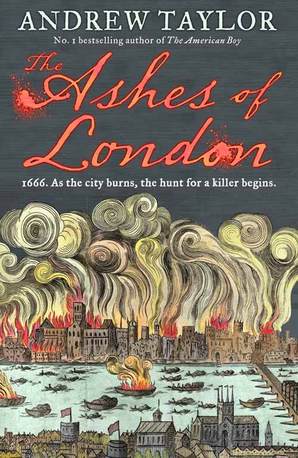
The Ashes of London by Andrew Taylor - review


Like many people, I enjoy historical fiction, and the past twenty years or so has seen a massive increase in the number of historical mysteries being written. There are various reasons for this, including the challenges inherent these days in writing contemporary fiction - over-familiarity is a problem, and so is the reach of new technology. But writing a good historical mystery is by no means a doddle.

I doubt it any crime writer, in Britain or elsewhere, has shown such consistent mastery of historical mystery writing in the past couple of decades than Andrew Taylor. Possibly the most impressive feature of his work is his ability to write in compelling fashion about different places and periods of the past. He's equally at home in the rural England of his post-war Lydmouth series and with much more distant times, as in The American Boy. And his Thirties novel Bleeding Heart Square is quite superb.

Now he's turned his attention to seventeenth century London. The Great Fire of 1666 provides a dramatic backdrop to the opening pages of The Ashes of London, a meaty tale in which James Marwood, the son of a supporter of Cromwell, tries to make his way in a world where Charles II has been restored to the throne. A strange encounter with a young woman dressed as a boy introduces him fleetingly to Cat Lovett, who will play a crucial part in the events that follow.

Cat seems destined for a loveless marriage before Fate, in the shape of her odious cousin Edward, intervenes. Soon she is on the run, and we follow her story, and James', as the two young people fight against the legacy of the past, and in so doing become enmeshed in murderous intrigue. This is an intensely readable novel; Taylor has done his research, but wears it lightly. The result is an enjoyable mystery that is intended as the first of a series.

Wednesday, 29 July 2015

Harrogate - and a question

Other commitments have meant that I'm reporting on the Theakstons Old Peculier Crime Writing Festival at Harrogate ten days after it came to an end. But it was a really enjoyable week-end, and it's prompted me to ask readers of this blog a question.

The programming chair for the Festival was Ann Cleeves, and she is such an efficient person that it was predictable that the whole week-end would be very well organised. And it was. Ann would be the first to give much credit to the very professional team that handles all the arrangements. It all seemed to me to run like clockwork. As usual, there was much socialising in the bar and elsewhere, and I took the opportunity to have a number of meetings, not least with my agent, with whom I was discussing my future writing plans. The good news is that he is happy with them!

I enjoyed the hospitality of Harper Collins at a dinner on the Friday evening, and met a number of fascinating people, including a new author, Ben McPherson; I sense that his debut novel will be well worth looking out for. Later on, Ann introduced me to Brenda Blethyn, the extremely pleasant star of Vera, and I finished up having a long chat with an old friend, that very fine writer Peter Robinson. The following night, I hosted a table at the Sicilian-themed murder mystery dinner masterminded by Kate Ellis. Great fun.

On Sunday, I took part in a panel celebrating the life and work of Patricia Highsmith. The moderator was Andrew Taylor and my colleagues were Peter James, Perer Swanson, and Sarah Hilary. Sarah had just won the Theakstons Prize for best crime novel of the year, and this gave me special pleasure as some years ago I included an early short story of hers in one of my anthologies for the CWA. She is a real star.

One questioner in the audience raised the issue of the relative significance of the author's life and the author's work. And this is my question to you - how interested, if at all, are you in the biography of a writer? Do you think it's relevant to their books?

My own views on this have shifted over the years. I used to think that the books were overwhelmingly more important than the life. Now, I take much more interest in the biographical material. In fact, I now think that you can't fully appreciate Highsmith (who, admittedly, had an extraordinary life) without knowing something of her life. But I'm sure that plenty of readers would take a different view. So - do let me know your opinion, and why you hold it.. 

Monday, 18 May 2015

Crimefest 2015


I'm just back from Crimefest, which was - as always - brilliantly organised by Adrian, Myles, Donna and their friendly and hard-working team. Twenty-five years have passed since I attended my first crime convention, the London Bouchercon of 1990, and during that time conventions have become an important part of the literary landscape - unquestionably a Good Thing.

Adrian and company kindly agreed that the Forgotten Authors' panel this year should be themed around The Golden Age of Murder,and I had a wonderful group of friends to help me in celebrating the book's UK publication (celebration enhanced over the course of the convention by terrific reviews from The Daily Mail, The Spectator, Bookbag, and Crime Fiction Lover). Dolores Gordon-Smith, Aline Templeton, John Curran and this year's CWA Diamond Dagger winner, Catherine Aird all came up with all manner of insights for the audience, and it was sheer pleasure to moderate the panel (the photo was taken by Karen Meek, whose Eurocrime blog is required reading for fans.)

That evening, I had dinner with Catherine and a few friends - a memorable occasion. She is one of those authors I admired long before I met her, and when we did meet, I found, as I have often done with major authors, that she is great company as well as a fine detective novelist. I continue to hope very much that she will publish her long-awaited biography of Josephine Tey, about whom she spoke rather movingly.

My second panel, moderated by John Harvey (whose "Fedora" is one of the best crime short stories of the past decade), tacked the subject of the short story. Andrew Taylor intrigued me by talking about his ghost story, which is a Kindle single,, and I was delighted to meet Robert Olen Butler, a Pulitzer Prize winning author who read out a very short but striking example of his work. The other panellist was Christine Poulson, one of Britain's most under-rated crime writers, and author of several highly distinctive short stories. Other events of note included Sophie Hannah and Matthew Prichard talking about The Monogram Murders, and Lee Child interviewing the legendary Maj Sjowall.

The banquet was smoothly run, and I was very lucky with all my dining companions, who included Catherine Aird, Sheila Mitchell (widow of Harry Keating) and James Runcie, author of the highly successful Grantchester books, who proved to be a witty toastmaster. I'd never met James before, but soon discovered he was a fellow Manchester City fan; after that, it was a struggle not to keep talking football, but somehow we managed it.

I met some other pleasant people for the first time, and as ever it was good to catch up with old friends. The latter include Ali Karim, pictured above with The Golden Age of Murder. Ali is one of the most entertaining companions one could wish to have, and I am really sorry that I shall not be with him at Bouchercon at Raleigh in October, where he will make a fabulous job of his far from easy task as programming chair. I also had the chance to talk to the publishers of the CWA fiction anthology and non-fiction anthology, as well as to catch up with my own publisher, Susie Dunlop of Allison & Busby, who hosted a drinks party during the week-end. It was lovely to see her again, and I'm so glad she's pleased with the next Lake District Mystery, The Dungeon House. All in all, a terrific week-end which I shall long remember.


.

Monday, 18 August 2014

St Hilda's


The 21st annual Crime and Mystery Week-end at St Hilda's College in Oxford was as enjoyable as ever. The theme, topically, was detective fiction and warfare, and this inspired a wide variety of interesting and informative papers from speakers ranging from Val McDermid, and Jake Kerridge of the Daily Telegraph, to Anne Perry and the conference guest of honour, Peter Robinson. My own contribution focused on the 'Golden Age and the Shadows of War', and I was truly gratified by response to news about the forthcoming publication of The Golden Age of Murder. Champagne was kindly provided by a good friend, and consumed with great appreciation, especially on my part!

The after dinner speakers on Friday and Saturday were, respectively, the legendary Colin Dexter (who mentioned, among many other things, his enthusiasm for John Dickson Carr),, and Keith Miles, better known to some readers as Edward Marston, author of the Railway Detective series. At the top table on Friday evening it was rather wonderful to be in the company of the likes of Colin, Anne, Andrew Taylor, Imogen Robertson, and Alan Bradley, a highly successful author whom I've never met before. Alan is Canadian, but after a spell in Malta, he now lives at Peel on the Isle of Man, an entrancing resort in which I once set a short story, 'Sunset City'.

A week-end like this gives you the chance to make new friends, and also to get to know some people better whom you may have met only fleetingly in the past. The setting gives this event a special character and atmosphere, and I encourage anyone who is interested in in-depth discussion of the genre, coupled with a great deal of conviviality, to consider attending in the future. Great credit is due to the tireless organisers, Eileen Roberts and Kate Charles. The talks themselves are chaired by N.J. Cooper (also know as Natasha Cooper and Daphne Wright), and I can only say that I've attended many different kinds of events in various sectors, but rarely encountered any chair as accomplished. It's a challenging role, because a great deal of concentration is required to do it well, but she makes it all look effortless, and her unfailing generosity makes the task of the speakers so much easier. And that's invaluable, because the audience is very knowledgeable, and all the speakers are naturally anxious to make sure that their talks live up to the standards expected.

I was delighted to share the platform with Ruth Dudley Edwards, who read and commented most helpfully on an early draft of The Golden Age of Murder, and her talk about Northern Ireland and terrorism was spell-binding. On the Sunday morning, Ruth and I went punting with Andrew Taylor (whose brand new book I'm longing to read after hearing him speak about it). Now, I've not been in a punt since I was a student a long, long time ago, but thanks to Andrew's expert steering with the punt pole we managed to avoid the calamity of capsizing that would definitely have ensued had I been left to my own devices. A fun memory of a great week-end.


Monday, 10 February 2014

The Craft of Writing: Defying Expectations

A familiar pitfall of genre fiction is the temptation of formula. Science fiction, romantic fiction, ghost stories, horror fiction, romantic fiction, all have their formulaic aspects. And so too does crime fiction. Now, there are some excellent stories that stick very closely to a formula, but it is always refreshing to read a story that defies one's expectations.

I was reminded of this when watching The Suspect the other night. There are several films sharing this title -the one I'm talking about dates from last year,and was written and directed by Stuart Connelly. The starting point is a bank robbery, but this is a story very different from Salamander, which I discussed over the week-end, and which also opens with a raid on a bank. Here, the robbery is followed by a quick arrest. Two cops behave unpleasantly towards the suspect, who is black,and for a while the story follows drab and conventional lines. But then the tables are turned.

There are a number of plot twists in The Suspect which I don't want to spoil. Overall, I felt it was an interesting film, with a number of thought-provoking ideas, although some of them didn't seem to me to be handled very smoothly. As a result, the film as a whole felt a bit disjointed, though the final scenes were pretty good. But what I liked about the screenplay was that it was quite ambitious, eschewing formula in favour of an unorthodox plot and some worthwhile observations about how easy it is to stereotype other people..

Because there are a number of well-established formulae for mystery stories, writers can have a good deal of fun subverting reader expectations. Sometimes, the result verges on parody or pastiche - the recent series of Sherlock is an example, taking a classic character and doing something fresh with it. The Evadne Mount books of Gilbert Adair show another way of subverting the genre - something the author does most brilliantly in And Then There Was No One. That book was a sort of homage to Christie, and of course she was particularly daring in the way she defied expectations. Think of whodunit in The Murder of Roger Ackroyd and Murder on the Orient Express, for instance. Not to mention Murder is Easy, Curtain, and... well, there are plenty of others.

Anthony Berkeley was another Golden Age writer who loved to defy expectations. Even when his experiments were not a complete success, they were invariably interesting. In the modern age, there are plenty of novelists who are very good at changing a story's direction when the reader least expects it - the very talented Andrew Taylor is an example, His Roth Trilogy is quite superb in this respect.

To write a novel that defies reader expectations isn't straightforward, and it's probably not a method to recommend to the inexperienced author. Done well, though, it can provide enormous pleasure for both reader and writer. Anyway, here's a question for you, faithful readers of this blog - what is your favourite example of a crime story that defies expectations?


Thursday, 17 October 2013

Raymond Flynn and Dorothy Lumley

In the crime writing world, the increasing number of conventions and events mean that there are many more opportunities for socialising between crime writers than was the case even when I started out as a published writer. As a result, one bumps into people from time to time who may not become close friends but who nevertheless prove to be pleasant acquaintances.

I'm sorry to say that a couple of people who fall into that category as far as I'm concerned have recently died. One is the novelist Raymond Flynn. Ray was taken on by Hodder & Stoughton two or three years before I joined their list and we met at a Dead on Deansgate conference in Manchester at the end of the Nineties. Ray also joined us, as far as I remember, for a very enjoyable Hodder author dinner at which those attending included those very interesting writers Andrew Taylor and Nick Blincoe. Andrew has of course gone on to great things in the crime world, while Nick Blincoe has not (as far as I know) stayed with the crime genre, but has moved on to other literary projects (and I gather he was also once an adviser to Nick Clegg...)

Ray inscribed for me a couple of his books, Busy Body and A Public Body, both of which featured DCI Robert Graham. He had been a career police officer in Nottinghamshire, and his experience strengthened the books. Like me and many others, however, he departed from the Hodder list, and I lost track of him in recent years, though I gather he continued to attend CWA regional chapter meetings in the West Midlands. He is, perhaps, a good example of an enjoyable mid-list writer who faded from sight all too soon because of the vagaries of the publishing world, rather than because of any lack of ability.

Another recent loss is that of Dorothy Lumley, often known just as Dot. I was quite shocked to hear of her passing. A former publisher, she was a literary agent whom I met at a few CWA events and also at the memorable Las Vegas Bouchercon. We once had a meal together and she told me she wanted to submit a short story for a future CWA anthology.I asked her about this a few times afterwards, but she never got round to doing it - too busy representing her clients, I think. She had a loyal set of writers on her books, including that very entertaining crime writer Amy Myers, and they will miss her greatly as agent and friend .

Monday, 19 August 2013

St Hilda's Crime and Mystery Week-end


St Hilda's Crime and Mystery Week-end is a crime conference with a distinctive and delightful personality which makes it very different from other crime-related events. The setting is St Hilda's College, Oxford, and I'm just back from the twentieth conference, which was, if anything, even more enjoyable than usual. The fact that this week-end is not advertised, has no promotional website, and yet has flourished for two decades, speaks for itself. When people do find out about it, and attend, they tend to love it, and go back year after year. There's no clearer sign of success than that.

The theme this year was "The Present and Future of Crime Fiction" and when I was asked to deliver a paper, I thought I would be very crafty and find a neat way to weave a talk about the Golden Age into the over-arching theme. What I hadn't anticipated was that some other writers would have the same idea - and my talk was on Saturday afternoon, while just before lunch P.D. James herself would be speaking about....the Golden Age.

P.D. James was aptly described by Natasha Cooper, the chair of the conference, as the true Queen of Crime and it was wonderful to see that her audience regarded it as a true privilege to be able to listen to her. And so it was. Fortunately for me, there was no overlap between her topics of mine, and one of the more daunting experiences of my public speaking career (yet a real honour) was to see Baroness James herself sitting in the front row to listen to my paper. I did feel a bit nervous, having foolishly said the previous evening that I feel more confident about speaking in public nowadays than I used to, but I managed to get through to the end without drying up completely. The papers are delivered in pairs, so P.D. James spoke along with Frances Fyfield, while I was paired with Peter Robinson - and it was very good to catch up with him again over the week-end.

The other speakers included Andrew Taylor (talking about C.S. Forester), and Val McDermid, while two after dinner speeches were given by Bernard Knight on the Friday, and Cilla Masters on the Saturday. There was also an extremely interesting panel chaired by Ayo Onatade on the future of crime publishing. The attendees included quite a number of notable writers who weren't actually speaking - a few examples include Frances Brody, Ann Granger, Marjorie Eccles, Kate Ellis, and AK Benedict - while I met several writers whose first books are due to appear shortly. As ever with these events, the combination of catching up with old friends and meeting new people was very pleasurable.

Much of the success of St Hilda's is down to continuity and the sterling efforts of the organisers, Kate Charles and Eileen Roberts, and Natasha Cooper, who chairs quite brilliantly in a calm, efficient and extremely generous style that few if any could match. This trio put a huge amount of work into the event, and their reward is simply that they give a lot of people a great time.If you've never attended St Hilda's, I do recommend it very strongly. The dates for next year are 15-17 August 2014.


Monday, 22 July 2013

Deadly Pleasures


I'm delighted to announce the publication this week of Deadly Pleasures, an anthology I've edited to celebrate the Diamond Jubilee of the Crime Writers' Association. The book is published by Severn House in hardback and trade paperback and will be available in the US as well as the UK.

Putting this book together has been a labour of love, since I've been lucky enough to receive a host of marvellous - and brand new - stories by some wonderful writers. Let me just pick a few at random to give you the idea. John Harvey has written a new Jack Kiley story, which deals with a tricky and highly topical social issue. Peter Robinson has supplied a fascinating story, based on a performance piece that he worked on last year along with the great folk singer Martin Carty. Liza Cody tells us a bit more about the fate of Anna Lee - or does she? Andrew Taylor, who just won (most deservedly) the Ellis Peters Historical Dagger, has contributed a very enjoyable story and so has Peter Lovesey.

David Hewson, recent author of a novelisation of The Killing, has a story in the book, and so does Lindsey Davis, who offers a sort of companion piece to a story she wrote for Mysterious Pleasures, the Golden Jubilee volume I edited for the CWA a decade ago. The other contributors of brand new stories are: Ann Cleeves, Cath Staincliffe,Simon Brett, Claire McGowan, Alison Joseph, Ruth Dudley Edwards, Michael Ridpath, Charles Todd and Christopher Fowler. Oh, and me!

I'm enormously grateful to the contributors, and also to Peter James, who wrote the intro. Let me assure you they didn't write these stories for the money, they just wanted to support the CWA, which is marvellous. There's one story that has been published before. Margaret Yorke, a former CWA chair who contributed to Mysterious Pleasures and other CWA anthologies I've edited, died while the book was in preparation. I wanted to include something by her as a tribute to her, and her family kindly agreed. All in all, it's a book I'm proud to be associated with, and I'm confident crime fans everywhere will love the stories written by some of the best writers around.

Monday, 13 May 2013

History and Mystery

Last week I rhapsodised over Andrew Taylor's wonderful new novel The Scent of Death, and I'm tempted to place him at the head of the list of my favourite writers of historical mysteries, given that Peter Lovesey, whom I also admire greatly, has been focusing on contemporary crime for quite a few years now. There's no doubt that history-mysteries are hugely popular, and with good reason (and no, I don't mean just because forensics were easier for writers to deal with in the past!)

The History Press, as the name suggests, has a particular niche in this area, although they have sometimes branched out, for instance with the Murder Squad anthology Best Eaten Cold and other stories. They have recently published two books by fellow CWA members whom I've known for a number of years.

Joan Lock was once a police officer, and she is very strong on non-fiction. Her publications include two very interesting books dealing with aspects of the history of Scotland Yard. But Joan has also developed a distinct reputation as a novelist,and The History Press have been reprinting some titles which appeared a few years ago. The latest is Dead Born, which features her character Detective Sergeant Best. The focus of the story is on the grim subject of baby farming, One of the appealing features of this book is that it's short and very crisply written. Well worth a look.

Linda Stratmann is another novelist who first made her name with non-fiction. She wrote a fascinating book about chloroform, and a recent study of the Marquess of Queensbury won rave reviews. When it comes to novels, her series character is Frances Doughty, who makes her third appearance in A Case of Doubtful Death. As with Joan Lock's novel, the setting is Victorian London and the story concerns the death of a doctor and the disappearance of one of his staff. Again, the research that has gone into the story strikes me as dependable, but there is not an excess of it. I'm certainly hoping that The History Press, a small firm that does produce attractive books, will continue to produce entertaining and attractive novels as well as non-fiction.

Wednesday, 8 May 2013

The Scent of Death by Andrew Taylor - review

Andrew Taylor has written a good many books over the years, but he has been slightly less prolific in recent times, which made me all the more eager to read his latest, The Scent of Death. And that's because I think it's fair to say that the appearance of a new Andrew Taylor novel has become an Event, rather in the way that the arrival of a new book by that exceptionally entertaining writer Reginald Hill used to be an Event. Yes, Andrew is that good. The over-riding question, inevitably, is whether the new book matches the high standards of its predecessors such as The American Boy and Bleeding Heart Square. The answer is an emphatic yes. This is a marvellous book.

The story is set in the late eighteenth century, in New York. Edward Savill, a clerk, has been sent on government business at a time when war is raging as many (but not all) Americans press for independence. His arrival sets in motion an elaborate seqeunce of events whose significance does not become clear for a long time. This is a long book, and a masterly example of how to pace a story. A series of small incidents keep the plot moving along while the characters and their environment are developed with unobtrusive skill.

Savill is staying with Judge Wintour and his family, the most intirguing of whom is Wintour's daughter-in-law, Arabella. A man called Pickett who had visited the Wintours in rather mysterious circumstances, is found murdered, and other deaths occur. Time passes, and Arabella's husband, a soldier, returns home. Strange tensions in the Wintours' marriage become evident,although their cause is unclear. Meanwhile, Savill's own marriage runs into trouble.

There are many incidental pleasures in this book. As usual, there are one or two sly references to Taylor's other work - he once used the pen-name Saville, for instance, and an HMS Lydmouth, named after his excellent series set in post-war Britain, makes an appearance. Whilst it's fun to try to detect these little snippets, I really hope that one day he can be persuaded to set out the various cross-references in his books, which I suspect some readers may not have noticed.

I knew very little about this period of American history, but Taylor achieves the distinction of imparting a great deal of information without making his research obvious - and he makes it all extremely interesting. The story-line is gripping from start to finish, even though I was unsure for a long time where it was leading, while the writing is of the highest quality throughout. I figured out one aspect of the plot, but others had me on tenterhooks. This is quite possibly the best book so far from one of our most distinguished crime novelists. Strongly recommended.


Monday, 10 September 2012

Cambridge


After a summer of disappointing weather, a promising forecast was enough to get me off on a trip down the motorway to a truly fascinating city I''ve only once visited in the past, in the long ago days when one of my brothers-in-law was a student there. Cambridge is not the most accessible place from the north west, but on a very sunny week-end, it was utterly charming and beautiful.

Highlights for my son and me included a river tour on a punt (courtesy of a current undergraduate - it's more than thirty years since I lasted punted and I suspect my technique hasn't improved in the intervening years) and a walk round the superb botanical gardens. We found countless attractive corners, and whilst a couple of days isn't enough to see everything - far from it - we packed a lot into the time available.

Cambridge isn't as well represented in crime fiction as Oxford, and, although I've never attempted a count, I'm sure there are, and have been fewer ex- Cambridge students who have written crime than is the case with Oxford. But this is irrelevant, really, because there are plenty of very good Cambridge-based books. Ostara Publishing (masterminded by Richard Reynolds of Heffers) has published a number of them,and this small press is well worth a look.

Perhaps my favourite Cambridge-based crime novel is a historical mystery, The Anatomy of Ghosts, by Andrew Taylor. Andrew is a gifted writer, one of the finest around, and is confident enough in his own skills to develop a story gradually, eschewing synthetic dramatic tricks that "up the stakes", and relying instead on craft and character (as well as a talent for unorthodoxl plotting) to draw his readers in. This is one of his very best books. Among other first-rate writers who use Cambridge as a setting, I'd highlight the talented and under-estimated Michelle Spring. I've not often mentioned Michelle in this blog, but although far from prolific, she is definitely worth of note.

After Cambridge, we had a fantastic day somewhere else that has occasionally featured in the genre. More of that tomorrow, if time permits....

Monday, 16 July 2012

Harry Devlin is back!


I’m truly thrilled to say that my early Harry Devlin books, set in Liverpool, are now enjoying a new life. They are available as ebooks, in new editions with some very special features that I hope readers will find fascinating. For me, it’s all very exciting. And the books are also being made available again, for those who prefer hard copies, in paperback editions.

Andrews UK, who specialise in ebooks and print on demand editions, have now produced six of the eight titles in this way – the whole series, that is, with the exception at present of Eve of Destruction and the much more recent Waterloo Sunset.

The most notable of the special features is that each book benefits from a brand new introduction by a leading crime writer. I’ve been extraordinarily lucky here – this original material, only available in these editions, comes from some of the most gifted and renowned of modern British writers.

CWA Gold Dagger Winner Frances Fyfield introduces my debut novel, All the Lonely People. Frances reviewed my earliest work in legal magazines (she and I, like Harry, are solicitors) and I have long felt an enormous debt of gratitude to her for her encouragement.

The same is true of Val McDermid, the CWA Diamond Dagger winner who has written a new introduction to the second book in the series, Suspicious Minds. Val reviewed one or two of the early Devlins very favourably, and her generous remarks in this new edition made me glow with pride.

I Remember You, the third book in the series, has an introduction from Margaret Murphy – the current joint winner of the CWA Short Story Dagger. Margaret is not only an old friend, but someone who knows Harry Devlin’s Liverpool  better than most.

Yesterday’s Papers, perhaps my favourite Devlin book, has an introduction from another CWA Diamond Dagger winner, Peter Lovesey. Again, Peter is a superstar of the genre who has supported me generously for many years. He and I share an enthusiasm for classic, twisty plots, and it seemed to me appropriate that this particularly elaborate mystery should include an intro from such a master of the genre.

A third CWA Diamond Dagger winner, Andrew Taylor, kindly wrote the introduction to The Devil in Disguise. This was a book I really enjoyed writing, though I remember being mortified when my original publisher didn’t care for it. As a result, I moved to Hodder, with increased sales as a result. Andrew was a Hodder author too, and we launched this book, and one of his Lydmouth titles, at the same enjoyable event in the late lamented Mysterious Press bookshop in London.

Finally, there is First Cut is the Deepest, with an introduction from Kate Ellis, twice shortlisted for the CWA Short Story Dagger.  This was the last Devlin story I wrote before taking a ten-year break, and it is also the longest and perhaps the most complex entry in the series. Kate, like Margaret, is a Liverpudlian with a deep love for Harry’s home city.

For each book, I have written a detailed new “Making of” feature, along the lines that you find in DVDs. There is also a biographical note, and an appreciation of my work which has most generously been contributed by former CWA Chair, Michael Jecks.

Each book includes a “preview chapter” for the next book in the sequence, a device that I hope will encourage people who dip into the series for the first time to return to it.

As we all know, the world of publishing is changing rapidly. With all change, there are advantages and drawbacks. But I am very optimistic that for writers like myself, who do not have massive publicity teams or budgets at their disposal, that digital publishing will help to make the books available to a new and wider readership. We shall see. One thing is for sure: it’s enormously gratifying to see these early books given a fresh life.

I can’t close this post without expressing my profound gratitude to Frances, Val, Margaret, Peter, Andrew, Kate and Michael, all of whom offered their contributions without the slightest degree of arm-twisting! (The same is true of CWA Gold Dagger winner Ann Cleeves, whose introduction to Eve of Destruction is at present unfortunately unavailable because of the frustrating and unhelpful attitude of the rights owner.) Generous people, as well as terrific writers, and I am proud to call them friends.


Monday, 22 August 2011

St Hilda's


The 18th St Hilda's College Crime and Mystery conference was another triumph for organisers Kate Charles and Eileen Roberts, as well as for Natasha Cooper, who chaired the sessions with the unobtrusive excellence as well as efficiency that seem to come so naturally to her.

I was glad to share a platform with Andrew Taylor, who gave a very good talk about Wilkie Collins - my subject was the British lawyer-author, with special focus on Cyril Hare and Michael Gilbert. Among the highlights of a varied programme, Ayo Onatade gave fascinating insight into the world of the courts, while Val McDermid spoke very interestingly about justice, referring to one of her own excellent thrillers, A Place of Execution. What I didn't know was that the book was inspired by a true crime case - which she learned about from our mutual friend, the true crime expert Douglas Wynn.

As ever, there was the chance to meet pleasant people for the first tme as well as to renew old friendships. I was glad, for instance, to have a chat with Marcia Talley, who is in the foreground in the photo. Marcia is an accomplished American author who is a regular attendee at St Hilda's.

It was a real privilege to be invited to take part, and I'm very grateful to Kate and Eileen for all their hard work. After an excellent but very hectic week, I must admit I was pretty exhausted by the time I was driving home. But it was well worth it.

Tuesday, 19 July 2011

Andrew Taylor


I’ve mentioned Andrew Taylor and his books several times in this blog. I was reading his crime novels long before I met him – he started his career young, and began with a series featuring the amoral William Dougal that is often described as ‘quirky’. It’s almost a cliché, but it’s still a fair description, because the Dougal books are definitely unusual and different. One of my favourites is The Sleeping Policeman.

As a full-time writer, Andrew has turned his hand to many kinds of projects. He even produced five novels based on the Bergerac TV series, under a pen-name, Andrew Saville. Every now and then he has turned out a stand-alone psychological suspense novel, and my favourite of these is The Barred Window – really good.

His next series was set in the 50s in the fictional Border town of Lydmouth. It features the relationship between a married cop and a female journalist – one book, cleverly, focuses on the story of the cop’s wife. This series began quietly, but the later books are exceptional. I’ve written an article about Thornhill, the cop, which Andrew included on his website, and I mean to update it some day.

The Roth Trilogy is, arguably, his masterpiece. I’ve written about it before on this blog. Suffice to say that it’s one of the most impressive trilogies I’ve come across in crime fiction – a study, going back through time, of the making of a sociopathic killer.

Then there are his historical novels. The American Boy is the best-known, and I reviewed The Anatomy of Ghosts recently. It's shortlisted for the Harrogate Festival award this week and I'm keeping my fingers crossed for him.

I’d particularly mention Bleeding Heart Square, which is superbly done. He always conveys the atmosphere of the period, and the setting, splendidly, and Bleeding Heart Square has a very good plot and also some resonances with present day Britain. A very good writer, whose work is varied and highly literate. If you don’t know his work, do give it a try.

Wednesday, 20 October 2010

The Anatomy of Ghosts


I've written before about my enthusiasm for the work of Andrew Taylor. The appearance of another historical mystery from Andrew, The Anatomy of Ghosts, is therefore a real treat. Bleeding Heart Square was one of my favourite crime novels of 2008, and while that book was set in the 1930s, here he writes with equal assurance about murky events in a Cambridge college in the late 18th century.

Taylor's fictional Jerusalem College is splendidly and atmospherically evoked. A map is provided at the start of the book, and it turns out that the layout of the college buildings and grounds is relevant to the unravelling of the mystery. I do like maps in books, and I'm actively thinking of trying to draw one for my next book. Only snag is, I'm not at all artistic...

The book opens in dramatic fashion, with the proceedings of the Holy Ghost Club, a secretive and sinister group based at Jerusalem, and a shocking initiation ritual ends in tragedy and death. Attention then switches to the misadventures of John Holdsworth, who suffers terrible double bereavement when first his young son drowns and then his wife commits suicide. Angered by the fact that his wife had been exploited due to her belief that her son's ghost was seeking to make contact with her, Holdsworth writes The Anatomy of Ghosts, debunking ideas about the spirit world, and comes to the attention of a wealthy woman who dispatches him to Jerusalem College to assess the state of mind of a student who was traumatised by events at the last meeting of the Holy Ghost Club.

The first half of the book is sedate, far removed from the quickfire style of many modern serial killer thriller, but is none the worse for that. Taylor establishes character and setting with equal care, and the period detail is very well done. In the latter stages of the story, the pace quickens and a number of plot threads are pulled together with the dexterity that we have come to expect of this highly accomplished author.

Saturday, 22 August 2009

Ludlow Castle


Wednesday evening was a lot of fun. The Mystery Women event was organised by Kate Charles, of whom more another day, and the setting, Ludlow Castle in Shropshire, was quite idyllic – especially as the weather was very kind to us.

I was a member of a panel of eight writers. My colleagues, in addition to Kate, were Andrew Taylor, Marcia Talley (an American writer who deserves to be better known in the UK), Suzette Hill, Laura Wilson, Natasha Cooper and Phil Rickman. It proved to be a good mix. The one person in the group I hadn’t met in person before was Phil Rickman, although he has interviewed me on the radio a couple of times. So it was good to make his acquaintance, and to hear him tell the audience that there is serious television interest in his books featuring Merrily Watkins.

We had a capacity audience – selling 100 tickets for a literary event is quite an achievement, and a tribute to the organising skills of Kate, and those working with her. A special mention for the Castle Bookshop, which supported the event admirably. Each of us spent a few minutes talking about our books, and then there were questions from a group of readers who were very well-informed. The event lasted for close on two and a half hours in all, and even then it seemed too short – a sign of the enjoyable time we had.

I can’t think of many venues for writing panels that I’ve found as delightful as Ludlow Castle. It really does reek of history. Prince Arthur (the first husband of Catherine of Aragon, and brother of Henry VIII) spent time there, for instance. A truly memorable occasion. I’m very grateful to Kate for having invited me to be part of it.