Showing posts with label Josephine Tey. Show all posts

Wednesday, 7 February 2024

Paranoiac - 1963 film review


If you were going to make a Hammer Horror movie, I don't think that a novel written by Josephine Tey would spring to mind as obvious source material. Yet her excellent story Brat Farrar was turned by Jimmy Sangster into Paranoiac, and what is even more surprising is that he made a pretty good job of it. Some Tey fans may hate the over-the-top elements, but the film was definitely more enjoyable than I expected. 

Directed by Freddie Francis - who won two Oscars for other work - the film moves at a sprightly pace, opening with a church service in memory of members of the Ashby family. The death of the parents, followed by the subsequent suicide of their oldest child Tony, meant that the remaining children, Eleanor and Simon, have been brought up by their Aunt Harriet.

But they are a troubled group, to put it mildly. Eleanor (Janette Scott) is haunted by Tony's death and Simon (Oliver Reed, at his most crazed and menacing) is trying to have her committed to an asylum so that he can inherit the whole of the family fortune. Eleanor is being 'looked after' by a glamorous French nurse who is having a torrid affair with Simon, while Harriet (Shelia Burrell) has plenty of issues of her own. The family solicitor and trustee (Maurice Denham) fights a losing battle to maintain order, not helped by the villainy of his son and junior partner. Elisabeth Lutyens' music adds to the mood of melancholy and melodrama.

The quality of the cast contributes to the success of the film. There are incestuous sub-texts that would have startled Tey, and although the 'returning prodigal' character is played rather woodenly by Alexander Davion, there are enough plot twists and moments of drama to satisfy most viewers looking for a Sixties horror movie that is better written than most.



Friday, 18 November 2022

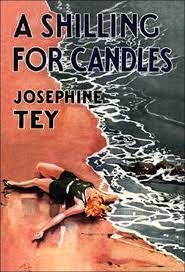
Forgotten Book - A Shilling for Candles


A Shilling for  Candles, published in 1936, was Josephine Tey's second detective novel to feature Inspector Alan Grant. I've mentioned it a couple of times on this blog, in connection with Nicola Upson's novel Fear in the Sunlight, and also as the basis for Alfred Hitchcock's film Young and Innocent, which as I said in a review way back in 2010 is very different from the book - even the murderer and motive are changed!

I first read this novel many, many years ago. I 'm a Tey fan, but I was disappointed with it overall. I think that was because she didn't, in my opinion, pay enough attention to characterising the killer or making the motive credible - and this helps to explain why Hitchcock made so many changes. It's certainly not a 'fair play' novel. However, I decided to give it another try and consider the story in part from a technical perspective - why did Tey make the choices she did, and which of them worked?

The fact that I knew what to expect didn't lessen my enjoyment and the first thing to say is that Tey, as always, writes very well and engagingly. The opening scene, where a coastguard discovers a body on a beach, is very well done. The 'man on the run' aspect of the story, which Hitchcock focused on, is also quite good. The title is intriguing and it refers to a mocking bequest in Christine's will. However, this part of the story rather fizzles out as Tey tries to draw the various strands together. 

The central problem, I think, is that although she came up with some wonderful story ingredients, she didn't think hard enough about how to integrate them into a satisfactory whole. Probably she was writing in a rush, and wanting to get back to her work in the theatre. I suspect she became worried about the thinness of the motivation and as a result decided to portray the killer, in the closing pages, as deranged. I feel that, despite an element of outlandishness, more could have been done to make this crucial part of the story plausible. But the book is not only worth reading - I was very happy to have read it for a second time, despite my reservations.  

Sunday, 21 November 2021

More about Josephine Tey


For a few years now, I've had an enjoyable correspondence with Jennifer Morag Henderson, whom I met after the publication of her excellent biography of that gifted writer Josephine Tey. I'm pleased to say that Sandstone Press have now produced an updated paperback edition of Jennifer's book, which I can warmly recommend.

Jennifer and I started discussing Josephine Tey's connection with the Detection Club, and the eventual outcome was a jointly-written article which has now been published on the excellent CrimeReads site. We've been pleased with feedback on the piece so far. Suffice to say that over the years I've collaborated with a wide range of authors on different subjects and every now and then it makes a very pleasant change from writing solo.  

Friday, 5 January 2018

Forgotten Book - The Poison Trail

Anthony Armstrong is remembered today, if at all, for his play Ten Minute Alibi, the novelisation of which I reviewed earlier this year. Armstrong's real name was George Anthony Armstrong Willis, and he was born in 1897 in British Columbia, the son of a British man who was in the Royal Navy. The family returned to England in 1900, and Armstrong became a successful writer. Among other things, he contributed to the screenplay of Hitchcock's Young and Innocent, a film which renders the source material, Josephine Tey's debut novel, pretty much unrecognisable.

Armstrong's career as a novelist was not outstanding, but among other books he wrote a series of five featuring Jimmy Rezaire. Rezaire is one of those characters, like Raffles, who begins life as a crook and ends up on the right side of the law. I recently read The Poison Trail, his final case, in which he is operating as a private investigator on good terms with the police.

The Poison Trail isn't a whodunit, but a howdunit. It's fairly clear from the outset that Gideon Davenport killed his brother Abel to inherit a fortune. But what baffles everyone is how he managed it. Richard Marty, who had hoped to inherit instead of Gideon, is frustrated by the inability of the police to nail the killer, and so he consults Rezaire.

Rezaire is assisted by his wife Viv and his chum Hyslop, but at first they are confounded by the case. Has Gideon outsmarted them? Armstrong was a readable writer, and although the plot is not over-elaborate, it's quite well-handled. Personally, I prefer more twists than were on offer in The Poison Trail, and the story is told in a slightly boyish way, but it's a competent piece of work, even if a minor one..

Wednesday, 24 February 2016

The Franchise Affair - film review

The Franchise Affair is a 1951 film closely based on Josephine Tey's excellent novel. It offers a crime story, but not a murder mystery. Rather, the puzzle is based on the real life Elizabeth Canning case. A girl accuses a woman and her grumpy old mother of kidnapping her, and forcing her to become their servant. The accused women call in a local solicitor, Robert Blair, to defend them.

It's a low-key premise, one which is, I think, better suited to a book than a film, because it's not an obviously dramatic situation, despite a courtroom scene (in which the key twist comes rather out of the blue - a flaw in the writing). That said, I found The Franchise Affair to be a good example of the "well-make" post-war British film, with good performances from an excellent cast who make the most of the story's potential.

Michael Denison plays Blair, one of those small town solicitors from the Good Old Days, when you could take on a client without worrying about letters of engagement, or compliance with the anti money laundering legislation. Nor does he have to bother with computerised time recording, or targets for chargeable hours, lucky fellow. This freedom enables him to take on a case for which he's not really equipped in terms of experience. But determination sees him through.

Marion Sharp is played by Dulcie Gray, who was Denison's wife in real life. She was also a writer of mystery stories. As it happens, I've recently bought one of her books, and look forward to reading it. The remaining cast includes such future stars as Kenneth More (later Father Brown) and Patrick Troughton (a future Doctor Who). All in all, I enjoyed this film. I watched it the day after watching the much more dramatic The Shining. But in its quiet and unambitious way, it was equally entertaining.

Monday, 18 May 2015

Crimefest 2015


I'm just back from Crimefest, which was - as always - brilliantly organised by Adrian, Myles, Donna and their friendly and hard-working team. Twenty-five years have passed since I attended my first crime convention, the London Bouchercon of 1990, and during that time conventions have become an important part of the literary landscape - unquestionably a Good Thing.

Adrian and company kindly agreed that the Forgotten Authors' panel this year should be themed around The Golden Age of Murder,and I had a wonderful group of friends to help me in celebrating the book's UK publication (celebration enhanced over the course of the convention by terrific reviews from The Daily Mail, The Spectator, Bookbag, and Crime Fiction Lover). Dolores Gordon-Smith, Aline Templeton, John Curran and this year's CWA Diamond Dagger winner, Catherine Aird all came up with all manner of insights for the audience, and it was sheer pleasure to moderate the panel (the photo was taken by Karen Meek, whose Eurocrime blog is required reading for fans.)

That evening, I had dinner with Catherine and a few friends - a memorable occasion. She is one of those authors I admired long before I met her, and when we did meet, I found, as I have often done with major authors, that she is great company as well as a fine detective novelist. I continue to hope very much that she will publish her long-awaited biography of Josephine Tey, about whom she spoke rather movingly.

My second panel, moderated by John Harvey (whose "Fedora" is one of the best crime short stories of the past decade), tacked the subject of the short story. Andrew Taylor intrigued me by talking about his ghost story, which is a Kindle single,, and I was delighted to meet Robert Olen Butler, a Pulitzer Prize winning author who read out a very short but striking example of his work. The other panellist was Christine Poulson, one of Britain's most under-rated crime writers, and author of several highly distinctive short stories. Other events of note included Sophie Hannah and Matthew Prichard talking about The Monogram Murders, and Lee Child interviewing the legendary Maj Sjowall.

The banquet was smoothly run, and I was very lucky with all my dining companions, who included Catherine Aird, Sheila Mitchell (widow of Harry Keating) and James Runcie, author of the highly successful Grantchester books, who proved to be a witty toastmaster. I'd never met James before, but soon discovered he was a fellow Manchester City fan; after that, it was a struggle not to keep talking football, but somehow we managed it.

I met some other pleasant people for the first time, and as ever it was good to catch up with old friends. The latter include Ali Karim, pictured above with The Golden Age of Murder. Ali is one of the most entertaining companions one could wish to have, and I am really sorry that I shall not be with him at Bouchercon at Raleigh in October, where he will make a fabulous job of his far from easy task as programming chair. I also had the chance to talk to the publishers of the CWA fiction anthology and non-fiction anthology, as well as to catch up with my own publisher, Susie Dunlop of Allison & Busby, who hosted a drinks party during the week-end. It was lovely to see her again, and I'm so glad she's pleased with the next Lake District Mystery, The Dungeon House. All in all, a terrific week-end which I shall long remember.


.

Friday, 24 April 2015

Forgotten Book - Who is Simon Warwick?

Who is Simon Warwick? is another Forgotten Book that I've chosen by Patricia Moyes, whose memory is being honoured this year at Malice Domestic. This is a book first published in 1978, and whilst I have not read every book that Moyes ever wrote, suffice to say that if she ever wrote a more ingenious whodunit than this one, I would be as surprised as I'd be impressed. Yes, you'll have gathered that I'm very enthusiastic about this one - it's my favourite Moyes.

The starting point is a search for a missing heir - a topic that has driven varied and interesting novels by Josephine Tey (the splendid Brat Farrar) and Julian Symons,(whose novels are nowadays sadly under-estimated, although The Belting Inheritance is enjoyable rather than brilliant) among other crime writers.

A rich man who does not have long to live summons his solicitor, who rejoices in the name Ambrose Quince, and asks him to draw up a new will, disinheriting various hopefuls in favour of his nephew,who was born during the war, and later adopted. This is the very mysterious Simon Warwick of the title.

Despite various well-founded reservations, Ambrose does as he is told, and when his client dies, he advertises for Simon Warwick - but two potentially credible claimants come forward  One of them - at least - is an impostor. But which one? When one of them is murdered, the plot thickens further. Did one of those who were disinherited commit the crime?

Henry Tibbett investigates, and as usual his wife Emmy gets in on the act. There are some splendid plot twists, and a neat solution to the various mysteries that Moyes has constructed with real cunning. She was, really, working in Golden Age territory long after the Golden Age - and using some of the freedom given by changes within society to come up with new ideas. A very entertaining puzzle.


Saturday, 7 February 2015

Catherine Aird - CWA Diamond Dagger winner

I could  not be more pleased that the CWA has announced the award of the CWA Diamond Dagger to Catherine Aird in recognition of the sustained excellence of her work. I've known Catherine for a long time, and I've enjoyed her books for even longer. She is a truly delightful person, and while the award is of course for her writing, it is all the more pleasing to see someone so popular in the crime fiction community receive such recognition. She is beyond doubt a worthy winner.

Because of my own membership of the CWA committee, I've been aware that this announcement was to be made for some time, and I did notice that, as soon as the news came out, many of Catherine's fans took to social media to express their delight. I'm not a bit surprised. Her plots are clever, her characters and situations are entertaining,, and her humour a real bonus..

I've written about Catherine previously on this blog, and I've had the pleasure of including her stories in CWA anthologies over the years. Recently, she contributed to a CWA anthology with a difference. Truly Criminal, which will be published in the spring, is a collection of essays about true crime by CWA members, and Catherine writes about a case that is interesting, but little known.

One item of trivia that may be unfamiliar to many fans of traditional detective fiction is that Catherine has a family connection with Josephine Tey, one of the great figures of Golden Age mystery writing. I share Catherine's enthusiasm for Tey, and I continue to hope that one of these she will write more about her. Tey and Catherine belong to different generations, but in both cases, their books will be read for many years to come.


Monday, 6 May 2013

Portmeirion and Crime Fiction


I was lucky enough to spend a night recently at one of my favourite places, Portmeirion, on the Dwyryd Estuary in North Wales. I first visited Portmeirion as a child, and this extraordinary Italianate village, created by a brilliant if slightly eccentric architect, Clough Williams-Ellis, made a great impression on me. I've returned many times since, and I still find it as entrancing as ever.

Because Portmeirion is so exotic,and so unexpected, some people think it outlandish, but not only is the setting lovely, there is a sense of fun and joyfulness about Clough's creation that makes a great many people feel good, simply by being there. And when the weather is excellent, as it was on this visit, it really is a terrific place to be.

Yet Portmeirion's strangeness did make it the perfect setting for that classic cult TV series The Prisoner, and it's also the setting for a recent crime novel, Fear in the Sunlight, by Nicola Upson. This is the latest in her series featuring the writer Josephine Tey as a character. Her version of Tey differs from the description of Tey given to me by a family member who knew her, but is nevertheless appealing.

In this story, Tey is staying at Portmeirion along with Alfred Hitchcock and his wife Alma, to negotiate a deal that will see Tey's novel A Shilling for Candles adapted into the film Young and Innocent. The Portmeirion meeting did not happen in real life, but it's a great idea, and Upson's evocation of the fantasy village is probably the strongest part of the book. Murder does not happen for about 200 pages, and some readers may feel that this was too long to wait. But the trip to Portmeirion was the ideal time to read the book, and I have little doubt that Nicola Upson likes the place as much as I do.


Saturday, 17 July 2010

Josephine Tey and Nicola Upson


When I first heard that a series of books was to be published featuring Josephine Tey as the lead character, I must admit that I was rather surprised. Tey is one of the Golden Age writers whose work has lasted well, but I’ve always had the impression that in real life she was a retiring individual, who never married and died relatively young, and who hid behind the pseudonyms of Tey and Gordon Daviot (her real name was Elizabeth Mackintosh.)

Yet Nicola Upson has not only now written three novels published by Faber and starring Tey, but she has teamed her up with an appealing cop called Archie Penrose. The first book in the series, which came out a couple of years ago, is An Expert in Murder, and it was followed by Angel With Two Faces. Two for Sorrow has now just appeared.

I’ve featured Tey in a new column for Bookdagger, which is due to appear shortly, so I won’t repeat what I’ve said there, but I do think it’s interesting to consider why her reputation has survived when that of many contemporary crime writers has faded from sight. After all, surely nobody would contemplate writing a new mystery series featuring E.R. Punshon, say, or J.J. Connington, or other Golden Age practitioners.

The explanation for her success owes something, I think, to the fact that Tey was a genuinely good literary stylist, while her plots were apt to be a bit ‘different’, for example because she did not always write about murder. The Daugher of Time is her most famous book, but I prefer the excellent Brat Farrar and The Franchise Affair. I do hope Upson’s books manage to interest more readers in the work of this fine writer.

Friday, 2 April 2010

Forgotten Book - Deadlier Than The Male


Jessica Mann is an accomplished novelist, and I plan to write about her fiction in a future blog post, but my choice today for Patti Abbott’s series of Forgotten Books is a non-fiction work dating back to 1981. Deadlier Than The Male was written at a time when reference volumes about the crime fiction genre came out in a trickle, rather than (as now) a flood. But nearly three decades on, it stands up to scrutiny very well indeed.

The book is sub-titled ‘An Investigation into Feminine Crime Writing’, and it seeks to answer the question: ‘Why is it that respectable English women are so good at murder?’

Mann displays her formidable knowledge of the genre throughout. The heart of the book is devoted to an in-depth look at the work of Christie, Sayers, Marsh, Tey and Allingham, but many other authors are considered (including Mary Elizabeth Braddon, one of whose forgotten titles I featured last week.) I was pleased to see mention of Nina Bawden – it’s now seldom noted that, early in her career, she wrote detective stories of real merit.

This is such a good book that I’m sorry Mann has not written further works of crime-related criticism – although she remains a highly regarded reviewer. One of her many interesting observations is that ‘Crime novelists…are particularly reticent about their own personal lives’. I think it’s fair to say that this is less the case today than it was in 1981, thanks to the pressures on authors to promote themselves, coupled with the rise of the internet, social networking, and, yes, blogging. It’s not at all easy for modern crime writers to maintain their privacy as did the likes of Sayers, Christie and their contemporaries. But whether the change is wholly a good thing is an interesting subject for debate.

One final point. Mann acknowledges the help of that delightful writer Catherine Aird, and refers to Aird's proposed biography of Josephine Tey. It's a matter for regret that the biography has never appeared, and I still hope against hope that, one day, it might.

Thursday, 25 February 2010

Young and Innocent


Young and Innocent sounds rather like the title of dodgy movie screened in a back street in Soho, but in fact it is the title of a pre-Hollywood Hitchcock movie, dating from 1937. I was alerted to its quality by comments on this blog some months ago, and now I’ve finally got round to watching it, I can say I agree that it’s a very entertaining film, which has stood the test of time better than many.

From the start, there isn’t much doubt about the identity of the murderer of actress Christine Clay, or the motive, but when her strangled corpse is found by a young man who was friendly with her, the police ignore the obvious suspect (this is never explained) and arrest the young man. The fact she was strangled with the belt of his raincoat is a clinching piece of evidence, although he claims the coat was stolen from him. The hunt for the coat in this film is an early example of a Hitchcockesque pursuit of a Macguffin.

The young man escapes police custody, and is assisted in his flight from justice by the daughter of the chief constable – a part played by a young woman with the marvellous name of Nova Pilbeam. Along the way, the pair bump into a jovial chap played by Basil Radford, soon to earn fame in a real Hitchcock classic, The Lady Vanishes.

The film is allegedly based on Josephine Tey’s book A Shilling for Candles. However, Hitchcock butchered the source material, not for the last time in his career. Inspector Alan Grant, Tey’s series detective, does not even feature in the film – nor, amazingly, does Tey’s murderer. A loose adaptation, then, to put it mildly – but a likeable film nonetheless.

Tuesday, 1 September 2009

Jessica Mann


I’ve been giving more thought to the discussion about gruesome crime fiction that we had the other day. It is always slightly unnerving when I read in the media about the latest real-life serial killer to be arrested – invariably, it turns out (horror of horrors!) that his home is full of books about murder. Of course, mine is too, even though I really don’t think I am that ghoulish, and my books certainly aren’t in the grisly mould of some current best-sellers.

Here is an interesting article by a notable reviewer, Jessica Mann, who has tired of gore. And I can well understand why. Jessica Mann’s own books are rather more sophisticated than those she has decided not to bother with in future. I’ve read several of them over the years, dating back to the days when I’d just started work and I haunted the local library, as book-buying was outside my budget.

One of her most notable books, however, is a non-fiction study of female crime writers, Deadlier Than the Male. This is full of interest, especially on the topic of the great ‘crime queens’ of the past. One of them is Josephine Tey, a class act who, although far from prolific, had many admirers at the recent St Hilda’s conference. From the discussion, it was clear that her work has stood the test of time better than most.

In her acknowledgements, Jessica Mann notes the assistance of that great Tey expert (and very agreeable crime writer) Catherine Aird, who was at the time working on a biography of Tey. Sadly, the book has never appeared. I’ve talked to Catherine about this project a few times over the years, and it’s by no means certain it will ever see the light of day. But I hope it will, eventually.