Showing posts with label Inspector Alan Banks. Show all posts

Friday, 18 November 2022

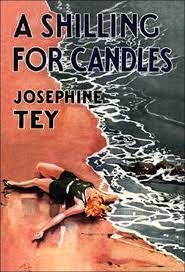
Forgotten Book - A Shilling for Candles


A Shilling for  Candles, published in 1936, was Josephine Tey's second detective novel to feature Inspector Alan Grant. I've mentioned it a couple of times on this blog, in connection with Nicola Upson's novel Fear in the Sunlight, and also as the basis for Alfred Hitchcock's film Young and Innocent, which as I said in a review way back in 2010 is very different from the book - even the murderer and motive are changed!

I first read this novel many, many years ago. I 'm a Tey fan, but I was disappointed with it overall. I think that was because she didn't, in my opinion, pay enough attention to characterising the killer or making the motive credible - and this helps to explain why Hitchcock made so many changes. It's certainly not a 'fair play' novel. However, I decided to give it another try and consider the story in part from a technical perspective - why did Tey make the choices she did, and which of them worked?

The fact that I knew what to expect didn't lessen my enjoyment and the first thing to say is that Tey, as always, writes very well and engagingly. The opening scene, where a coastguard discovers a body on a beach, is very well done. The 'man on the run' aspect of the story, which Hitchcock focused on, is also quite good. The title is intriguing and it refers to a mocking bequest in Christine's will. However, this part of the story rather fizzles out as Tey tries to draw the various strands together. 

The central problem, I think, is that although she came up with some wonderful story ingredients, she didn't think hard enough about how to integrate them into a satisfactory whole. Probably she was writing in a rush, and wanting to get back to her work in the theatre. I suspect she became worried about the thinness of the motivation and as a result decided to portray the killer, in the closing pages, as deranged. I feel that, despite an element of outlandishness, more could have been done to make this crucial part of the story plausible. But the book is not only worth reading - I was very happy to have read it for a second time, despite my reservations.  

Tuesday, 6 July 2010

Peter Robinson


Peter Robinson is now one of the leading crime writers, but he certainly paid his dues. He wrote a good many novels about his series detective, Inspector Alan Banks, as well as an excellent stand-alone, Caedmon’s Song, before his talents were widely recognised. When a publisher finally got behind him, and gave his work the marketing push that had previously been lacking, his sales soared.

I started reading Peter’s books shortly after he was published for the first time. They appealed to me a good deal, because they were to some extent in the vein of the kind of story I fancied writing. Before long, I met Peter at a meeting of the Northern Chapter of the Crime Writers’ Association, probably getting on for twenty years ago. Although he was living in Canada at the time, he was born in Yorkshire, and his stories are mainly set in that county. Banks is based in Eastvale, which is a fictional place in the north of Yorkshire, with elements reminiscent of one or two real-life towns.

In addition to his novels, Peter is a prolific writer of short stories of high calibre. I’ve been listening to an audio version of his short story collection The Price of Love, and I’ll post about this before long. With his short fiction, he ranges widely in his settings and plots, and I suspect that, like many of us, he finds the ‘break’ offered by writing a short story or two helps to keep him fresh in between novels.

I last bumped into Peter a couple of years ago at the Harrogate Festival, at a party to celebrate 21 years of Alan Banks mysteries. It was a lively and well-attended event, and a good illustration of how a writer who keeps working hard may, after a number of years, finally hit the jackpot. Like Ian Rankin, Andrew Taylor and Ann Cleeves, he was by no means an overnight success. But like them, he richly deserves the success he has achieved on the back of a long run of soundly written and entertaining mysteries.