Showing posts with label Julian Symons. Show all posts

Friday, 7 April 2023

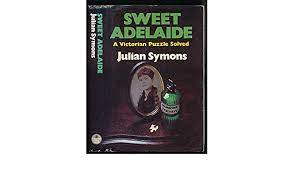
Forgotten Book - Sweet Adelaide


Sweet Adelaide, first published in 1980, was the second of Julian Symons' three Victorian mysteries. He'd deserted the contemporary scene to write The Blackheath Poisonings, which most people agree is the most successful of the trio. The plot of that book drew on elements of a famous real life crime. With Sweet Adelaide, Symons went much further. The eponymous Adelaide is Adelaide Bartlett, who was tried for the murder of her husband in 1886. Symons invents quite a lot of material, but most of the essentials are factual.

In an interesting afterword, he describes this as an 'experimental' novel, trying to cast light on a real life case by filling in the gaps - in this case, most particularly, the precise means by which Edwin Bartlett died. I realise with hindsight that when I wrote Dancing for the Hangman, I was doing something that is perhaps comparable, although in my novel, there was less invented material: I tried to be rigorous in sticking to the established facts, but also to use my imagination so as to try to see things from the point of view of Dr Crippen. For perfectly understandable reasons, Symons felt that he needed to bulk out his own story by introducing a range of elements of his own devising (for instance, an encounter with the Theosophist Madame Blavatsky). Some of these are definitely plausible, some less so.

When I first borrowed this book from a library, shortly after publication, I was very taken with it, partly because I wasn't familiar with the trial and I found his explanation of events interesting. As I've mentioned before, it's a story that casts light not only on the case itself, but on Victorian life. 

On reading the story again, I focused on trying to understand the techniques Symons employed in bringing the story to life. One of his key methods is to juggle timeframes. So we begin with the death of Edwin; then there is a long flashback about Adelaide's early life prior to her marriage. Another method is to juggle point of view. So we have some extracts from Adelaide's journal, but also scenes presented from the perspective of other people in the story, plus third person narrative, mostly but not entirely seen from Adelaide's point of view. 

I suspect that he used these methods to introduce variety and interest and also to help build suspense. After all, anyone who knows the case knows what happens at the trial (though Symons also adds an interesting coda, set in the US many years after the trial). My guess is that he was worried that the story might become a bit mundane if told in an entirely straightforward way. He does his best to solve that problem. 

It's clear that he did a huge amount of research into the case, and on my latest reading of the book, I found myself reflecting that perhaps he packed too much of it into the storyline, resulting in a slackening of tension. His prime concern was to explore Adelaide's psychology and I think this is done fairly well. However, there is quite a lot of medical/technical detail relating to Edwin's health and what precisely happened to him, and although that was crucial to the trial and its outcome, I felt that it slowed down the second half of the book. An interesting novel, certainly, but - for me - not a complete success on a second reading.    


Monday, 11 April 2022

A Visit to Kent


I had a wonderful time last week on a short but very packed visit to Kent. I was hoping to combine pleasurable socialising with research into some aspects of British crime writing heritage, but I didn't know exactly what to expect. As things turned out, I met some truly delightful people as well as a couple of friends who happen to be crime writers for whom I've a huge amount of admiration.

In Deal - a resort I'd never visited before - I had the pleasure of spending time with Frances Fyfield, a fellow lawyer as well as one of the finest British crime novelists of the past thirty years. She's always great company and an added bonus was that she threw a party for a friend and neighbour which led to my meeting a host of interesting people, including Nick Dear, whose highly successful plays include Frankenstein and whose TV work includes half a dozen episodes of Poirot. Deal obviously has a very cohesive literary community as well as two castles, and I was definitely impressed.

I also had the chance to visit Catherine Aird, who lives just outside Canterbury. Another real pleasure. Catherine is, I'm glad to report, working hard on her latest novel and at the same time turning her mind to the next. The passing years have diminished neither her wit nor the fertility of her imagination - she outlined a plot idea that I felt was really appealing. I wish I'd thought of it...

In addition I had the good fortune to be able to meet friends and family of Julian Symons. This was fascinating and I learned more about a writer in whom I've long been very interested. It was great to see the British Library editions of his books lined up the shelves along with his first editions. And not to mention the Edgars - see below! 

Finally, there was the opportunity for a small amount of sightseeing and I wandered along the front at Walmer (where Symons used to live) and also around the lovely old town of Sandwich. And no, I didn't get to eat a sandwich there... 


Friday, 1 April 2022

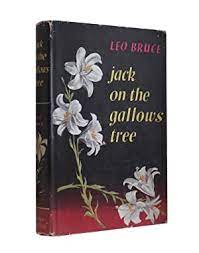
Forgotten Book - Jack on the Gallows Tree


I like Leo Bruce's Sergeant Beef stories, as I've mentioned on this blog a number of times. I haven't, however, talked about his second series, featuring the history teacher and amateur sleuth Carolus Deene. However, the time has come to sing the praises of a 1960 book, Jack on the Gallows Tree. It really is very funny, but at the same time Bruce manages to offer a teasing puzzle about motive as well as whodunit.

Deene has suffered from jaundice and heads off to the resort of Buddington to recuperate. But the real attraction of the place is that there is a teasing puzzle concerning a double murder. On the very same night, two elderly women were strangled. Each was left with a white lily. Plenty of people made have had good reason to kill one of them. But why both, and why on the same night?

There is a lot of pleasure to be had from the minor characters, including the hypochondriac Gilling, the fierce Miss Tissot, the pub landlady who abhors bad language, and two health fanatics, a couple called Baxeter. There are some laugh-out-loud lines. I was also amused by the reference to a book written by Rupert Croft-Cooke - which was Bruce's real name. For good measure, there are witty mentions of two leading crime critics of the day, Julian Symons and Maurice Richardson.

There is one element of the plot that is far from original, but I thought Bruce disguised it pretty well. There are also one or two appealing false solutions and a good climactic scene. For a good blend of mystery and humour, I'd say this book is hard to beat. I really enjoyed it.

Friday, 4 March 2022

Forgotten Book - The Detling Murders aka The Detling Secret


I first read Julian Symons' The Detling Murders not long after its original publication in 1982. It was the third of his Victorian mysteries, following the highly successful (and televised) The Blackheath Poisonings and the very interesting Sweet Adelaide. Both those novels drew heavily on real life nineteenth century murder cases, although they were very different from each other. The Detling Murders was different again - Symons strove not to repeat himself, hence his distaste for series characters - but I remember feeling rather underwhelmed. 

For one thing, if not for the title(which was changed for the US anyway), I'd have wondered if I really was reading a murder mystery. Murder doesn't occur until we are more than half way through the story, while the second killing takes place very near the end of the book. Symons himself felt dissatisfied with the book and decided to go back to writing contemporary mysteries.

On rereading the book, however, I was more impressed. This is partly because Symons' picture of upper class Victorian society is very entertaining in its own right. The Detlings are a fading branch of the landed gentry and Sir Arthur Detling, the head of the household, is almost a caricature of a crusty old reactionary. But the family dynamics are nicely portrayed. The starting point is the news that Dolly Detling wants to marry an up and coming Liberal MP, Bernard Ross, whose background is rather mysterious. Sir Arthur isn't happy, but the couple get their way.

As usual, Symons moves the story along over a period of time, shifting focus from one character to another, so that it's not clear where events are heading. There are some Fenian dynamiters lurking in the background and shady business dealings aplenty. Roderick Detling is a gambler who has run up debts, while Nelly Detling gets herself involved with a dodgy crowd of artists (allowing Symons to write yet another bohemian party scene - he really did like writing those). The plot is carefully constructed, and stronger than I appreciated on a first reading. And as ever with Symons, the book is extremely readable. It ends up with a Christmas family gathering in rural Kent - the sort of scenario which usually opens detective stories rather than closing them. In this part of the book, as earlier, there are some nice comic touches.

The main reason why this book isn't a complete success is, I think, that Symons didn't pay enough attention to the building of tension and suspense. He sets up a series of intriguing situations but there's not as much excitement as many readers expect and indeed demand. Nor is it clear (and this is a problem in quite a few of his books) which member of his ensemble cast of characters is the central protagonist. For me, Bernard Ross is clearly the central figure and I think the story might have worked better if the focus on him had been clearer and more unrelenting. I guess Symons feared that this would reduce the surprise element of his story, but there could have been ways round that challenge. As it is, the murders and their investigation seem more perfunctory than is desirable in a detective novel. So this is a minor Symons, but it's definitely good enough to justify a read. Or two. 


Friday, 28 January 2022

Forgotten Book - Cat and Mouse


 I first read Christianna Brand's Cat and Mouse a very long time ago - probably in the early 80s. I knew Julian Symons had extolled the book in Bloody Murder as her best (I believe he was also a fan of a later novel, The Rose in Darkness) but I confess I was underwhelmed. Having forgotten pretty much everything about the story except for the fact that it's set in Wales, I've had another go. And, as sometimes happens, my judgment this time was considerably more favourable.

I've always been a fan of Brand, but at the same time I've had reservations about some aspects of her characterisation. She does set out, clearly, to create people who are much more than mere ciphers, and that is admirable. The snag, at least for me, is that her characters are often highly-strung and overwrought. Given the nightmare of being involved in a murder case, that's fair enough up to a point, but at times I think Brand overdoes the hysterics so that the angst becomes a bit irritating. That said, I suspect this is a minority opinion, at least among Golden Age fans.

Cat and Mouse is unusual in her repertoire in that it sets out very deliberately to conjure up melodrama. There is an entertaining dedication to 'Mary Lewis' (this was Brand's married name!) which references Northanger Abbey, and this sets the context for the story. What we have here is an overt homage to Austen's splendid novel (I read it as a schoolboy and loved it; time for a re-read) in terms of the melodrama. 

The catalyst for the mystery (which Brand took from a real life incident) is a set of letters received by a journalist on a magazine by a woman who calls herself Amista. It seems that Amista has married a glamorous chap called Carlyon and the journalist, while in Wales, attempts to look up the happy couple. But there is no sign of Amista and it is soon clear that Something Is Up. What follows is a twisty puzzle that is rather unorthodox and, despite those overwrought bits, intriguing and enjoyable.


Friday, 21 January 2022

Forgotten Book - One is One


Miles Tripp is an author who has intrigued me for a long time. His writing was admired by Len Deighton and Julian Symons (who mentioned him in Bloody Murder) and you can't get much better judges than those two, yet he faded into obscurity even while he was still writing, and I've not found many people who have read his books. Reading his 1968 stand-alone One is One reminded me of the quality of his writing, but it's a book which also supplies some clues as to why he never really made it big as a crime writer, despite publishing no fewer than 37 novels, including a series featuring the private eye John Samson.

The early pages of One is One chart a marriage that is seemingly on the rocks. Mark Donaldson is a businessman married to the gorgeous Marie, but her extravagance is driving him into debt. He conceives a wild plan, connected to Marie's potential inheritance, which involves killing an old man in France. At first it seems that he has got away with murder, but there is a witness to his crime...

I found this book extremely readable,while Tripp's insights into character are sometimes compelling. What is more, the story is unusual. It begins as a relatively straightforward variation on the 'inverted mystery' theme and develops into something much more elaborate. There are several surprise twists, some of them involving impersonation.

I haven't been able to find any discussion about this book, or any significant reviews, and I imagine Tripp must have been disappointed that the novel seems to have made little impression. But there are reasons for this. In a nutshell, Tripp was too unorthodox for his own good. We start by following Mark's activities, but the viewpoint keeps shifting and there are a number of flashbacks. I'm not convinced that Tripp found the best way of structuring a rather interesting plot. His chosen method doesn't quite achieve the necessary suspense, and feels a bit disjointed. This is a pity, because he has some interesting things to say about relationships, in particular those involving mutual dependence. All too often, I've found myself frustrated by the way he handled his material. But he could write very well indeed, and his novels, despite their flaws, have an admirable ambition.  

Friday, 17 December 2021

Forgotten Book - The Second Shot

Anthony Berkeley's The Second Shot is rare if not unique among detective novels for being more renowned for its preface than for the substance of its story. In what is really an extended dedication to his literary agent, the legendary A.D. Peters (whose former wife Berkeley married not long afterwards), he argued that 'the detective story is already in process of developing into the novel with a detective or crime interest, holding its reader less by mathematical than psychological ties.' This opinion was quoted with approval by Julian Symons in Bloody Murder and I agree that Berkeley was spot on.

Symons pointed out that in fact this particular novel did much less to demonstrate the point Berkeley was making than did his first Francis Iles book, Malice Aforethought. Again, I agree. Nevertheless, it's a distinctive effort, a Roger Sheringham mystery narrated by Cyril Pinkerton, although Pinkerton certainly isn't a Watson-character. In fact, he's the prime suspect for the murder of loathsome Eric Scott-Davies.

Berkeley's ideas about crime, punishment, and justice were invariably as interesting and often as controversial as his opinions (and he was never short of opinions) about the crime genre. This novel was, along with Gladys Mitchell's Speedy Death, one of the first Golden Age puzzle to tackle head-on - explicitly, rather than by implication - the notion of the 'altruistic crime',  which I explored in The Golden Age of Murder. If you can think of an earlier example, do let me know. Christie, Carr, and others tackled the 'altruistic crime' during the Thirties, but Berkeley led the way.

Apart from Sheringham, the writer Morton Harrogate Bradley, who had appeared in The Poisoned Chocolates Case, pops up in the story, albeit without contributing much. There's also passing mention of Alice Dammers, from the same novel. This novel reflects his habit of fictionalising real life places and people. There's a wonderful map on the endpapers of the crime scene, Minton Deeps, which was based on Berkeley's own Devon home, Linton Hills. I suspect that Paul de Revel and his glamorous wife were based on people in Berkeley's circle (E.M. Delafield and her husband Paul, perhaps?). The same may also be true of Armorel Scott-Davies, who plays a central role in the story. 

The main problem with the novel is that, after a sprightly start, the pace drags. Berkeley's prose is never less than readable, but there is endless discussion about who was where and when. There are compensations in the way Berkeley juggles multiple false solutions, while the final revelation of the culprit is highly characteristic of his ironic approach to crime writing: he gives a fresh twist to a narrative technique that had been around for a few years. This novel was published in 1930, a year that in many ways marked a turning point in the genre. Berkeley was one of those who showed the way ahead, and his influence continues to be felt.   

Friday, 26 November 2021

Forgotten Book - The Criminal Comedy of the Contented Couple


I first read Julian Symons' The Criminal Comedy of the Contented Couple not long after its original publication in 1985. I must admit that I found the title rather off-putting (in the US, it was retitled A Criminal Comedy) and the story didn't really strike a chord with me. I'd forgotten all about the characters and plot by the time I came to reread it the other day. And on the whole, my reaction second time around was much more favourable.

Symons felt it was one of his best books, noting in Jack Walsdorf's bibliography of his work that he found the writing of it unusually smooth, 'with none of my customary back-tracking and elimination of what seem otiose characters'. That said, although the writing is very snappy, with short scenes and multiple changes of viewpoint, there are a lot of minor characters, almost certainly more than necessary for the purpose of the plot. But they contribute to Symons' purpose, which was at least in part to offer a satirical portrayal of bourgeois English life; in that respect the novel now reads like a slice of social history. 

There are plenty of enjoyable vignettes in this story. Most of the events take place in the prosperous town of Headfield, but there are important developments in Venice and on the island of Elba. One character, Jason Durling, is interested in an obscure writer called D.M. Cruddle (here Symons was reworking his brother A.J. Symons' The Quest for Corvo) and also records some events in his diary. An extract from a newspaper article at the start of the book tells us that two mysterious deaths connected with Headfield take place in Venice, but for a long time it's really unclear where the story is heading. On first reading, this irritated me, but this time I felt more sympathetic to what Symons was trying to do. 

What strikes me very forcibly now is that, in a roundabout way, Symons was updating the classic Golden Age novel. Yes, the scourge of the Humdrums was playing the game! I don't think this has been sufficiently appreciated, either by me or by other critics. But consider the ingredients: a spate of mysterious poison pen letters; ingenious use of poison; disguise/impersonation'; literary references aplenty; an amateur detective solving a puzzle that defeats the official police; and even a thinly disguised version of the 'challenge to the reader' beloved of Ellery Queen and various other Golden Age greats, which is put forward in the newspaper article towards the end of the novel. 

To cap it all, there is a pleasingly ironic finale that I'm sure Francis Iles would have approved. I don't claim that this novel is a masterpiece - the build-up is too fragmentary for that - but it's an enjoyable and unexpected piece of work. I'm very glad I gave it a second try.


Friday, 20 August 2021

Forgotten Book - The Plot against Roger Rider


After finding A Sort of Virtue, Julian Symons' final novel, rather a let-down, I went back to one of my favourites among his eclectic works. This is actually the third time I've read The Plot against Roger Rider. First time around was not long after the original publication in 1973, and the plot twist blew me away. The second time was twelve years ago and resulted in one of my early Forgotten Book blog posts. Rather than rehash what I said before, let me take a fresh look at the book's strengths and weaknesses.

The latter were hinted at in Edmund Crispin's review in the Sunday Times, which found 'too many abrupt changes of viewpoint, and a certain amount of peripheral material which seems perfunctory'. Because the story is told from numerous different perspectives (with bits of omniscience added to the mix as a means o building suspense), it isn't easy to find someone to identify with, though young James Paradine eventually emerges as an effective amateur detective. One character's preoccupation with the Russian Royal Family doesn't add anything to the story, an example of that perfunctory peripheral material Crispin mentioned. There's also a brief passage where Symons slips into the present tense for no apparent reason. Today, I think, the main weakness is the treatment of sex and sexual orientation. In this respect, the story seems dated and unsatisfactory. 

In Symons' defence, some of this arises from his use of sexual attraction between characters as a means of misdirecting the reader from what is really going on. And as Crispin says, the novel offers 'considerable rewards - audaciously intricate contrivance, lucid, sinewy prose, characters who spring to life with the first sentence they utter, variegated backgrounds (London, Spain, Sardinia) and a stimulating shock ending whose only fault is that it is possibly a little too frailly prepared.' Is this last remark fair comment? Arguably, but on the whole, I'd say the preparation is sufficient, even though the hints about the truth are rather oblique. The characterisation, as often with Symons, is crisp and generally effective, while the presentation of Spain under Franco is rather interesting.

When reading the book this time, I've focused on the craft of the writer, trying to figure out how Symons set about putting together the disparate ingredients of this complicated mystery.I don't want to give spoilers, because it's a novel well worth reading and the final twist is definitely gasp-inducing and memorable, but my guess is that two of the real life crimes referenced in the text provided important raw material, and that the key concept was that of a 'biter bit' conspiracy. If that's right, he will have had his solution in mind at the outset, and then had to make decisions as to how to build up interest in the relationships between the central characters. I sense that he may have struggled with this - he wasn't entirely happy with the book - and this explains the faults that Crispin identified. But having read the novel three times, I remain a fan.    

Friday, 19 June 2020

Forgotten Book - The Broken Penny


Broken Penny : Julian Symons : 9780552082587

For all my admiration of Julian Symons as a novelist, as well as as critic and historian, one of his novels has always passed me by. Until now, that is. The book in question is The Broken Penny, first published in 1953, and Symons' only attempt at writing a political thriller. In the first edition of his Bloody Murder, Symons invited Edmund Crispin to comment about his writing, and Crispin - though positive generally - was less than enthusiastic about the book. I suppose that may have influenced me.

More recently, I discovered, to my surprise, that Symons had quite a soft spot for the novel, so I thought I'd give it a go. And I was even more surprised to discover that it's a good book, far superior to a good many thrillers I've come across. Interestingly, it seems that Symons based the central character, Charles Garden, very vaguely on George Orwell...

Garden is a man of 45, and has a history of political radicalism, although the war has left him somewhat disillusioned. It is the post-war period, when the map of Europe has been redrawn, and it seems that a small country - not named, but shaped like a broken penny - may offer a foothold for Britain and its allies who are concerned by the power of Russia. A man named Arbitzer from that country is now based in Britain, and he is seen as a suitable leader for a movement of insurgents.

Against his better judgement, Garden is persuaded to join Arbitzer and his family as they return to the Broken Penny, but the planned revolution rapidly unravels. A tale of one double-cross after another unfolds. It's all done rather excitingly, and it's not like any other Symons novel. I was impressed. The Broken Penny is a book of its time, but it's an entertaining story which deserves to be better known.


Friday, 29 May 2020

Forgotten Book - I Love, I Kill

I Love, I Kill, is an absurdly lurid title for a book that isn't at all lurid, by a writer of considerable discernment, John Bingham. It's a novel of psychological suspense and my copy has a cover blurb from Julian Symons praising the subtlety and psychological penetration of his best fiction. This book, however, was published in 1968, at a time when Bingham's powers were beginning to falter. It's extremely interesting (I even found its flaws rather interesting), but I don't think it ranks with his best.

The story is told in the first person and framed, so that the narrator is speaking in the present and looking back on events of the past. We know that someone called Paul King has been killed but we don't know why or by whom. Most of the story takes the form of extended flashbacks as the narrator, Charles Maither, looks back to his first meeting with King, a fellow actor, and how King married the woman that Charles loved, another actor called Shirley. Charles then explains how he conceived a highly elaborate plan to win Shirley back.

It's not a spoiler to say that the plan was for Charles, in his new role as a publicity agent, to help King (a vain and handsome man with limited talent as an actor) to become a success, so that King became bored with dull old Shirley, leaving the way clear for Charles to reclaim her. Of course, things don't go quite the way that Charles planned.

In Michael Jago's interesting biography of Bingham, he says that the publishers were worried that they might be sued for libel by Richard Burton. Maybe Bingham revised the book to address this, because King didn't remind me of Burton at all. Jago also says that the publishers' reader found parts of the story boring. Because I like Bingham's crisp, readable style, I did not have that problem with the book. He was a genuinely engaging stylist in my opinion. A fairer criticism is that he lacked in-depth knowledge of the theatrical background, but on the whole I felt he did enough to make the setting credible.

I did, however, struggle with the premise. Bingham simply didn't make me understand Charles' obsession about Shirley. She is not terribly interesting at any point in the story, while Charlie is unpleasant and at times surprisingly stupid - a big disadvantage with a first person narrator. As for his plan to make Charlie famous and thus get hold of Shirley, I thought it crazy. Nor did the resolution of the murder plot, handled in a very casual way, satisfy me. The structure was clearly designed to build tension - or rather to overcome the inherent lack of tension in the story, but it didn't really work for me. There are some good scenes in which the police interrogate Charlie, but here Bingham was simply repeating what he'd done in more successful books such as My Name is Michael Sibley.

All in all, I can understand why this book didn't do particularly well on its first appearance, and why it has since slipped out of sight. So why did I rather like it, despite its manifest failings. The answer, as I say, is because Bingham knew how to write readable prose and was a talented storyteller. Even though this story isn't a strong one, I raced through it, rather than giving up because I was frustrated by Charlie's behaviour. Which has to be a positive sign.   


Monday, 9 March 2020

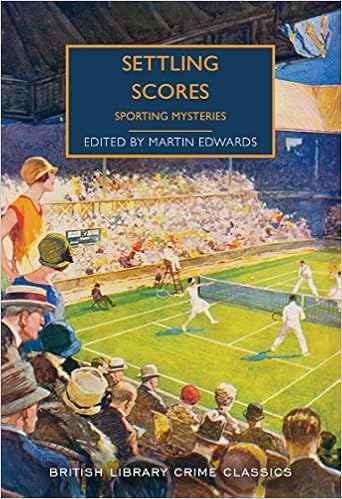
Settling Scores


Tomorrow sees the publication in the UK of my latest anthology in the British Library's series of Crime Classics. The unifying theme of Settling Scores is not revenge, but sport. Each story is not only by a different author, but it features a different sport. I'm not aware of any other crime anthology which is quite the same; there was a splendid book edited almost 80 years ago by Ellery Queen, Sporting Blood, but that one included poker, chess, and butterfly collecting.

I'm often asked what my favourites are among my own books - assuming that I do have favourites. Well, I never release a book on an unsuspecting world unless I'm happy with it, and it seems worthy of publication. And naturally it's a matter of personal and professional pride to try to make sure that each book is as good as it possibly can be. That said, inevitably there are books which give rise to different feelings - especially after a lapse of time. And different levels of satisfaction too.

Among my British Library anthologies, I'm especially proud of Foreign Bodies, because of its ambition, and several others, such as The Measure of Malice, strike me as interestingly different from the general run of anthologies. And Settling Scores is right up there, partly because there are some fascinating stories, and partly because I find it intriguing to see how different authors have set about integrating a sporting background into their narrative. I'm hopeful the book will do well.

So what of the specific contents? There's a long story by Julian Symons, set around Wimbledon, and a characteristically accomplished one by Celia Fremlin which is a bit different because it concerns a school sports day. And then there are stories by little-known figures such as F.A.M. Webster, David Winser, and Gerald Verner. Each of these three men, by the way, had a very interesting life, and I recently read a biography of Verner by his son Chris which I'm hoping will be published fairly soon. In the meantime, if you like sport, or if you hate sport but love crime fiction, do consider giving Settling Scores a try...


Friday, 10 January 2020

Forgotten Book - The Marriage Bureau Murders

My interest in John Bingham and his work has led me to cover quite a few of his books in this blog over the past year or so. I admire the originality of his approach to crime fiction, while his ironic storylines made him, along with Julian Symons, the most important successor to Francis Iles of his generation. It's no surprise to me that Iles the critic also admired Bingham. As novelists, they were both risk-takers. And as my regular readers will know, I do like a crime writer who is prepared to avoid formula and take a few risks. Nobody could sensibly accuse John Bingham of being formulaic. Although certain elements recur, each book he wrote strikes me as pleasingly different from its predecessor.

Taking risks doesn't, alas, necessarily pay off. Bingham could write in a very readable style, but his unorthodox plots often depend on coincidences outlandish even by the standards of our coincidence-rich genre. His literary style involves a good deal of authorial intervention: too much for my taste. And occasionally his attitudes strike me not merely as dated but also as a bit odd.

The Marriage Bureau Murders was published in 1977, when his crime writing career was more than a quarter of a century old. He should have been at his peak, but I'm afraid this is a novel of a writer whose powers are in serious decline. It's a pity, because there's a very dark and unusual idea (about a voyeur of murder) at the heart of the story which, although exceptionally tricky to handle, might drive a powerful work of crime fiction.   

This book, however, is a misfire. Sidney Shaw sets up a "friendship bureau" as a means of getting his kicks, but what happens after he chances upon a sociopath who signs up with his bureau is so odd and unlikely that I found the whole bizarre business hopelessly unconvincing. Of course it's reasonable to ask readers of a crime novel to suspend their disbelief - I do so myself in books like Gallows Court, and so do many of my colleagues - but there must be a limit. There are plenty of stabs at black humour, and I suspect that Bingham was trying for the mood of Symons' first two "Man Who..." books, but although I'm a fan of black comedy, it doesn't really work here.

So I was disappointed with this novel, and can't recommend it. Even at the time of its appearance, the critics weren't impressed. Edmund Crispin, who liked Bingham and his work, described it as a "nadir", and I'm not surprised. Despite Bingham's past achievements, it sold few copies and I don't think it's ever been reprinted. Many of his books definitely deserve a second look. This one certainly has curiosity value, but not much else.

Friday, 20 September 2019

Forgotten Book - Dear Laura


Image result for dear laura jean stubbs

The rise of the historical mystery can be dated to the 1970s (although some good examples were written much earlier). An especially strong Victorian crime story is Dear Laura by Jean Stubbs. So good, in fact, that it was nominated for an Edgar. It remains, I think, the outstanding achievement of a capable, Manchester-born author whose wrote a variety of books including a short series featuring the Victorian cop Inspector Lintott. She wrote some novels directly inspired by real life crimes, but this is a story of her own invention.

This is a Lintott novel, and he is called in following receipt of anonymous letters which suggest that Theodore Crozier, a Wimbledon businessman (he runs a toymaking business; I was slightly sorry not to hear more about this) whose death has been attributed to natural causes was in fact murdered. Hid body is exhumed, and sure enough it emerges that he was killed by a fatal dose of morphine.

We are presented with a classic emotional triangle. Crozier was a cold man, and his attractive young wife Laura, having presented him with three children, is fed up with their marriage. Consolation is supplied by her brother-in-law Titus, a ladies' man who is charming but feckless. Lintott, affable but remorseless, probes their affair and also puts the servants of the house under the microscope.

The upstairs-downstairs relationships are very well done, and there's an especially powerful presentation of a cruel nanny. There are lashings of period detail, and just occasionally the painstaking research shows itself a bit too obviously. But overall, it's very well done, and the story progresses in leisurely but engaging fashion. Lintott is an extremely good character, very well portrayed. I'd rank this, alongside Julian Symons' The Blackheath Poisonings among others, as one of the most enjoyable Victorian history-mysteries.

Friday, 21 June 2019

Forgotten Book - Obelists Fly High


Image result for obelists fly high

I first came across the name of C. Daly King in Julian Symons' Bloody Murder. Symons was notoriously dismissive of many Golden Age writers, although he admired Anthony Berkeley and Agatha Christie, and he clearly had a sneaking affection for King's work. I think he recognised that although King's stories were usually quite barmy and riddled with flaws of various kinds, there was something breathtaking and at times admirable about the sheer outrageousness of his use of the tropes of the classic whodunit. My feelings are much the same.

Symons felt, and again I agree, that King's most notable novel was Obelists Fly High. When introducing a 1980 reprint for Collins Crime Club (which had published several of King's books - first editions are rare and much sought-after by collectors; the jacket image comes from Mark Sutcliffe's site), he summed it up as "one of the most extraordinary detective puzzles of the twentieth century". It was the third of the "obelist" books, each of which involved a bizarre killing aboard a particular form of transportation: the first as on board ship, the second on a transcontinental express, and this one on an aeroplane.

There are three diagrams, one of them a plan of the plane. Then comes a "schedule of reported movements" of the passengers, because this is one of those books where timings and whereabouts of suspects are key. And finally there is a "schedule of actual movements", whose contents are naturally rather different. But there is more. The book begins with an epilogue. And it ends with a prologue. King was one of those writers who played games with the structure of the whodunit, and I'm sure Borges would have approved.

There is also a "cluefinder", a device I really love. Basically, it ties in with the idea of "fair play" in detection, and highlights clues in the text that the reader may have missed. It's sometimes been said that King originated the "cluefinder", which isn't the case, although the example in this book is my favourite. J.J. Connington came up with one before King turned to fiction, and his example was followed by others, including Freeman Wills Crofts. If there was an earlier pioneer of this device than Connington, I'd be interested to know, but I'm not aware of one. (Similarly, whilst other writers have begun their books with an epilogue, has anyone else ended with a prologue as well?)

What of the story? Well, it involves a threat to kill a famous surgeon. Michael Lord, King's series cop, is tasked with guarding the surgeon, but suffice to say that he doesn't make a good fist of it. There is plenty to cringe about in the story, quite apart from Lord's bungling, and King's habit of giving his characters jokey names is especially irksome. He doesn't ramble quite as much as in some other books, but his habit of inserting his own idiosyncratic opinions in his stories is also rather challenging to a modern reader. So it is undeniably a flawed novel. But if you are fascinated by the structure and techniques of the Golden Age mystery, as I am, it is a must-read.

Friday, 24 May 2019

Forgotten Book - Night's Black Agent

John Bingham's seventh novel, Night's Black Agent, was published in 1961. In Michael Jago's excellent biography of Bingham, it doesn't get a particularly warm write-up, as Jago focuses on aspects of the story that test the suspension of disbelief. There are indeed some coincidences and unlikely incidents. Julian Symons, however, greatly admired the novel, and I think that it's my favourite of all the Binghams I've read.

We're told right from the start who wishes to kill whom and (at least in part) why. The would-be killer is a journalist (as Bingham once was) and the proposed victim, a man known as Green, is not only a blackmailer who ruins lives, but also a sociopathic sex killer. In other words, it's a book in the tradition of Francis Iles' Malice Aforethought. But the story follows an unusual path, effectively with two major digressions to explain the background before a climax in Norway. It's a relatively short book, and I found it compelling.

I was lucky enough to acquire a copy that Bingham had inscribed to Joe Gaute, a publisher and expert on true crime. The dust jacket bears a laudatory quote from none other than Francis Iles, in respect of one of Bingham's earlier novels, and I'm sure Iles must have been impressed with this one too, since Bingham tackles a favourite Iles theme - how can we do justice, when the legal system proves inadequate to meet the task?

The title of the book is taken from Macbeth, but it's also a punning reference to Bingham's secret service work - he was a member of Maxwell Knight's team of spies, known as Knight's Black Agents. But this isn't a spy novel. It's a study of crime and character, and even if the Bad Guy is thinly characterised, the portrayal of his victims is done with considerable skill. I really enjoyed this book, and I recommend it warmly, coincidences and all.

Friday, 17 May 2019

Forgotten Book - The Name of Annabel Lee

Julian Symons' books are an eclectic mix, and this is as true of his novels as of his non-fiction. The Name of Annabel Lee, first published in 1983, is one of his later works, and I've enjoyed it on each of the three occasions that I've read it over the past thirty years. As the title suggests, there's a Poe connection, and indeed Symons wrote a biography of Poe. The story also draws upon a year that Symons spent teaching in the US, where the early scenes are set.

Dudley Potter is a pleasant British academic who has relocated to the US for reasons which are at first not clear. He's an introverted character, but when he meets a beautiful young woman who introduces herself as Annabel Lee, he is instantly hooked. They enjoy a passionate affair, but then she leaves suddenly, and he determines to find out what has happened to her.

His quest takes him back to England, where he stays with an old friend and his wife. The pal is a lawyer who, by a striking coincidence (or is it?) acted for Annabel Lee, who is due to inherit a large sum of money. Dudley's search takes him to the Yorkshire coast, although I found these scenes less convincing than the rest of the book; I'm not convinced Symons really "got" Yorkshire. There's also a plot issue that seemed to me not to be in keeping with the fair play tradition.

However, it's a good story. Not up there with the best of Symons, but a highly readable example of his second-tier work. The experienced detective fiction fan will, I think, figure out what is going on, but I enjoyed studying Symons' technique for pulling the wool over the reader's eyes. And Dudley's obsessive search for the girl of his dreams is in itself intriguing.

Friday, 10 May 2019

Forgotten Book - The Accident of Robert Luman

The Accident of Robert Luman was published in 1988. The author, David Fletcher (a pen-name for Dulan Barber) died in the same year. He was only 48. Fletcher's tragically early death probably explains why his work has been neglected in recent years. Another reason for that neglect is that he didn't create a major series character (although this novel introduces a cop called DS Jolley, who appeared in Fletcher's last two novels). He was a well-regarded novelist in his day, but I'm pretty sure that he'd have developed further had he lived, and he might well have become a doyen of the genre.

This novel is interesting on several levels. First, it's a "whowasdunin". An introductory section reveals that a murder of extraordinary savagery has been committed - but we don't know the identity of the victim. This aspect of the story is intriguing, though it's not Fletcher's main focus - and I think it's fair to say that the victim isn't characterised in great depth, a weakness of the story.

Second, it's a novel of psychological suspense, a gripping tale which reads in some respects like an updating for the 80s of the work that John Bingham and Julian Symons were doing twenty or thirty years earlier. Fletcher builds the tension as he shows a young man being trapped in a web of suspicion. In fact, in some respects, this book is a development from his previous novel, On Suspicion - but it's a superior work.

And one of the reasons why it's superior is that Fletcher presents a very interesting picture of a brain-damaged character, Robert Luman himself. I'm not sure that I can think of an earlier, more convincing portrayal of a character with a severe mental disability - if you can, please let me know! In recent years, several authors have tackled a comparable challenge with great success: one thinks of books like Elizabeth is Missing and The Curious Incident of the Dog in the Night-Time. Fletcher's novel is not quite as impressive as either of those two books, but I thought it a highly readable piece of work. 

Friday, 29 March 2019

Forgotten Book - Murder Plan Six


Image result for john bingham murder plan six

John Bingham's Murder Plan Six, first published in 1958, is an unusual book. Julian Symons, who was friendly with Bingham, and lauded several of his novels, found it "esoteric", and not in a good way. It's an extremely interesting piece of work, and it begins with a dedication, to Bingham's publisher Victor Gollancz, in which he denies that he is "anti-police" and talks about his ambitions as a crime novelist.

Even more interestingly, Bingham introduces Gollancz as a character in his novel. What is more, Gollancz doesn't just take a bit part - his role is important from start to finish. Nor does Bingham succumb to the temptation which may have struck some novelists over the years, and murder his publisher... I did find this aspect of the book thought-provoking, but I can't envisage ever putting any of my publishers into my fiction - assuming they continue to behave themselves, of course!

Much of the story takes the form of recordings sent to Gollancz by one of his novelists, who is known as Michael Barlow. Barlow, like some of Bingham's other protagonists, seems to be a rather weak-willed individual. His wife is killed in a car crash, and he starts an affair with a married woman he met on holiday. But when the woman encourages him to kill her husband, matters take a dark turn.

I thought this book began splendidly, but later on, some of the contrivances (and Barlow's endless soul-searching) began to get on my nerves. I applaud Bingham's determination to be different, and to explore character, but I suspect that sometimes he found it a struggle to combine these qualities with entertainment. Yet it must be said that the tension builds pretty well. I didn't enjoy this as much as some of his other books, but it did fascinate me.

Friday, 1 March 2019

Forgotten Book - Purloining Tiny

John Franklin Bardin was an American author whose brief career would have been deeply obscure had it not been for the advocacy of Julian Symons. Symons praised Bardin's first three novels in Bloody Murder, and in the mid-Seventies facilitated their being reprinted as a Penguin omnibus volume, which I devoured as soon as I could lay my hands on it. I shared Symons' enthusiasm for Bardin's work. The three books are very interesting examples of psychological suspense writing in the aftermath of the Second World War - pre-dating Patricia Highsmith, among many others.

The attention that the omnibus gained seems to have galvanised Bardin to resume his writing career in earnest, and he published another crime novel in 1978, with the characteristically odd title of Purloining Tiny. However, it wasn't a success, and copies are hard to find. It's only in relatively recent times that I've had the chance to read it.

The book has attracted one or two enthusiastic admirers over the years, and Dorothy Salisbury Davis said that it was "bizarre, wicked and wonderful". It also bears, on the back cover, a rather carefully worded blurb from Stanley Ellin, who described it as "certainly one of the strangest mystery tales I have ever read." As he says, the story focuses on "the perverse and shadowy wish-fulfillments of its astonishing characters". These are, it has to be said, not exactly words of undiluted praise.

I think Ellin got it right. It's a very odd book, about a glamorous young woman, a famous contortionist no less, who is kidnapped and held captive in an apartment by her long-lost father. At the time, I suspect it was seen as a cutting-edge example of a crime novel involving kinky sex. As with the earlier Bardin books, but to an even greater extent, incestuous desires play an important part in the story. For me, it simply didn't work. Really, it reads like an over-the-top pastiche of those early, intriguing novels. A major disappointment, I'm sorry to say.