Showing posts with label ellery queen. Show all posts

Wednesday, 9 November 2022

'Darling Lorraine', Paranoia Blues, and The Adventures of the Puzzle Club


I first became aware of Josh Pachter back in the early 80s, when I came across his anthology Top Crime. I learned that, in addition to being a meticulous anthologist, he is a short story writer of considerable accomplishment. Many years later, I met Josh and his wife Laurie and discovered that they are terrific companions - one of the downsides of the pandemic is that I've not been able to meet up with them in person for several years.

But we remain in regular contact. Josh was a great help when I was working on the anthology Foreign Bodies and some time ago I had the chance to contribute to a new anthology that Josh was putting together. The connecting theme was that each story would be inspired by a Paul Simon song, though only one song per album could be chosen. I've been a huge Paul Simon fan since my teens. He's a great performer, and a quite wonderful songwriter (and did you know that he once did demo records for Burt Bacharach? Timeless classics such as 'Gotta Get a Girl', later recorded by Frankie Avalon? Suffice to say that both Paul and Burt went on to do much better work!) 

To cut a long story short, I finished up writing a story called 'Darling Lorraine'. The inspiration came from a fascinating visit to the house of a crime writing friend. The building is unique and very appealing and the grounds and local setting are just as intriguing. I felt they would make a terrific setting for a story and the Paul Simon spark was all I needed to come up with a plot. 

And now the anthology has just been published. It's called Paranoia Blues and although I haven't received my copy yet, I'm really looking forward to seeing the other stories, penned by writers ranging from Edwin Hill and Gabriel Valjan to Tom Mead. And as if that were not enough, Josh has also got a new book out via Crippen & Landru. The Adventures of the Puzzle Club combines original snappy mysteries by Ellery Queen and new ones in the same manner by Josh himself. I've made a tiny contribution to the book, but the stories are the thing, and they are great fun.


Monday, 9 March 2020

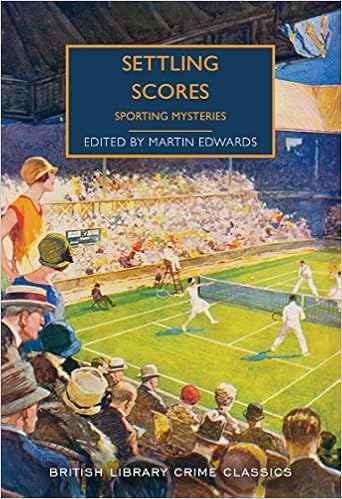
Settling Scores


Tomorrow sees the publication in the UK of my latest anthology in the British Library's series of Crime Classics. The unifying theme of Settling Scores is not revenge, but sport. Each story is not only by a different author, but it features a different sport. I'm not aware of any other crime anthology which is quite the same; there was a splendid book edited almost 80 years ago by Ellery Queen, Sporting Blood, but that one included poker, chess, and butterfly collecting.

I'm often asked what my favourites are among my own books - assuming that I do have favourites. Well, I never release a book on an unsuspecting world unless I'm happy with it, and it seems worthy of publication. And naturally it's a matter of personal and professional pride to try to make sure that each book is as good as it possibly can be. That said, inevitably there are books which give rise to different feelings - especially after a lapse of time. And different levels of satisfaction too.

Among my British Library anthologies, I'm especially proud of Foreign Bodies, because of its ambition, and several others, such as The Measure of Malice, strike me as interestingly different from the general run of anthologies. And Settling Scores is right up there, partly because there are some fascinating stories, and partly because I find it intriguing to see how different authors have set about integrating a sporting background into their narrative. I'm hopeful the book will do well.

So what of the specific contents? There's a long story by Julian Symons, set around Wimbledon, and a characteristically accomplished one by Celia Fremlin which is a bit different because it concerns a school sports day. And then there are stories by little-known figures such as F.A.M. Webster, David Winser, and Gerald Verner. Each of these three men, by the way, had a very interesting life, and I recently read a biography of Verner by his son Chris which I'm hoping will be published fairly soon. In the meantime, if you like sport, or if you hate sport but love crime fiction, do consider giving Settling Scores a try...


Friday, 9 November 2018

Forgotten Book - The Shop Window Murders


The Shop Window Murders Hardcover  by

Vernon Loder had been out of print for many years before Collins' Detective Story Club reissued The Mystery at Stowe, an engaging novel with an introduction by Nigel Moss, whose knowledge of Golden Age fiction is exceptional. I rather liked that book, and was pleased to see that Loder's 1930 novel The Shop Window Murders has been reprinted in the same series, again with a valuable introduction by Nigel.

The opening of the book is striking and memorable. Mander's Department Store (loosely based on Selfridge's) in the west end of London is renowned for its elaborate window displays. So much so that each Monday morning, crowds gather to watch the blinds being raised to reveal the latest display. Unfortunately, on this occasion, they see a human corpse nestling among the wax mannequins. To make matters worse, a second body is quickly discovered.

All this is enough to put a damper on any retail activity, and the store is closed while the investigation is conducted. Enter Devenish of the Yard, a shrewd and likeable fellow (I'm a little surprised that the prolific Loder did not turn him into a series character). As Nigel Moss says, Devenish is in the mould of Crofts' Inspector French, while one of the killings prefigures a crime in a later novel by two leading authors, published not long after Loder's death at the early age of 57.  Loder's real name, incidentally, was John George Hazlette Vahey, who wrote under other pen-names (including Henrietta Clandon - this was an unusual example of a male Golden Age author using a female pseudonym).

Nigel Moss points out the similarity between the opening situation of this book, and that in The French Powder Mystery, an Ellery Queen novel published in the very same year. A remarkable coincidence, as he says, and it may be one more example of the way certain story ideas seem to be "in the ether" at a particular time. I've been looking forward to having the chance to read this book since I read a laudatory review on John Norris' excellent blog four years ago. I'm not quite as much a fan of the story as are John and Nigel, because I found the solution frustratingly dependent on guesswork. The early chapters seem to me to be the best. But I'm delighted that this hitherto obscure novel is now readily available. 

Friday, 3 August 2018

Forgotten Book - The Greek Coffin Mystery

Ellery Queen's name lives on today mainly through the wonderful mystery magazine which bears his name, and I suspect that there are plenty of modern readers who are unfamiliar with the Ellery Queen novels. Yet the books written by Ellery Queen (a pen-name for two cousins) and starring a young and brilliant amateur detective whose father was, conveniently, a cop, made a huge impact during the Golden Age, and for decades afterwards. It's interesting, however, that when I give talks about Golden Age fiction, I'm sometimes asked if there were any American counterparts to Christie, Sayers, and company. Mention of Ellery Queen's name is often greeted by blank faces.

The Greek Coffin Mystery, first published in 1932, was the fourth Queen novel, and is widely regarded by connoisseurs of Golden Age fiction as a classic example of the cerebral whodunit. There is a cast of characters - 33 of them, plus six staff detectives, are named. There is a foreword, explaining that this case occurred very early in Ellery's sleuthing career. There's a map of the location of the main action. There are two floor plans. There is a jaunty "challenge to the reader". There are no fewer than four elaborate solutions to the mystery put forward at various times. And there is a contents list which reveals that the initial letters of the chapter titles form an acrostic, giving the title of the book and name of the author. What more could any Golden Age fan want?

A elderly, blind Greek art dealer and collector dies of heart failure at his residence in New York. But was he blind? Did he die of natural causes? These questions spring instantly to mind, but aren't really central to the mystery. A missing will - another classic Golden Age ingredient - certainly is, and so is the discovery of the body of someone who is undoubtedly a murder victim.

The plot twists and turns, and it almost goes without saying that it's very cleverly constructed. That long list of characters is a clue to one of the story's flaws - there are so many people in it that it's not entirely easy to keep them all straight in one's mind, and it's certainly impossible to care about the fate of most of them. And I do find the early Ellery a bit wearisome - he became more human and, to my mind, more appealing in later books. But if it's an ingenious plot you're after, this novel certainly delivers.

Friday, 4 July 2014

Forgotten Book - Death in the Dark

Death in the Dark by Stacey Bishop is today's Forgotten Book. I've been hunting for it for a good many years - I first heard of it when I read Julian Symons' wonderful history of the genre, Bloody Murder, a book which interested me in a great many books and writers of which I'd never previously heard (in part because their books weren't in my local library). The book was published in 1930, but is extremely rare. I'm glad I've finally managed to read it, though to buy a copy would be beyond my budget - in fact, so obscure is it, that I've never seen a copy for sale.

As Symons indicated, it's an extraordinary book, written by an extraordinary man. Stacey Bishop was a pseudonym for Georges Antheil, a controversial American avant-garde composer who was a great fan of Stravinsky, and also a good friend of Ezra Pound and T.S.Eliot. Stravinsky and Pound get generous mentions in the story, while the book's UK edition was published by Faber, a company with which Eliot was very closely connected.

The book begins in dazzling fashion, setting out a summary of what is to happen (an impossible crime is included) in a tantalising way that is almost impossible to resist .In classic fashion, we're also provided with a plan of the apartment in which the first shooting (in a series of them) takes place. The story is told by Stacey Bishop, who acts as a Dr Watson to the brilliant sleuth Stephan Bayard.

There are, I am sure, a lot of in-jokes in this story, most of which were lost on me. Bishop has a great deal to say about modern music, and I'm sure he was paying off old scores. There's a touch of S.S. Van Dine and Ellery Queen in the complexity of the problem, but the small and thinly characterised circle of suspects didn't appeal to me very much. I found the whole thing fascinating but highly eccentric and the interest of this book lies in its oddity, its rarity and the remarkable nature of the author rather than in the excellence of the plot. I'm delighted I found it, though, and I'm very grateful to the kind person who made it possible. Symons mentioned a rumour that there was a second Stacey Bishop book, but there's no evidence to suggest that Antheil ever returned to the genre. One thing is for sure, if he had written another crime story, it could not have been much stranger than this one.

Friday, 21 February 2014

Forgotten Book - Calamity Town

Ellery Queen was one of the great American exponents of the classic whodunit, and Calamity Town, first published in 1942 is a book that marked a departure from his elaborate mysteries of the Thirties. Here he is aiming for a more realistic style, reflected in the setting of Wrightsville, the small town where Ellery arrives incognito one day. He rents a house in order to write in peace and quiet. But of course he becomes involved at once in mysterious goings on.

The Wright family gave their name to Wrightsville,but mystery surrounds Nora Wright, a woman who was mysteriously abandoned by her husband-to-be just before her wedding. Three years later, he turns up again, and they are happily reunited. This time the marriage does take place, and for a while, all seems to be well. But is it? I must say that if I'd been in Wrightsville at the time, I'd have wanted to know more about the reasons for Jim Haight's absence, but even Ellery seems relatively incurious....

The discovery of some rather odd letters seems to suggest that Nora's life is at risk. In due course, murder follows. It appears that the wrong person was killed, but the finger of suspicion points firmly at Jim Haight. There is a lengthy and enjoyable trial scene, and more than one twist. Queen the author manages to juggle suspicion neatly, and the result is a satisfying mystery.

Although this book marked a new direction for Ellery Queen, there is no doubt that he owed quite a debt to the leading British Golden Age writers, whom he much admired. I spotted plot devices used previously by that trio of giants Agatha Christie, Anthony Berkeley and Dorothy L. Sayers. But Queen was clever enough to blend the ingredients in a new and satisfying way. The result is a tasty dish, and I'll be coming back for more Ellery Queen before long.

Saturday, 15 October 2011

Curtain and Take My Breath Away


Kerrie Smith, of Mysteries in Paradise, whom I was so pleased to meet at Crimefest, suggested I contribute to the celebrations of the anniversary of Agatha Christie's birth 121 years ago, and I'm very glad to do so.

Curtain, the last Hercule Poirot novel, boasts a fascinating modus operandi. Agatha Christie explicitly gives a nod of gratitude to a play by Shakespeare and another by the rather less celebrated St John Ervine. In both plays, the same pattern of murderous behaviour is deployed. She had briefly toyed with the idea earlier, in the excellent Peril at End House. Its sheer cleverness has always appealed to me, but I agree with Robert Barnard’s verdict on Curtain. ‘For a long-cherished idea…this is oddly perfunctory in execution’. In particular, the murdererer’s character, crucial to the whole concept, is inadequately portrayed.

For years, I thought about reviving the idea. But how to do it? In the end, I decided that the secret lay in a combination of a law firm setting and a dose of political satire. The result was Take My Breath Away, published in the UK some years ago but only just now published in the US by Five Star. It marked a complete departure from my earlier books about the lawyer-detective Harry Devlin. Given that I was building upon foundations laid by Christie and the Bard, I am ashamed to say that it took me two and a half years, and endless re-writing, to produce the book. But I like to think that at least the effort was worth it.

And an odd thing happened while I was writing the novel; I received a book which featured Ellery Queen’s plot outline for a novel never actually published, The Tragedy of Errors. It boasts the same central concept. Like Christie and like me, Ellery Queen makes due acknowledgment to the inspiration that he drew from the Bard. As I understand it, Curtain was written before, but not published until after, The Tragedy of Errors plot was concocted. Great criminal minds thinking alike? I'm sure it wasn't plagiarism on Queen's part.

Wednesday, 16 February 2011

Langtail Press


Langtail Press is a new kid on the block so far as publishers go. It’s a venture run by James Prichard, and it produces print on demand traditional format books and e-books.

What is special about Langtail is the list of titles, which include many ‘forgotten classics’. For instance, there are several titles by Anthony Berkeley, the brilliant plot-twister of the Golden Age and founder of the Detection Club.

Other authors on the list so far are three of the great American crime writers – John Dickson Carr, Ellery Queen and Fredric Brown. All of them fascinating novelists, all brilliantly ingenious. I am reading one of them now and will review it before long.

James told me: ‘I set up the business about a year ago, with the general idea of bringing out of print books back to life. I started with crime books because a) it is a genre I love and b) because they lend themselves to this publishing model: the writers were prolific, the books are short, readers are many, voracious and completists, and there is a good community on the web. I approached a few agents and, possibly to my surprise, I got some really great authors quite quickly...I have about 50 titles available currently, and am now desperately trying to gather more titles for publication early in the Summer. Part of the difficulty with this as a project is tracking down the rights for the authors: some Estates (mostly it is Estates, not authors) have agents, but some do not and tracking these down is not easy (though fun).'

More power to his elbow!


Monday, 6 September 2010

Solving Mysteries


The world of mystery readers divides into two broad categories – those who like to try to solve the mystery themselves, before the solution is revealed, and those who simply enjoy the story and make no serious effort to work out what is going on. Many people I know, including some crime writers, are in the latter camp, but I’m firmly in the former group.

In the Golden Age of complicated plots and ingenious if unlikely solutions, I suppose many readers liked to figure out the answer to the puzzle, and this was why Ellery Queen introduced the Challenge to the Reader in his early books – an idea taken up, as I have mentioned recently, by Rupert Penny in The Talkative Policeman and some of his later mysteries. Agatha Christie set her challenges less explicitly, though she usually managed to ‘play fair’ with the reader by giving a variety of clues to the answer. Her great gift in this respect was a matchless ability to disguise her clues. Information is supplied so surreptitiously that you may not notice you are receiving it. Her ability to misdirect truly matched any conjuror’s.

Penny couched his Challenge like this: ‘At this point the intelligent reader, if he has not already done so, should be able to attempt the solution of the problem with every prospect of success by taking thought, eked out where necessary with a guess or two...The less intelligent reader may perhaps be allowed to guess first and think afterwards, always provided that he does not shirk the thinking...nothing can too strongly express condemnation of those who use guesswork alone....’

Plainly, he had his tongue in his cheek when he wrote this, and generally, there’s a sense of fun about Penny’s writing that gives it an enduring appeal. For my part, as an author, I do like to set an implied challenge to readers who want a puzzle to solve, by offering clues to motivation and hidden secrets during the course of the narrative. Of course, plenty of my readers aren’t interested in this aspect of the stories, preferring to focus on the characterisation, setting and evocation of a particular society at a particular point in time, but that is fine by me. A writer of mysteries is in the business of entertainment, and it’s possible to entertain on a number of different levels. Rupert Penny and some of his contemporaries focused too heavily on things like train timetables for the taste of modern readers. But the fact that the genre has moved on doesn’t mean that there isn’t much pleasure to be had, both for writers and readers, in plots with fairly clued puzzles .

Saturday, 19 June 2010

Margot on short stories versus novels


Margot Kinberg needs no introduction to readers of her insightful blog, ‘Confessions of a Mystery Novelist’ or her two novels, Publish or Perish (great title!) and B-Very Flat. Her blog posts are not merely regular but detailed and very skilfully conceived, leaving the rest of us in awe at her industry as well as her depth of knowledge. She also manages to find time to be an associate professor in San Diego.

I greatly appreciate her comments on this blog, and I’m delighted she has agreed to contributed a guest post today, as part of her current blog tour, on the pros and cons of short stories as compared to novels. Over to Margot...

‘First, thank you, Martin, for your kind invitation to guest blog. I am truly honored. One of the appealing aspects of crime fiction is that it can take any number of forms. Many crime fiction authors focus on one of those forms or subgenres (e.g. police procedurals, psychological thrillers, historical crime fiction, and so on). Mastering even one of those subgenres or forms takes talent. There are some authors, though, who’ve mastered more than one form of crime fiction. That requires even more talent and hard work, since crime fiction is not the same across the genre. For example, let’s consider crime fiction short stories versus crime fiction novels.

In novel form, a well-written crime fiction story usually involves solidly-developed characters, a strong plot that keeps the reader guessing, and the buildup of tension and suspense as the story goes on. Crime fiction short stories, though, are quite different in some ways. For one thing, there’s little opportunity to develop characters, so the author has to let the reader know as much as possible about the character in a very efficient way. Also, there’s little opportunity for the buildup of tension and suspense. The author has to convey the suspense with far fewer words. There are other differences, too, of course. The linear approach to telling a story that can work well for a short story can be quite unsatisfying in a novel. The slow buildup of tension that can make a novel unforgettable is too slow for the short story. Given these differences, most authors choose one or another of these forms of crime fiction. Some, though, master both.

Arthur Conan Doyle is perhaps best known for his short stories, especially the fifty-six short stories in which his sleuth, Sherlock Holmes, features. However, Conan Doyle also wrote four Holmes novels. In fact, Holmes first appears, not in a short story, but in the novel A Study in Scarlet. In that novel, Holmes and his new room-mate, Dr. Watson, discover the murderer of Enoch Drebber and his friend, Joseph Stangerson, who’ve been staying in the same rooming-house. At first, Drebber’s murder is blamed on his landlady’s son, since Drebber had been making advances on the boy’s sister. But then, it looks as though Stangerson may be guilty. When Stangerson, too, is murdered, Holmes looks into both men’s histories, and the clues that connect the deaths. He finds that Drebber’s murder and that of Stangerson are connected with their past lives. Conan Doyle wrote three other Holmes novels, as well as other novels of historical fiction and numerous other novels and stories.

Agatha Christie is usually remembered for her novels, in particular those featuring her sleuths Miss Marple, Hercule Poirot and Tommy and Tuppence Beresford. However, she also wrote several short story collections. Some of them, such as The Labors of Hercules, Partners in Crime and The Thirteen Problems feature her famous sleuths. Other collections of her stories, though, have featured other characters. One of the most memorable of Christie’s short stories is The Witness for the Prosecution, which appears in The Witness for the Prosecution and Other Stories. In that story, Leonard Vole is tried for the murder of wealthy Emily French, who befriended him without knowing that Vole was married. Vole’s attorney wants to enlist Vole’s wife, Romaine, as a defense witness, but in one of the story’s many twists, she plans to appear as a witness for the prosecution. Romaine Vole’s reasons for appearing for the prosecution (and, of course, the outcome of the trial) make for compelling reading.

The writing team of Frederic Dannay and Manfred Bennington Lee, better known as Ellery Queen, wrote dozens of Ellery Queen novels from 1929’s The Roman Hat Mystery through 1971’s A Fine and Private Place. While a few of those novels didn’t feature Ellery Queen himself, the vast majority of them did. The prolific “Queen team” also wrote several short story collections featuring Queen. One of their more famous short stories is The Adventure of the One Penny Black, in which Queen solves a baffling series of thefts. Several copies of the same book have been stolen from the owners. At the same time, there’s been a robbery of a very valuable stamp from the collection of the Ulm brothers, a pair of stamp collectors. In an interesting twist, Queen finds out how these events are all tied together.

Ross McDonald, who created the famous private investigator Lew Archer, was also talented both at novels and short stories. In the course of his career, McDonald wrote nearly twenty novels featuring his empathetic but world-weary private detective. Many consider Lew Archer to be one of the groundbreaking characters in the genre. McDonald was also the author of several Lew Archer short stories, including The Singing Pigeon. In that story, Archer’s on his way back to Los Angeles from Mexico when he decides to stop for the night at the small, family-owned Siesta Motel. All is not as peaceful as it looks at the hotel, as Archer finds out when he discovers that there’s been a murder there. He also discovers that the murder is connected to the disappearance of a young woman he met at the hotel. McDonald wrote other short stories, too, that don’t feature Archer.

And then there’s Ed McBain, the author of the very popular 87th Precinct series featuring Detective Steve Carella. He, too, is well-known for his novels, but he’s also written several short stories. One of them is One Down, the story of Ben, a traveling sales representative who finds a unique way to deal with his domestic complications. This and McBain’s other stories are an interesting departure from his 87th Precinct series, but they still have his distinctive style.

Ruth Rendell has also carved a literary niche for herself as a novelist and as a short story writer. She is, of course, the author of the popular Inspector Reg Wexford series of novels. She’s also written several standalone novels, both as Ruth Rendell and as Barbara Vine. Novels such as From Doon With Death (Rendell) and A Dark Adapted Eye (Vine) have established Rendell’s reputation as a novelist. She’s also, though, written several collections of short stories. Her stories have the same intensity that her novels do and she’s been able to create memorable scenes and characters with them. For instance, in Catamount, which appears in Piranha to Scurfy and Other Stories, we meet Nora and Gordon, who visit their friends, Carrie and Chuck, who live in the Rocky Mountains. Over the course of several visits, Nora finds that she has a certain fear of how big and even un-tamed everything is. It turns out that her fears are justified when a severe storm strikes the area where she’s staying on the same night that Chuck falls ill and desperately needs medical assistance. As we follow Nora’s attempt to help her friends, we see how Rendell explores the psychology of fear.

I would be more than remiss not to mention the contributions my talented blog host has made both to the world of crime fiction novels and the world of crime fiction short stories. Martin Edwards’ Harry Devlin novels and Lake District novels have justly received commendation. They feature strong characters, engaging plots and unexpected twists and turns. His recent novel, Dancing For the Hangman is a fascinating fictional look at a real-life murder case, the Crippen case, from the point of view of Crippen himself. He’s written other novels and non-fiction as well. But Edwards is also an award-winning short-story writer. Some of his stories feature his sleuth, attorney Harry Devlin. Others don’t. For instance, in 24 Hours from Tulsa, we meet Lomas, a sales and marketing director for whom the world is changing so fast that he’s struggling to survive in it. His children have grown up so fast that they’re nearly strangers to him. He’s found out his wife’s been unfaithful. His company is putting more and more pressure on him and his colleagues to keep increasing sales in a world where people are purchasing online. Even the traffic patterns are no longer what they used to be. Lomas’ stress at having to deal with this new world is causing some people, including his boss, to think he’s “losing it,” and that only adds to Lomas’ anger, resentment and, in a sense, bewilderment at what’s happening around him. We feel Lomas’ increasing rage and fear as, desperate to retain some control over his life, he takes a drastic step.

Writing crime fiction stories in any form can be challenging. Writing different forms of crime fiction takes particular flexibility and talent, and I salute those who accomplish this successfully. Which are your favorite authors who write both novels and short stories?

Thanks once again, Martin, for your hospitality.’


Tuesday, 8 December 2009

Collaboration


It’s trite to say that writing is a solitary occupation, but it’s usually true. However, there is more scope for collaborative writing than is often appreciated, and I must say that I very much enjoy writing in collaboration, and I've written several books (including one novel, The Lazarus Widow) with one or more other writers. After all, if it worked for Rodgers and Hammerstein, Lennon and McCartney and Bacharach and David, why can’t it work with novels?

In the crime genre, there have been quite a few notable writing teams over the years. Two cousins working together made the name of Ellery Queen famous, while in Britain, the names Manning Coles and Francis Beeding concealed pairs of writers. In the 60s and 70s, Maj Sjowall and Per Wahloo wrote the Martin Beck series, while in the States, two female writers combined to produced the finance-based Emma Lathen mysteries. Behind the pseudonyms of Patrick Quentin, Jonathan Stagge and Q. Patrick hid Hugh Wheeler – better known later for his work on musicals – and a variety of associates. Dick Francis collaborated with his wife Mary on his racing thrillers, although her name did not appear on the books – it’s different now that he is writing with his son.

Nowadays there are plenty of examples of writing teams. Nicci French is a notable husband and wife pairing, while Charles Todd writes with his mother Caroline. There are even crime writing twins – the Mulgray Twins.

‘Round-robin’ novels involve an especially elaborate form of collaboration, where a story is told by a succession of different authors. The Detection Club’s The Floating Admiral is a very famous example, but there are plenty of others, including a 19th century curiosity, The Fate of Fenella, whose contributors include Conan Doyle and Bram Stoker. Intriguingly enough, I was asked a while back to contribute to a round-robin novel. Whether it will see the light of day, I’m not sure – but it’s an appealing idea.

Friday, 14 August 2009

Forgotten Book - The Lucky Policeman


Although I didn’t contribute to Patti Abbott’s series of Forgotten Books when I was sailing in the Med last Friday, I was busy at the time sitting in the sun and devouring a minor classic of the past which deserves to be highlighted this week.

Rupert Penny is a British writer who flourished briefly just before, and at the start of, the Second World War. He wrote convoluted puzzle stories in the best traditions of classic Golden Age detective fiction – and then he disappeared from sight (at least as a crime writer – a lover of flowers as well as ciphers and puzzles, he spent time working in Bletchley and he later became a doyen of the British Iris Society.)

Penny’s books were published in the UK by Collins Crime Club, but have become very scarce and expensive. Happily, that excellent publisher Ramble House has brought out several of his books, and supplied my copy of The Lucky Policeman. Suffice to say that it is the most enjoyable Penny novel I have read so far.

The set-up is excellent. An American shrink, Hilary Peake, has come to England and set up a private asylum (oddly, to my mind, it only has two patients, one of whom plays no effective part in the mystery, rather dashing one of my own theories about the puzzle.) When Simon Selby escapes from his quarters and disappears, we are presented with a variant on the ‘locked room’ concept, but matters take a more serious turn when a series of murders take place in the New Forest nearby. The local police are duly baffled, and send for Penny’s regular detective, the likeable Inspector Beale. Beale, as usual (although inexplicably) is accompanied by his pal and personal Watson, Tony Purdon, though Tony doesn’t play much of a part in the story.

There is a direct challenge to the reader to guess what has happened – shades of Ellery Queen and C.Daly King. I confess that I fell for Penny’s red herrings and got the solution wrong .The explanation for the mystery is cunning, if inevitably far-fetched and all in all this was wonderful holiday reading. Ramble House deserve heartfelt congratulations for making this lost classic available to modern puzzle fans at a very reasonable price.

Tuesday, 30 June 2009

George Dies Again


Friday evening saw me visiting Carlisle Library, to host another Victorian murder mystery evening when the question again was asked – 'Who Killed George Hargrave?' There was a large audience, which engaged admirably with the puzzle, and Paul Kimberley ultimately proved himself the best detective in Carlisle. The actors who played the suspects, from the Green Room company, were extremely good – the person who took the role of the culprit in particular put in a truly exceptional performance.

I’ve hosted more than twenty of these mystery events now, and typically, I find they attract much bigger audiences than conventional talks or panels with other writers. Why is this? I think it’s to do with the interactive element – people like the idea of being involved in solving a mystery. It’s not the prizes that matter to them, I’ve learned, as much as the sheer fun of taking part. One is reminded of those whodunits, very popular in the Golden Age, where writers such as Ellery Queen overtly set a ‘Challenge to the Reader’. But perhaps today more of us than in the past prefer to play the game in person rather than as readers.

One of the incidental pleasures of these events involves the people you meet. On Friday, a former client of mine showed up together with her partner – it was great to see her again. And the library staff were terrific – top marks for their period costume!

A special word of thanks to Helen Towers, the Reader Development Officer for Cumbria Libraries, who looked after me superbly. She has a large area to cover, and does a great deal of driving in her job, which must be hard work, but her enthusiasm is infectious – and her efficiency admirable.

Thursday, 25 June 2009

GMOTD


The latest issue of Arthur Vidro’s crime fanzine Give Me That Old-Time Detection has just arrived. It is similar to CADS, although being less well-established, it is shorter and tends to include more reprinted contributions and fewer original pieces of research. There is, among many other items, a piece of mine which originated in this blog.

A short piece by Francis M. Nevins announces a forthcoming documentary about Ellery Queen (although, since it is being produced for Japanese TV, I’m not sure whether it will be available in an English-speaking version.) The next issue of the magazine will focus on Ellery Queen.

Among many pleasing items, there is another instalment of Marvin Lachman’s study of mystery stage plays. A Charles Shibuk review heaps praise on a book called A Funeral in Eden by Paul McGuire (1938) - I have never heard of either book or author, but it sounds intriguing. And the merit of magazines such as this is that they lead one to fresh and fascinating discoveries.

The cover is marvellous. It was drawn by the Golden Age crime novelist Stuart Palmer, author of The Penguin Pool Murder, and features a variety of penguins posing as famous detectives. A 1950 article by Palmer, ‘Some of My Best Friends’ entertainingly describes his enthusiasm for penguins and describes Sherlock Holmes as a ‘super-penguin’.

With that teaser, I shall say no more. I hope it encourages one or two people to seek out the magazine, because Arthur Vidro’s enterprise and enthusiasm for classic crime fiction deserves support.

Sunday, 19 October 2008

Janet Hutchings and EQMM


One of the real highlights of my trip to Baltimore was to be invited to lunch by Janet Hutchings, the editor of ‘Ellery Queen’s Mystery Magazine’. We originally met ten years ago, when the first US edition of one of my novels was published, and I visited New York ahead of a trip to the Philadelphia Bouchercon, and it was lovely to see her again.

Janet has published a sizeable number of my stories in EQMM over the years and I’m grateful to have such a connection with a marvellous short story magazine that now enjoys legendary status within the genre.

Janet also introduced me to an American crime writer I hadn’t come across before – Melodie Johnson Howe (lower photo.) Melodie turned to crime (fictionally) after a career in acting, and I’m keen to check out her work.

Incidentally, Melodie is married, as she says, to a legend – the record producer Bones Howe. Bones produced one of my favourite sixties songs of lost love – ‘One Less Bell To Answer’, written by the great Burt Bacharach, who featured yesterday in an interview in 'The Guardian', and whose latest concert at The Roundhouse is to be televised on the BBC on Tuesday night (just as well because I couldn't get a ticket...) The title of that song, by the way, is one I fancy using for a crime story one of these days.