Showing posts with label The Floatng Admiral. Show all posts

Wednesday, 15 June 2016

The Sinking Admiral


Tomorrow sees the official publication of the Detection Club's first collaborative novel for more than half a century. The Sinking Admiral was masterminded by Simon Brett, and is the work of fourteen members of the Club, including me. There's a launch, incidentally, this evening at Goldsboro Books in Cecil Court, London. Do come along if you are in the area; the launch is from 6 pm for an hour or so.


The book is, as its title implies, to some extent a homage to The Floating Admiral, the classic round robin mystery which the Club's founder members produced in 1931. But it's very much a contemporary mystery, with plenty of touches of humour (you'd expect nothing less from a gang of contributors that includes Simon, Ruth Dudley Edwards, and Len Tyler).


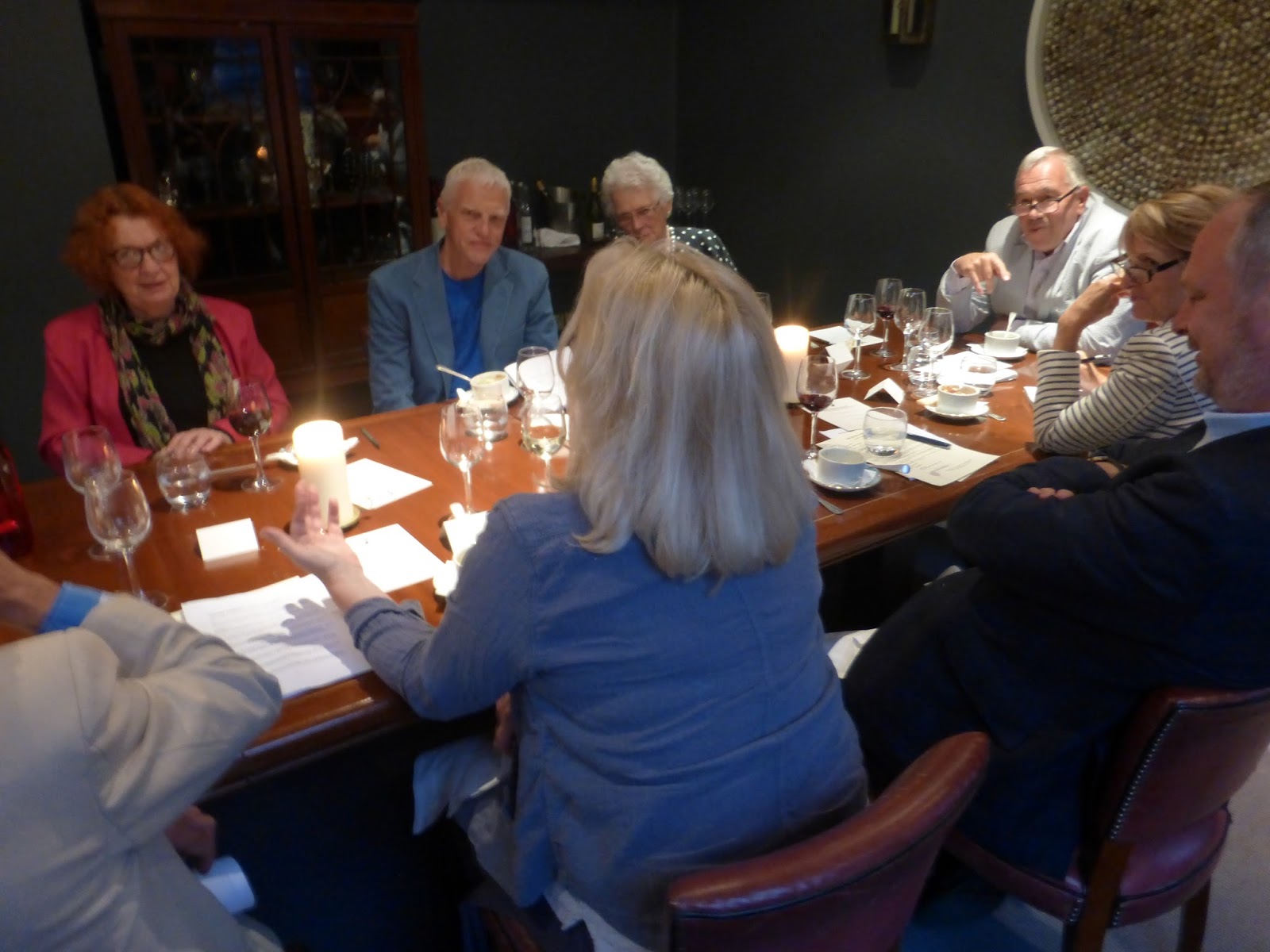
I contributed one chapter, and found it fun to write. Equally entertaining were the sessions we had - usually in pubs, it has to be said, when we were planning the storyline (you can see that some of the plot complications caused Janet Laurence momentary despair, but needless to say, she sorted them out).. However, we did reach a point, with a couple of chapters to go, where we still had not decided on the solution. Simon duly organised an unforgettable dinner at the Groucho Club where we worked it all out, and elected two brave souls to do the necessary writing.


Harper Collins are the publishers, and I think they've done a lovely production job: I really like the cover artwork, and the reality of publishing is that such things do make a difference to the way in which a book is perceived in the trade, and by readers. More than that, this is an unusual and innovative novel. Whilst it's not to be taken too seriously, of course, I'm very optimistic that it will supply lovers of twisty, light-hearted mysteries with a great deal of entertainment. .


Tuesday, 29 March 2016

The Folio Society and The Floating Admiral

About thirty years ago (blimey!) the Folio Society commissioned me to write an article for its magazine "Folio" about Raymond Chandler's literary style. This accompanied a lovely set of Chandler's books, which still has pride of place on top of my bookshelves, close to where I'm typing this blog post. The set sold well, and there was a second edition a few years later. Over the years since then, I've added a few more Folio Society editions of crime novels to my collection. They are always highly attractive.

And now the Folio Society have reissued The Floating Admiral by the Detection Club, in a beautiful new edition with lovely illustrations by Mark Thomas. I've picked out one of them to head this blog post. All in all, this edition strikes me as highly collectible.

The book also boasts a brand new intro from Simon Brett, which is characteristically witty and enjoyable. The enduring appeal of this "round robin" detective novel is clear. And members of the Detection Club are very much hoping that our latest collaborative novel, The Sinking Admiral - not a sequel to the original, but in some ways a homage to it - will also find an appreciative audience. It will be published in June. Can't wait!

Wednesday, 2 September 2015

The Whodunit Dinner and The Sinking Admiral


Right at the end of The Golden Age of Murder, I make passing mention of a new Detection Club project. This is a novel in the tradition of the Club's 1931 classic The Floating Admiral, a round-robin story written by "certain members of the Detection Club". The new book is to be called The Sinking Admiral, and again it is written by "certain members of the Detection Club" - including me.

This project has been masterminded by Simon Brett as President, and participating in it has been hugely enjoyable. I'm glad to say that the book has now been completed, and that it will be published next year by Harper Collins, who have already enjoyed great success in recent years with reissues of earlier Detection Club books, including Ask a Policeman and The Anatomy of Murder.

When Simon first mooted the project, a group of members volunteered to take part, and although one had to drop out for health reasons, unfortunately, someone else stepped in to take her place.The early stages of planning took a considerable time, but once we had the publishing contract signed, the deadline concentrated our minds, as it usually does with writers. We've had a number of meetings to discuss the project as it proceeded, and when the summer arrived, the book was in a pretty decent state.

We did not, however, know whodunit! So Simon, who has put a great deal of energy and skill into the whole exercise, organised a wonderfully enjoyable Whodunit Dinner at the Groucho Club - not far away from the site of the Detection Club's original premises in Gerrard Street - and as well as having a highly convivial time, we worked out a solution, and who would write it. (The menu above is signed by the contributors who were present, although a few could not make it.) It must rank as one of the most memorable occasions of my writing career. Wild horses would not, of course, drag any more information out of me about the story at this stage, but it's fair to say that we are both relieved and happy about the way the project has turned out. It's been tremendous fun, and we are very much hoping that readers will find the book is a lot of fun, too.


Thursday, 14 April 2011

The Detection Club Archivist


I'm proud to say that the Detection Club has appointed me as its archivist. Given that I have been fascinated by the history of the crime fiction genre for more years than I care to remember, this is not only an honour, but a role that I'm sure I will find rewarding.

Appropriately enough, a good deal of detective work is bound to be required. Although many crime writers are fascinated by history, only a minority take an interest in the details of the evolution of their genre, and information about the early days of the Club in particular is very hard to come by. To a large extent, this is perhaps understandable for a social group whose main objective has always been simply to have a few convivial dinners each year. Looking back, however, it would be fascinating to know more about the discussions and relationships between people like Agatha Christie, Dorothy L. Sayers, G.K. Chesterton, Anthony Berkeley and Hugh Walpole.

To this day, there is continuing uncertainty in many quarters about when the Detection Club actually came into existence. For example, the club's own list of members suggests that it started up in 1932, but that cannot be right, since it published The Floating Admiral in 1931. In fact, I'm pretty sure that it began "officially" in 1930.

I'm keen to gather material for the archives, and if any readers of this blog can help, I'd be delighted to hear from them.


Sunday, 7 February 2010

A New Floating Admiral?


Round robin detective novels fascinate me. I’ve mentioned before the round robin books produced by the Detection Club, such as The Scoop, Behind The Screen, Ask a Policeman and most notably The Floating Admiral. These were stories written by a group of writers, with one person kicking off the book with an opening chapter, and then others developing the story in turn.

I’ve now fulfilled an ambition by participating in a round robin book of this kind. It’s not complete at present, though, and subject to confidentiality, so I can’t say too much about it – but it’s not a product of the Detection Club this time.

A question that is often asked is whether such books are planned in advance. Certainly, the project in which I’ve participated has not involved pre-planning – everyone has made it up as they have gone along! I was asked to contribute the sixth of ten projected chapters and I found it a very enjoyable experience. The fact that I have in the past finished The Lazarus Widow, which Bill Knox began, stood me in good stead.

Will the project see the light of day? I really hope so, and all being well it will happen, because a number of much more eminent writers than me are involved. But one thing is for sure. I really don’t envy the person who has to write the final chapter and bring all the strands of the story together!

Tuesday, 8 December 2009

Collaboration


It’s trite to say that writing is a solitary occupation, but it’s usually true. However, there is more scope for collaborative writing than is often appreciated, and I must say that I very much enjoy writing in collaboration, and I've written several books (including one novel, The Lazarus Widow) with one or more other writers. After all, if it worked for Rodgers and Hammerstein, Lennon and McCartney and Bacharach and David, why can’t it work with novels?

In the crime genre, there have been quite a few notable writing teams over the years. Two cousins working together made the name of Ellery Queen famous, while in Britain, the names Manning Coles and Francis Beeding concealed pairs of writers. In the 60s and 70s, Maj Sjowall and Per Wahloo wrote the Martin Beck series, while in the States, two female writers combined to produced the finance-based Emma Lathen mysteries. Behind the pseudonyms of Patrick Quentin, Jonathan Stagge and Q. Patrick hid Hugh Wheeler – better known later for his work on musicals – and a variety of associates. Dick Francis collaborated with his wife Mary on his racing thrillers, although her name did not appear on the books – it’s different now that he is writing with his son.

Nowadays there are plenty of examples of writing teams. Nicci French is a notable husband and wife pairing, while Charles Todd writes with his mother Caroline. There are even crime writing twins – the Mulgray Twins.

‘Round-robin’ novels involve an especially elaborate form of collaboration, where a story is told by a succession of different authors. The Detection Club’s The Floating Admiral is a very famous example, but there are plenty of others, including a 19th century curiosity, The Fate of Fenella, whose contributors include Conan Doyle and Bram Stoker. Intriguingly enough, I was asked a while back to contribute to a round-robin novel. Whether it will see the light of day, I’m not sure – but it’s an appealing idea.