Showing posts with label Edmund Crispin. Show all posts

Friday, 29 October 2021

Forgotten Book - Shadow Show


Shadow Show, published in 1976, was the final book of Pat Flower's career. I've talked about Flower a few times in my blog, because although today she is an obscure figure, she is an author who interests me. Born in Britain, she spent most of her life in Australia, and after a number of detective novels she concentrated on novels of psychological suspense. Even in her hey-day, she was never high profile in her native land, but her later books appeared in the Collins Crime Club and Edmund Crispin was among the critics who admired her work.

Shadow Show is a novel of suspense and paranoia. Richard Ross, the protagonist, is essentially an innocent who finds himself entangled in a web of crime and coincidence. He is a young accountant in an export business and he suspects one of his colleagues, Athol Cosgrove, of corruption. But he dithers, characteristically, before doing anything about it, and his hesitation proves costly.

Before long, he is being treated as a prime suspect in a murder case. He tells a number of lies to try to protect himself, and inevitably sinks deeper into the mire. He has a lovely wife, Laura, but their marriage has been affected by the death of their young daughter, and although he is good at his job, and liked by his boss, his involvement - and growing obsession - with the deeply unpleasant Cosgrove is investigated by a shrewd and painstaking cop called Forrest. 

Kate Jackson has previously reviewed this book and I agree with her that Ross is something of a wet blanket. His irritating naivete is the reason we don't sympathise with him quite as much as would be desirable if we were to become deeply absorbed by his troubles and deeply anxious about his fate. The challenge for an author writing a book of this kind is to persuade us that the unwise choices made by the protagonist were somehow inevitable, and this is easier said than done. Several times during the story I found myself groaning about Ross's errors of judgement.

And yet. This book does have something that kept me engaged throughout. Pat Flower was a highly capable storyteller and the very last sentence in the novel, nicely under-stated, is genuinely chilling and impressive. It is a terrible tragedy that, the year after the book appeared, Pat Flower - who had long been troubled by poor health - took a fatal overdose. Her work is definitely worth a look. 

Friday, 20 August 2021

Forgotten Book - The Plot against Roger Rider


After finding A Sort of Virtue, Julian Symons' final novel, rather a let-down, I went back to one of my favourites among his eclectic works. This is actually the third time I've read The Plot against Roger Rider. First time around was not long after the original publication in 1973, and the plot twist blew me away. The second time was twelve years ago and resulted in one of my early Forgotten Book blog posts. Rather than rehash what I said before, let me take a fresh look at the book's strengths and weaknesses.

The latter were hinted at in Edmund Crispin's review in the Sunday Times, which found 'too many abrupt changes of viewpoint, and a certain amount of peripheral material which seems perfunctory'. Because the story is told from numerous different perspectives (with bits of omniscience added to the mix as a means o building suspense), it isn't easy to find someone to identify with, though young James Paradine eventually emerges as an effective amateur detective. One character's preoccupation with the Russian Royal Family doesn't add anything to the story, an example of that perfunctory peripheral material Crispin mentioned. There's also a brief passage where Symons slips into the present tense for no apparent reason. Today, I think, the main weakness is the treatment of sex and sexual orientation. In this respect, the story seems dated and unsatisfactory. 

In Symons' defence, some of this arises from his use of sexual attraction between characters as a means of misdirecting the reader from what is really going on. And as Crispin says, the novel offers 'considerable rewards - audaciously intricate contrivance, lucid, sinewy prose, characters who spring to life with the first sentence they utter, variegated backgrounds (London, Spain, Sardinia) and a stimulating shock ending whose only fault is that it is possibly a little too frailly prepared.' Is this last remark fair comment? Arguably, but on the whole, I'd say the preparation is sufficient, even though the hints about the truth are rather oblique. The characterisation, as often with Symons, is crisp and generally effective, while the presentation of Spain under Franco is rather interesting.

When reading the book this time, I've focused on the craft of the writer, trying to figure out how Symons set about putting together the disparate ingredients of this complicated mystery.I don't want to give spoilers, because it's a novel well worth reading and the final twist is definitely gasp-inducing and memorable, but my guess is that two of the real life crimes referenced in the text provided important raw material, and that the key concept was that of a 'biter bit' conspiracy. If that's right, he will have had his solution in mind at the outset, and then had to make decisions as to how to build up interest in the relationships between the central characters. I sense that he may have struggled with this - he wasn't entirely happy with the book - and this explains the faults that Crispin identified. But having read the novel three times, I remain a fan.    

Friday, 19 June 2020

Forgotten Book - The Broken Penny


Broken Penny : Julian Symons : 9780552082587

For all my admiration of Julian Symons as a novelist, as well as as critic and historian, one of his novels has always passed me by. Until now, that is. The book in question is The Broken Penny, first published in 1953, and Symons' only attempt at writing a political thriller. In the first edition of his Bloody Murder, Symons invited Edmund Crispin to comment about his writing, and Crispin - though positive generally - was less than enthusiastic about the book. I suppose that may have influenced me.

More recently, I discovered, to my surprise, that Symons had quite a soft spot for the novel, so I thought I'd give it a go. And I was even more surprised to discover that it's a good book, far superior to a good many thrillers I've come across. Interestingly, it seems that Symons based the central character, Charles Garden, very vaguely on George Orwell...

Garden is a man of 45, and has a history of political radicalism, although the war has left him somewhat disillusioned. It is the post-war period, when the map of Europe has been redrawn, and it seems that a small country - not named, but shaped like a broken penny - may offer a foothold for Britain and its allies who are concerned by the power of Russia. A man named Arbitzer from that country is now based in Britain, and he is seen as a suitable leader for a movement of insurgents.

Against his better judgement, Garden is persuaded to join Arbitzer and his family as they return to the Broken Penny, but the planned revolution rapidly unravels. A tale of one double-cross after another unfolds. It's all done rather excitingly, and it's not like any other Symons novel. I was impressed. The Broken Penny is a book of its time, but it's an entertaining story which deserves to be better known.


Wednesday, 27 November 2019

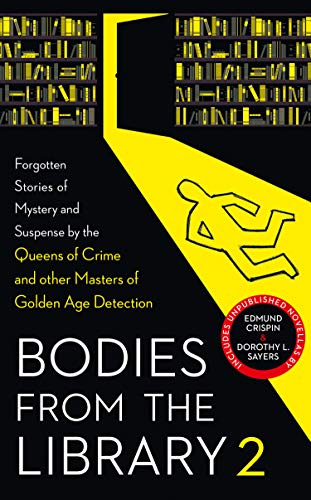
Bodies from the Library 2, edited by Tony Medawar


The title and contents of this HarperCollins anthology are inspired by the Bodies from the Library conference, which has for the past five summers been held at the British Library and brought together fans of Golden Age detective fiction from all over the world. Tony Medawar, who has been researching the genre for a good thirty years, has conceived the idea of a series of books gathering stories (and radio plays) which he has, in many cases, rescued from obscurity.

Tony is a particular expert on Agatha Christie and the first Bodies book included an excellent rare story by the Queen of Crime. She features again in this book, which I think represents an advance on its predecessor in terms of the overall range and quality of content. There are two particular stand-out contributions, one a long-lost Lord Peter Wimsey story and the other a novella by Edmund Crispin. Rare finds indeed.

The Dorothy L. Sayers story is called, simply and splendidly, "The Locked Room". There is, arguably, a question mark over one aspect of the plot, which may explain why the story (which evidently dates from the late 20s) wasn't included in the Wimsey collections. It's a mystery to me why Crispin's "The Hours of Darkness" disappeared from sight. It's a very pleasing case for Gervase Fen, which is not even mentioned in David Whittle's magisterial biography of Crispin.

The other contributions are a very diverse assortment. So there's a story by S.S. Van Dine,and three others by American authors: Clayton Rawson, Jonathan Latimer (not an author normally associated with the Golden Age, a term which has to be interpreted broadly in the context of this book), and Q. Patrick, whose work in various incarnations I've always enjoyed. The Patrick story is also a novella.

There are several other notable names in the book, such as Margery Allingham and E.C.R. Lorac, but I particularly liked "No Face" by Christianna Brand and the characteristically amusing "Before and After" by Peter Antony. There's even a previously unpublished play by John Rhode, "Sixpennyworth", which Tony speculates may have been written for a local am dram group.

Friday, 15 February 2019

Forgotten Book - The Client

I was first drawn to Martin Russell's books many years ago, when I started borrowing them from my local library. His crime novels were a Collins Crime Club staple, and I very much enjoyed the clever plots. I think it's fair to say that characterisation wasn't his main interest, but his ingenuity was impressive. He continued to publish into the 1990s, and is still alive, though I've never met him, which I rather regret.

One day recently, while going through some old crime fiction reviews written by Edmund Crispin, I came across a rave review for Russell's 1975 novel The Client, and I decided to give it a go. It's an unusual stand-alone novel of psychological suspense - although Russell did create a series character, the journalist Jim Larkin, he didn't last long - and my impression is that the author was here aiming to create a more in-depth psychological portrait of a damaged individual, while preserving the mystery element.

Two men and one woman are drawn to a house in Streatham by an advertisement placed by a solicitor. They all had connections to a young and apparently wealthy woman, Susan Bradshaw, who dreamed of becoming a model. But Susan is dead (or is she? nothing can be taken for granted in this story) and she has given the solicitor some very curious instructions, which must be followed to the letter.

It soon becomes clear that the three people who have been summoned all played a negative part in Susan's life. Something sinister is going on, but we can't be sure exactly what it is. As usual with Russell, the story is told fluently, and the pages keep on turning. I wasn't convinced that the ending lived up to the premise, and I didn't love the book quite as much as Crispin did - but even so, its originality was impressive. Well worth seeking out. 

Sunday, 16 September 2018

Eyewitness - 1956 film

I didn't have particularly high hopes when I settled down to watch Eyewitness, a 1956 British B movie, on Talking Pictures. But I liked the music that accompanied the titles, and soon discovered that it was written by Bruce Montgomery (better known as Edmund Crispin).  A plus. And then I saw the script was written by Janet Green, who was also responsible for those excellent screenplays, Sapphire (which won an Edgar) and Victim. A definite plus. What's more, the cast was excellent, packed with good actors of the period.

The film proved to be excellent, taut and highly entertaining. It must rank as one of the finest achievements of the director, the under-estimated Muriel Box. The suspense is maintained throughout, but there are also plenty of nice touches, including quite a bit of social comment and comedy, that make the watching experience very enjoyable. I'm surprised it isn't better known.

At the start, Jay Church (Michael Craig) buys a television on hire purchase, infuriating his wife Lucy (Muriel Pavlow, actually a former girlfriend of Edmund Crispin). The couple argue, and she storms out of the house, and goes to watch a film to simmer down. Becoming bored, she leaves her seat in the cinema, and chances upon an armed robbery. Two crooks (Donald Sinden and Nigel Stock) are robbing the manager's safe, but the manager turns up unexpectedly. While Barney (Stock, a future TV Dr Watson) chases Lucy, Wade (Sinden) shoots the manager dead. Lucy runs out into the street, and is knocked down by a bus.

Wade realises that he needs to silence Lucy, and discovers the hospital she's been taken to. Together with the hapless Barney, he follows her there. But things get complicated, as the ward is busy, with an eagle-eyed sister, an extremely attractive nurse (Belinda Lee, who five years later was tragically killed in a car crash at the age of 26), a chatty old patient, and an inquisitive young girl. Tension builds as Wade's murderous designs are thwarted more than once.

The wonderful cast, which also includes Richard Wattis, Nicholas Parsons (as a charming young doctor!), Leslie Dwyer, and Allan Cuthbertson, does an excellent job. But the strength of the film lies in its script, economical yet full of telling lines and scenes. Janet Green was a class act, and Eyewitness is definitely an under-rated film, absolutely worth watching.

Friday, 18 May 2018

Forgotten Book - Holy Disorders

Holy Disorders was Edmund Crispin's second book, written in 1945 and published the following year, but set in wartime, and featuring German spies as well as Gervase Fen. It begins with a young composer called Geoffrey Vintner receiving a bizarre warning not to accept an invitation to travel to a small town called Tolnbridge to play the organ. An equally bizarre telegram from his old friend Fen asks him to buy a butterfly net.

When Geoffrey obediently goes to a department store to purchase the net, he is attacked, only to be rescued by a young man who works there, and whose name, he says, is Henry Fielding. He also reveals that he's a member of the aristocracy. What's more, he accompanies Geoffrey to Tolnbridge to help him find out what on earth is going on.

One organist at Tolnbridge has already bitten the dust, and before long there is another tragedy. Fen is as exuberant as ever, and irritatingly keeps saying that he knows what is happening, while refusing to reveal the truth to Geoffrey or the police. This know-all behaviour was, of course, a feature of Great Detectives - Hercule Poirot was apt to tease in similar fashion - but Fen rather overdoes it.

But that doesn't detract from the enjoyment of a complicated mystery with a startling "least likely person" solution. You don't read Crispin for the characterisation, and the main villain wasn't really believable to my mind, but there is more than adequate compensation in the witty writing. There's even a cluefinder element - footnotes to the closing pages referring the reader to the clues in earlier chapters. Great fun.

Thursday, 15 March 2018

Essex Book Festival 2018


I spent last week-end taking part in Essex Book Festival. As the name suggests, the Festival involves events all around the county, but I was in Southend-on-Sea for a week-end focusing on crime fiction. It's a long way from Cheshire to Southend, but I accomplished the drive quite easily, only for my car to become immobilised in Southend. Cue a visit from the AA breakdown truck and then a frantic drive to a main dealer to get my key battery fixed - only to find the problem recurred when I returned to Southend. Apparently there are 'problems with electronics' in the vicinity of the hotel where I was staying. I can only assume that Russian hackers are to blame!

Anyway, after this drama, I was more than ready for a drink or three, and spent a convivial evening in the company of Festival organisers and fellow writers, among them Seona Ford, Camilla Shestopal, David Whittle, and Ruth Dudley Edwards. The following morning, David, Ruth, and I took part in a panel chaired by Seona which celebrated the life and work of Edmund Crispin. Later, I attended a talk by David - who wrote an excellent biography of Crispin - about the man behind the books (and the music he wrote under his real name, Bruce Montgomery).

This allowed plenty of time for a bracing walk to the end of Southend's amazing pier - the longest pleasure pier in the world, more than twice the length of two piers I know well, those at Southport and Llandudno. I rather like Southend, and it will feature as one of the settings in my next novel, of which more news (I hope) fairly soon.

On Sunday, I chaired a panel featuring three authors who contributed to Mystery Tour, the CWA anthology: Paul Gitsham, Jeanette Hewitt, and Christine Poulson. We talked about a wide range of subjects concerning the ups and downs of the crime writing life, and it was a good deal of fun, as I think the photo (taken by Cheryl Shorter) makes clear. The Festival is very well organised, and I warmly recommend it.

Monday, 12 March 2018

Blood on the Tracks - out now!

Railways have, for some mysterious reason, long been associated with crime fiction. Is it something to do with the feeling of rage that commuters feel when their train is delayed, or doesn't turn up? Or is there perhaps some subtler explanation? Whatever the truth of it, I'm delighted to say that the latest British Library Crime Classics anthology of vintage mysteries themed around the railways is now available.

Blood on the Tracks (a title I found irresistible, even though I'm not the world's biggest Dylan fan) is quite a chunky volume, I'm glad to say, and I hope that its contents are sufficiently varied to appeal to the broad range of taste of Crime Classics enthusiasts. I called in at the British Library shop last week, the day copies went on sale there, and several were sold during my stay of a few minutes, which augurs quite well.


As in the past when compiling anthologies for this series, I've mixed well-known stories and authors with less renowned counterparts. But when researching the book, I found that a striking number of high-calibre authors had tried their hand at railway mysteries, and even though I'd included examples in previous anthologies, by the likes of John Oxenham and Edmund Crispin, there were still plenty to choose from.

So there are quite a number of famous names in the book, from Arthur Conan Doyle and Dorothy L. Sayers to the two Michaels, Innes and Gilbert. And among the more obscure titles is "The Railway Carriage" by F. Tennyson Jesse, a writer I find very interesting and whose life and work  I've been researching extensively this past year. Doug Greene's collection of her complete Solange Fontaine stories, incidentally, is most enjoyable. 

Saturday, 3 March 2018

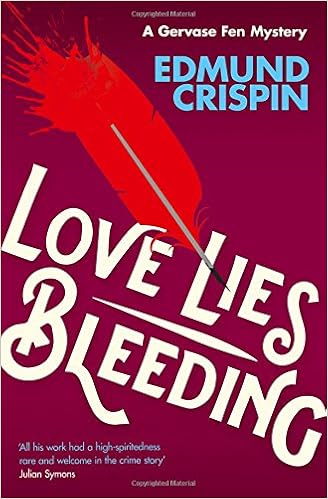
Forgotten Book - Love Lies Bleeding


Image result for edmund crispin love lies bleeding

I'm reading up on Edmund Crispin at the moment. It's always a pleasure to read such an entertaining writer, and the forthcoming Essex Book Festival, when I'll be taking part in a panel (with, among others, Crispin's biographer David Whittle) focused on Crispin's work. It will be a long journey to Southend, but I had a great time at the Festival a couple of years back, and I'm looking forward to this one.

Anyway, what about the book? Well, Love Lies Bleeding was published in 1948, and it's an excellent example of the traditional detective novel. Crispin offers all the classic ingredients - an elaborate alibi, more deaths than one, an appealing amateur detective, a chase, and clever fair-play clueing. There's plenty of humour, and literary heritage plays a central part in the storyline. Yes, you can take it than I'm a fan of this book, even if the complications of the plot do take some explaining at the end.

The book has a school setting, like so many vintage mysteries: Gladys Mitchell, Nicholas Blake, James Hilton, Agatha Christie, and R.C.Woodthorpe among others all saw the potential of the school (and I mean, of course, the fee-paying private/public school, not a state school of the kind I attended) as a setting for a murder mystery. It provides for a "closed circle" of suspects, and also a setting in which tensions and jealousies can erupt into violence.

Gervase Fen has been invited to give a speech at Castrevenford School, a boys' school, and his arrival coincides with the mysterious disappearance of a girl from the local girls' school. Soon, two murders are committed, and Fen fears for the safety of the missing girl. Superintendent Stagge is all too grateful for his help, and the plot thickens further when a young man on a walking tour discovers a third body. It's all done with rare skill. My only regret is that Crispin's active career as a crime novelist was so short. 

Friday, 23 June 2017

Forgotten Book - The Case of the Gilded Fly

Yes, I know. It's pushing things to describe Edmund Crispin's The Case of the Gilded Fly as a Forgotten Book. But the Harper Collins Detective Story Club has reissued the novel, and it's good to see it featuring in this eclectic and attractively presented collection. And this edition benefits from an introduction by Doug Greene, who knows more about classic crime than almost anyone I know.

I first came across this novel as a teenager. I'd read and enjoyed The Moving Toyshop, so I borrowed this one from the public library next. Now at the age of 13 or so, I had never been to Oxford, and certainly no concept of what it was like - quite a disadvantage when reading Crispin. This story, like The Moving Toyshop, features an apparent impossibility, but is an apprentice work - Crispin wrote it when he was still an undergraduate at St John's College. And the first chapter introduces a large cast of characters, wittily yet a little clumsily. I have to say that the young Martin Edwards was a bit disappointed, and in fact I didn't finish it. Nor did I return to Crispin until some years had passed.

Now, of course, I appreciate Crispin much more than I did then. His wit and cleverness are strengths, though I think that in this novel, the intelligence is rather self-conscious, a sign of the author's inexperience. My adolescent judgement of the book was too harsh, And now that I love Oxford as Crispin did, I empathise with his portrayal of the city and its eccentric characters.

Especially for such a very young author, this is a well-contrived mystery, although it's still, in my opinion, clearly inferior to books such as The Moving Toyshop and Buried for Pleasure. Yseut, the victim, is suitably unpleasant, but Fen is also, as Crispin seems to acknowledge, pretty irritating too - especially when he makes clear that he knows whodunit early on, but declines to tell. I know Poirot did this time and again, but Fen doesn't carry it off quite as well, and the killer strikes again before the final unmasking.. A critic in The Indpendent even said in a review that he wished Fen, rather than Yseut, had been the victim! As for the murder motive, I'm afraid it' emerges from nowhere, really: not exactly fair play. For a Golden Age fan, Crispin is always worth reading, and there's a lot of pleasure to be had here from his humour and his evocation of Oxford. But for all its merits, it is an apprentice work..

Friday, 3 March 2017

Forgotten Book - Buried for Pleasure

Although I've chosen one of his novels for today's Forgotten Book, the happy truth is that Edmund Crispin has never been entirely forgotten as a crime writer. I was recently interviewed about Crispin by a magazine in Colombia, of all places. I was told that Crispin's name is no longer very familiar over there, but I think I'm right in saying that he's always had some admirers in the US. And certainly the recent reissue of several of his books in the UK has kindled further interest here.

In Buried for Pleasure, Gervase Fen rather rashly decides to stand for Parliament, and finds himself staying in a rickety inn in Sanford Angelorum, meeting an assortment of unlikely characters. These include a vicar who is plagued by a poltergeists, and although some of the scenes bear only a limited relation to the central mystery plot, they are never less than amusing and well-written.

Fen comes across an undercover police officer, investigating a questionable recent death - occasioned by consuming - guess what? - poisoned chocolates. Soon the police officer himself is murdered, and there is an obvious suspect. But we all know that obvious suspects are innocent, right? (Unless the author is Agatha Christie, that is, and she has a cunning double-bluff in mind).

I enjoyed this book. It's short and entertaining, and even if the murder mystery is flawed in some ways (I was irked that Fen's conversation with the deceased was censored so as to deprive us of vital information, but the whole story depended on this) it makes for a very good relaxing read - ideal for a holiday. The political stuff also is handled with a light touch. It's such a shame that Crispin's career was so short-lived. But he left a considerable literary legacy.

Monday, 8 June 2015

The Return of Edmund Crispin and Alexander Wilson

The republication of classic crime novels continues apace with two rather different, attractively produced new series. The first comes from Harper Collins, who are starting to reissue the books of Edmund Crispin in paperback. Three titles have recently appeared: Love Lies Bleeding, The Moving Toyshop, and Holy Disorders. Each book features Crispin's amateur sleuth Gervase Fen, and my understanding is that the rest of Crispin's books are likely to appear in similar editions in due course.

Crispin was a lively and intelligent writer who enjoyed the game-playing aspect of detective fiction, even though he came along at the end of the Golden Age (which is why he is mentioned only in passing in The Golden Age of Murder; alas, had I tried to cover writers like Crispin, Christianna Brand and Dorothy Bowers in detail, the book would have been even weightier.)

Crispin was influenced by the likes of fellow Oxford man, Michael Innes, and John Dickson Carr. His work has always retained an appeal to readers; I recall listening to a very enthusiastic discussion of his work by Susan Moody a while back, which revived my interest in his work. So his books have never been too hard to find; all the same, it's good to see these new editions. Here's my take on The Moving Toyshop.

Alexander Wilson, in contrast, really is a forgotten writer. But perhaps not for much longer. Allison & Busby have set about reprinting his thrillers, with cover artwork in a style eerily reminiscent of the British Library Crime Classics series (though where are the wonderful introductions? Only joking!) Wilson was a spy as well as a writer, and there's a very interesting Wikipedia page about him. The first three titles to appear are: Mystery of Tunnel 51, The Devil's Cocktail, and Wallace of the Secret Service.

Wednesday, 26 June 2013

Edmund Crispin's Classic

I first came across the work of Edmund Crispin as a teenager, and I vividly remember reading The Moving Toyshop at school when I was about fourteen. I'd borrowed it from the town library, and took it in with me to while away dull moments in between lessons. The book had a map of Oxford, a city which I'd never visited, and never dreamed that I would get to know well. I really enjoyed the story, and acquired my own copy of the book many years later. But for some reason I've not got round to re-reading it until now.

There are a couple of reasons why I returned to The Moving Toyshop. First, I've been asked to talk to visiting crime writers from overseas about Oxford detectives at a conference in a couple of months' time and I felt I'd better do some homework. Second, I attended a talk given by Susan Moody at Crimefest on the subject of Oxford detective stories. Susan's enthusiasm made me think it was time to go back to Crispin.

I'm glad I did. The Moving Toyshop is tremendous fun, light-hearted and with an unusual, if occasionally eccentric plot that makes use of a very interesting legal device, the secret trust. The early chapters are quite dazzling and there are some memorable characters, including a very dodgy solicitor, and lots of witty lines. Gervase Fen, the amiable English don, leads the chase for the person who killed Miss Tardy in the toyshop..

Of course, in a high-spirited book like this, it is not easy to maintain tension throughout, and there are moments when farce predominates. The mystery is nicely constructed, but not as striking as the wonderful premise of the toyshop that appears to be in two different parts of Oxford. Crispin is very good at capturing the city's essential atmosphere, and it is a genuine tragedy that his great talent burned out so soon. After a flurry of novels, he was in effect burned out at the age of thirty and he spent the rest of his life drinking himself slowly to death. We had a long wait for his last book,The Glimpses of the Moon, but it proved to be a disappointment. Far better to remember this witty entertainer by books like The Moving Toyshop.

(Incidentally, are other Blogger users finding, as I have done lately, that the previous torrent of spam comments has reduced to a trickle at most? Long may this continue...)

Tuesday, 4 June 2013

Crimefest 2013 - part two

Among the pleasures of the second day of Crimefest 2013 were the chance to moderate a panel dealing with international mysteries. The panel members were Jeffrey Siger, Quentin Bates, Xavier-Marie Bonnot and Stan Trollip. I'd never met Jeff, Quentin or Xavier-Marie before, and it was a great opportunity to put faces to names and learn more about their books. Stan was a last minute addition to the team, replacing Peter James, who had been involved in a car crash (thankfully, Peter assures me he's still in one piece.) Despite the lack of notice, Stan made a terrific contribution to an enjoyable discussion.

I also attended a talk given by Susan Moody on Oxford Detectives. Susan is a long time member of an international group of crime writers who are coming to Oxford this August. As they have invited me to conduct a literary walking tour, I thought I'd better get some research in early, and Susan's enthusiasm for Edmund Crispin and Michael Innes in particular reminded me I ought to read more of their books. I've never been a great Innes fan, I must confess .I suspect I just read the wrong books long ago - a few of the later ones, which maybe don't fully represent his talent.

Other highlights included a chat with Lindsey Davis, and a meal with James Wills, whom I'd never met before. My literary agent, Mandy Little has represented me from the start of my career, but has recently announced that she will be retiring as an agent before long, while remaining with the business as a consultant. James is her successor and is now managing director of the business, so we were keen to meet each other at long last. And a very good companion he proved to be.

I also attended a panel moderated by Nev Fountain, which dealt with writing for other media. I'm not especially interested in (for example) graphic novels, but I do find the idea of writing for radio quite appealing In fact it's something I did at university, before moving back to the idea of writing novels. Various interesting points were made by a good panel which included Alison Joseph, the recently installed chair of the CWA. And it was especially interesting to me that I met Nev for the first time at the Crimefest gala dinner the following evening. More of that tomorrow.

Monday, 3 June 2013

Crimefest 2013 - part one

I've just returned from Crimefest 2013 in Bristol, a terrific event as usual. In fact, I feel that Crimefest is getting better each year. I know a number of people who told me they wanted to attend but were too late to book a place, and this is a sign of the convention's increasing popularity. It really does strike a nice balance between providing opportunities to socialise and providing panels, interviews and other events of genuine interest. There was a lot going on, and not for the first time I found myself, on leaving, amazed that I'd been so busy yet had still not managed to have a chat with a number of friends and fellow attendees. Next time!

I was lucky enough to be involved with three separate panels, two of them as participating moderator, and the first of these was Forgotten Authors, an event which is now a regular feature of the first afternoon of Crimefest. My fellow panellists were all very knowledgable and enthusiastic about books of the past. Moderating a group comprising John Curran (who chose two of my favourites, Dorothy Bowers and Patrick Quentin, to talk about) , Ruth Dudley Edwards (who chose two more, Cyril Hare and Edmund Crispin), Zoe Sharp and Adrian Magson was the easiest job in the world. The only snag with Forgotten Authors is that there is so much to talk about, we really need several hours. But the room was packed out, and people left with many suggestions about old books to seek out. There's always a feelgood factor about this panel, a sign of the rise in appreciation of books that vanished from the shelves years ago which remain worth reading to this day. I'm pleased to say the organisers have asked me to moderate the same panel again next year.

After a short break it was time for the annual pub quiz. I joined a team which included John, Zoe, Kate Ellis and my former editor at Hodder, Kate Lyall Grant. But it's also good to meet people for the first time, and these included the highly successful American author, Dorothy Cannell, with whom I was also due to be on another panel (at which she came up with an idea which fascinated me, and which I'll talk about in another Crimefest post.) We lost that knowledgeable crime fan Mike Linane to Ali Karim's team on the next table, but also joining us was Alexandra Benedict. There are two novelists called Alexandra Benedict, and so our colleague is published as A.K. Benedict. It turned out she is not only a Cambridge graduate who has written a highly successful debut, but also a composer of music for film and television, a singer and an expert on the ghost story. One website bio says she "writes words and music in a red-walled room filled with mannequins, teapots and the severed head of a ventriloquist's dummy." So really she ought to be a character in a book as well.

Anyway, it was an extremely convivial group and we called ourselves the Forgetful Authors. (In a surreal twist, this anticipated my forgetting the following day to post a Friday Forgotten Book for the first time in ages - you did notice, didn't you?) The quiz was closely contested and we finished up tying with Ali's team. The first tiebreaker question didn't separate the teams, but the next one enabled us to win the day, and collect some very nice prizes, including box sets of Sherlock, about which more soon.) Great fun, and I'll continue the Crimefest Chronicles tomorrow. If I don't forget, that is....

Wednesday, 9 November 2011

Bruce Montgomery/Edmund Crispin


Bruce Montgomery was the real name of the detective novelist Edmund Crispin, who wrote his first novel while he was still an undergraduate at Oxford. I read his most famous book, The Moving Toyshop, when I was about 14, some time before I thought about going to university. It's a book full of high spirits, which makes good use of the Oxford setting. It appealed to me more than Gaudy Night, that's for sure.

Crispin was influenced by John Dickson Carr, rather more than by Michael Innes, who wrote even more stories with an Oxford background, and I must say Carr is more to my taste than Innes, because the mystery plots are more compelling. But Crispin produced nothing for many years, and when his amateur sleuth Gervase Fen finally reappeared, I found The Glimpses of the Moon a sad disappointment.

David Whittle's sympathetic biography, Bruce Montgomery/Edmund Crispin: a life in music and books, explains the downward trajectory of his subject's life. He was an alcoholic, who suffered a good deal of ill health in his later years. It's a sad story, and his rather inept love life sounds rather depressing.

And yet he achieved a good deal. Not only those excellent early mysteries (though as a crime novelist he was burned out at 30) but also light music - he wrote often for films, including Carry On and Doctor movies. He was friendly with Kingsley Amis and Philip Larkin, and in some ways as talented. Whittle gives a good deal of insight into a life that began brilliantly, but all too soon entered a decline. A pricey but worthwhile biography.

Wednesday, 19 October 2011

The Oxford Mysteries


It's been a lousy summer in Britain, but of course there have been some exceptional days, and two of the last three Saturdays have been terrific. Last Saturday I walked in the sun around a relatively unfrequented part of the Lakes - gorgeous. And a fortnight earlier, it was baking hot in Oxford, quite amazingly so for early October, as I set about installing my children and their countless belongings in their college rooms.

Oxford was full of life, and I found myself wondering why it is that fictional death in the city has featured so often when compared to Cambridge. The Oxford crime mystery got going in the 30s, with books like J.C. Masterman's An Oxford Tragedy (a pretty good one I shall talk about in more detail one day). Michael Innes and Edmund Crispin set plenty of stories there, and then in the modern era Colin Dexter made the place his own.

But there have been plenty of other Oxford mysteries. I have in my TBR pile a book called The Body in the Turl, which I really must read now my daughter lives in Turl Street. And I was once responsible for a short story set in 19th century Oxford - 'The Mind of the Master'. Benjamin Jowett was my choice as a legendary armchair detective, and I did contemplate writing a whole series of stories about him. But I've never got round to it. One day, perhaps.

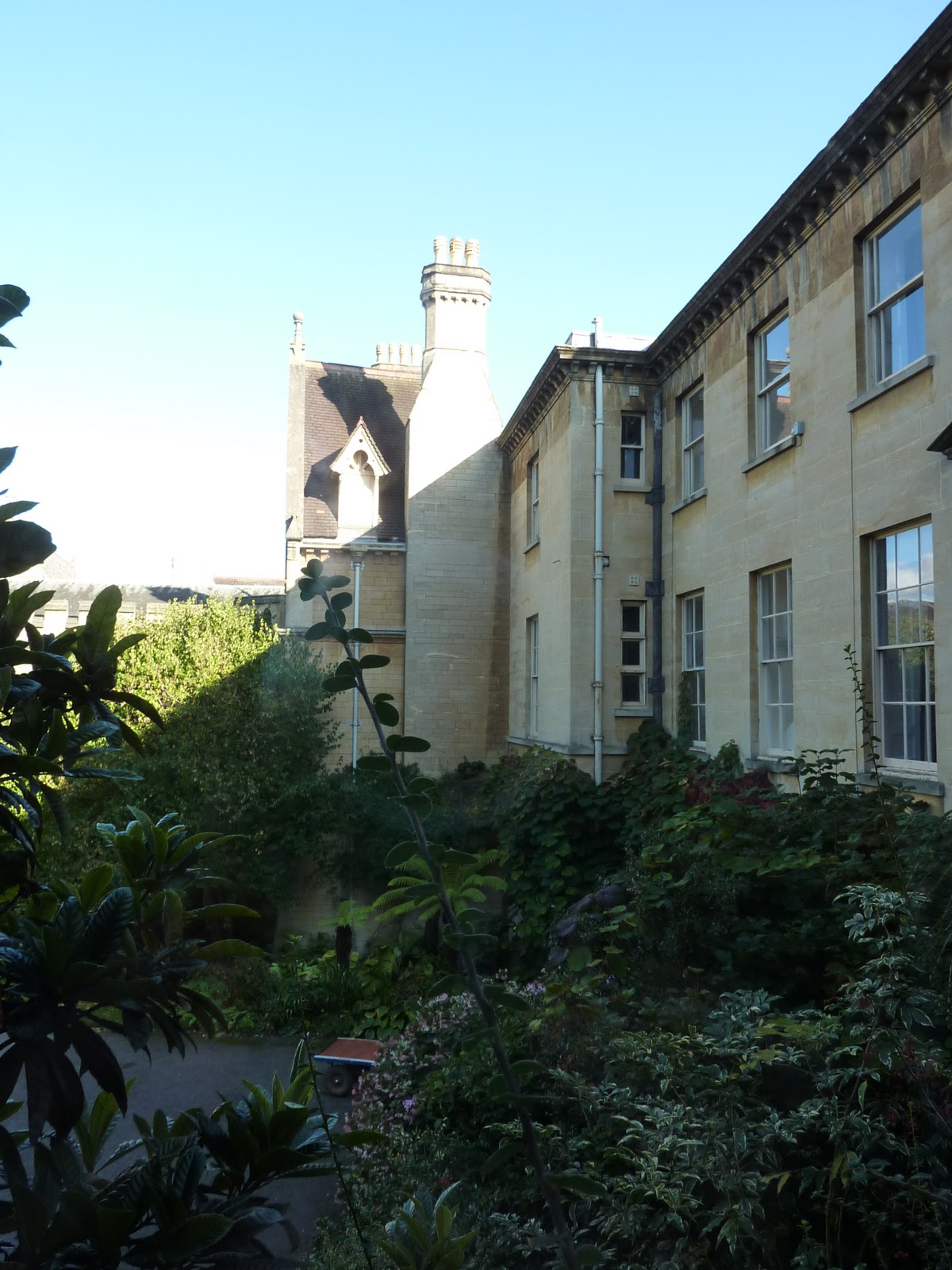
As for the photos, they show some of the views that greet the young Edwardses when they finally get round to opening the curtains in their college rooms. Lucky things.

Saturday, 13 August 2011

Robert Robinson R.I.P.


Robert Robinson has just died, news I was sorry to learn. In my youth, he seemed to be a fixture on TV, often as a quizmaster, but sometimes involved with documentaries. He was also a very regular presence on radio, both on news programmes and the 'Brain of Britain' quiz.

I only came across him once in person, when he was guest speaker at a CWA annual conference. However, one thing that many people didn't know about him was that, at the tender age of 29, in 1956, he published a detective novel, called Landscape with Dead Dons.

Robinson was born in Liverpool (you'd never guess from his accent) and educated at Exeter College, Oxford, where no doubt he had plenty of opportunities to develop the confident and urbane persona that was to become so familiar. His novel is rather in the school of Michael Innes and Edmund Crispin, both of whom lavished praise on it.

As a mystery, it's not exactly The ABC Murders, but it was a high-spirited and amusing debut, and my old green Penguin copy has a blurb which says: 'May he write more.' But although he produced one or two further novels, he never returned to the detective genre, although perhaps he'd have been well suited to it, had he been at work during the Golden Age. So his book remains an agreeable curiosity, a small part of the legacy of a highly successful man.