Showing posts with label Margery Allingham. Show all posts

Friday, 24 June 2022

Forgotten Book - Look to the Lady


At Bodies from the Library last weekend, Jake Kerridge talked engagingly about the merits of Margery Allingham as a mystery writer. I like Allingham - although I prefer Christie and Sayers - and I was prompted to read one of her novels that I haven't tried previously. Look to the Lady, known in the US as The Gyrth Chalice Mystery, was an early Albert Campion novel, published in 1931.

It's a novel which illustrates the fact that it's often unhelpful to lump crime writers and their work into categories. In its early days, the Detection Club made much of the distinction between detective stories and thrillers - I guess this was due largely to the views and influence of Sayers and Anthony Berkeley - and thriller writers weren't even allowed to become members. But the fact is that Christie wrote several thrillers in the 1920s, as well as in later years, and there's no doubt in my mind that if I was forced to categorise Look to the Lady, I'd describe it as a thriller, not a detective story.

But that isn't a criticism. This story is a romp, generally light-hearted, but with one or two darker moments, notably when Campion is about to be kicked to death by an aggressive horse; this is a crafty murder scheme devised by a pleasingly villainous baddie. Of course, our hero survives, but it's a memorable scene.

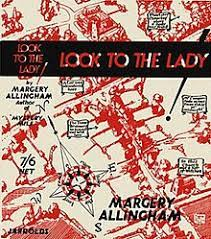
The novel concerns a family legend concerning a priceless artefact, the Gyrth Chalice. The legend reminded me slightly of a pleasing ingredient in Derek Smith's later book Whistle Up the Devil, but the stories are really very different. There are two maps (not counting the one of the lovely first edition dustjacket, pictured above) and plenty of incident, much of it entertaining. Not a masterpiece, but well-written and enjoyable light fare.

Monday, 18 March 2019

A Golden Age week-end


I've just returned from a thoroughly enjoyable week-end at the Essex Book Festival. This is a very well-organised festival indeed. I've been lucky enough to attend for the past three years, and each time I've been impressed by the range and quality of the programme as a whole, as well as for the Golden Age week-end at Southend-on-Sea in which I've participated. Ros Green, Jo Nancarrow, and the team do a very good job.

Two years ago, in fact, my trip to Southend inspired me to use the resort as the setting for one of the chapters in Gallows Court. And this year, I had the very enjoyable experience of being interviewed by Seona Ford, Chair of the Festival, about the writing and publication of Gallows Court. When high winds caused the lights in the hotel venue to go out for a few moments near the end of the session, it really was suitably atmospheric! All in all, the session was great fun, and so was a panel about Queens of Crime, moderated by Seona, earlier in the afternoon. My fellow participants were Barry Pike and Geraldine Perriam, and it really was a terrific session as we debated the relative merits of Christie, Allingham, Sayers, Tey, and company.

Now Essex is a very long way from home, and I felt that as I was undertaking such an epic journey, it would make sense, weather permitting, to see something of a part of England that I'm not very familiar with. On the way down, therefore, I digressed to the old Roman city of Colchester, which I've never visited before. It was a fleeting stop, but I saw enough of the place to be rather taken with it. An excellent dinner in Southend with Seona and others rounded the day off nicely in good company.

On the way back to Cheshire yesterday, I decided that, as the sun was shining (well, intermittently; there was also hail and torrential rain), I'd take a look at the island of Mersea. I've come across the place in the fiction of Margery Allingham and Andrew Garve (The File on Lester), and  Seona told me it also features in a non-crime novel by Sabine Baring-Gould. As I am very keen on islands, I wanted to see what it was like in reality.


I liked Mersea, both the quiet east side, with its mud flats, and old gun emplacements, and the bustling west side, with all the fishermen's boats, oyster bars, and restaurants. You reach the island by a causeway known as the Strood and it's definitely worth a visit. Time didn't permit a visit to the little museum in West Mersea village, but Mersea is a place with a distinctive charm, and I'm glad I visited it. And on the way there and back, I passed through Tolleshunt d'Arcy, a village where Allingham made her home. How nice it was to see that she's remembered in a street name!


Friday, 9 December 2016

Forgotten Book - The Fashion in Shrouds


The description "forgotten book" is, to be honest, a misnomer when it comes to Margery Allingham's 1938 novel The Fashion in Shrouds. The famous Observer critic Torquemada extolled the book, saying, "To Albert Campion has fallen the honour of being the first detective to figure in a story which is also by any standard a distinguished novel". I'm not sure whether Dorothy L.Sayers would have agreed; perhaps she'd have thought that she'd beaten her friend Allingham to that particular achievement. But it's undeniably a stylish novel.

Time and again there are pleasing and inventive turns of phrase, of a kind that one doesn't usually find in the typical Golden Age mystery. What's more, the presentation of the fashion world, which provides, in the early stages of the story, an interesting setting, is convincing. Allingham's presentation of character generally avoids the usual cliches, and the relationship Campion has with the lovely young Amanda Fitton is quite subtly done.

It's not easy to read this book in the precisely way that readers in 1938 would have read it. There's a good deal about social class, and the role of women in society, that relates to the time, and although Allingham handles these issues in a thoughtful way, so much has changed. Overall, I did not find these aspects of the book to be as compelling as some of her admirers suggest. For me, as with Sayers' Gaudy Night, Fashion in Shrouds does sacrifice something in the attempt at literary sophistication. The plot simply isn't as exciting as, say, the plot of Christie's The ABC Murders or Wade's Lonely Magdalen.- and the latter also offers a fascinating picture of society, and the role of police in enforcing the law.

What of the story? The amoral Georgia Wells poses a threat to the relationship between Campion's sister Valentine and Alan Dell (for whose company Amanda works).Georgia's husband is murdered, and the fate of his predecessor also comes under the microscope. But the plot is secondary, I think, and for that reason I don't feel tempted to rave about this book in the way its most ardent fans do. Even so, I enjoyed reading it, and as Torquemada said, the writing is distinguished.

,  .

Monday, 16 May 2016

Golden Moments


I'm drawing breath after a hectic week with a number of highlights. I've been involved in three events, including a murder mystery evening at Wrexham Library (hence the photo) which attracted a very large audience and a talk at Alsager Library. At both these events, a lot of interest was expressed in Golden Age detective fiction, and the same, perhaps more predictably, was true on Saturday, when I was the guest speaker at the annual general meeting and lunch of the Margery Allingham Society.

The theme of my talk to the Society was the recent renaissance of interest in Golden Age fiction - not just the work of Crime Queens such as Margery, but also other writers, many of them much less well known. John Bude is an example who springs to mind. Another is Christopher St John Sprigg. When asked which book I was happiest to have persuaded the British Library to publish in its series of Crime Classics, I chose Death of an Airman, and it's clear from reaction on Saturday, as on other occasions, that this is a widely appreciated title. I also made the point that some of the as yet unpublished titles n the series are, in my view, among the best of the list. Plenty to look forward to there, I can promise you.

The Society is clearly thriving under the chairmanship of that great expert on the Golden Age, Barry Pike, and the audience included two contemporary novelists, Mike Ripley (who has continued the Campion series) and Ann Granger, as well as a leading agent and several other luminaries. I enjoyed being shown the 'Crossed Red Herrrings' award (a forerunner of the CWA Silver Dagger) given to Margery for Hide My Eyes, and Barry also showed me an interesting part of the venue - the University Women's Club in South Audley Street, London- which was the room fictionalised by Dorothy L. Sayers as the place where Harriet Vane did her writing.

Although my talk was, to some extent, off the cuff, my theme was one I've been thinking about lately, with a view to the St Hilda's Crime and Mystery Week-end in August, where I'll be giving a paper on the Golden Age revival. That there is a revival, and that it is significant, is to my mind beyond dispute. There's a recent blog post by Curtis Evans on this subject, which I was pleased to read; I agree with his observations about the renaissance.

A few years ago, I assumed it was inconceivable that The Golden Age of Murder would attract a major publisher, let alone achieve lots of glowing reviews and two major awards. I think it's fair to say that the British Library were equally taken aback by their successes with the Crime Classics. What we GA fans must try to do now is to seize the moment, and help maintain this revival by encouraging the publication of more of the good books of the past, and continuing the very constructive discussions of them that are to be found on many blogs and elsewhere.

This isn't always straightforward. In particular, copyright complications (even assuming one can trace the copyright holder - no luck so far with one or two of my favourites, such as Milward Kennedy) can make the process of republishing in-copyright books fraught with difficulty. Never mind; estates of deceased writers are, more and more, realising the benefits of a co-operative approach, and realistic financial expectations, and I hope this trend will continue. On the larger question of spreading the word about the merits of the best GA fiction - and the fact that some of it is far from 'cosy' - I am aiming to make further contributions to the debate - watch this space!


Tuesday, 16 February 2016

The CWA Margery Allingham Short Story Prize


Calling all short story writers! If you like the short form as much as I do, why not try your hand at submitting an entry to the CWA Margery Allingham short story prize competition? The details about how to enter can be found here. The prize on offer is fantastic - £1000 plus a free pass to Crimefest.

The prize is sponsored by the Margery Allingham Society, and the judges are looking to find a previously unpublished story that conforms to Margery's idea of what makes a good mystery story: for her, it was "box-shaped, at once a prison and a refuge", and it had four walls - a crime, a mystery, an enquiry, and a conclusion with an element of satisfaction in it.

The competition is open to established authors and newcomers alike. To give an example, I entered a story myself during the competition's first year, and so did my wife, who at that time had never published any fiction at all. We both finished up on the shortlist of ten, and my story "Acknowledgments" was the eventual winner. It was all very gratifying for us, the more so for being unexpected. And it underlines my message to people who like writing short stories - have a go, and you never know what may happen!

But you'll have to be quick. The closing date is 1 March. However, it's still plenty of time, if you can find an idea that really grabs you. There is an upper limit on the word count of 3500 words, so the story doesn't need to be, and indeed shouldn't be, an epic. Something short, snappy and a bit different is the objective. Good luck!

Friday, 3 July 2015

Forgotten Book - The Case of the Late Pig

The Case of the Late Pig by Margery Allingham was first published in 1937, and I suppose there is room for debate as to whether it really qualifies as a Forgotten Book. After all, Allingham's reputation has survived much better than that of many Golden Age writers, and the Margery Allingham Society is a flourishing body, with an excellent journal and a range of activities for members. What I can say is that this is a short novel (it began life as a paperback original, and a UK hardback edition didn't appear for more than a quarter of a century) which definitely deserves to be remembered. It offers more entertainment than many much longer efforts.

An unusual feature of the book is that it's narrated by Albert Campion. An ambitious move on Allingham's part, I think, because Great Detectives aren't naturally suited to recounting their own cases - Sherlock Holmes seems to me to have been a noticeably less effective narrator than Dr Watson, for instance. It's maddening enough when a sleuth (Poirot, for example) declines to tell his sidekick whom he suspects and why. The risk of frustrating the reader is much greater when the detective is actually telling the story. Christie was wise, I think, not to have Poirot or Miss Marple act as narrators. Perhaps Allingham was experimenting -she did not repeat this particular experiment in another novel. And yet here, I think, she gets away with it, and does so rather stylishly.

A mysterious unsigned missive persuades Campion to attend the funeral of the late and unlamented "Pig" Peters, with whom he was at school. But the plot really starts to thicken five months later, when Campion returns to the splendidly named village of Kepesake. There has been another death - but this time, once again, the deceased is Pig Peters. What on earth is going on?

This is a splendid village mystery, neatly plotted and with plenty of twists. It's a very good example of Allingham's technical skill as a writer - she was able to vary her approach with much more flair and success than most Golden Age novelists, and this is, surely, one of the reasons why her work has lasted so well. I enjoyed The Case of the Late Pig - and the TV version, starring Peter Davison as Campion, which I saw some time ago, isn't at all bad, either.

Thursday, 20 November 2014

Publication Day - Acknowledgments

A major highlight of my year came at Crimefest in May when I won the inaugural CWA Margery Allingham Prize for my short story "Acknowledgments". Among other lovely things, part of the prize was the commitment of Bloomsbury to publish the winning entry in ebook form, via their successful Bloomsbury Reader platform. Bloomsbury has - in less than thirty years- established a very impressive reputation, not least thanks to the Harry Potter series and a Man Booker Prize winner. So I'm honoured to announce that today is publication day of Acknowledgments, an ebook that includes not just the story, but rather more.

It seemed to me that it would be desirable to offer readers some "added value", given that the story itself is short of necessity, because of the word limit in the competition rules. Luckily, Bloomsbury agreed. So the ebook includes two other stories of mine of which I'm fond, and which I felt would benefit from a fresh life. There is also an essay by me about Margery Allingham and her short stories, and a generous intro from Julia Jones, biographer of Allingham and closely involved with the Margery Allingham Society I had a lot of fun writing "Acknowledgments", and I hope it will entertain and amuse you if you read it..

Allingham was a very interesting woman and an accomplished writer. I've wavered, if I am honest, in my views about her books over the years, and to this day I haven't read them all. But I rediscovered her, in a sense, while researching her for The Golden Age of Murder, and I'm becoming ever more enthusiastic about her writing. I'm hoping, with Julia's encouragement, to go on an Allingham tour next year and explore some of the locations of the books. And I devoted the prize money to acquiring some delightful first editions inscribed by Allingham herself - it seemed fitting, and much better for me and my family than lots of chocolate...

I've quite often been shortlisted for prizes that were won by someone else, and my sympathies are at least as often with those on the shortlist as with the winners. All the more so this year, because my wife Helena was one of the runners-up. However, we still speak occasionally...and I'm thrilled to say that her story will be published in Ellery Queen's Mystery Magazine before long. This will be her first taste of publication as a fiction writer, but another one (a contribution to an anthology of stories edited by Ann Cleeves) is already looming. This leads me to my final point - competitions can be Very Good Things for writers, whether experienced or inexperienced. The CWA Margery Allngham prize will be awarded again next year, and more details for prospective entrants can be found here.  


Friday, 6 June 2014

Forgotten Book - Dictator's Way

Thanks to the sterling efforts of Ramble House, a very likeable publisher indeed, a few of E.R. Punshon's long-forgotten books have become available again to modern readers. Dictator's Way, first published in 1938, is among them, and it is notable above all for the insight it gives into the issues preoccupying thinking men and women like Punshon at the time - the grim state of international affairs and the threat posed by totalitarian dictators.

This is an entry in the Bobby Owen series, and another reason why Dictator's Way is of note is that it introduces Olive, a resourceful young woman who was to become the love of Bobby's life. The path of true love does  not run smooth at first, but it seems to me that Punshon, like Margery Allingham, Nicholas Blake, Ngaio Marsh and others was following the lead set by Dorothy L. Sayers in having a youngish male detective meet, during the course of his cases, the woman whom he would marry. In each case they are strong women, not content to sit on the sidelines of life, and this helps the reader to appreciate them.

Punshon had liberal/leftish political views, and takes the opportunity to show his contempt for Hitler, Mussolini and Oswald Mosley in the course of a story dealing scathingly with the so-called "Redeemer" of Etruria. This political perspective gives the book spice, and also gives the lie to the often repeated but false claim that Golden Age writers were just a bunch of cosy reactionaries. Why have so many otherwise sensible people made such a claim? I suspect it's because, for the most part, the really successful Golden Age writers were conservative in outlook, although I'd describe some of them at least as questioning conservatives.

Anyway, on to the book. It contains thrillerish elements and a loveable working class rogue whom I found rather irritating. The whodunit element of the story isn't especially memorable. You can see why Punshon fell into neglect - but you can also see why good judges found something to admire in his work. It's often a mixed bag, but his thoughtfulness makes him a Golden Age writer about whom I'd like to know much more. But my knowledge of his life doesn't extend far beyond what's to be found on the internet. I don't suggest he's a superstar, but I do think he deserves to be remembered.  Ramble House are doing a great job in bringing some of his books back to life.


Friday, 31 August 2012

Forgotten Book - Silence of a Purple Shirt


R.C. Woodthorpe is best known for his debut novel, The Public School Murder, but his Silence of a Purple Shirt (Death of a Purple Shirt in the U.S.), my Forgotten Book for today, seems to me to be a more enjoyable book. It was published in 1934 and featured Nicholas Slade, a novelist who appeared in one other novel before Woodthorpe abandoned him. A pity, because he and his confidential clerk Alfred Hicks make a pretty likeable Holmes and Watson duo.

The story features the murder of a political agitator, and a related child kidnapping, but the real interest of this book lies in its humour – which Dorothy L. Sayers lauded in a review. Woodthorpe pokes fun at the Purple Shirts, a Fascist group who want to “Make Britain Free”. I’d say he was ahead of many writers in recognising not only the absurdity but also the unpleasantness of the reactionary groups who became so formidable in the Depression era.

There are plenty of jokes, including a nice nod to Margery Allingham, whose husband Pip was once a pupil of Woodthorpe’s. before he abandoned teaching for writing. I enjoyed especially the civil servant who had written a single thriller, which sounds suspiciously like the author’s debut novel. 

The early chapters sparkle, and the resolution of the mystery is pretty good. I did feel, though, that the middle section of the book sagged. Woodthorpe spends ages describing an island hotel and its occupants, and although the writing is amusing, this is not enough to disguise the skeletal nature of the plot – a recurrent failing in Woodthorpe’s work. He was a genuinely talented entertainer, but not much interested in weaving complex fair play whodunits. That said, he was too good a writer to have disappeared from sight. It would be interesting to know why he gave up writing after 1940. Perhaps he felt he'd done all he can. Possibly he might have changed direction instead. I'm certainly on the look-out for the rest of his books, hard to find though they are.

Friday, 19 August 2011

Forgotten Book - The Crime at Black Dudley


Margery Allingham is widely regarded as one of the great British crime writers, but although I like her short stories, I’ve had mixed feelings about her novels. But I decided to give her another go, and my choice for today’s Forgotten Book is the 1929 novel in which Albert Campion made his debut, The Crime at Black Dudley.

In reading the book, it’s vital to remember that Allingham was only 23 when she wrote it. The story is breezy, and begins very well, with a pleasingly mysterious ritual in a country house, and murder being done in the dark. But after that, I’m afraid, things fall apart.

A sinister gang commanded by a nasty German hold the house party hostage, and I felt it all became rather silly and tedious. Only when we get back to the main plot do things improve, but vital information is withheld from the reader; it’s not really a fair play whodunit at all.

Campion is presented as almost a rogue. Allingham’s main focus is on a pathologist called Abbershaw, who does the main detective work. The real merit of this book for modern readers lies not in the story-line but in its historic interest, as the apprentice work of a very interesting and unpredictable writer.

Thursday, 21 April 2011

Police at the Funeral


Quite some time ago I invested in the complete set of DVDs featuring Peter Davison as the legendary sleuth created by Margery Allingham, Albert Campion. I have to admit that I have only just opened the box, but this is not due to any particular lack of enthusiasm. I'm afraid that I have three other box sets still awaiting attention – too many shows, too little time!

I started by watching Police at the Funeral, simply because I had heard good things about the book on which the episode was based. What I did not know was that the plot bears a passing resemblance in some respects to a rather good Sherlock Holmes short story. But Allingham handled the material in her own distinctive style, and to good effect.

Peter Davison has always been a likeable actor and, although I do not claim to be any sort of expert in Allingham's work, it does seem to me that he is rather well cast as Campion. He is aided and abetted by the splendid Yorkshireman, the late Brian Glover, who plays the part of Lugg. I always relished the enthusiasm that Brian Glover seemed to bring to every role, and he was in his element here.

The supporting cast included Timothy West, who was as watchable as ever. The story moved at a brisk enough pace and I enjoyed the episode, possibly more than I expected to. I shall certainly not leave it too long before watching another instalment in a series

Tuesday, 25 August 2009

St Hilda's


I was lucky in that my paper for the St Hilda’s Crime and Mystery weekend conference was scheduled for presentation at 11.30 on the Saturday morning – an excellent time. Not too early, but soon enough that, having given the presentation, one can then chill out without agonising further about last minute edits to the paper.

The opening paper was presented by Jill Paton Walsh, who talked fascinatingly about The Attenbury Emeralds (Lord Peter Wimsey’s first case) and retribution. She was paired with the Conference’s guiding light, Kate Charles, whose main focus was on that classic by Margery Allingham, The Tiger in the Smoke. I’m not an Allingham expert, but I agree with Kate that it’s one of the most notable books in the genre.

The theme of the weekend was The Wages of Sin, and I focused on the topic of sinful victims in crime fiction. I’m planning to publish the paper on my website in due course. My aim was to highlight, amongst the famous titles, a few books that are undeservedly obscure. The set-up is that two linked papers are presented, and then the two presenters answer questions from the (formidably well-informed) audience. I was partnered with my friend Christine Poulson, a very good writer about whom I’ll have more to say in a future blog post. We were both very pleased with the reaction to our session.

When I last visited St Hilda’s College for the conference some years back, it was the last remaining women-only college in Oxford. Now it has bowed to the inevitable and become mixed, but if traditionalists feared that the atmosphere around the place would be adversely affected, their anxiety was misplaced. St Hilda’s benefits from a gorgeous setting by the River Cherwell, close to Magdalen and the Botanic Garden, and to sit in the grounds on a sunny day and watch people drifting by on punts is extremely relaxing and agreeable. I can recommend this conference unreservedly.

Sunday, 12 April 2009

The Adventures of Margery Allingham


Some years ago, I read a very good biography of the accomplished Golden Age writer Margery Allingham, written by Julia Thorogood. The Adventures of Margery Allingham, which I’ve just acquired, turns out to be an updated version of that book, appearing under the author’s current name of Julia Jones. The publisher, originally Heinemann, is now Golden Duck, which I imagine is in effect a private venture run by the author, or someone based in her (and Allingham’s) neck of the woods in Essex.

The first edition appeared in 1991, and the 2009 version boasts an introduction by the best-selling novelist Nicci Gerrard (who also forms half of the ultra-successful writing partnership Nicci French). There is also an afterword, which tells the amazing story of how Allingham’s husband Pip (Philip Youngman Carter, a notable illustrator and occasional writer) was the father of a child borne by Nancy Spain, herself a detective novelist and tv personality of the 1950s, and something of a lesbian icon in the days when lesbianism was not as widely discussed and celebrated as it is today.

The book is so good, and the material so worthwhile, that I think it is a real pity that Julia Jones did not engage in a proper re-writing of the book for its second incarnation. The afterword is short and has an unsatisfactory ‘tacked-on’ feeling – it would have been better to have integrated the latest revelations into the Allingham story as a whole. I wasn’t really convinced that the money I spent on the book was worth it. But if you haven’t read the first edition, and you’re interested in Allingham and her work, the investment would certainly be justified, for Julia Jones is a good writer who definitely knows her stuff.

On a separate note, I send my thanks to that marvellous blogger Dorte H, for her ‘Grasshopper Award’. I don’t know how inspirational this blog really is, but I very much appreciate the comments and input of Dorte, and her own blog is a consistently delightful read.