Death in a Deck Chair is a novel written by K.K. Beck and published in 1984. Kathrine Kristine Beck (also known as Marris, a surname of one of the characters in the story), who also wrote as Marie Oliver, was a prolific American crime writer for the fifteen years up to 1999. She was married to the talented British crime novelist Michael Dibdin, who sadly died in 2007, but why she gave up writing herself when she was still under the age of 50, I don't know. She originated from Seattle and evidently worked in advertising, as so many detective novelists have done.
This novel is very much in the American "cosy" tradition. It's set in the summer of 1927, and introduces an attractive 19 year old girl, Iris Cooper, who proceeded to appear in two further novels before Beck moved on to produce other stories. And it's another cruise ship story, as Iris and her aunt Hermione take a trip on board the luxury liner HMS Irenia, sailing from Southampton back home to Portland, Oregon.
Iris befriends a shy young man called Twist, who is secretary to Professor Probrislow, a specialist in criminal lunacy. She is, however, warned against Twist by the ship's pianist. The other passengers include a Count, a Cardinal, a German governess, a newspaperman, a judge, and the rather enigmatic Mrs Destinoy-Pinchot.
Before long, someone is murdered, and a rather inept investigation is conducted on board, with Iris brought in to perform secretarial services. Needless to say, she decides to try her hand at amateur sleuthing. I'm afraid my attention was beginning to wander even before a Ruritanian-style European kingdom was introduced into the storyline. My worst fears were confirmed when affairs in Graznia proved to play an important part in the plot. It's quite competently done, but it was all too tame for me, I'm sorry to say. Death in a Deck Chair makes the typical Agatha Christie look like something by Jim Thompson.
Showing posts with label Michael Dibdin. Show all posts
Showing posts with label Michael Dibdin. Show all posts
Friday, 2 August 2019

Thursday, 10 October 2013
Italy and Crime Fiction

Like so many lovely places, Italy is a popular setting for crime stories, and I suppose the leading exponent of Italian detective fiction currently known to British readers is Andrea Camilleri, creator of Inspector Montalbano. As the years pass, I draw some comfort from the fact that he did not create his most successful character until he was nearly 70! Like Ellis Peters, he achieved international fame late in life,but it is well deserved. Camilleri comes from Sicily, a gorgeous island I've enjoyed visiting twice, but during my recent holiday I concentrated on exploring the north of the country, and spent a day with Italian friends in Florence.


Florence is the setting for the books by the late Magdalen Nabb, possibly my favourite British author of crime novels set in Italy.The fabulous Duomo also earns a thought-provoking mention in Harlan Coben's Stay Close, which I'm reading in the moment, though that book is firmly set in the US. Flroentine daggers were popular murder weapons during the Golden Age in particular, but I resisted any temptation to invest in one of my own whilst I was in the city.
My visit reminded me that it's a long time since I read any of the Zen novels by the late Michael Dibdin. One I never read was Back to Bologna, but that's now zoomed up the to-read list. I can't recall if he set any of his stories in any of the smaller, but quite breathfaking, places within easy reach of Bologna. Modena, for instance, is famous for its cathedral, and I was also struck by the nearby 'haranguing stone', an elevated slab in the piazza on which wrongdoers were placed to face public opprobrium.


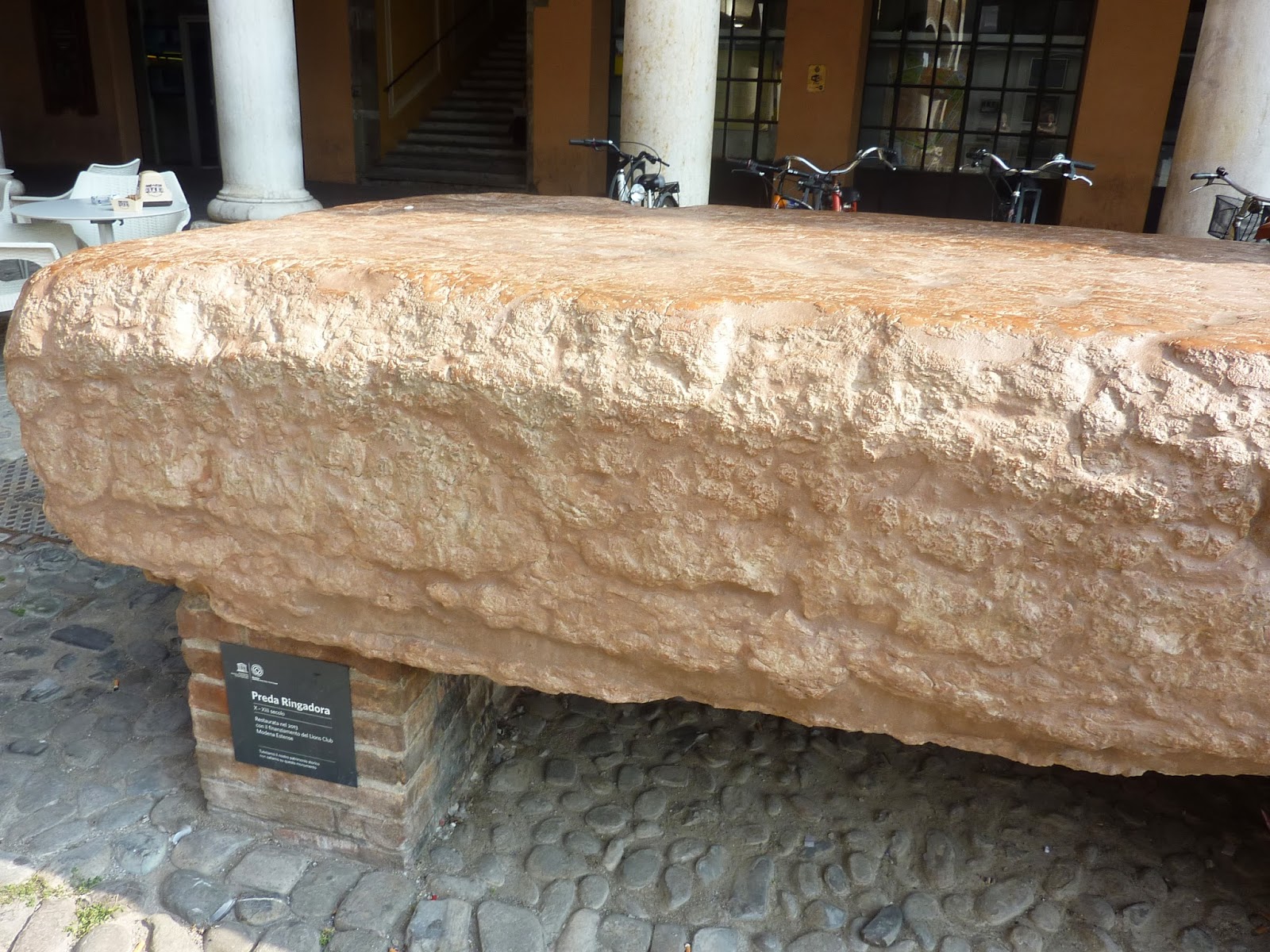
Ferrara is, to my mind, even more impressive, with its terrific moated castle,grassed ramparts and a host of wonderful sights. As I was walking round, the idea for one of the two short stories I mentioned in my blog post yesterday came to mind.


Finally, Ravenna. It's famous for its mosaics, and these really are dazzling. The old mausoleum and the archaeological museum, with its ivory throne, are among countless sights packed in to a small area, easily walkable. You can also find Dante;'s grave and an interesting exhibition, which gave me a much better understanding of his work (perhaps I should read Dan Brown's Inferno too?) Dorothy L. Sayers translated and admired Dante, but I don't know if she ever visited Ravenna. If so, I'm sure she was impressed. Like Ferrara, it would make a terrific setting for a detective novel, and I'm sure that some writers have already made good use of it. I look forward to tracking down one or two examples.


Monday, 19 November 2012
Margaret Yorke R.I.P.

I was very sorry to learn earlier today, via our mutual friend Kate Charles, that Margaret Yorke, one of Britain's most distinguished crime novelists, has died at the age of 88. I'd learned a short time ago from Margaret's family that she was very unwell, news that came as a great shock, given that she was sending me cheery emails as recently as a couple of months ago. I shall miss her greatly.
I've mentioned Margaret numerous times on this blog, and regular readers will therefore know that I was a great fan of her work. I started reading her in the late 1970s, and among my favourites of her books were Devil's Work and No Medals for the Major. The latter marked a change of direction in her writing. She'd begun with romantic fiction, and then wrote light detective novels with Patrick Grant as her sleuth. But her greatest achievements came with stand-alone novels of psychological suspense. She excelled at studies of domestic tension, spilling over into violence, and her characterisation showed profound insight into human nature.
Much later, after I became a published writer, I met Margaret occasionally, not only at the St Hilda's Crime Week-end, which Kate organises, but also when she received the CWA Cartier Diamond Dagger to mark her outstanding and sustained achievements as a crime writer. This was a memorable occasion, at the House of Lords, and made such an impression on me that it later gave me the opening scene for Take My Breath Away.
Margaret also contributed a couple of stories to anthologies that I edited, but I came to know her much better in the last few years. The catalyst for this was my research into the provenance of a pastiche of Golden Age detective fiction, Gory Knight, by Margaret Rivers Larminie and Jane Langslow. To cut a long story short, both writers were related to Margaret, and she became as fascinated as I was by trying to fathom how they'd come to write the book and by trying to prove Jane Langslow's real identity. The result was an article published in CADS to which Margaret made a massive conribution.
After that, she offered me much help and advice as regards my continuing researches into the history of detective fiction, and one of her last emails, which arrived out of the blue, was a kind note congratulating me on my foreword to the reprint of Ask a Policeman. I was fortunate to be invited to visit her at her lovely cottage in Buckinghamshire a couple of times, when she made excellent lunches, as well as providing stimulating and convivial company. Age had not dimmed her at all, it seemed to me; she was a truly perceptive woman, with a terrific fund of anecdotes. I am sad to think that there will be no more of those conversations.
Margaret was a strong character, with strong opinions, which she was never afraid to express (she recalled, for instance, once coming to "verbal blows" with that talented writer Michael Dibdin in a radio broadcast, when he made some rather ill-judged criticisms of Agatha Christie, of whom Margaret was a big fan). I found her unflinching honesty wholly admirable, whether or not I agreed with her opinions, (in fact, as with the Mike Dibdin debate, generally I did agree). There were many examples of her kindness and generosity, and it's also worth adding that she did all writers a service with the work she put in to the campaign to secure Public Lending Right.
To lose someone, whatever their age, is hard to take, but Margaret's family and friends will all know that she, and her books, will long be remembered, not only with admiration, but with great affection and appreciation. I am so glad I had the chance to get to know her.

Monday, 17 January 2011
Zen: Cabal and Ratkiing: review
Zen is the latest BBC cop series, starring Rufus Sewell as Michael Dibdin's Italian detective, Aurelio Zen. I've seen the second and third episodes, Cabal and Ratking. Glamour and quirkiness are the most striking features of these two shows. I read some of the Zen books years ago, and really liked them. The TV version seems rather different, but it does have a genuine appeal.
Sewell is a handsome actor and everyone in the cast seemed to be rather good-looking, not least Zen's dear old Mum. Women are very much attracted to Zen, including his lovely but troubled girlfriend, a tough female prosecutor and a suspect in Ratking. He also has two slightly cartoonish superiors in successive episodes, plus a crafty political master.
Italy is one of my favourite countries, and it provides a stunning backdrop. The plots are secondary, but Ratking was especially neatly structured. I still prefer the books, but I'd be glad to watch Zen again.
Finally, it strikes me as really poignant that Mike Dibdin didn't live to see Zen on the screen. It's rather like the late Alan Hunter, who never saw Inspector George Gently.
Thursday, 27 August 2009
Oxford and Crime


It’s intriguing that such an apparently civilised place as Oxford should have formed the backdrop to so many murder stories, on the page, and on the screen. I’ve much enjoyed working on a new essay about the city’s murderous heritage. Of course, Colin Dexter is the leading writer of Oxford crime, but there have been many others.
The reason for Oxford’s long-term popularity as a setting for crime fiction s is surely not so much the inherently criminal tendencies of the local population as the enthusiasm of alumni of the University, and others associated with it, and with the city, for writing detective stories. For instance, more than thirty old members of Balliol College alone have published crime fiction.
J.C. Masterman, who later became a notable war-time spymaster, and then Provost of Worcester College, is credited with inaugurating the Oxford whodunit set in academe, in 1933, with An Oxford Tragedy. Soon, there was a flurry of books to delight dons and many others. Michael Innes, who again would become a don, introduced his series policeman John Appleby in Death at the President’s Lodging, set in a fictional university strongly reminiscent of Oxford, and Operation Pax sets key scenes in the Bodleian. Innes’ principal disciple was Edmund Crispin (the pen-name adopted by Bruce Montgomery, whose first detective novel was written while he was still an undergraduate.)
Surely the most famous crime novel set in Oxford appeared just four years after An Oxford Tragedy. Dorothy L. Sayers’ Gaudy Night,, in which Somerville College (where Sayers read English) is fictionalised as Shrewsbury College, which she locates in Jowett Walk, on Balliol's cricket ground. Ian Morson’s historical Falconer series is set in medieval Oxford, while Veronica Stallwood has written eleven books to date featuring historical novelist Kate Ivory. The late Michael Dibdin wrote a witty stand-alone set in the city, Dirty Tricks – and fascination with the city is not confined to English authors. And even a novelist from Argentina, Guillermo Martinez, got in on the act. He wrote The Oxford Murders, the film of which I covered in a blog post a while back.
Subscribe to:
Posts (Atom)