Showing posts with label S.S. Van Dine. Show all posts

Friday, 26 January 2018

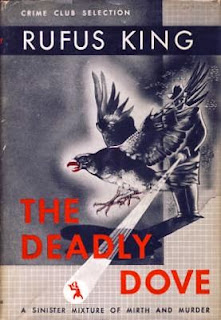
Forgotten Book - The Deadly Dove

Image result for rufus king deadly dove

When I blogged about my recent trip to New York City, I mentioned a visit to the Strand Bookstore, a cavernous place on four floors with, so they tell me (and I didn't check) eighteen miles of books. That's a lot of books. There's a rare book room on the top floor, and I looked at several very interesting titles. Among them were a couple of signed books that caught my eye. And one of these had a fascinating inscription. It's my Forgotten Book for today.

The author was Rufus King, and the title The Deadly Dove. I have to say that, when the jacket proclaimed that it offered "a sinister mixture of mirth and murder", I had plenty of qualms. Writing a truly successful comic crime novel is very, very difficult. And I didn't even realise that Rufus King did comedy. I'd always thought of him as someone who began as a disciple of S.S. Van Dine before branching out with his Valcour series, an omnibus of which has lurked on my shelves for many years. But I was loving my trip to New York, so in merry mood, I bought the book.

I read it very quickly because it's quite short. And that's a good thing, because if there's one type of book that's harder to write than a comic crime novel, it's a long comic crime novel. The Deadly Dove was published in 1944, and perhaps it afforded some relief from thoughts of warfare. As a matter of fact, it begins well.

The premise is that a grasping young chap called Alan has married an older woman, Christine, for money. Alan owes a gangster $25,000, and the pair of them come to an arrangement. The gangster will arrange for a veteran assassin called Dove to kill Christine. You can guess what's coming, can't you? Yes, that's right. Circumstances change, and Alan becomes desperate to prevent Dove from carrying out his assigned task. But where is Dove? Oh no, he can't be found! The later plot developments became, for me, progressively less gripping, and although King was quite a capable crime writer, this novel is really a minor work. But at least it didn't outstay its welcome as far as I was concerned.

Friday, 4 July 2014

Forgotten Book - Death in the Dark

Death in the Dark by Stacey Bishop is today's Forgotten Book. I've been hunting for it for a good many years - I first heard of it when I read Julian Symons' wonderful history of the genre, Bloody Murder, a book which interested me in a great many books and writers of which I'd never previously heard (in part because their books weren't in my local library). The book was published in 1930, but is extremely rare. I'm glad I've finally managed to read it, though to buy a copy would be beyond my budget - in fact, so obscure is it, that I've never seen a copy for sale.

As Symons indicated, it's an extraordinary book, written by an extraordinary man. Stacey Bishop was a pseudonym for Georges Antheil, a controversial American avant-garde composer who was a great fan of Stravinsky, and also a good friend of Ezra Pound and T.S.Eliot. Stravinsky and Pound get generous mentions in the story, while the book's UK edition was published by Faber, a company with which Eliot was very closely connected.

The book begins in dazzling fashion, setting out a summary of what is to happen (an impossible crime is included) in a tantalising way that is almost impossible to resist .In classic fashion, we're also provided with a plan of the apartment in which the first shooting (in a series of them) takes place. The story is told by Stacey Bishop, who acts as a Dr Watson to the brilliant sleuth Stephan Bayard.

There are, I am sure, a lot of in-jokes in this story, most of which were lost on me. Bishop has a great deal to say about modern music, and I'm sure he was paying off old scores. There's a touch of S.S. Van Dine and Ellery Queen in the complexity of the problem, but the small and thinly characterised circle of suspects didn't appeal to me very much. I found the whole thing fascinating but highly eccentric and the interest of this book lies in its oddity, its rarity and the remarkable nature of the author rather than in the excellence of the plot. I'm delighted I found it, though, and I'm very grateful to the kind person who made it possible. Symons mentioned a rumour that there was a second Stacey Bishop book, but there's no evidence to suggest that Antheil ever returned to the genre. One thing is for sure, if he had written another crime story, it could not have been much stranger than this one.

Monday, 25 June 2012

The Kennel Murder Case

S.S. Van Dine was an American Golden Age detective novelist whose elaborate mysteries featuring amateur sleuth and know-all Philo Vance were hugely successful for a few years. I’ve only read one of them so far, although I’d like to take a look at some of the others. Van Dine is, though, an acquired taste, and Ogden Nash wrote a derisive rhyme about Vance, who needed “a kick in the pance.”

Vance – played by William Powell- is the hero of The Kennel Murder Case, which is easily available on DVD, and I rather enjoyed watching it – a guilty pleasure, perhaps. The story starts, to my mind, unpromisingly, with a dog show (Vance’s dog isn’t successful) but we are introduced to Archer Coe, and soon learn that he is the sort of chap who is crying out to be murdered, given the number of people who have good reason to hate him.

Sure enough, Archer is found dead by his butler the following day – in a locked room! The hopeless police (and medic) at first leap to the conclusion that it is a case of suicide, but Vance – who has abandoned a trip to Europe to help out the authorities – soon demonstrates that this is a murder case. The plot thickens when Brisbane Coe, Archer’s brother, is also found dead.

The plot is satisfactorily convoluted, and although the characterisation is not exactly sophisticated, the story moves at a decent pace. Turning a Golden Age murder mystery into a good film is a real challenge – Hitchcock himself admitted defeat in the end, after a few unsatisfactory attempts. My own favourite remains Green for Danger, but The Kennel Murder Case is decent light entertainment and a pleasing period piece.

Tuesday, 16 June 2009

CADS 56


I mentioned the latest issue of that terrific magazine CADS the other day and I’ve been dipping into it, as usual, with great pleasure. The range of articles is as wide as ever. Examples include an excellent piece by Dick Stewart on Little Dorrit, a book which I have to own up to never having read. There’s a history of the spy story, an examination of the crime novels of Macdonald Hastings by the indefatigable Philip Scowcroft, and an account of the first Dennis Wheatley Convention. I’m not really a fan of Wheatley, but his Murder Dossiers were a fascinating idea, and there is an article about them on my website.

A number of current crime novelists read and contribute to CADS. Among them is Harry Keating, who has written an entertaining piece about the return of Inspector Ghote, his most popular character, in A Small Case for Inspector Ghote? Marvin Lachman continues his features about mystery series characters who have made the transition from printed page to television, and includes a long list of recent genre-related obituaries. There’s an intriguing article by John Herrington called ‘The Case of the Novel that Never Was’, about a banned detective story of the 30s, and a range of short reviews by the phenomenally knowledgeable Bob Adey.

Bob Cornwell contributes an assessment of reviews of crime novels published in 2008, and does an extremely interesting Q&A with Len Deighton, but the emphasis of the magazine is on books and short stories of the past. There’s a continuation of Nick Kimber’s article about S.S. Van Dine and Philo Vance, while an academic with a great interest in crime fiction, B.J. Rahn, writes about ‘The Mystery of Ernest Bramah’.

Bramah, by the way, created the blind detective Max Carrados – but his first book was English Farming and Why I Turned It Up. Later, he published A Guide to the Varieties and Rarity of English Royal Copper Coins. Who says crime writers can’t be versatile?