The Pale Horse began on BBC tonight, the first episode of a two-parter based on an Agatha Christie novel and scripted by Sarah Phelps. She is one of TV's leading popular dramatists, with an enviable track record. She began as a writer on EastEnders and the disciplines learned through writing soap opera scripts must be invaluable when one turns to other projects. (And of course some crime series, albeit not Christie's, have strong soap opera elements.) But having discussed Sarah Phelps' adaptations with many crime enthusiasts, I find it tempting, if overly simplistic, to suggest that her versions of Christie are geared more to viewers who aren't natural Christie fans than to the purists.
I'm a lifelong Christie fan but I have always felt it's perfectly reasonable to make changes to the original stories for dramatic purposes - the real question is: do they actually work? I've watched all Sarah Phelps' versions of Christie stories, and my impression is that they are more effective when she digs down into the essence of the original storyline than when she goes off on a tangent of her own. When she's inventing new stories, she'd surely be better to craft her own series rather than tack them on to someone else's.
I enjoyed Phelps' And Then There Were None, and to a lesser extent Witness for the Prosecution, but felt that Ordeal by Innocence (despite a new plot ingredient that I really admired) rather missed the point of the story. The ABC Murders was a curate's egg, with some compelling elements marred by a decision to give Poirot a backstory that, for me, simply didn't carry conviction.
These mixed experiences led me to watch The Pale Horse with an open mind, but a keen desire to enjoy the story as much as possible. The earlier adaptations have demonstrated that the quality of the opening episode is not always sustained. But I must say that I think this was a very good choice of Christie story, a rural melodrama with a looseness of structure that suits Phelps' talents better than the confines of a traditional whodunit.
The starry cast is led by Rufus Sewell (cast as Aurelio Zen in the regrettably short-lived TV versions of Michael Dibdin's novels) who plays Mark Easterbrook. The three witches include the wonderful Rita Tushingham and Sean Pertwee is very good as the cop Lejeune. There's a strong Wicker Man feel to the village fete scene - here Phelps is paying homage not to Christie but to another screenwriter who adapted the Queen of Crime with verve, Anthony Shaffer. Will I be tuning in to part two? Yes, definitely.
Showing posts with label Sarah Phelps. Show all posts
Showing posts with label Sarah Phelps. Show all posts
Sunday, 9 February 2020

Sunday, 1 April 2018
Ordeal By Innocence - BBC TV review
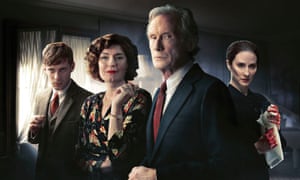
Ordeal By Innocence, episode one, finally appeared on BBC TV this evening, the intended screening at Christmas having been postponed. This was because one of the actors, Ed Westwick, has been accused of sexual offences, allegations which he denies. His scenes have now been re-shot, with another actor, Christian Cooke, taking his place. It's all been done very skilfully, so that the effect is as if his contribution had never existed.
The Agatha Christie novel on which Sarah Phelps has based her screenplay was published in 1958, and it's one of the most interesting books written by the Queen of Crime in the later part of her career. In particular, it explores a theme which fascinated her, as it continues to fascinate me: the idea that suspicion can have a cruel and corrosive effect on people who have not actually committed a crime; perhaps they may not even have done anything wrong at all. Suffice to say that more than one of my own novels have addressed this concept, and in writing them I've borrowed the phrase "ordeal by innocence", in homage to Christie. A thought-provoking issue, isn't it?
It's a sort of cold case mystery. Jacko Argyle was convicted of murdering his mother (played, excellently as always, by Anna Chancellor) and is now dead. He always claimed to have an alibi, but the witness who might have got him off the hook was never found. Now Arthur Calgary turns up, explaining that he's been away on an expedition to the Arctic, and has only just found out what has happened. Which gives rise to a question: if he's telling the truth, who did kill Mrs Argyle?
Bill Nighy leads a stellar cast, and the production values are high. The stunning setting is, apparently, Ardgowan House in Scotland, which looks utterly wonderful: I'd love to visit it. Phelps' screenplay brims with Gothic touches, although so far it's not as compelling as her version of And Then There Were None. Whether it was a good idea to stretch the story out to fit three episodes of one hour is, however, debatable. My instinct is that less is more, but we'll see...
Monday, 26 December 2016
The Witness for the Prosecution - BBC TV review

Wilder's version boasted a crisp script and a terrific cast, including Marlene Dietrich, Tyrone Power, and Charles Laughton. It is my favourite movie based on a Christie story. and set a very high standard for any subsequent adaptation. The BBC commissioned Sarah Phelps to write the new screenplay, a sound decision bearing in mind her good work last year with the script for And Then There Were None.
Less obvious was the decision to turn the story into a two hour-long episodes. That choice meant that Phelps was required to add quite a lot of backstory material - rather more than was needed last year. To update a Christie to this extent is always a risky enterprise, and Phelps' solution to the challenge is, in part, to focus on period atmosphere. In the first episode, this worked fairly well, but (pending seeing episode two) I'm inclined to think that a single 90-minute drama might have had more focus, and therefore greater intensity. There's a lot of darkness in this version, but that's not quite the same as intensity.
The BBC cast, if not quite in the league of Dietrich and company, is pretty good, with Toby Jones impressive as usual, playing the part of a down-at-heel solicitor. Naturally I empathised with him, just as Harry Devlin would. Billy Howie takes the role of Leonard Vole, while Andrea Riseborough is Romaine, and Kim Cattrall the older woman who takes up with a toy boy before meeting an untimely end. This version of a classic crime story has not yet displaced Wilder's film in my affections, and probably won't do so, but I will certainly be watching to see how Phelps handles the rest of the story.
Saturday, 26 December 2015
And Then There Were None - BBC 1 TV review

And Then There Were None is the finest of all Golden Age detective stories in my opinion- never mind that it lacks a great detective in the mould of Poirot or Marple. Agatha Christie wrote plenty of fine crime stories, but this has been my favourite since I first read it at a tender age. So the question I asked myself when anticipating this evening's first episode of the BBC TV three-part adaptation by Sarah Phelps was - would the TV version do the book justice?
There's been a lot of cunningly contrived publicity in the run-up to this showing which has been designed to generate interest. It has been suggested that Phelps was modernising the story in an inappropriate way, by introducing drug-taking, bad language, and other terribly topical features. Phelps, we were told, had never read any Christie before taking on the task of writing the script. I was rather sceptical about whether the script would prove as shocking as was implied. If you've ever read much Agatha Christie, you will know, for instance, that drug-taking crops up in a good many of her stories. And I devoted a good slice of The Golden Age of Murder to explaining why the perception that Christie's work is "cosy" is feebly inadequate.
The early scenes, which set up the complex mystery, were well done, I thought. This was probably where a less accomplished screenwriter would have found it easiest to mess up. The book supplies plot, dialogue and characters aplenty, but the challenge of creating the right mood at the outset was an important test, and I felt Phelps passed it with flying colours.From then on, the excellent cast, did the work of keeping me glued to the screen. The filming hasn't been done, as far as I can tell, on Christie's beloved Burgh Island, but I kept thinking back to my own trip to Burgh in September, and my brief experience of being cut off from the mainland for a while, due to the heavy seas....
Phelps has quite an interesting approach to pacing the plot developments, and as I'm starting to study the art of scriptwriting myself, it's helpful to see how an expert does it. Charles Dance, Miranda Richardson, Aidan Turner and Maeve Dermody (who was excellent in the key role of Vera) were all particularly good, while Noah Taylor and Anna Maxwell Martin made splendidly creepy servants. Two members of the cast have met untimely ends so far. The body count will continue to mount tomorrow night. And I will definitely be watching.
Subscribe to:
Comments (Atom)