Showing posts with label The Hollow Man. Show all posts

Friday, 22 April 2016

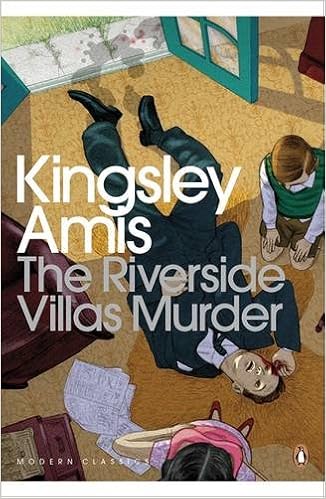
Forgotten Book - The Riverside Villas Murder


Kingsley Amis published The Riverside Villas Murder in 1973, and I read it not long after that, during a phase when I was very keen on Amis' work. Oddly enough, my enthusiasm for him faded after attending a talk by him at the Oxford Union - perhaps a salutary reminder for authors that events don't always have the desired effect on one's readership! There's no doubt that he was a talented writer, although I'm not sure time has been equally kind to everything that he wrote. But this particular novel is nowadays branded as a Penguin Modern Classic, and is certainly interesting to crime fans.

When I first read the book, I was intrigued that Amis was writing a homage to the classic detective story, but I felt disappointed with the resolution of the story, mainly because I found the whodunit element unsatisfactory. Re-reading the novel recently,with lowered expectations, I was pleasantly surprised. It's not a masterpiece, but it's interesting and very readable.

The events of the story are set in 1936, and Amis makes direct reference to detective fiction of the period. Anthony Berkeley is name-checked, while the protagonist, 14 year old Peter Furneaux, is lent a copy of John Dickson Carr's The Hollow Man, and the text includes a quote from that splendid story. Amis was much keener on Carr than on Christie, and the 'howdunit' aspect of the plot is the cleverest aspect of the whole novel.

Young Peter's attempts to broaden his sexual experience are rudely interrupted by the murder of an unpleasant chap called Inman, who has been threatening to reveal the dark secrets of supposedly respectable members of their suburban community. Peter doesn't get very far with 15 year old Daphne, but has more joy with a married neighbour, and their affair plays a significant part in the development of the plot. There's plenty of humour, and some neat characterisation, even though there's a surprising lack of tension in the build-up to the revelation of the culprit's identity. Despite its flaws, I enjoyed this book much more the second time around. Definitely worth  a read, even though it's a stretch to call it a modern classic.

Friday, 22 May 2015

Forgotten Book - The Judas Window

Why has it taken me so long to get round to reading Carter Dickson's The Judas Window? It is regarded highly by a number of good judges who are fans of Dickson - better known as John Dickson Carr. I suppose my main justification for describing it as a Forgotten Book is that I've forgotten, or at least neglected, to read it until now.

I've long admired Carr's work, and his mastery of the intricacies of the "impossible crime". In particular, I am a fan of the books featuring Dr Gideon Fell, the Chestertonian lexicographer who strs in classics such as The Hollow Man. A good many people prefer Sir Henry Merrivale, alias "H.M.", who is the rumbustious hero of the books written under the Carter Dickson alias. This is, in part, because of their humour - one of the neat features of the stories is that sometimes a slapstick scene will conceal an important clue to the mystery.

Merrivale features in a truly brilliant short story, "The House in Goblin Wood", but I've not been quite as keen on some of the Merrivale novels I've read. But The Judas Window is a high calibre mystery, no question of that. It's also rather different from "typical" Carr stories, in that it centres around a murder trial at the Old Bailey- and Merrivale is counsel for the defence.

His client is Jimmy Answell, a young man who seems the only possible suspect in a locked room murder case. We know Jimmy is innocent, but how on earth can this be established, in the face of apparently overwhelming evidence that he killed his prospective father-in-law? As the trial proceeds, we come across testimony from various people in the dead man's circle - but how can any of them have committed the crime? And if one of them did do the dastardly deed, for what reason?

The technicalities of the crime are very cleverly handled. I was much less convinced by the culprit's motivation, but the fact is that Carr was not as preoccupied with criminal psychology as some of his colleagues in the Detection Club. Yet he could weave a tantalising mystery, and I agree with those who rate this book highly. If you are a locked room fan, I recommend you get round to reading it more quickly than I did..