I read John Le Carre's novel Call for the Dead a very long time ago, but I've only just caught up with the film made of it by Sidney Lumet, a director of distinction. It was retitled The Deadly Affair and stars James Mason as Charles Dobbs - the same character as George Smiley in the novel, but renamed for legal reasons as the naming rights were tied up by someone else. (I always tend to think, by the way, that a mutually sensible approach to negotiation could resolve these oddities, but alas, people don't always negotiate sensibly...)
The cast is excellent, starting with the ever-reliable Mason, who really was a good actor. Harry Andrews is a highly believable retired cop, while Simone Signoret, in a less than glamorous role, is terrific. So is Harriet Andersson as Anne, Mason's wife, who loves him but torments him with her affairs. Roy Kinnear, Kenneth Haigh, and Lynn and Corin Redgrave also make telling appearances. The script is by Paul Dehn, who had worked on Goldfinger and later teamed up with Lumet again on Murder on the Orient Express. The soundtrack is by Quincy Jones, and there's a decent title song, "Who Needs Forever" by Astrud Gilberto; the music isn't quite in the John Barry class, but it's still high-calibre 60s easy listening.
With so much talent involved, the film is very watchable, even if the story seems slightly stretched out and a bit predictable. The legendary Freddie Young was responsible for the cinematography and he gives the movie a distinctly dark look, with several very well-chosen London locations. It's quite a modern-seeming look, even if the Hyde Park restaurant in which one scene was shot was demolished about thirty years ago. The visual style of the film coupled with the performances contribute to a downbeat mood which works well, even if it lacks the pace and melodrama of, say, the James Bond movies. It wasn't a box office hit, and I can see why, but it's stood the test of time pretty well.
The premise is simple. After a tip-off, Dobbs interviews an agent who may be a spy. The agent promptly commits suicide - but did he really kill himself, or were dark forces at work? The answer to that question is easily guessed, but Lumet and his collaborators still kept me engaged from start to finish.
Wednesday, 30 October 2019

Monday, 28 October 2019
"The Cap of Liberty"
My latest short story, "The Cap of Liberty", has just been published, and it's safe to say that it's a bit different. For a start, it's accompanied by an academic essay written by Professor Robert Poole and exploring the factual background to the story. And it's appearing in an anthology just published by Comma Press, and edited by Ra Page, called Resist. The sub-title is: Stories of Uprising. I was commissioned to write a work of fiction connected to the Peterloo Massacre, which occurred two hundred years ago last August.
Those who know me may well think that I'm an unlikely contributor to an anthology of fiction about protest, a book with subjects ranging from the distant past (Boudica's Rising) to the recent present (Grenfell). The fact is that I'm seldom seen on marches or waving banners, far less glueing myself to anything (except by accident) but I was pleased to be asked to take part. I've had a connection with Comma Press for a long time now, getting on for fifteen years, and they are an admirable independent outfit, based in Manchester, and dedicated to producing high quality books at the cutting edge of contemporary literature. They are (I quote from their very interesting website) a not-for-profit initiative dedicated to promoting new writing, with an emphasis on the short story, and committed to a spirit of risk-taking and challenging publishing, free of the commercial pressures on mainstream houses, and they aim "to put the short story at the heart of contemporary narrative culture". Words to savour. I've always regarded these aims not just as worthy but truly admirable.
A long time ago I had a short story published in a Comma publication of Liverpudlian fiction edited by Tane Vayu, and this led to a couple of CWA anthologies which I edited for them: I.D.: Crimes of Identity and M.O.:Crimes of Practice . Suffice to say that contributors included Mick Herron and Sarah Hillary, then relatively unknown and now superstars of the crime genre. More recently I contributed an essay about Sherlock Holmes short stories to Morphologies, another very interesting Comma Press book.
For those interested in how a story of this kind gets written, let me quote from Ra Page's original brief: "I would love to see what a no-holds-barred crime/detective story dealing with a historical protest might look like. Especially a protest like Peterloo. Of course, you might want to set the bulk of the story in the aftermath of the event (or even much later down the line), and then reveal aspects of the massacre through the backstories. That's up to you. I realise there weren't detectives or even police officers in 1819; it was all magistrates and soldiers, agent provocateurs and debt-bonded 'spies'. But I'd be super-excited to see what you did with it.
I thought long and hard about whether to accept this invitation, partly because I do have quite a lot of projects going on at present, and partly because I knew it would require a good deal of work, not only in terms of practical research but also thinking myself into the right mindset for the story. But I love Ra's enthusiasm and commitment, and so I said yes. He'd arranged for me to talk to Robert Poole, an expert on Peterloo, and I found our conversations and his writings on the subject very helpful. I decided to set my story in the 1830s, so that it became a sort of "cold case" narrative. Once I'd figured out a way in to the material - always so important when one tries something different - I went on a research trip to find out more about my chosen protagonist (a person from real life who has, in fact, appeared once before in my fiction).
The result was "The Cap of Liberty". It is in essence a story about both justice and injustice, which are key themes of so many crime stories and pretty much all of my own fiction. I'm glad that it's now seen the light of day and I hope the book will be a big success for Comma.
Friday, 25 October 2019
Forgotten Book - A Case in Nullity
Evelyn Berckman is a writer whom I've only started to read in the past year or so. She was an American who moved to London after earlier having a career as a pianist and composer; she only embarked on a new career as a crime writer in the mid-Fifties, when she herself was in her mid-fifties. Her fiction was quite diverse, and she also wrote books about naval history. It may be that her failure to focus on a memorable series character has contributed to her neglect in recent years, but she could write very well.
A Case in Nullity is an example of the way she takes an interesting scenario, of the kind that you might find in many a novel of psychological suspense, and turns it into a novel of character, where development and revelation of character is at least as important as development of the plot. Actually, I'm not sure whether she was really very interested in plot, but even if (like me) you are, don't allow that to discourage you from looking at her work.
This is, on the surface, a variation on a classic woman-in-jeopardy theme. Auriol makes an unsatisfactory marriage, and when she seeks an annulment, because her husband refuses to have sex with her, he embarks on a malevolent campaign of persecution. The suspense builds well, as Auriol's situation becomes increasingly desperate.
Yet it becomes clear in the closing pages that Berckman's real interest is in the effect of the events of the story on her people. This book was first published in 1967, the year that homosexual acts were decriminalised in Britain, and attitudes towards (and on the part of) gay and lesbian people are central to Berckman's concerns. It must have seemed very "cutting edge" when it was written. Today, some of the attitudes portrayed seem questionable and dated, but even so, I found this an intriguing and unusual story.
A Case in Nullity is an example of the way she takes an interesting scenario, of the kind that you might find in many a novel of psychological suspense, and turns it into a novel of character, where development and revelation of character is at least as important as development of the plot. Actually, I'm not sure whether she was really very interested in plot, but even if (like me) you are, don't allow that to discourage you from looking at her work.
This is, on the surface, a variation on a classic woman-in-jeopardy theme. Auriol makes an unsatisfactory marriage, and when she seeks an annulment, because her husband refuses to have sex with her, he embarks on a malevolent campaign of persecution. The suspense builds well, as Auriol's situation becomes increasingly desperate.
Yet it becomes clear in the closing pages that Berckman's real interest is in the effect of the events of the story on her people. This book was first published in 1967, the year that homosexual acts were decriminalised in Britain, and attitudes towards (and on the part of) gay and lesbian people are central to Berckman's concerns. It must have seemed very "cutting edge" when it was written. Today, some of the attitudes portrayed seem questionable and dated, but even so, I found this an intriguing and unusual story.
Wednesday, 23 October 2019
The Seven Deaths of Evelyn Hardcastle by Stuart Turton
There's something admirable about crime writers who take risks with their work, who try to do something different. Agatha Christie did this plenty of times, and so did Dorothy L. Sayers. And there are various examples among modern day writers. Of course, sometimes the risks don't pay off. Experiments can fail. Innovative books are often flawed - think of Dorothy L. Sayers and Robert Eustace's The Documents in the Case, a book sometimes criticised as drab, yet genuinely ground-breaking and in my opinion under-rated. Another example would be Freeman Wills Crofts' Antidote to Venom, a detective story with a moral message at its heart.
When I heard about Stuart Turton's bestselling debut, The Seven Deaths of Evelyn Hardcastle, I was at once keen to read it. In a note at the end of the paperback edition, he talks about discovering Agatha Christie at the age of eight and wanting to emulate her. So although I've never met him, I certainly have a fellow feeling for him. The energy and invention of his book seem to me to be absolutely admirable.
I want to be careful about what I say about this novel, so as to avoid spoilers, but it's widely known that it's an homage to the Golden Age with a difference - the luckless protagonist finds himself trapped in a number of different bodies as he tries to discover the truth about Evelyn Hardcastle's fate (which in turn entails discovering the truth about a crime 19 years earlier), and to see if he can change the course of history. In the classic manner, the setting is a country house, called Blackheath. There's a homicidal footman, a mysterious Plague Doctor, and much else besides.
This is a witty book, and although it calls for a huge amount of suspension of disbelief, the pace and drive of the first hundred pages or so ensure that Turton achieves a key goal - most readers, I'm sure, will be willing to buy into the premise. It's a complicated story, and a long one. In the latter stages, I felt that the author was probably trying a bit too hard to add on extra layers of meaning and complexity. There are also some turns of phrase that don't really fit in with a Golden Age story, and which I felt an editor should have picked up. I'm not convinced that the explanation of what is really going on at Blackheath stands up to much scrutiny, and for me, the motivation of the ultimate culprit was inadequately foreshadowed, thus weakening the power of that particular revelation. So the final part of the book didn't work as well for me as the very gripping early pages. No matter. Stuart Turton has written a novel which plays with Golden Age tropes in an absorbing and unusual way, and the result is something strikingly original. Quite something for a debut novel! I'll be fascinated to see what he comes up with next.
When I heard about Stuart Turton's bestselling debut, The Seven Deaths of Evelyn Hardcastle, I was at once keen to read it. In a note at the end of the paperback edition, he talks about discovering Agatha Christie at the age of eight and wanting to emulate her. So although I've never met him, I certainly have a fellow feeling for him. The energy and invention of his book seem to me to be absolutely admirable.
I want to be careful about what I say about this novel, so as to avoid spoilers, but it's widely known that it's an homage to the Golden Age with a difference - the luckless protagonist finds himself trapped in a number of different bodies as he tries to discover the truth about Evelyn Hardcastle's fate (which in turn entails discovering the truth about a crime 19 years earlier), and to see if he can change the course of history. In the classic manner, the setting is a country house, called Blackheath. There's a homicidal footman, a mysterious Plague Doctor, and much else besides.
This is a witty book, and although it calls for a huge amount of suspension of disbelief, the pace and drive of the first hundred pages or so ensure that Turton achieves a key goal - most readers, I'm sure, will be willing to buy into the premise. It's a complicated story, and a long one. In the latter stages, I felt that the author was probably trying a bit too hard to add on extra layers of meaning and complexity. There are also some turns of phrase that don't really fit in with a Golden Age story, and which I felt an editor should have picked up. I'm not convinced that the explanation of what is really going on at Blackheath stands up to much scrutiny, and for me, the motivation of the ultimate culprit was inadequately foreshadowed, thus weakening the power of that particular revelation. So the final part of the book didn't work as well for me as the very gripping early pages. No matter. Stuart Turton has written a novel which plays with Golden Age tropes in an absorbing and unusual way, and the result is something strikingly original. Quite something for a debut novel! I'll be fascinated to see what he comes up with next.
Monday, 21 October 2019
Announcing 'Howdunit'

Front page news on The Bookseller on Friday was the announcement of a deal to publish an exciting new book written by members of the Detection Club. Howdunit, which I've compiled and edited, is about the art and craft of crime writing and it will be published by HarperCollins in June next year.
The contributors will include almost all the current members of the Detection Club, including Ian Rankin, Val McDermid, Ann Cleeves, Mick Herron, James Runcie, Peter James, Sophie Hannah, Peter Robinson, Felix Francis, Elly Griffiths, Peter Lovesey, Mark Billingham, and Len Deighton, to whom the book is dedicated - given that this year, Len celebrates 50 years as an enthusiastic member of the Club. They will offer a marvellous range of insights into the writing life, including personal reminiscences, practical tips for aspiring writers, and an insight into the realities of being a writer - there are terrific pieces, for instance, about "imposter syndrome" and "improvisation techniques" as well as thoughts on social media, writing for radio, and the experience of having your work adapted for TV and film.
And that's not all. The book will also include shorter pieces by a number of illustrious Detection Club members of the past, from G.K. Chesterton onwards. So readers will have a chance to compare the approaches of luminaries of the Golden Age, for instance, with those of their present day successors. It will, I think, be quite a book. I've been working hard on it for much of this year - since Club members decided at our AGM in February that they wanted to put together a book to raise funds for the Club.
And that's another remarkable and highly gratifying feature of this book - the lovely people who are contributing to it are donating all the proceeds to Club funds, to ensure that as it celebrates its 90th anniversary next year, it continues to thrive for the foreseeable future. I'm enormously grateful to each and every one of them for their wholehearted support, as well as for the wonderful pieces they are contributing.
More about this book before long. But in the meantime, there's still work to be done...
Friday, 18 October 2019
Forgotten Book - A Bullet for Rhino
Clifford Witting (1907-68) is one of those writers who flew somewhat under the radar. His work isn't often discussed, but he was elected to membership of the Detection Club ten years before his death, and his books are admired by such knowledgeable aficionados as Barry Pike and Nigel Moss. Nigel it was who lent me his copy of A Bullet for Rhino, originally published in 1950, and I'm glad he did.
This was the ninth case for Inspector Harry Charlton, a likeable fellow who happens to be an old boy of Mereworth School. He's invited to a reunion, at which, he's told, his well-known but highly controversial contemporary "Rhino" Garstang will be present. But it becomes clear that someone is anxious for him not to attend. It's clear (and not merely from the title) that murder is in the air. And as soon as we are introduced to Rhino, it's clear that he is a very suitable victim. He is one of those Golden Age victims who makes a point of giving people reasons to kill him. Most unwise.
Even though this is a post-war novel, it certainly has a Golden Age flavour. The restricted private school setting, so popular with Golden Age novelists, contributes to this. And Charlton here acts rather like an amateur detective, with the local cops taking charge when someone tries to blow up Rhino. The clever finale in particular seemed to me to be more typical of a Golden Age mystery than a conventional police story.
A cricket match at the school plays quite a significant part in the storyline, and as a cricket fan myself, I found this pleasing. Possibly those who aren't cricket lovers may be less impressed, but again cricket, with its ethos of fair play, is very much a game in keeping with the Golden Age tradition. All in all, I liked this book and felt Nigel's recommendation was spot on.
This was the ninth case for Inspector Harry Charlton, a likeable fellow who happens to be an old boy of Mereworth School. He's invited to a reunion, at which, he's told, his well-known but highly controversial contemporary "Rhino" Garstang will be present. But it becomes clear that someone is anxious for him not to attend. It's clear (and not merely from the title) that murder is in the air. And as soon as we are introduced to Rhino, it's clear that he is a very suitable victim. He is one of those Golden Age victims who makes a point of giving people reasons to kill him. Most unwise.
Even though this is a post-war novel, it certainly has a Golden Age flavour. The restricted private school setting, so popular with Golden Age novelists, contributes to this. And Charlton here acts rather like an amateur detective, with the local cops taking charge when someone tries to blow up Rhino. The clever finale in particular seemed to me to be more typical of a Golden Age mystery than a conventional police story.
A cricket match at the school plays quite a significant part in the storyline, and as a cricket fan myself, I found this pleasing. Possibly those who aren't cricket lovers may be less impressed, but again cricket, with its ethos of fair play, is very much a game in keeping with the Golden Age tradition. All in all, I liked this book and felt Nigel's recommendation was spot on.
Wednesday, 16 October 2019
More Crime Classics on the way
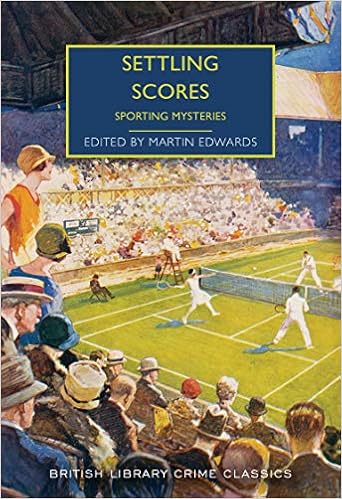
The British Library has just issued its catalogue for the first half of next year, and it's full of good things. Including, naturally, half a dozen Crime Classics that will offer a wide variety of delights for fans of good mystery fiction. For many people, I suspect the stand-out title will be The Woman in the Wardrobe by Peter Shaffer. This splendid impossible crime story was the work of a major writer in the making. Shaffer wrote it in his early twenties and I've been trying to get it back in print for years. This has not been easy to achieve, but I'm glad that a new generation of readers will have a chance to enjoy it at last.
John Dickson Carr returns, with another Henri Bencolin story, the splendidly atmospheric Castle Skull, set in the Rhineland. We're also back in continental Europe with Crossed Skis, by Carol Carnac. Carnac was a pen-name of Carol Rivett, better known as E.C.R. Lorac, and this is a very enjoyable Alpine mystery indeed - even if, like me, you wouldn't want to be caught dead on a pair of skis.
I'm delighted that Mary Kelly's The Spoilt Kill is included in the list. This is the book that won her the CWA Gold Dagger when she was still in her early thirties - perhaps there have been younger winners since then, but not many, that's for sure. I read the novel many years ago and thoroughly enjoyed it when rereading it prior to writing my intro for this edition. I've also benefited from the insights of the author's husband, Denis, who has been enormously helpful.
By popular demand, there's another John Bude book - in fact, a volume which contains two rare Bude novels, Death in White Pyjamas and an impossible crime story, Death Knows No Calendar. And finally there is another anthology which I've put together. Settling Scores is a collection of sporting mysteries; each story is by a different author, and each features a different sport.
Monday, 14 October 2019
The Hooded Gunman by John Curran - review
John Curran is renowned as an expert on Agatha Christie, and his research into her private notebooks broke fresh ground in terms of the analysis of how detective novelists devise their stories. I've referred to his books many times, and I've no doubt that I'll be referring frequently to his latest book, The Hooded Gunman, just published by HarperCollins. It's a detailed assessment of that splendid, and much-missed imprint, the Collins Crime Club. I should disclose that I'm one of those thanked in the acknowledgements at the front of the book, but regardless of that, I can recommend this book unreservedly to all serious students of the genre.
The Hooded Gunman is a beautifully presented book, crammed with full colour illustrations of dust jackets as well as many photographs of great interest to the crime fan. It's the most gorgeous book about the crime genre I've seen since It's All One Case, a superb book about Ross Macdonald's work published three years ago which deserves to be much better known. Terence Caven's design work is admirable.
In one sense The Hooded Gunman is a coffee table book, because of the heavy focus on quality illustrations. But it's much more than that. I'm not quite sure if John has read every single book published under the Crime Club imprint, but I wouldn't be surprised. He's certainly done a huge amount of research, and as a result, the text is more interesting and valuable than is usually the case with coffee table books (something else it has in common with It's All One Case). A large section of the book is devoted to reprinting jacket blurbs which will be a very useful tool for readers who want to consider seeking out particular titles.
There are also several short but informative sections, for instance about Crime Club card games and the dons' detective novel competition judged by Agatha Christie among others. John makes the point that E.C.R. Lorac was particularly well-served by the artists who produced dust jackets for her books, and there's evidence here to substantiate this claim. I've enjoyed reading John's text and I've also had a lot of pleasure simply leafing through this handsome volume, admiring the illustrations. A joy for book lovers, and a very good Christmas present for the detective fan in your life.
The Hooded Gunman is a beautifully presented book, crammed with full colour illustrations of dust jackets as well as many photographs of great interest to the crime fan. It's the most gorgeous book about the crime genre I've seen since It's All One Case, a superb book about Ross Macdonald's work published three years ago which deserves to be much better known. Terence Caven's design work is admirable.
In one sense The Hooded Gunman is a coffee table book, because of the heavy focus on quality illustrations. But it's much more than that. I'm not quite sure if John has read every single book published under the Crime Club imprint, but I wouldn't be surprised. He's certainly done a huge amount of research, and as a result, the text is more interesting and valuable than is usually the case with coffee table books (something else it has in common with It's All One Case). A large section of the book is devoted to reprinting jacket blurbs which will be a very useful tool for readers who want to consider seeking out particular titles.
There are also several short but informative sections, for instance about Crime Club card games and the dons' detective novel competition judged by Agatha Christie among others. John makes the point that E.C.R. Lorac was particularly well-served by the artists who produced dust jackets for her books, and there's evidence here to substantiate this claim. I've enjoyed reading John's text and I've also had a lot of pleasure simply leafing through this handsome volume, admiring the illustrations. A joy for book lovers, and a very good Christmas present for the detective fan in your life.
The Isle of Wight Literary Festival

This weekend, I was delighted to take part in the Isle of Wight Literary Festival, at Northwood House in Cowes. It's a long time since I last visited the island (back in the days before I had a car; the future Mrs Edwards and I spent a few days touring around via the local bus service...) and so I seized the opportunity to combine the event with some sight-seeing. The luck I've had all year with the weather finally ran out, but even in damp conditions, the island is a pleasant place to visit, and this time I travelled over via the car ferry from Southampton, which made it possible to drive around from place to place and dodge the showers.

The Festival has been running for a number of years now, and the Chair, Maggie Ankers, has an excellent team of colleagues assisting her and making sure that this is an event that many writers, ranging from Dan Snow to Alexander McCall Smith, are keen to attend. The hospitality was first-rate, with not one but two receptions, each followed by a pleasant meal in the setting of a yachting club. I enjoyed learning about the island.


It's a place with a lot of history, and I visited Newtown, once a major medieval harbour, now a highly atmospheric coastal village, as well as the Bembridge Windmill and the Needles. There's a chairlift for sight-seers at the Needles, but the wind was so strong that it was out of action when we visited Alum Bay.


Friday, 11 October 2019
Forgotten Book - Fer-De-Lance
Of all the great American crime writers, Rex Stout has been something of a blind spot for me. Many years ago, Some Buried Caesar was strongly recommended to me, and I was underwhelmed. But he was an important figure in the genre, and I decided to give him another try. I opted for the first Nero Wolfe mystery, Fer-de-Lance, which dates from 1934.
The story was the first recorded case of Wolfe and his sidekick Archie Goodwin, who narrates. But as Loren D. Estleman, who wrote the intro to my paperback edition says, you really wouldn't realise this - the duo are portrayed compellingly, and as Estleman points out, that portrayal really didn't vary during their long career. Wolfe was the supreme armchair detective, and Archie did the leg-work.
It was a clever idea, to combine a Great Detective in the classic mould with a character who might have sprung from the pulp magazines, and Stout married the two traditions to better effect than perhaps anyone else. I was more impressed this time around than on my first encounter with his work, and the mystery is a clever one. But although I'm warming to Stout, I still wouldn't class myself as a devotee.
The principal murder method here is very much in the Golden Age tradition, and so is the idea of murder committed on a golf course, while the vivid finale is in keeping with the action story template. It's also historically interesting that Wolfe is struggling financially because he is as affected by the Great Depression as everyone else in the US at the time, an unusual aspect of the story which did appeal to me. Well worth reading, and some regard this one as a masterpiece.
The story was the first recorded case of Wolfe and his sidekick Archie Goodwin, who narrates. But as Loren D. Estleman, who wrote the intro to my paperback edition says, you really wouldn't realise this - the duo are portrayed compellingly, and as Estleman points out, that portrayal really didn't vary during their long career. Wolfe was the supreme armchair detective, and Archie did the leg-work.
It was a clever idea, to combine a Great Detective in the classic mould with a character who might have sprung from the pulp magazines, and Stout married the two traditions to better effect than perhaps anyone else. I was more impressed this time around than on my first encounter with his work, and the mystery is a clever one. But although I'm warming to Stout, I still wouldn't class myself as a devotee.
The principal murder method here is very much in the Golden Age tradition, and so is the idea of murder committed on a golf course, while the vivid finale is in keeping with the action story template. It's also historically interesting that Wolfe is struggling financially because he is as affected by the Great Depression as everyone else in the US at the time, an unusual aspect of the story which did appeal to me. Well worth reading, and some regard this one as a masterpiece.
Subscribe to:
Posts (Atom)