Monday, 20 April 2020

The Coffin Trail and the Lake District Mysteries


The Coffin Trail: You can never bury the past... (Lake District ...

The Coffin Trail is available today as an Amazon Kindle Daily Deal for a modest 98p - a price which I hope will tempt you if you haven't already read it! (The offer isn't available in the US, I'm afraid.) And this reminds me that I ought to give an update on progress with the Lake District Mysteries. In case you're wondering - I'm writing a new one right now!

The Coffin Trail is the first book in the series and when I went back to it to refresh my memory about a number of details, I was startled to realise that I wrote it seventeen years ago; it was then published in 2004 and shortlisted for the Theakston's Prize for best crime novel of the year. Since the other shortlisted novels were by Ian Rankin, Val McDermid, Susan Hill, Stephen Booth, and Lindsey Ashford, it was a truly memorable experience.

When I wrote The Coffin Trail, I intended that it should be the first in a series. That said, I didn't anticipate the direction my career would take in the ensuing years; if you'd told me what would happen, I doubt I'd have believed you. But because I write for the long term, there were ingredients of that first story which I intended would gain greater significance in subsequent books.

The first of those ingredients concerned the garden of Tarn Cottage, which becomes relevant in the second book in the series, The Cipher Garden. The second ingredient - well, I'll leave you to figure it out. Suffice to say that, at long last, I've picked up those early threads in the new book, The Crooked Shore. And readers will therefore encounter the resolution of a mystery they might not even be aware was bubbling under the surface...

I'm hoping that within a week or so, I will have completed the first draft, with a view to the book being published next year. It's been fascinating to return to the Lakes, after a break of several years while I've focused on Gallows Court and Mortmain Hall, among other projects. And I hope that today's deal will introduce a few more readers to the delights of the Lakes as well as the tangled lives of the lead characters, Hannah Scarlett and Daniel Kind. 

Friday, 17 April 2020

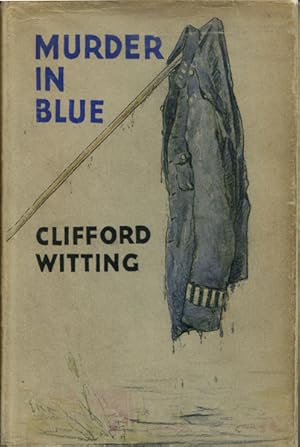
Forgotten Book - Murder in Blue


clifford witting - murder in blue - AbeBooks

Murder in Blue, published in 1937 by Hodder & Stoughton, was the first detective novel of Clifford Witting. It was an auspicious debut, proclaimed by Hodder as "a first-class detective story...about the murder of a policeman". It's interesting to compare the first edition of this book with first editions written by debut authors today. Now, readers are always presented with information about the author. Publishers are keen, almost to the point of obsession sometimes, to focus on an author's "platform", i.e. the means by which, it's thought, he or she can attract readers. It was very different in 1937. We are not told a word about Witting.

So who was he? I don't possess a lot of biographical information but I do know that Clifford Witting (1907-68) was educated at Eltham College and worked for many years for Lloyds Bank. He enjoyed a long career as a crime novelist, spanning 27 years, but was much less prolific than many others who started during the Golden Age. In that time he published sixteen novels. Quite possibly, like Cyril Hare for instance, his day job reduced his literary output. But lack of productivity is no bad thing if it is matched by a corresponding increase in quality. He wrote accomplished traditional mysteries and in 1958 he was elected to membership of the Detection Club, a sign of the esteem in which he was held by fellow practitioners.

Nick Fuller writes about Witting on the excellent gadetection site, and asks why he is so obscure, given the engrossing nature of his stories. It's a good question. I missed out on Witting for many years and it was only because of the advocacy of Nigel Moss, an excellent judge, that I sampled him. I'm glad I did, because all the books of his that I've read have merit.

Narrated by a likeable bookseller, John Rutherford, and set in a thinly disguised Sussex, Murder in Blue introduced Detective Inspector  Charlton, who was to become a series character. There's more focus on characterisation and setting than you find in, say, most of the Freeman Wills Crofts books, and definitely more humour. Witting was witty! The story begins extremely well thanks to Witting's smooth narrative style, although I felt it sagged in the later stages. Overall, however, a decent start to a career of under-valued accomplishment.


Wednesday, 15 April 2020

Charade - 1963 film review

Charade is a film made by an accomplished director, Stanley Donen, who was here venturing into Hitchcock territory with a light thriller starring Cary Grant and Audrey Hepburn. The movie was a commercial success and boasted a theme song by Henry Mancini and Johnny Mercer. When I first saw it, the mix of crime with romance and comedy slightly underwhelmed me, and the same was true (as I said on this blog twelve years ago) when I took another look.

But time passes and views change and on a recent third viewing - intended as light relief in the lockdown era - I enjoyed it more. It's a well-crafted confection of highly commercial if highly derivative ingredients although not in the same league as, say, Hitchcock's North by North West, which is by far my favourite Cary Grant film.

The source material was a short story called "The Unsuspecting Wife", written by Peter Stone. He and Marc Behm (best known as author of The Eye of the Beholder) turned it into a screenplay. When this didn't sell, Stone turned the story into a novel, Charade, which did. Donen secured a high-calibre cast, including Walter Matthau, James Coburn, and George Kennedy.

Hepburn plays Regina, whose marriage is on the rocks at the start of the film. She's not too heartbroken to learn of the death of her husband Charles or to meet a charming man (Grant) who calls himself Peter Joshua. When it turns out that Charles was a crook who nicked a quarter of a million dollars that assorted villains want for themselves, Regina finds herself in danger. Peter comes to her aid - but what's his real game?

There are some good set-piece scenes and I enjoyed George Kennedy's steel claw, which reminded me of Major Whitlow in Mortmain Hall, not to mention Louis Crandell, the inspiration for my character! The Parisian backdrop adds to the movie's charm and overall it ranks as an agreeable piece of escapism. Very suitable at the moment!


Monday, 13 April 2020

Walter Satterthwait's Dead Horse


Dead Horse by Walter Satterthwait

I've been interested in the writing of Walter Satterthwait since reading his excellent historical mystery Miss Lizzie shortly after it was published in the UK at the end of the 80s. At that time it seemed to me that he was destined to become one of the genre's major figures. His versatility - he wrote a short series about the private eye Joshua Croft as well as novels featuring such notable figures as Oscar Wilde and Harry Houdini - was in many ways a great strength, but although I admire authors who avoid the same-old, same-old, possibly it counted against him. His work was well-respected but it's probably fair to say that he never quite achieved the level of commercial success that one might have anticipated. Of course, that is true of many, many gifted authors.

I never met Walter but I gather he had an extremely interesting and varied life and he was a good friend of someone I did knows slightly, the late Sarah Caudwell, another charismatic figure who was in many ways a very different kind of character. It would have been wonderful to listen to them in conversation together. Sadly, he died earlier this year after a long illness. The good news is that Stark House Press have recently republished his 2008 novel Dead Horse, together with an excellent intro by Rick Ollerman.

And what a fascinating book it is. Like much of his best work, it's a historical crime novel, inspired by real life events - in this case the apparent suicide of Emily Whitfield, second wife of the hardboiled writer Raoul Whitfield. Satterthwait's version of events is invented, but compelling.

I devoured this book in just 24 hours. Satterthwait's terse style here is very much in the hardboiled tradition. He invents a dogged local cop, Tom Delgado, who is convinced that there is more to Emily's death than meets the eye. It's a doom-laden story set in Santa Fe, where the Whitfields had a ranch called Dead Horse. This is an excellent reprint, which I can recommend. And it's made me want to read Whitfield too...

Thursday, 9 April 2020

Forgotten Book - Crossed Skis


Crossed Skis by Carol Carnac, Martin Edwards | Waterstones

I've discussed my interest in the detective novels of E.C.R. Lorac often enough on this blog, but I've not had much to say about the work of her alter ego, Carol Carnac, which features a Scotland Yard cop called Julian Rivers. This is simply because I've not read many Carnacs. However, a while ago I was offered the chance to acquire an inscribed copy of the Carnac novel Crossed Skis, and I jumped at it.

The book was published in 1952, and is dedicated to Lorac's fifteen fellow members of a ski-ing party that travelled from England to Lech in Austria: "with thanks for their help and advice and happy memories of their charming company". My copy was inscribed to a member of the party, and I wonder what he made of it. I'm pretty sure he'd have been fascinated, since the story is all about - guess what? - a party of sixteen English people who go ski-ing to Lech...

This is an interesting and fairly unusual detective story, and I'm delighted that the British Library has decided to publish it in the Crime Classics series. There are two narrative strands. The ski-ing party set off for the continent, with some of its members unknown to each other. I did worry that Lorac had made a mistake by introducing too many characters, and personally I think a party of four men and four women would have been viable in this story, but I can see why she thought her plot called for more people.

The second strand of the story begins with a fire in a London house. Is it an insurance scam, is it an accident, or is something more sinister happening? Rivers takes charge of the investigation, and soon finds himself on the trail of a ruthless killer. As the two strands come together, the tension mounts. This is an enjoyable book, even for someone like me, who would rather do almost anything than ski!


Wednesday, 8 April 2020

Reviewing and Being Reviewed


Do book reviews matter? As someone who has reviewed crime fiction since the late 80s (and legal books before that), I'd like to think the answer is yes. As an author myself, I'm pretty sure the answer is yes. This isn't to say that great reviews necessarily equate to great sales; the publishing world isn't as simple as that. But reviews affect a writer's morale, both positively and negatively. Perhaps most authors remember the poor reviews more than the good ones, but I think the key thing is to see what one can learn from reviews. As a reviewer, I try to make judgements based on my opinion about what the writer was trying to achieve. And as an author I find that the reviewers whose comments are most valuable are those who "get" what I was aiming to do.

I vividly remember the pleasure I had when Frances Fyfield gave a glowing review of an early Harry Devlin novel of mine. She "got" what I was trying to do with the characters, and that was highly satisfying. Years later, I met her in person and had the opportunity to thank her. The late Matthew Coady and Marcel Berlins were other critics who worked for the national press and showed an understanding of and empathy for my early books. That too was gratifying at a time when I was trying to establish some kind of niche.

The Puzzle Doctor has recently been generous enough to review three very different books of mine, two novels and The Golden Age of Murder, on his blog In Search of the Classic Mystery. Once again he's demonstrated the virtues and value of a thoughtful and insightful reviewer. His comments about The Dungeon House, which is probably my own favourite of my Lake District books, remind me that many fans of series hope for a significant focus in the storyline upon the recurring characters. This is something I'll bear in mind with my current work-in-progress, The Crooked Shore. It's shaping up to be a story that is at least as much about psychological suspense as the police investigation, but it's helpful to be reminded that readers do like to know what's going on in the lives of Hannah and Daniel. 

His comments about Mortmain Hall I found equally interesting. And it's enormously heartening (as well as a relief!) when a good reviewer enjoys a book so much. I'm particularly glad that he feels it's a book that keeps you thinking long after you've finished it. That's a reaction, like Frances', which delights me, because although my focus is definitely on entertaining my readers, I also like to include elements in all my books that provoke thought. Sometimes those elements are a long way under the surface (probably they were too far under the surface in Take My Breath Away, which I wrote nearly twenty years ago and hoped would be something of a breakthrough - but commercially it was about my least successful novel.)

I do understand why some fellow novelists prefer not to read reviews, but my own feeling is that it's well worth hardening oneself against the occasional brickbats, because there's so much to be gained from a well-crafted and constructive assessment of something one has written. The Puzzle Doctor's trio of reviews illustrates what I mean, and I'm grateful to him not just for his kind words but for taking the time and trouble to analyse what I set out to do with each book.


Monday, 6 April 2020

Forty Years On!


Last week was, for me, notable for a couple of landmark moments. The one that I concentrated on was the publication of Mortmain Hall on Thursday. But the day before saw another milestone. It was April Fool's Day, and the fortieth anniversary of my qualifying as a solicitor. As it happens, April Fool's Day was also the day when I became a partner in my firm, in 1984, and then an equity partner, twelve months later. Surely some significance in that date...


Anyway, this is a blog about crime writing, so I've avoided discussing my other life as a lawyer. Perhaps this explains why most people I meet seem to think that I retired from the law many moons ago. An understandable assumption, but in fact I am still a consultant with my firm, though on a part-time basis; I retired from the partnership six years ago. The firm in question is Weightmans LLP, with which my old firm, Mace & Jones, merged in 2011. That merger was a great thing for me, as well as for many others. In my case, it opened the door to a fresh way of life, which I've embraced with enthusiasm.

I didn't expect to stay in the law as long as I have, and the fact that I've done so is due entirely to the decency of the people I work with. It may seem invidious to pick out just a few names, but over my career I was especially lucky to work with a series of fantastic secretaries/PAs who were long-serving and perhaps long-suffering: Heather Jones, Ann Geraghty, Lea Doran, and now Jo Wright. I'll always be grateful to them.


Forty years is a long time, and I hope you'll forgive my indulging in a spot of nostalgia today. Since I believe strongly in job satisfaction, you can take it for granted that I've enjoyed being a lawyer. I trained in Leeds, where I discovered employment law, which I hadn't studied at university. At that point, I thought it made sense (and I've never regretted it) to combine working in employment law, then a very new and minor subject, with commercial and corporate law, because of the synergy between those subjects. Most firms, however, treated employment work as a branch of litigation. But I never regarded myself as a litigator, even though in the first half of my career I spent a lot of time as an advocate in the industrial/employment tribunal. And the Liverpool tribunal was a notoriously tough training ground, one which supplied me with a lifetime of anecdotes. As regards commercial work, which I gave up after about ten years, a highlight was working on legal aspects of the film Letter to Brezhnev, a unique experience in my career.


To me, the key to employment work is managing relationships between employers and employees, and resolving disputes - however irreconcilable the parties may seem to be - rather than magnifying the gulf between them. I always believed in acting for both employer and employee clients, so that one had the whole picture. There's no doubt, though, that acting for a deserving employee and trying to secure justice for them is very rewarding. The two most significant cases I ever handled as an advocate, both of which found their way into the official law reports, concerned clients who were very badly treated because they were pregnant. 

Conversely, one attraction of acting for employers is that, over the course of time, you build up pleasant relationships with people, including HR specialists, in-house lawyers, and people running small or medium-sized firms and trying to make a go of it. I was lucky to act for some very high profile clients, such as Liverpool FC for about twenty years, the Health and Safety Executive, Littlewoods, and numerous NHS trusts, as well as many much smaller concerns. The rich mix of clients meant that I got a picture of life inside all kinds of different organisations and I have always found this absolutely fascinating. The reason why employment law appeals to me, I realised eventually, is because it's about people and relationships under pressure - much the same concerns as those of the novelist. A lawyer's work tends to make one cynical, but overall I've come to the conclusion that most bad behaviour results from stupidity or ignorance rather than outright malice, and this means that it is usually possible, in the end, to encourage people to find a reasonable solution to their differences, however bitter the initial dispute.

I also enjoyed writing about the law and trying to make it comprehensible to non-lawyers. My first published book was Understanding Computer Contracts and my various other legal books included six editions of Careers in the Law and four editions of Tolley's Equal Opportunties Handbook. I published well over a thousand legal articles in publications ranging from Good Housekeeping to (believe it or not) Practical Woodworking and Amateur Gardening and I was a columnist for various magazines, e.g. the Law Society's Gazette, The Expatriate, and Social Services Insight. For 18 months I was leader writer for The Solicitors' Journal and this gave me a platform to pontificate about all manner of things - great fun. All this experience has, I'm sure, helped me as a writer of fiction, because even novelists need to understand about the importance of deadlines and the vagaries of the publishing world. It was especially beneficial when I came to write non-fiction about the crime genre, not least The Golden Age of Murder.

Over those forty years, there have been many moments to remember (plus a few I'd rather forget). I recall quite vividly a lunch in the early 80s at the Wig and Pen with, of all people, a leading light in the Workers' Revolutionary Party who predicted the miners' strike - and in particular its outcome - with uncanny accuracy. I enjoyed going behind the scenes at places as different as Heathrow Airport, the Football Association, Liverpool Museum, and Harrods to conduct interviews, while other highlights included receiving a couple of "best employment team" awards at glitzy occasions.   


One of the memories which particularly stands out was a day back in 2008, which with hindsight feels like a transitional moment involving my twin careers. I was taken on a behind-the-scenes tour of Wembley Stadium, for whom I acted, and was allowed to go on to the pitch and into the dressing rooms. Magical for a lifelong football fan. I then headed into central London, visited the Sherlock Holmes Museum, and then rocked up for the CWA Daggers dinner that night. To my amazement, given that the shortlist included Michael Connelly and Laura Lippman, I received my first literary award the Short Story Dagger; the below photo shows me with Craig Russell. Money can't buy memories like that, and I'm enormously thankful to have had two careers which were not only satisfying but brought me into contact with some wonderful people.


My main focus in the future will, of course, be writing. But the law's been good to me, and I know I'm exceptionally fortunate to have had not just one career that I've enjoyed, but two. 


Friday, 3 April 2020

Forgotten Book - The Private Wound

The Private Wound was the last crime novel published by Nicholas Blake, aka C. Day-Lewis, and appeared in 1968, after his appointment as Poet Laureate. He did start another book, which featured his series detective Nigel Strangeways, and which he was going to call Bang, Bang, You're Dead, but he never finished it.  But this stand-alone novel marked a notable end to a crime writing career of distinction.

It's well-known that he based his story on an affair he'd had in real life, almost thirty years earlier, with a woman known as Billie Currall. He shifted the events to west Ireland, but the power of the narrative reflects his vivid memories of a passionate relationship. His protagonist is a novelist, Dominic Eyre, who falls for glamorous Harriet "Harry" Leeson. But it's a dangerous and doomed romance.

The setting is well-evoked. Day-Lewis was an Irishman, and he displays a real understanding of the country and its troubled history. The characterisation is equally strong as Dominic finds himself swept away, even though he feels guilty in relation to Harry's husband, Flurry Leeson. He and Flurry develop a rather unusual relationship, and I did feel there was some element of wish-fulfilment about it. A priest who plays an important part in events is another very good character.

I was impressed by this book and the climax is dramatic yet somehow credible. I like the Nicholas Blake novels, and until now The Beast Must Die, with its fascinating premise, has been my clear favourite, but this one runs it close. I find it interesting that though Day-Lewis' reputation as a poet has not fared too well since his death, he remains quite popular as a mystery writer. Perhaps there's a moral in that, but I'm not sure what it is.

Forgotten Book - The Widower

Xavier Lechard is one of my favourite crime fiction bloggers. His blog, At the Villa Rose, has been around for a long time, predating this one, and I've learned a lot from him. As you can tell from the fact that the blog takes its name from a Hanaud story by A.E.W. Mason, Xavier is a big fan of vintage crime fiction, and when he recommends a book, I listen. So when he expressed admiration for The Widower by Van Siller, I took note, and when he highighted the availability online of a cheap paperback edition, I swooped.

Van Siller was the writing name of Hilda Van Siller (1911-82). She dropped her first name when she started out, presumably thinking that the type of books she was writing would attract more attention if readers thought the author was male. Her first novel appeared in 1943 and there was an espionage element in some of her early books. She enjoyed a long career and created a number of series characters but I have to confess that I hadn't heard of her until Xavier mentioned The Widower.

The protagonist of the story is an architect called Phillip Sargent. He's successful, but his marriage, to an attractive but disgruntled woman called Louise, is far from happy. They live in an attractive town called Bishop's corner, and Louise's irritating sister Irene lives with them, following the breakdown of her own marriage. One day, Phillip is intercepted on his way home by an attractive neighbour, Caroline Winters, who breaks the news to him that Louise has committed suicide.

A psychological tangle develops, as tongues in the town begin to wag. One review suggested that this book combines Peyton Place with a whodunit, and it's not a bad description. The portrayal of the cruelty of the gossips is very well done, as is the steady ratcheting-up of the tension. The plot is, however, rather thin. Even in a short book, which this is, I could have done with a rather twistier narrative. So it's not exactly up to Margaret Millar's standard, but few books are. I found this an enjoyable read even if I wasn't quite as impressed as Xavier, and I'm glad I followed his recommendation.


Thursday, 2 April 2020

Mortmain Hall - Publication Day!


Mortmain Hall is published by Head of Zeus today, and you can bet I'll be celebrating tonight, even if it's in the family home rather than at a public launch. As I've mentioned before, I've never enjoyed writing a novel quite as much as I enjoyed this one and I hope that pleasure shines through the pages.

The current lockdown means that many authors are trying out new ways of reaching readers, and I'm no exception. Tonight at 6 pm UK time, I'm hosting my first Facebook Live event to discuss Golden Age fiction in general and Mortmain Hall in particular. Definitely moving outside my comfort zone in IT terms! So I'm putting this post together in some haste...

I've written a number of pieces for different platforms, including an article today for Bookbrunch about multi-tasking and another about jacket artwork for the Head of Zeus website. I talked to Ed Bettison, designer of the Mortmain Hall jacket, and found his comments so interesting that I plan to discuss this subject in more detail before long, and perhaps in a new video.

The Mortmain Hall blog tour is progressing splendidly and I'd again like to express my gratitude to the 27 bloggers who have agreed to take part. There's a wonderful review this morning on The Book Cosy Review - https://thebookcosy.wixsite.com/bookclub/post/mortmain-hall-by-martin-edwards-the-bookcosy-review

Here are some of the other latest quotes:


"An absorbing and intricately plotted golden age murder mystery." Culturefly - 8 of the best books to read this April; https://culturefly.co.uk/8-of-the-best-books-to-read-this-april/

"Richly detailed with vintage glamour and an intricate puzzle to solve, Mortmain Hall is a supremely gripping and clever mystery with intriguing characters and twists and turns aplenty." Bookshelf Butterfly: http://bookshelf-butterfly.blogspot.com/2020/04/mortmain-hall-by-martin-edwards.html?m=1


"I just simply fell in love with this book. The extensive possibilities, intricate plotting and connections lead by two engaging characters all kept me hooked until the very last page." Vicky Lord reviews: https://vickylordreview.com/2020/03/31/mortmain-hall-by-martin-edwards-%E2%AD%90%EF%B8%8F%E2%AD%90%EF%B8%8F%E2%AD%90%EF%B8%8F%E2%AD%90%EF%B8%8F%E2%AD%90%EF%B8%8Fnon-spoiler-review-blog-tour/

"Utterly compelling":
 https://hayleysbookroomblog.wordpress.com/2020/04/02/mortmain-hall-by-martin-edwards/