Wednesday, 6 March 2024

Eyes of Laura Mars - 1978 film review


Eyes of Laura Mars is an offbeat serial killer film that has a great deal going for it. For a start, the trendy fashion photographer Laura Mars is played by Faye Dunaway, while the role of a troubled cop gave a good part to Tommy Lee Jones quite early in his career. The cast also includes Raul Julia, while the title song, 'Prisoner', was sung by Barbra Streisand. And the original version of the story (and an early draft of the screenplay) was written by John Carpenter.

There's a strong 70s feel to the movie, which probably made it seem daring at the time but is now rather too dated for comfort. It's been compared to the Italian giallo films, and it does have something in common with them. Laura's photography emphasises stylish violence, and this courts controversy. Things soon take a dark turn when Laura dreams of a home intrusion and attack, in circumstances quickly replicated when her photo editor is murdered rather horribly.

Neville, the cop, points out to Laura the previous unsolved killings which seem to mirror her fashion shoots. Laura continues to have visions, and the body count continues to rise. The story material is promising, but after a while I felt the film lost its way. We don't care as much for the characters as we should. This is partly because of Laura's glacial personality, partly because (spoiler alert!) the visions are never explained, which I found pretty unsatisfactory.

There are moments when one senses that the film's makers are trying to comment on the nature of the fashion business, but the balance between plot, character, and situation seems to me to be unsatisfactory. I came to the film with quite high expectations, and although it's not a bad movie, it's certainly not as good as it could have been. And that, I gather, was very much John Carpenter's view too.


Monday, 4 March 2024

Books and Book News


The sun is shining and there's definitely a touch of spring in the air. After a winter of writing, I'm looking forward to various book activities and associated trips. Today I've sent in the fruit of my winter labours, the manuscript of Hemlock Bay, to my publisher, after it received the seal of approval from my agent. So it was timely as well as gratifying to learn that the extremely well-read Kate Jackson has chosen Sepulchre Street, the previous Rachel Savernake novel, as her February book of the month

I mentioned Bill Knox and The Lazarus Widow the other day and was pleased to be name-checked in a BBC website article about Bill  I'm also delighted that this month sees the first two books in the series, Gallows Court and Mortmain Hall, published in Taiwan. This is the very first time I've ever been published in Taiwan and I'm grateful to Tymo Lin and everyone else who has made this possible. Here are the covers:


Yesterday I was glad to catch up with a number of friends at an excellent CWA Northern Chapter Sunday lunch in Knutsford. I took along the gorgeous, specially bound copy of Eileen Dewhurst's The House That Jack Built, which celebrates Eileen's joy in membership of the CWA. Here's a photo of Jean Briggs and me with the book, taken by Jason Monaghan:


File on Fenton and Farr by Q. Patrick


File on Fenton and Farr isn't a Forgotten Book but a Forgotten Crime Dossier. It was written by Q. Patrick (Richard Webb and Hugh Wheeler) and appeared in 1938. The dossiers compiled by Dennis Wheatley and J.G. Links, starting with Murder off Miami, had proved a big hit, and so - as often happens in the publishing world - the bandwagon soon found others clambering aboard. Helen Reilly produced File on Rufus Ray (which I hope to read soon) while Q.Patrick turned out this one and then File on Claudia Cragge, before war intervened to put the dampener on the dossier craze for a good many years - although not forever.

I've never seen any online review of File on Fenton and Farr, which is a testament to the dossier's rarity. I'm fairly sure that the basic premise was inspired by the real-life Hall-Mills case, which has interested a number of crime writers over the years, including Antony Abbot and Mary-Carter Roberts. But the Q. Patrick storyline soon deviates sharply from the real-life situation.

I would hazard a guess that Webb and Wilson may have conceived this story as a novel before turning it into a dossier. I say this because there is a lot of text in the story, while the visual clues (which include a lipstick!) seem, for the most part, to be incidental to the main elements of the story. There is one visual clue relevant to an alibi which struck me as unconvincing, to say the least. Well, perhaps I say this simply because I didn't figure it out, but I'm not sure how anyone would figure it out.

Another reason why I think this began life (at least in the planning stage) as a novel is that the characterisation is less superficial than that of the Wheatley-Links dossiers, the first two of which are probably my favourites among all the dossiers. One interesting ingredient is that I'm fairly sure that the photograph of one of the suspects in the story was actually of Hugh Wheeler, while it's possible that one of the others showed Webb. Overall, quite an entertaining mystery, with a number of clever touches.


Friday, 1 March 2024

Forgotten Book - Strip Death Naked


Strip Death Naked, first published in 1959, is a rather odd murder mystery. The author, Norman Longmate, worked for the BBC as a senior administrator, but wrote in his spare time. A versatile author, he was best-known as a historian, several of whose books achieved considerable acclaim. He wrote five detective novels in as many years, starting with Death Won't Wash in 1957; the first four were published by Cassell, and the fifth by Robert Hale, a sign of declining fortunes, which is probably why he abandoned the genre.

As the title hints, the setting of the story is a naturist camp. More than twenty years earlier, a nudist colony featured in E.R. Punshon's Death among the Sunbathers, a pretty dreary mystery by any standards, and the weakest Punshon that I've read. Punshon tackled naturism satirically and yet in a rather decorous way. Longmate's writing reflects the attitudes of the late 50s. In other words, it's much franker and less twee than Punshon's book, but by modern standards old-fashioned and in some respects sexist.  

Longmate's series detective, Superintendent Bradshaw, is consulted when patrons of Sunways are photographed naked and the photos are sent to their employers. This happens on several occasions over a period of time, but somehow a great Press scandal is avoided. A small group of potential suspects is identified and when they conveniently stay at Sunways at the same time, Sergeant Chris Raymond is sent to join the happy campers and investigate.

Longmate writes pretty well and there are some good touches in this story. The pace doesn't flag and a key aspect of the killer's M.O. is very fairly clued. However, I simply didn't believe the motive, which I didn't think was properly foreshadowed, and the killer's objective could have been achieved much more easily by adopting a more direct approach. And that wasn't the only aspect of the story that I simply couldn't buy into. Overall, I'd rate this novel as a curiosity, more notable for reflecting social attitudes of the time (a subject that Longmate was very interested in) than for its eventful yet somewhat wayward plot.

Wednesday, 28 February 2024

Felicia's Journey - 1999 film review


I first came across the name of William Trevor as a teenager, when a rave review of his novel The Children of Dynmouth prompted me to borrow the book from the local library. I was greatly impressed, and the final paragraphs have stayed with me ever since, which I can't say about many books. I then discovered Trevor's admirable short stories. I've not read him for a while, but he remains my favourite Irish writer.

When I discovered that Felicia's Journey, directed by the estimable Atom Egoyan, was based on a novel by Trevor, I decided to watch it, and I wasn't disappointed. It's a slow-burn, subtle film, but I found it thoughtful, mysterious (although not in a detective puzzle way) and gripping.

We're introduced to a man called Hilditch, who is in charge of the works canteen at a factory in Birmingham. He's fussy but pleasant and well-respected by the people who work for him - always a good sign. But there are one or two things about him that strike a slightly odd note, especially when he goes home in his Morris Mini Minor and cooks elaborate meals for himself while watching an old cooking programme on television. Meanwhile, Felicia, a naive but lovely teenager, travels from Ireland to England in search of Johnny, a boy she's fallen in love with. She bumps into Hilditch a couple of times, and he takes pity on her, offering to help her find Johnny. But all is not as it seems...

The cast is excellent, and is led by Bob Hoskins, who had an unrivalled ability to combine menace with genuine pathos. The role of Hilditch is challenging, to say the least, but he handles it with aplomb. Elaine Cassidy is excellent as Felicia, and there's a smallish role for Brid Brennan, who plays Johnny's mother. I watched Brid Brennan recently in a newish film, the Irish language suspense movie Doineann, where she carries a slight story with a great performance in the role of a veteran detective. Doineann is a decent enough film, but it isn't (perhaps because the script lacks Trevor's quality) in the same league as Felicia's Journey, which explore the relationships between parents and children, and between innocence and guilt, with a sophistication that is never dull, never irritating. 

Monday, 26 February 2024

Crippen & Landru's 30th birthday


Long before the British Library (and its many followers) started publishing Crime Classics, there was Crippen & Landru, a small press based in the United States which quickly established a splendid reputation for quality of book production matched with high-calibre content. It's a reputation which has been burnished over the years and I'm delighted that this year sees the press's 30th anniversary since it came into being. A remarkable achievement, well worth celebrating.

Crippen & Landru were founded by Douglas G. Greene, who was already well-established as an authority on classic detective fiction. His biography of John Dickson Carr is a model of its kind and he had done some great work in helping to shepherd deserving books back into print. The main focus of his imprint was short stories and this has remained the case through the years. There have been many wonderful single author collections, some of them from contemporary writers, many from notable authors of the past.

When Doug was ready to take a step back from the intensive demands of running Crippen & Landru, Jeffrey Marks took over at the helm (although Doug is still involved). Jeff was the ideal man for the job; he too has published significant books about the genre, including bios of Craig Rice and Anthony Boucher, and the very interesting Atomic Renaissance about female post-war crime writers.

Although I'm based on the other side of the Atlantic, I've had the pleasure of working with Crippen & Landru on a number of occasions, starting with editorial work on The Trinity Cat, a collection of stories by Ellis Peters for the 'Lost Classics' series - was it really 18 years ago?  It's always a pleasure to spend in the company of Doug and Jeff and this anniversary is as good a moment as any to thank them for their contribution to the genre. And if you like good mysteries, Crippen & Landru have plenty of books to keep you royally entertained.

Friday, 23 February 2024

Forgotten Book - The Murders Near Mapleton


Steve Barge, who blogs as The Puzzle Doctor, has done Golden Age mystery fans a big favour by reviving interest in the books of Brian Flynn and working with Dean Street Press to reissue a good many of the novels. Steve's intros are a model of their kind: concise, informative, and readable. I've read several of the books now and I must say that they contain some excellent ideas, several of which are genuinely ingenious and definitely pleasing.

This is certainly true of The Murders Near Mapleton, which dates from 1929. The story gets off to a tremendous start. The setting of the first chapter, a country house dinner on Christmas Eve, is conventional enough, but there are interesting undercurrents in the dinner table conversation and Flynn wastes no time in getting down to action. By page 34, the master of the house has gone missing, a threatening message has been discovered in a Christmas cracker, two dead bodies have been found (one on a railway track) and one of the deceased, believed by everyone to be a man, turns out to be a woman. Oh, and quite apart from various other minor excitements, somehow the Metropolitan Police Commissioner, Sir Austin Kemble, has got involved. 

I was impressed by all of this and it's fair to say that, when all is revealed, there are some very clever touches indeed. But - you knew there was a 'but' coming, didn't you? - this book also displays Flynn's characteristic weaknesses. The first of these is that his brilliant amateur detective, Anthony Bathurst, is smug and (in this book more than the others I've read) frankly irritating. One also wonders how Sir Austin got such a plum job - he seems to be so useless as to make Francis Durbridge's Sir Graham Forbes seem like Poirot. Flynn's over-ornate writing style also makes me groan. For instance: 'The realisation flooded his brain with pellucid certainty that once again the clutch of circumstance had summoned him to cross swords with one who was undoubtedly a master criminal.' Steve wonders why Flynn was never elected to the Detection Club; I'm pretty sure the answer is to be found in Dorothy L.Sayers' reviews of two of his 1934 novels - she notes the ingenuity, but flays the prose. 

In any elaborate mystery of this type, the author hopes (believe me, I know!) that the reader will be generous in terms of suspending disbelief. Fair enough. However, I was completely baffled by the fact that the transvestism was almost ignored by the detectives, even though inevitably it played a - wholly unconvincing, I'm afraid - part in the story. Sir Austin and the almost equally hapless Inspector Craig hardly mention it and even Anthony seems to take the deception for granted. 

As Steve Barge points out, Gladys Mitchell used a very similar idea in a novel also published in 1929 - a notable coincidence, but I agree with him that there's no reason to suspect plagiarism; it's clearly just an idea that occurred to two writers at much the same time, something that happens in reality with quite depressing frequency, perhaps as a reaction to a topical news item. But I do think better use could be made of this idea than Flynn managed. For some time, inspired by the Mitchell novel, I've been wondering if the concept could become an ingredient in a Rachel Savernake mystery and used in a fresh way. Maybe reading this book is the spur I needed!

This novel has been widely discussed on the blogosphere, and although the review on The Grandest Game in the World is pretty crushing, the overall consensus of the reviews is definitely favourable - see, for instance, this one at Murder Ahoy! Despite my reservations, and my sense that this book could have been terrific and didn't live up to its early promise, I did enjoy reading it, something that without Steve's efforts and his advocacy for Brian Flynn simply wouldn't have been possible.

Wednesday, 21 February 2024

The Usual Suspects - 1995 film review


I've mentioned The Usual Suspects a number of times on this blog over the years, although I've never discussed it in any detail. It's a film I enjoyed watching not too long after its release and I decided to take another look at it, to see how well it has held up, twenty-eight years on. The short answer is that it still seems pretty good to me.

Christopher McQuarrie won an Oscar for his screenplay, while Kevin Spacey won for 'best supporting actor'. Both Spacey and the director, Bryan Singer, have had well-documented issues in recent years, but I think it's fair to say that this movie remains a major highlight in their careers. Spacey plays the part of 'Verbal' Kint, a talkative guy with a limp who is a confidence trickster.

Most of the story is told via flashback and it's not always easy to follow. In essence, Kint is explaining to a sceptical cop the circumstances surrounding a fire on a ship in California, which followed a sequence of gangster killings of those on board. Kint and a severely injured Hungarian criminal are the only survivors. The tale unfolds suggests that the person responsible was a master-criminal called Keyser Soze whom nobody can identify.

There's a brilliant twist ending, which I enjoyed again even though I knew it was coming. Really, it's the twist that lifts the film out of the ordinary, even though there are excellent performances by Gabriel Byrne and Pete Postlethwaite as well as Spacey, and a number of good lines and visual images. A very clever idea, nicely executed. 

Monday, 19 February 2024

Bill Knox, Sue Ward, and The Lazarus Widow


It's hard for me to believe, but twenty-five years have passed since I was commissioned to finish Bill Knox's last novel, The Lazarus Widow, which was published under our joint names way back in 1999. This was the final entry in his long-running and best-known series featuring the Scottish cops Thane and Moss.

It was an extremely interesting project to undertake and one of the lasting pleasures I've had from it is that I got to know his widow, Myra, and their daughter Sue. Myra died some years ago, but Sue and I are still in regular touch. She has kindly shared a couple of photos from the family album. The above picture dates from her 21st birthday and shows Bill, Myra and the three children. The one below is from the Knoxes' wedding day.


I'm delighted to say that Bill's books are now being made available again. There's a link to the very first Thane and Moss novel here. The big question in my mind with The Lazarus Widow was always: what will the family think about my effort? Sue has kindly shared her own thoughts, which are definitely reassuring from my point of view!


'My mum was with my dad for all her adult life. They experienced many ups and downs and moments of happiness and grief together.

When my father sadly died her practical nature chose to focus, in part, on the completion of his last book. He had dedicated his working life to journalism and it seemed unjust to her that a work of his should remain uncompleted. It was the ending or closure that she needed to see a job well done and to do his considerable talent justice.

That was not to be as easy a task as it seemed. The chosen writer would need a certain style and to be a fan of my dad’s work if the right feeling was to be present in the completed novel.

An additional challenge would be the lack of directional and plot planning evidence left for the brave creature who, once chosen, agreed to such a task. Not a single clue as to the intended ending or chain of events to reach that end was available. It was simply not the way he worked.

To read the completed work was a seamless and thrilling experience. A mixture of job extremely well done and a pleasing feeling of closure and completion.'  

Susan Ward MBE


Friday, 16 February 2024

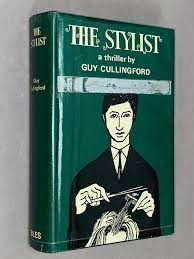
Forgotten Book - The Stylist


The early members of the Detection Club, notably Anthony Berkeley, Dorothy L. Sayers, and Agatha Christie, were all exceptionally interested in the study of true crime cases, and that enthusiasm informed their own work in many ways. I talked about this in some detail in The Golden Age of Murder and it's a subject I plan to return to at a later date. In the meantime, I'm researching widely and I've just read an interesting novel by a Detection Club member of later vintage, Guy Cullingford (whose real name was Constance Taylor) which, in its later stages, reveals the influence of some of the same real life cases that fascinated Berkeley, Sayers, and Christie.

The book in question is The Stylist. It was published in 1968 and was the penultimate Cullingford crime novel (although she also wrote a historical novel a decade or so later). The Stylist is a seriously obscure book. It was never published in paperback or in the United States. I've never read any discussion about it anywhere online, although I have managed to find one contemporary review, from Edmund Crispin, in the Sunday Times. I'd have been unaware of its quality had I not chanced upon an inscribed copy (complete with a photo of the author and a letter from her husband) that caught my fancy.

The jacket describes the book as a 'thriller', but if you're looking for slam-bam action from the get-go, this one is not for you. It's a slow-burn novel, very much character-driven. One ingredient in the story, local government corruption, calls to mind Michael Gilbert's very different The Crack in the Teacup, published two years earlier. Another element is suggestive of yet another very different book, Patricia Highsmith's The Talented Mr Ripley. And the true crime cases which are name-checked late on in the story are those involving Edith Thompson and Alma Rattenbury, which have inspired quite a few crime novels. This one, however, is distinctive.

Laura Chance is a wealthy woman in her fifties married to a dodgy self-made man. She's bored, but when she encounters a new hair stylist, Pierre (an Englishman called Peter) who is half her age, she finds a new interest in life. Slowly, slowly, Cullingford deploys an interesting range of characters in Laura's circle, and in Pierre's, but one can neve be entirely sure where the story is heading. Not much happens for ages, but I was kept gripped by the quality of writing and characterisation. It's subtle and occasionally witty and I really enjoyed it. 

And if that isn't enough to encourage you, then I should add that Edmund Crispin, who likened the writing to Trollope, was also enthusiastic. So was Francis Iles, who described it as 'comfortably disturbing throughout...a book not to be missed by the discerning' (with thanks to Arthur Robinson for highlighting the Iles review). What a pity that the book made so little impact - the author must have been very disappointed, because it's clear to me that she took great pains over the writing, and to very good effect.