The Exit, a novel of psychological suspense written by Helen Fitzgerald and published earlier this year by Faber, is one of the best contemporary crime novels I've read in quite a while. It's witty, clever and poignant by turns, and I enjoyed it despite the fact that, in the early pages, I took quite a strong dislike to the narrator, a self-absorbed young woman whose ageism was repellent.
It's a mark of Fitzgerald's literary kill that I warmed to her protagonist, just as I did - at least to some extent - to her extremely irritating mother, who is one of those control freaks who is convinced that she knows what is best for other people, even when, transparently, she does not. Control freaks make interesting studies for fiction, and I thought Fitzgerald did a very good job in showing the motivations of Catherine's mother, and the unintended consequences of her actions.
Catherine reluctantly takes a job in a local care home, and there she encounters an 82 year old woman called Rosie, who is convinced that there is dirty work afoot in the home. Since Rosie suffers from dementia, it is not easy to take what she says seriously, and here again Fitzgerald makes telling points about the way we treat people with impaired mental faculties. Of the three main women characters, Rosie was, for me, by far the most consistently appealing.
The mystery element of the story is relatively thin; it is not too difficult to figure out what is going on. But for me, perhaps untypically, that really didn't matter. The story is told in such a gripping way that I had to keep reading - though I'm not suggesting that such a dark novel will be everyone's cup of tea. I've never read Helen Fitzgerald before, and I've never met her, but she really can write. I wouldn't be surprised if this book picks up awards. Yes, it's that good.
Showing posts with label Faber. Show all posts
Showing posts with label Faber. Show all posts
Wednesday, 12 August 2015

Wednesday, 1 July 2015
In Bitter Chill by Sarah Ward - review
In Bitter Chill is a first novel by Sarah Ward, best known hitherto for her excellent blog Crime Pieces. The book is published by Faber, which is in itself a hallmark of quality, and I must say that I think it's a very satisfying book, judged by any standards, let alone those applicable to a debut. I should also say that Sarah is someone I've known and liked for several years, but I would not enthuse about this novel in the way that I do unless I genuinely found it to my taste.
The story is set in a fictional Derbyshire town, Bampton. Derbyshire is a wonderful county, one I know and love (I've also had the mixed blessing of supporting the county's cricket team since I was young; this has at least proved character-building, given the team's propensity for snatching defeat from the jaws of victory...) Until now, Stephen Booth, a very capable author indeed, has been the leading writer of Derbyshire crime, but Sarah's writing is in the same league. They both produce well-crafted traditional mysteries with credible police officers and good descriptions of landscape..
I'm conscious that one has to be wary of comparing one writer with another, but the other comparison that did cross my mind when reading this book was with Ann Cleeves. Ann has a gift for combing her well-plotted mysteries with sound evocation of character and place, a gift that amazingly was long under-estimated before the massive success of Vera and Shetland caused her to receive her well-deserved international acclaim.I don't expect Sarah to have to wait as long for widespread recognition. She is, like Ann, someone whose work demonstrates an understanding of human frailty, but also a good deal of compassion, a combination that is very appealing to many readers.
The plot involves a "cold case" in a cold climate. Back in 1978, two girls went missing, and only one returned. A death in the present day causes the local police to start reconsidering what happened. The kidnapping of the girls might seem reminiscent of Brady and Hindley at work, but the storyline is very different from the tragedy of the Moors Murders, though it is certainly not without bleakness. A really good read.
The story is set in a fictional Derbyshire town, Bampton. Derbyshire is a wonderful county, one I know and love (I've also had the mixed blessing of supporting the county's cricket team since I was young; this has at least proved character-building, given the team's propensity for snatching defeat from the jaws of victory...) Until now, Stephen Booth, a very capable author indeed, has been the leading writer of Derbyshire crime, but Sarah's writing is in the same league. They both produce well-crafted traditional mysteries with credible police officers and good descriptions of landscape..
I'm conscious that one has to be wary of comparing one writer with another, but the other comparison that did cross my mind when reading this book was with Ann Cleeves. Ann has a gift for combing her well-plotted mysteries with sound evocation of character and place, a gift that amazingly was long under-estimated before the massive success of Vera and Shetland caused her to receive her well-deserved international acclaim.I don't expect Sarah to have to wait as long for widespread recognition. She is, like Ann, someone whose work demonstrates an understanding of human frailty, but also a good deal of compassion, a combination that is very appealing to many readers.
The plot involves a "cold case" in a cold climate. Back in 1978, two girls went missing, and only one returned. A death in the present day causes the local police to start reconsidering what happened. The kidnapping of the girls might seem reminiscent of Brady and Hindley at work, but the storyline is very different from the tragedy of the Moors Murders, though it is certainly not without bleakness. A really good read.
Monday, 27 August 2012
Safe House



As I’ve mentioned before in this blog, Chris Ewan is one of the most interesting young writers around. He has my admiration not only because of his entertaining crime novels, but also because he was brave enough to quit the law at a young age in order to write full-time. Something that, for a variety of reasons, I never really contemplated.
Chris’s
career is taking off in a big way with his move to an excellent publisher,
Faber, and his latest novel has just come out. This is Safe House, a
stand-alone thriller of which I had an enjoyable sneak preview earlier this
year. It represents a departure from his earlier work, and a step forward in career
terms, I’m sure.
Rob Hale
wakes up after a motorbike crash and wonders what has happened to the woman who
was his passenger. But he is told he was riding alone. This is a teasing situation
with which to kick-start a thriller, and although we never doubt that Rob is
right, the twists keep coming as a mystery from Rob's past is unravelled, though not in the way one might expect.
One of the
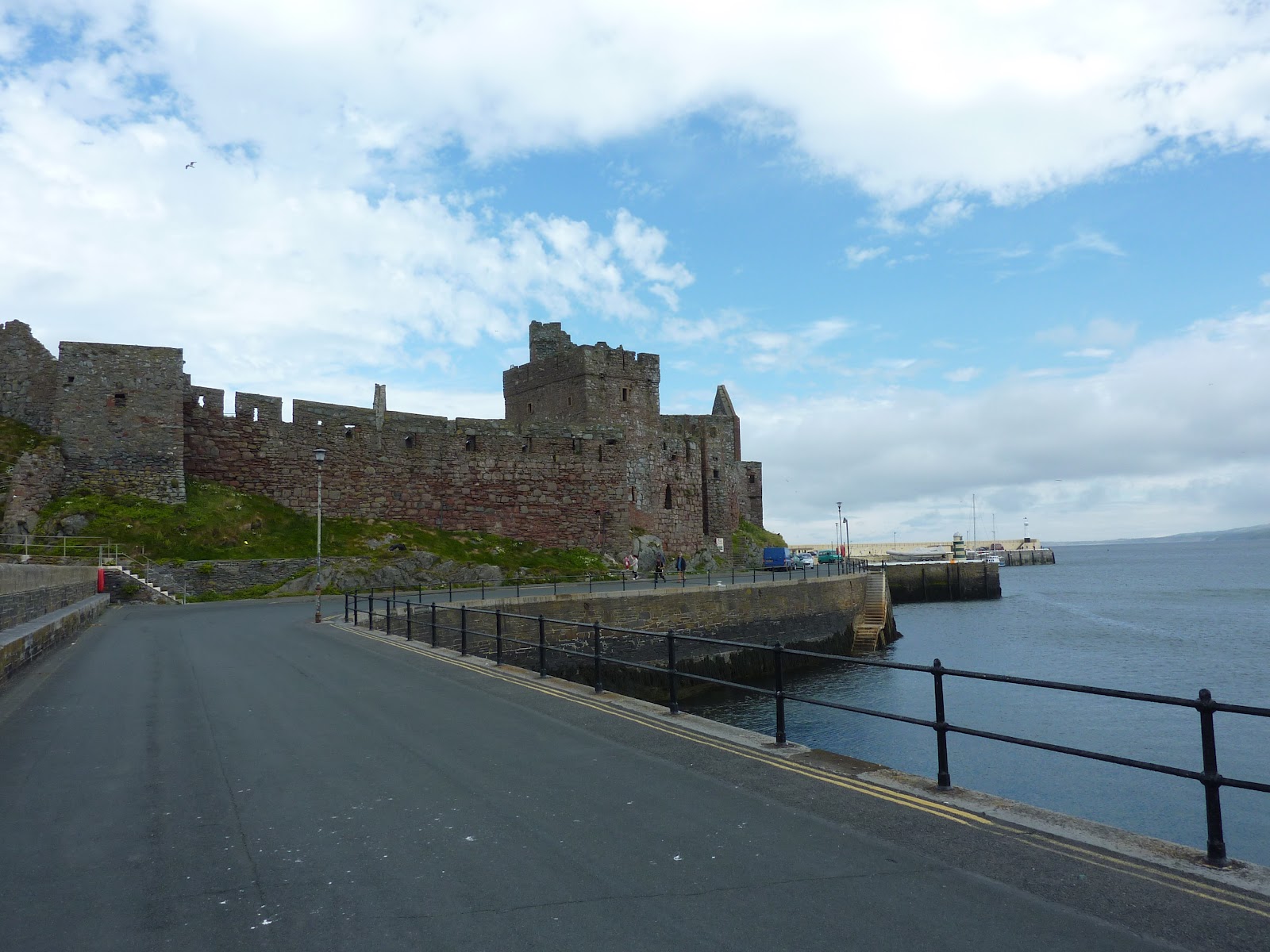
best features of this book is its setting, in the atmospheric Isle of Man. I’m
very keen on the island, which is rich in character, and once wrote a short
story set in Peel; it was called "Sunset City". Chris, who has lived there with his wife Jo for a number of
years, knows it inside out. This lends an authenticity to the story which is highly
appealing. I’m sure Safe House will be a great success and expand his readership yet further..The photos, by the way, were taken over a very enjoyable week-end I spent on the island with Chris and Jo last year. I hope to get back there before long.
Friday, 9 October 2009
Forgotten Book - Patterns in the Dust
Like my last entry in Patti Abbott’s Forgotten Books series, Patterns in the Dust was an auspicious debut novel by a writer of distinction who, in the 1980s, seemed sure to be a major figure in the genre for many years to come. Yet Lesley Grant-Adamson has produced very little crime fiction in recent times, and that is a pity, for as Patterns in the Dust shows, she is highly accomplished.
This short novel (published by Faber, one of the choosiest of publishers) appeared in 1985, and it introduced Rain Morgan, a journalist with a penchant for detection (as well as conversation – she has a gossip column.) Rain’s creator was also a seasoned journalist, and the character is both appealing and credible.
In this story, Rain encounters murder while on holiday in Somerset, and the story blends a rural setting reminiscent of Golden Age mysteries with elements that were (at least in 1985) bang up-to-date, including punks and answerphones. The final words of the book convey character and nuance with Grant-Adamson’s customary economy as Rain looks out on a hunt taking place on the hillside: ‘She could not see the fox but her heart was with it.’
Rain appeared in four more books, before Grant-Adamson turned her attention to stand-alones. A change of publishers didn’t work out, and her principal work in recent years so far as our genre is concerned is a teach-yourself book about crime writing, which has run to a couple of editions. But her books are worth seeking out, not least this first effort. I bought the paperback edition when it came out in 1986, and although I couldn’t have guessed it, the cover artwork was done by the same artist, Nick Hardcastle, who would later create the artwork for my first four paperbacks.
Saturday, 21 February 2009
Saturday Selection - Gilbert Adair and Margie Orford
I first encountered Gilbert Adair’s fiction when I read A Closed Book some years ago – it was an intelligent and ingenious spin on the crime genre. More recently, Adair has mined the fertile ground of the classic Golden Age whodunit for two amusing and neatly constructed pastiches, The Act of Roger Murgatroyd and A Mysterious Affair of Style. Both featured an agreeable amateur sleuth, Evadene Mount.
Now Evadne has returned in And Then There was No One, sub-titled The Last of Evadne Mount. It involves the murder of a Booker Prize winning novelist during a Sherlock Holmes festival in Switzerland. The Faber blurb is rather witty and pretty much irresistible:
‘It’s a novel like no other, a hall of mirrors, a hole-in-one, a tour de force of stylistic brio and narrative ingenuity, a conjuring act which ends with the conjuror, or author, actually sawing himself in half’.
Blimey!
A little more conventional is the tag-line ‘A killer who won’t stop. An investigator who won’t give up’ which adorns Margie Orford’s first novel Like Clockwork (Atlantic). The author lives in Cape Town, and that is where the story is set. A profiler, Dr Clare Hart, does the detective work and, needless to say, ‘is drawn into the web of a brutal serial killer’. The material may be samey, but Michael Connelly has given the book a very positive blurb, which makes it seem rather tempting.
Subscribe to:
Posts (Atom)