Showing posts with label John Buchan. Show all posts

Friday, 11 February 2022

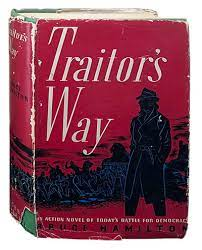
Forgotten Book - Traitor's Way


Traitor's Way by Bruce Hamilton was published in 1938 in Britain and in the US in the following year. It's a lively manhunt thriller, very much in the tradition of John Buchan's The Thirty-Nine Steps. I found it a fast and easy read, but this is a book that has hardly ever been discussed, though it receives one or two glances in books about spy fiction. 

One reason for this neglect may be Bruce Hamilton's lack of celebrity. For instance, his early novels Hue and Cry and Middle-Class Murder are also elusive. But it's also true that the political premise on which he based the plot was rendered absurd shortly after the book was written and I guess publishers would think that this made a nonsense of his story. 

I'll try to discuss the book without giving too much away - not an easy task. The ten chapters have short, snappy titles, such as 'Fracas' and 'Conspiracy', and this is in keeping with the writing style - this is Hamilton at his paciest. The story is told by Noel Mason, an ordinary individual, who starts out as 'an entirely non-political person' but finds himself caught up in a web of political intrigue, and a game played for very high stakes indeed.

This is an anti-Fascist novel, featuring a charismatic chap called Greatorex who leads something called the Order of British Chivalry. Not that they are at all chivalrous in practice. Poor Mason ends up committing a crime and he finds himself in Dartmoor. But when the chance to escape arises, he grabs it...

I enjoyed this story, even though it's not in the Buchan class and I felt it showed Hamilton's naivete about politics. What happens in his story is very, very different from what actually happened in the world a year or two later. He wasn't much of a crystal ball gazer. But at his best, he could tell a good story.


Monday, 3 November 2014

Terror and Wonder: The Gothic Imagination

Gothic literature fascinates millions of people, including me. Much of it is not too far distant from some types of crime fiction, and there's a Gothic influence on some of my short stories, as well as on some aspects of one or two of my novels - including my current work-in-progress, The Dungeon House. So it was with great delight that, last week, I had an opportunity to explore the British Library's fantastic exhibition Terror and Wonder: The Gothic Imagination.

The exhibits are eclectic and comprehensive, and take us all the way from Horace Walpole and The Castle of Otranto, through the Brontes, Poe, Stoker and John Buchan's Witch Wood, to modern Goth festivals at Whitby, the atmospheric Yorkshire resort that is the setting for a story I wrote last year, "The Killiing of Captain Hastiings". There are rare handwritten manuscripts (Wilkie Collins' Basil among them) and also several melodramatic paintings, by Henry Fuseli and others. The key role of landscape and setting in Gothic fiction is brought home in vivid fashion.

A number of film clips - including extracts from Dead of Night and The Wicker Man, two of the finest of all horror films - can be watched, and there are some intriguing bits and pieces, including a vampire slayer's kit. Ghosts, vampires, demons and zombies abound. It was fitting that I timed my visit more or less to coincide with Hallowe'en. I recommend this exhibition unreservedly..  

The British Library has also teamed up with BBC Four, which has been showing an excellent documentary by Andrew Graham Dixon, The Art of the Gothic, which concludes this evening. The programme covers art, architecture and literature and I've found the first two episodes engrossing. The same can be said of last night's Frankenstein and The Vampyre, and  Dan Cruickshanks' excellent study for BBC Four of the Gilbert Scott family's influence on Gothic architecture, including Liverpool Cathedral, which I know well, and even little Stretton Church, just down the road from where I live. To this day, the Gothic influence is pervasive, and although I've been interested in the subject for a very long time, visiting the exhibition and watching the recent documentaries has given me more insight, as well as a good deal of pleasure.