Is The Eighth Circle a truly forgotten book? After all, it did win the Edgar from the MWA for best novel in 1959 and by then, when he was still in his early 40s, he'd already won two previous Edgars, for short stories. In later life, he'd become an MWA Grand Master. So this was a major book by a highly successful author. And it would be wrong to describe it as obscure. But I think it's fair to say that nowadays, it's far from well-known, and I must admit that I've owned my copy, a tattered green Penguin, for a long time without feeling moved to read it.
But finally I've done so, and although I don't think it's an absolute masterpiece - not as stunning as some of Ellin's brilliant short stories, such as "The Question", for example - it's a very good novel, a private eye story with a difference. Written at the same time that Ross Macdonald was establishing himself as the heir to Raymond Chandler, it's an attempt to get away from the traditional American p.i. story. And at the time of its appearance, I'm sure it struck a fresh note.
We see events from the perspective of Murray Kirk, a good-looking and successful gumshoe, who runs a highly successful agency. Ellin portrays the business, authoritatively, as being similar to many other forward-looking office-based firms of the late 50s, filing cabinets and all. Kirk's a cynic, not least about women, and has a rather strange relationship with a women called Didi whom he met through a case.
His life changes when he is persuaded to take on a case involving an allegation of police corruption. Murray's basic assumption is that the police are corrupt, and when he falls in love with the girlfriend of his ultimate client, a rather unappealing cop, he sets about trying to prove to her that the man is crooked. Things do not, however, go according to plan.
It's a long novel, and there isn't a huge amount of action or convoluted plotting. Nor are there as many snappy lines as you find in the Ross Macdonald books. Nevertheless, it's consistently engaging, with some very well-defined characters. I enjoyed it, as I always enjoy reading Ellin. He was a highly accomplished crime writer, and I think there's a simple reason why his reputation has faded a little. It's just because he never repeated himself. He wasn't a series writer, and he never followed fashion or a formula. Admirable.
Showing posts with label Stanley Ellin. Show all posts
Showing posts with label Stanley Ellin. Show all posts
Friday, 22 November 2019

Friday, 1 March 2019
Forgotten Book - Purloining Tiny
John Franklin Bardin was an American author whose brief career would have been deeply obscure had it not been for the advocacy of Julian Symons. Symons praised Bardin's first three novels in Bloody Murder, and in the mid-Seventies facilitated their being reprinted as a Penguin omnibus volume, which I devoured as soon as I could lay my hands on it. I shared Symons' enthusiasm for Bardin's work. The three books are very interesting examples of psychological suspense writing in the aftermath of the Second World War - pre-dating Patricia Highsmith, among many others.
The attention that the omnibus gained seems to have galvanised Bardin to resume his writing career in earnest, and he published another crime novel in 1978, with the characteristically odd title of Purloining Tiny. However, it wasn't a success, and copies are hard to find. It's only in relatively recent times that I've had the chance to read it.
The book has attracted one or two enthusiastic admirers over the years, and Dorothy Salisbury Davis said that it was "bizarre, wicked and wonderful". It also bears, on the back cover, a rather carefully worded blurb from Stanley Ellin, who described it as "certainly one of the strangest mystery tales I have ever read." As he says, the story focuses on "the perverse and shadowy wish-fulfillments of its astonishing characters". These are, it has to be said, not exactly words of undiluted praise.
I think Ellin got it right. It's a very odd book, about a glamorous young woman, a famous contortionist no less, who is kidnapped and held captive in an apartment by her long-lost father. At the time, I suspect it was seen as a cutting-edge example of a crime novel involving kinky sex. As with the earlier Bardin books, but to an even greater extent, incestuous desires play an important part in the story. For me, it simply didn't work. Really, it reads like an over-the-top pastiche of those early, intriguing novels. A major disappointment, I'm sorry to say.
The attention that the omnibus gained seems to have galvanised Bardin to resume his writing career in earnest, and he published another crime novel in 1978, with the characteristically odd title of Purloining Tiny. However, it wasn't a success, and copies are hard to find. It's only in relatively recent times that I've had the chance to read it.
The book has attracted one or two enthusiastic admirers over the years, and Dorothy Salisbury Davis said that it was "bizarre, wicked and wonderful". It also bears, on the back cover, a rather carefully worded blurb from Stanley Ellin, who described it as "certainly one of the strangest mystery tales I have ever read." As he says, the story focuses on "the perverse and shadowy wish-fulfillments of its astonishing characters". These are, it has to be said, not exactly words of undiluted praise.
I think Ellin got it right. It's a very odd book, about a glamorous young woman, a famous contortionist no less, who is kidnapped and held captive in an apartment by her long-lost father. At the time, I suspect it was seen as a cutting-edge example of a crime novel involving kinky sex. As with the earlier Bardin books, but to an even greater extent, incestuous desires play an important part in the story. For me, it simply didn't work. Really, it reads like an over-the-top pastiche of those early, intriguing novels. A major disappointment, I'm sorry to say.
Friday, 1 February 2019
Forgotten Book - Dreadful Summit
Stanley Ellin was one of those admirable writers who was always trying something different. He wasn't especially prolific, publishing fourteen novels in just shy of forty years, although he did write a good many short stories of high calibre. Today, he is best remembered for those short stories - "The Question" is one of my all-time favourites - but his novels definitely should not be overlooked. Those I've read are of a very high standard.
This is true even of his debut, Dreadful Summit (the title comes from Hamlet), which was published in 1948, the same year as his famous short story, "The Specialty of the House". It's a remarkable book, and was filmed in 1951 by Joseph Losey as The Big Night; I've not seen the movie, but reviews of it seem to be mixed. As far as I can tell, the novel has been out of print for years, though it was a green Penguin paperback in the 60s.
In some ways, the novel anticipates The Catcher in the Rye. It's a first person narrative, and all the action is crammed into 24 hours, as the narrator, George LaMain, turns sixteen. It's also the day his life changes forever. George's mother died when he was very young and he's been brought up by his father Andy, who runs a bar and grill in New York City. When a well-known columnist called Al Judge assaults Andy in front of George's eyes, the boy vows revenge.
At first, one's instinct is to sympathise with George. But it soon becomes apparent that he'd not really the nice young kid he might seem to be. He records disturbing incidents and behaviour in a way that makes the reader realise that he's deeply troubled. What will become of him? The tension mounts, and this is a good example of a book that benefits greatly from brevity. I'm always intrigued by narratives which disclose a gap between the narrator's perception of the world and objective reality - my own Dancing for the Hangman explored that very theme, though is otherwise utterly different from Ellin's book - and this is a striking, and dark novel. Recommended.
This is true even of his debut, Dreadful Summit (the title comes from Hamlet), which was published in 1948, the same year as his famous short story, "The Specialty of the House". It's a remarkable book, and was filmed in 1951 by Joseph Losey as The Big Night; I've not seen the movie, but reviews of it seem to be mixed. As far as I can tell, the novel has been out of print for years, though it was a green Penguin paperback in the 60s.
In some ways, the novel anticipates The Catcher in the Rye. It's a first person narrative, and all the action is crammed into 24 hours, as the narrator, George LaMain, turns sixteen. It's also the day his life changes forever. George's mother died when he was very young and he's been brought up by his father Andy, who runs a bar and grill in New York City. When a well-known columnist called Al Judge assaults Andy in front of George's eyes, the boy vows revenge.
At first, one's instinct is to sympathise with George. But it soon becomes apparent that he'd not really the nice young kid he might seem to be. He records disturbing incidents and behaviour in a way that makes the reader realise that he's deeply troubled. What will become of him? The tension mounts, and this is a good example of a book that benefits greatly from brevity. I'm always intrigued by narratives which disclose a gap between the narrator's perception of the world and objective reality - my own Dancing for the Hangman explored that very theme, though is otherwise utterly different from Ellin's book - and this is a striking, and dark novel. Recommended.
Friday, 10 August 2018
Forgotten Book - Mirror, Mirror, on the Wall
Mirror, Mirror on the Wall is a novel which illustrates, among other things, the late Stanley Ellin's versatility as a crime writer. He was always, and will I think remain, best known as an author of short stories, most famously "The Specialty of the House", but he was also an accomplished novelist, equally at ease with the private eye story and with the novel of psychological suspense.
The first edition dust jacket of Mirror, Mirror, describes the book as "spellbinding, shocking - unlike anything else Stanley Ellin has ever written". The victim of the bullet lies on Peter Hibben's bathroom floor in his Greenwich Village apartment. What has happened? The scene seems like a nightmare, yet it is not. Peter's search for answers becomes a journey into his sexual past". The blurb concludes: "The disclosures will be disturbing to some, but you will not be able to put Mirror, Mirror down any more than you can guess the outcome".
The book was first published in 1972, and the date is significant. At the time, the publication of Portnoy's Complaint had ushered in a new era of frankness about sex; it's impossible to imagine this book being regarded as publishable even ten years earlier, even though the central plot twist was comparable to that in an earlier classic of psychological suspense (no, I'm not going to reveal which one!) I suspect that present day readers may feel that Ellin takes the then-new freedoms a bit too far at times, but it's certainly true that he manages to blend controversial material with a plot of classic ingenuity. The story is, in essence, a cunning refashioning of the "whowasdunin" type of mystery, and there is even a sort of cipher which provides a vital clue to the mystery.
Harry Keating included this novel in his list of the 100 best crime books; it also won a major prize in France. Keating pointed out, correctly, that as well as all the shocking stuff, there's plenty of humour. This was, in its day, a ground-breaking crime novel, and although I have some reservations about it, it is nevertheless a good example of the taut, readable prose of an author who was in the front rank of post-war American mystery writers, and deserves to be remembered.
The first edition dust jacket of Mirror, Mirror, describes the book as "spellbinding, shocking - unlike anything else Stanley Ellin has ever written". The victim of the bullet lies on Peter Hibben's bathroom floor in his Greenwich Village apartment. What has happened? The scene seems like a nightmare, yet it is not. Peter's search for answers becomes a journey into his sexual past". The blurb concludes: "The disclosures will be disturbing to some, but you will not be able to put Mirror, Mirror down any more than you can guess the outcome".
The book was first published in 1972, and the date is significant. At the time, the publication of Portnoy's Complaint had ushered in a new era of frankness about sex; it's impossible to imagine this book being regarded as publishable even ten years earlier, even though the central plot twist was comparable to that in an earlier classic of psychological suspense (no, I'm not going to reveal which one!) I suspect that present day readers may feel that Ellin takes the then-new freedoms a bit too far at times, but it's certainly true that he manages to blend controversial material with a plot of classic ingenuity. The story is, in essence, a cunning refashioning of the "whowasdunin" type of mystery, and there is even a sort of cipher which provides a vital clue to the mystery.
Harry Keating included this novel in his list of the 100 best crime books; it also won a major prize in France. Keating pointed out, correctly, that as well as all the shocking stuff, there's plenty of humour. This was, in its day, a ground-breaking crime novel, and although I have some reservations about it, it is nevertheless a good example of the taut, readable prose of an author who was in the front rank of post-war American mystery writers, and deserves to be remembered.
Friday, 25 August 2017
Forgotten Book - The Conjure-Man Dies
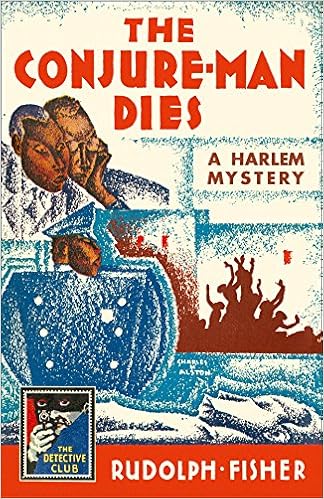
The Detective Story Club imprint has, since its welcome recent revival by Harper Collins, seen some fascinating titles come back to life. I've enjoyed my own involvement, writing intros for books by authors as diverse as Hugh Conway, Edgar Wallace, and E.C. Bentley, and I've enjoyed equally reading some books that are entirely new to me, by authors such as Vernon Loder.
A particular example is The Conjure-Man Dies, sub-titled "A Harlem Mystery". The author is Rudolph Fisher, and there is an excellent intro by that very fine writer Stanley Ellin, who is perhaps best remembered for his brilliant short stories, although he was no mean novelist. As he says, the book is "highly readable, wholly entertaining."
The book was, as far as is known, the first detective novel written by an African-American. His name was Rudolph Fisher, and he had previously one mainstream novel. By profession, he was a doctor, and his interest in the potential of science as an aid to detection is very much in tune with the work of Arthur Conan Doyle and Richard Austin Freeman in Britain. The reason that, despite his considerable gifts as a writer, his name has been more or less forgotten, is that he died all too young. He was born in 1897, this book appeared in 1932, and he died in 1934. Very sad.
The story is a good one, dealing with the death, in exotic and highly mystifying circumstances, of Frimbo, a "psychist". The official detective, Perry Dart, is assisted by John Archer, a doctor, in a pleasing variation on the Holmes-Watson partnership: both are good characters. This edition carries an extremely welcome bonus, a short story called "John Archer's Nose" which was published just after Fisher's death. As Ellin says, this novel offers not merely a good mystery puzzle but also a fascinating social document. Recommended.
Subscribe to:
Posts (Atom)