Freeman Wills Crofts has enjoyed quite a revival during the last couple of years. The British Library has reissued several of his best novels, and Harper Collins have reprinted others, both in paperback editions and in some cases as hardbacks under the Detective Story Club imprint. The latter include his third book, The Pit-Prop Syndicate, which first appeared in 1922.
Crofts was still learning his trade at that time. Inspector French was yet to be created, and he'd followed up the success of The Cask with the slightly disappointing The Ponson Case. Here, he experiments rather interestingly. The first half of the book follows an amateur investigation into a suspected criminal conspiracy. The second half sees the professionals take over, in the form of Inspector Willis. It's a tricky blend, but I found it appealing.
Seymour Merriman (great name!) is cycling in France when he chances upon a strange puzzle. Why would a lorry change its number plate? He comes across a pit-prop exporting business (one of those enterprises that presumably died out long ago) and also a pretty girl. Back in England, he tells a friend, and they decide to return to France to investigate (and Seymour also wants to get to know the pretty girl better). The plot thickens from there.
This is a classic Crofts story, meticulously planned and written. And I can't think of many Golden Age stories featuring Goole and Hull, but this is one! In the second half of the book, the investigation dragged a bit, and I found some of the detail a bit dull, much like Seymour's romance. All the same, it's an enjoyable story, and there's also a bonus in the dust jacket artwork, as well as the inclusion of an intro by John Curran and a little-known short story with a railway setting, "Danger in Shroude Valley".
Showing posts with label The Cask. Show all posts
Showing posts with label The Cask. Show all posts
Thursday, 28 June 2018

Friday, 16 June 2017
Forgotten Book - The Lyttleton Case
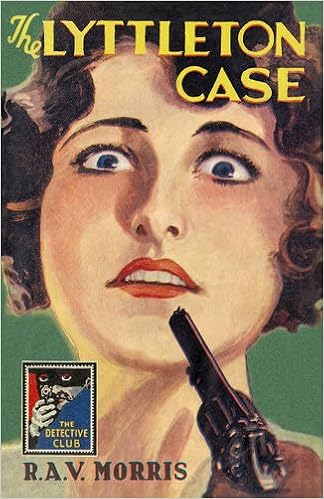
The Lyttleton Case by R.A.V. Morris is a fairly early example of the Golden Age detective novel. It was first published by Collins in 1922, and was well received, but the author never returned to the genre. I find this puzzling, and so evidently did Douglas A. Anderson, who contributes a useful foreword to the new edition, which appears in Harper Collins' splendid Detective Story Club series of reprints.
I have to say I'd never heard of Morris, or his book until this new edition came out. Douglas Anderson suggests that Morris was tempted to write because he wanted to keep up with the achievements of his brother Kenneth, who wrote fantasy novels. Both men were members of the Theosophical Society, but there's no explanation as to why Morris didn't build on the success of his crime fiction debut.
Anderson points out that there are various references to detective fiction in the story - Dupin and Sherlock are name-checked, but perhaps the most significant mention is that of Freeman Wills Crofts' The Cask (1920). My impression is that the success of the Crofts book inspired Morris, because there are some similarities between his approach to crime writing and Crofts'. (Crofts also influenced better known writers such as G.D.H. Cole, Henry Wade, and John Bude).
The first part of the story is clever and appealing. A rich man called Lyttleton disappears, and we soon fear the worst for him. An ingenious crime has been committed, and the story is enhanced by several nice touches of wit. I felt, however, that it sagged quite noticeably from about the half-way point, and after the major revelation, the explanation of what has been going on is prolonged. These flaws are the marks of an inexperienced writer. But Morris certainly had talent, and it's a shame he didn't go on to greater things in the genre.
Friday, 7 April 2017
Forgotten Book - Inspector French and the Starvel Tragedy
Freeman Wills Crofts published Inspector French and the Starvel Tragedy (aka The Starvel Hollow Tragedy) in 1927. It's often cited as one of his best books, and I concur with that view. The story is readable from start to finish, and the plot is worked out rather cleverly. So although I latched on to one aspect of the solution at an early stage, Crofts managed to confuse me with some rather neat twists.
At first, the focus is on an attractive young woman who lives with her miserly uncle in a Yorkshire mansion - the location seemed from internal evidence to be somewhere in the vicinity of Helmsby and Thirsk. After she goes away on a short visit to a friend, she returns to find the house burned to the ground. Three corpses are discovered, evidently those of her uncle and two servants. At first it looks like a tragic accident.
But a local bank manager takes a different view, and before long Scotland Yard are called in, in the person of good old Inspector Joseph French. He's portrayed in a rather human fashion, yearning for promotion and keen to keep on the right side of his superiors, but utterly relentless in his pursuit of the guilty once it becomes clear that this is a case of arson and multiple murder.
As with The Cask, Crofts manages to sustain interest in the detailed police investigation by offering a sequence of surprising developments. I enjoyed this book - which was reissued by Hogarth back in the 80s - and can recommend it to anyone who likes Croftsian writing. Crofts was an engineer by profession and this mystery is certainly engineered with high calibre craftsmanship.
At first, the focus is on an attractive young woman who lives with her miserly uncle in a Yorkshire mansion - the location seemed from internal evidence to be somewhere in the vicinity of Helmsby and Thirsk. After she goes away on a short visit to a friend, she returns to find the house burned to the ground. Three corpses are discovered, evidently those of her uncle and two servants. At first it looks like a tragic accident.
But a local bank manager takes a different view, and before long Scotland Yard are called in, in the person of good old Inspector Joseph French. He's portrayed in a rather human fashion, yearning for promotion and keen to keep on the right side of his superiors, but utterly relentless in his pursuit of the guilty once it becomes clear that this is a case of arson and multiple murder.
As with The Cask, Crofts manages to sustain interest in the detailed police investigation by offering a sequence of surprising developments. I enjoyed this book - which was reissued by Hogarth back in the 80s - and can recommend it to anyone who likes Croftsian writing. Crofts was an engineer by profession and this mystery is certainly engineered with high calibre craftsmanship.
Wednesday, 2 November 2016
Christie and Company
Today I'd like to talk about some of the excellent Golden Age-related publications available from Harper Collins. We're hoping that people with GA fans in their lives will consider giving them copies of The Golden Age of Murder as Christmas presents, naturally! And if there's any cash left in the kitty, trust me, there are plenty of other options. Good ones, too...
Agatha Christie's Complete Secret Notebooks by John Curran is among them. I should say that this is not a brand new book, given that it combines John's two earlier volumes about Christie's journals, the virtues of which I've extolled on this blog before now. I find the insights into Christie's approach to her craft fascinating. John has also taken the opportunity to amend and update the text and commentary. I strongly suspect that John, like me,is one of those authors who is always keen to revise and improve what he has written. It's an endless task, and you have to draw a line somewhere, but he (like me) has benefited from our editor's admirable willingness to allow improvements to be made. (When The Golden Age of Murder appears in paperback in the UK next year, it too will incorporate some revisions, reflecting in particular new information that has come to light).
Harper Collins' Detective Story Club reprint series continues to yield some interesting titles. Freeman Wills Crofts' first (and some say, his best) book, The Cask, came out recently, and Hugh Conway's Darker Days has been issued in a Christmassy cover (you can bet that Waterstones and other bookshops will be overflowing with Yuletide-themed book covers in the coming weeks as everyone tries to emulate the Mystery in White effect!) In the new year, incidentally, Anthony Berkeley will feature in this series, notably with that early serial killer story The Silk Stockings Murders.
Harper Collins have also revived the Crime Club imprint, which I think is good news, and titles include Lord Dunsany's short story collection Two Bottles of Relish. The title story is an acknowledged classic, and although Dunsany never surpassed it, his imaginative story-telling doesn't deserve the neglect into which it has fallen.
Agatha Christie's Complete Secret Notebooks by John Curran is among them. I should say that this is not a brand new book, given that it combines John's two earlier volumes about Christie's journals, the virtues of which I've extolled on this blog before now. I find the insights into Christie's approach to her craft fascinating. John has also taken the opportunity to amend and update the text and commentary. I strongly suspect that John, like me,is one of those authors who is always keen to revise and improve what he has written. It's an endless task, and you have to draw a line somewhere, but he (like me) has benefited from our editor's admirable willingness to allow improvements to be made. (When The Golden Age of Murder appears in paperback in the UK next year, it too will incorporate some revisions, reflecting in particular new information that has come to light).
Harper Collins' Detective Story Club reprint series continues to yield some interesting titles. Freeman Wills Crofts' first (and some say, his best) book, The Cask, came out recently, and Hugh Conway's Darker Days has been issued in a Christmassy cover (you can bet that Waterstones and other bookshops will be overflowing with Yuletide-themed book covers in the coming weeks as everyone tries to emulate the Mystery in White effect!) In the new year, incidentally, Anthony Berkeley will feature in this series, notably with that early serial killer story The Silk Stockings Murders.
Harper Collins have also revived the Crime Club imprint, which I think is good news, and titles include Lord Dunsany's short story collection Two Bottles of Relish. The title story is an acknowledged classic, and although Dunsany never surpassed it, his imaginative story-telling doesn't deserve the neglect into which it has fallen.
Friday, 26 February 2016
Forgotten Book - The Ponson Case
The Detective Story Library imprint of Harper Collins has revived several fascinating titles, including some of my favourites. The Rasp by Philip MacDonald, which has an excellent intro by Tony Medawar, is an example. But Freeman Wills Crofts' second book, The Ponson Case, is a mystery I'd never read until I read the DSL reprint. This nicely presented reissue benefits from an intro by crime novelist Dolores Gordon Smith, who talked about Crofts at last year's hugely successful Bodies in the Library conference.
Dolores tells a story about Crofts' meticulous approach to the plotting of this novel, which was a follow-up to his best-selling debut The Cask. He spent three hours persuading his publishers that he had researched the plot detail with intense attention to detail. And this shows in the book, although I have to say the result is not totally gripping. There's a nice description of an English country house at the start of the book, but once the body of Sir William Ponson is discovered in the river, the focus is on alibis, and how to crack them.
Crofts ditched Inspector Burnley, who took the lead in The Cask, and introduced the equally painstaking Inspector Tanner. A sketch map of the scene of the crime is supplied, and Tanner ventures as far as Portugal in search of the truth about Ponson's death. But there is a shortage of suspects, a failing of several Golden Age novels. Why is it a failing? Because the characters are not explored in enough depth to compensate for the limited nature of the mystery.
Eventually Tanner gets to the truth, but it turns out to be rather anti-climactic, to say the least. But I'm really glad I read it, and not only because it filled a gap in my knowledge of Crofts' writing. What we have here is a book which shows a capable crime writer at the start of his career, trying to do something unusual in genre terms to build on the conspicuous success of his debut novel. It was this determination not to get stuck in a rut (despite his long-term fondness for alibi puzzles) that set Crofts apart from lesser writers. If you look at his inverted novels, such as Antidote to Venom, you see how keen he was to experiment, and that same freshness of approach is the most notable feature of The Ponson Case..A welcome reprint, then, which has given me a better understanding of Crofts' approach to his craft.
Dolores tells a story about Crofts' meticulous approach to the plotting of this novel, which was a follow-up to his best-selling debut The Cask. He spent three hours persuading his publishers that he had researched the plot detail with intense attention to detail. And this shows in the book, although I have to say the result is not totally gripping. There's a nice description of an English country house at the start of the book, but once the body of Sir William Ponson is discovered in the river, the focus is on alibis, and how to crack them.
Crofts ditched Inspector Burnley, who took the lead in The Cask, and introduced the equally painstaking Inspector Tanner. A sketch map of the scene of the crime is supplied, and Tanner ventures as far as Portugal in search of the truth about Ponson's death. But there is a shortage of suspects, a failing of several Golden Age novels. Why is it a failing? Because the characters are not explored in enough depth to compensate for the limited nature of the mystery.
Eventually Tanner gets to the truth, but it turns out to be rather anti-climactic, to say the least. But I'm really glad I read it, and not only because it filled a gap in my knowledge of Crofts' writing. What we have here is a book which shows a capable crime writer at the start of his career, trying to do something unusual in genre terms to build on the conspicuous success of his debut novel. It was this determination not to get stuck in a rut (despite his long-term fondness for alibi puzzles) that set Crofts apart from lesser writers. If you look at his inverted novels, such as Antidote to Venom, you see how keen he was to experiment, and that same freshness of approach is the most notable feature of The Ponson Case..A welcome reprint, then, which has given me a better understanding of Crofts' approach to his craft.
Subscribe to:
Posts (Atom)