Showing posts with label The Dungeon House. Show all posts

Wednesday, 2 March 2022

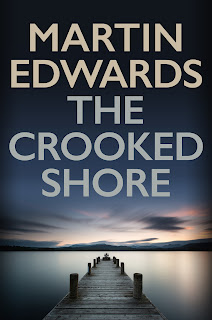
The Crooked Shore in paperback and ebook


The elegant UK paperback edition of The Crooked Shore has just been published by Allison & Busby and I had a chance to celebrate this pleasing milestone last night, by giving my first library talk since before the pandemic changed the world. The venue was Barnton Library, in Northwich, a few yards from the house of one of my great friends from schooldays, Andrew Golding, whose home I visited many times, and who sadly died far too young. 

I've been delighted by reaction to The Crooked Shore from reviewers and readers alike. This is my first Lake District Cold Case Mystery for six years, and just as The Dungeon House was a bit of a departure within the series, so - even more so - is this novel. Last night I was discussing the craft of crime writing and explaining why I believe that, even within a series which has been running for years, it's desirable and rewarding to keep trying new things. It keeps me fresh as a writer and I hope that readers find it adds to the enjoyment.

The danger with any series is that, even if it begins brilliantly, it can become a bit stale and formulaic. Ever since Conan Doyle tried to kill of Sherlock Holmes at the Reichenbach Falls, there have been cases of writers becoming bored and frustrated with series characters. I'm glad to say that has never happened to me and I guess part of the reason is that I write quite a varied mix of things, as well as trying to ring the changes while working on existing projects.

Because of a million other projects, I haven't got round to updating the reviews page on my website as regards The Crooked Shore, but here is some of that reaction I mentioned:

‘Detective Chief Inspector Hannah Scarlett's latest cold case involves the disappearance of a waitress from Bowness more than 20 years ago. The man charged with her murder was found not guilty but committed suicide thereafter. Now, on the anniversary of his death, his son has gone and done the same thing: walked out into Morecambe Bay and drowned himself. Meanwhile, the real killer is planning more midsummer mischief. This is the eighth of Martin Edwards's Lake District novels. As always a satisfying mystery is played out with lashings of local colour and history. Favourite line: "Through the trees peeped the dome of the eighteenth-century Round House, mocked by Wordsworth as a ‘tea canister in a shop window’”.’

Mark Sanderson, The Times Crime Club


'A splendidly imaginative plot will have you guessing and gasping until the very end.’

Mat Coward, Morning Star


‘Well-drawn characters…Readers old and new will be well served by The Crooked Shore, which delivers twists and turns against an evocative backdrop of the Furness Peninsula…The Lakeland feel is heightened throughout with fun, fictionalised locales…Martin is something of a crime writer’s crime writer. Plaudits from Lee Child, Peter Robinson, and Ann Cleeves testify to the esteem he’s held in by his peers. The Crooked Shore is playful, creative, and solid storytelling from a writer in tight control of his material.

Will Smith, Cumbria Life Book of the Month

‘One of Martin’s strengths is that even when writing a series of books, he never seems content to write the same book twice, and there is a central idea in The Crooked Shore that I am not convinced that I’ve seen before. For a long time reading the book, I wasn’t convinced of what direction the plot was moving in…All in all, this is an engrossing read with some very clever ideas running through it…an excellent novel, one of the very best in the series to date, and easily one of the best police procedural (which is sort of is) that I’ve read in a very long time.’

Steve Barge, In Search of the Classic Mystery 

‘There is a splendidly labyrinthine plot and a great cast of characters, many with secrets in their past….I raced through this book and enjoyed it enormously. There were points where I thought I knew where things were going, but I was wrong-footed at pretty much every turn and the end came as a complete surprise. All this and a visit to the Lake District. What more could you ask for? Except, of course, for the next instalment.’

Christine Poulson, A Reading Life


Monday, 27 August 2018

Taking a fresh direction as a writer

Writing careers fascinate me, and I know from questions put at the "Life of Crime" talks I've been giving up and down the country for many years that they also fascinate a great many readers. A major part of my thinking in starting this blog more than ten years ago was to supplement those talks by giving further insight into the life of a crime writer who was far from being a household name. Since then, my career has moved in a very happy direction, but I remain fascinated by the rollercoaster nature of literary lives.

It's often said that these days, it's as hard to stay published as it is to become published in the first place, and there's at least a degree of truth in that. So what can a writer do? Regular readers of this blog will know that I am a strong believer in keeping one's writing fresh. In my case, this means varying the nature of what I write - short stories as well as novels, fact as well as fiction, writing about other people's books even more than about my own. With each Lake District Mystery, I've tried to do something a bit different from the last book - this was especially the case with The Dungeon House, the most recent entry in the series.

Gallows Court, however, is very, very different from my earlier books. It took a long time to write, and naturally I have been nervous about how it might be received. There are various stages in that process of getting reaction. First, the agent's reaction. Happily, that was very positive. Second, the reaction from publishers. Here, I was thrilled to be taken on by Head of Zeus, a really excellent publisher. Third, what would good judges say? Advance copies of the book were sent to a splendid mix of leading authors, from Lee Child, Peter James, Stephen Booth, and Peter Robinson to Ragnar Jonasson, Peter Swanson, and Shari Lapena  I've been truly overjoyed by their comments.

And finally, what do readers and reviewers say? Well, I'm holding my breath, but I've been gratified by the very first review, which has just appeared on the In Search of the Classic Mystery blog. I'm so pleased that Puzzle Doctor approves the book. When you send a book out into the world, you have to accept that not everyone will love it; that's life. But it's certainly great for morale if initial reaction is largely favourable. And that is especially true when one has taken the risk of striking out in a fresh direction. 


Monday, 13 February 2017

Twinges of Regret?

One of the pleasures of the writing life comes from interactions with readers. I find the feedback of those who are kind enough to read my books, and this blog, quite fascinating. Occasionally, as with reviews, the feedback is either eccentric or less than positive, but life is far too short to become unduly disheartened by negativity. I treasure, for instance, the Amazon review of one of my novels which read "not a lot of interest in this as no trains", evidently from a railway lover who was not deterred from purchasing the book despite the complete absence of a promise of train-related material. Naturally, though, positive and constructive reactions warm the heart rather more.

I always pay close attention to comments, both positive and critical, from those who are supportive of my writing. As with suggestions from trusted agents or editors, they are well worth taking on board, whether or not one is always fully in agreement. One can always do better. And in another context, I found a comment the other day from Fiona, who has long been a valued supporter of my writing, very thought-provoking.

Fiona was commenting on the paperback publication of The Golden Age of Murder, and she asked an interesting question: "do you have any twinges of regret that you are becoming best known as an Authority rather than an Author...any pangs about your characters waiting for you to breathe new life into them?" Well, it's nice to be regarded as an authority, but to ask about twinges of regret is very perceptive. I've often talked about the ups and downs of the writer's life - and Chrissie Poulson's recent blog on the subject was very well received - and the issue underlying Fiona's very good question is to some extent about priorities and focus..

Fiona actually raises an issue which a number of people have raised with me in one way or another. Indeed, some years ago, when I was working on The Golden Age of Murder, someone advising me queried whether it was the right book to write, as the heavy workload involved might prove a distraction. But I carried on with what was really a labour of love. Similar points have been put to me in the past couple of years, and it is all to do with the fact that, at least apparently, I've focused much more on non-fiction during that time - The Golden Age of Murder, my work with the British Library, and The Story of Classic Crime,in 100 Books and so on. I've published various short stories, but no novel since The Dungeon House in 2015 (though I do have a storyline for another Lake District Mystery roughly worked out).

My answer, though, is unequivocal. I'll always see myself as a novelist, whether or not my novels are published and read, and whether or not they reach a wide audience. I was publishing non-fiction, though, before my first fiction was accepted, and I've always enjoyed non-fiction, researching subjects which intrigue me, and sharing my thoughts on them. The success I've been lucky enough to enjoy of late -The Times printed a rave review by Marcel Berlins of The Golden Age of Murder at the week-end - has been hugely gratifying. And my feeling, rightly or wrongly, is that all this has been very good for me as a novelist. I say this partly because sales of my books, including the early Harry Devlins, have steadily improved. But also because it's helped to motivate me as a fiction writer. I'm not absolutely sure why that is, if I'm honest, but it is a fact.

And right now, I'm feeling rather happy about my fiction for another reason. Over this past weekend, I've just finished the first draft of a brand new novel, quite different from everything I've done before. What is more, I've written it in a completely different way from my approach to all my earlier novels. But is it any good? you ask. I don't know, but I do know that at least the idea which is the driving force behind it is a strong one, compelling enough to have preoccupied me ever since I finished The Dungeon House. At this stage, I've no idea what will happen to the book. My previous stand-alones failed to become bestsellers, to put it mildly. So you could call it a bold or even foolhardy experiment. I can't be sure anyone else will love it as much as I do, but even if they don't, I won't regret having had a crack at the story. I'm not a believer in spending much time on regrets. My enthusiasm for writing fiction remains as strong as ever, and my aim is simple. For as long as I can, my priority will be to combine writing stories with writing about the genre I love.

Monday, 9 November 2015

Responding to Feedback


I'm returning to the topic of reviews, and how authors respond to feedback from people who read their books, a subject that fascinates me whether in the capacity of reader, reviewer or author. There's been a lot of discussion lately about fake Amazon reviews, and of course it's true that one has to assess any reviews with care, especially internet reviews, most especially if the reviewer is anonymous or in disguise. I quite understand why many authors dislike negative feedback from such individuals. But constructive reviews, written in good faith by someone who doesn't have an axe to grind (that's important), and who understands, and is reasonably sympathetic towards, what the writer was aiming to do (desirable, I think), are deserving of attention.

I've been spoiled this year by the wonderful reaction to The Golden Age of Murder, most recently from Jon L. Breen, one of the US's leading mystery critics, who said in Mystery Scene that the book was one of the most important contributions to crime fiction history in recent memory. Very pleased by that. I was fortunate to have the chance, when the book was reprinted recently, to address a few helpful points raised by reviewers and people who contacted me, and was very glad to do so.

I've also been heartened by a review last Friday of my new anthology for the British Library, Silent Nights, from Barry Turner in the Mail. In addition, Barry gave All the Lonely People the thumbs-up in his column not long ago, which was hugely gratifying, so long after the book's original publication.

As regards The Dungeon House, I set out to vary my approach - as I had done with The Frozen Shroud, but even more so. The story was set up differently, and the mystery resolved in a rather different way. This was a conscious risk, and although I'm happy (or as happy as a self-critical author ever can be) with the result, naturally I've wondered how readers would react. Early reviews have been extremely positive - for example on three leading blogs, Kiwi Crime, Mysterious Reviews, Harriet Devine's blog, and Random Jottings. There has, in addition, been a nice response from Publisher's Weekly ("engrossing") and Kirkus Reviews ("Edwards works exceptionally close to his characters"). I've also received a number of emails from readers - some who have followed the series for several years, some who have come to it afresh, and these too have encouraged me. It's nice when people take the trouble to get in touch like that..

One bit of feedback from two or three reviewers is that they noted that Daniel Kind had a smaller part to play in this story than in the others, and they expressed some regret about this. I found this very interesting. I've wondered, in recent years, whether people might be getting tired of Daniel, and might want to see more of Hannah. As it happened, the plot idea of The Dungeon House meant that I focused on two women characters, Hannah and Joanna Footit, although Daniel does make a crucial intervention late on in the story. But I'm pleased that several discerning readers are keen to see more of him, and the plot idea for the next book does mean that Daniel is likely to be much more significant.

To a large extent, this is just happenstance, but I do think carefully about what sympathetic readers and reviewers say about my books. It's quite invaluable feedback, and I'm grateful for it. Ultimately, the writer has to decide how to approach their book, and it is a mistake to worry excessively about reviews, but I am sure that many writers share my view that constructive comments and suggestions are more than welcome. . . .

Tuesday, 29 September 2015

Inspirations for The Dungeon House


I said yesterday that I found the west Cumbrian setting of my latest Lake District Mystery, The Dungeon House, to be quite inspiring. Not just the tiny Roman port of Ravenglass, but the dunes and lonely beaches of Drigg, and the coastal resort of Seascale,which lies in the shadow of a massive nuclear plant. I enjoyed so much the experience of wandering around that area, and trying to see it through the eyes of my characters.


There were other inspirations for the storyline. Some time ago, I became fascinated by a terrible type of criminal, the so-called "family annihilator" who kills members of his family and then himself. I found myself wondering what could lead anyone to do something so dreadful that it is almost beyond comprehension. I didn't take any particular real life case as my starting point, but the general (and, sad to say, increasing) trend of family annihilation cases. But it's not giving too much away to say that the story evolves into something different - there's a reasonably convoluted whodunit plot, with a number of clues planted where I hope not many readers will be looking...

Two residents of Ravenglass, Neil Anderson and Mark A. Pearce, kindly gave me a good deal of insight into the lives that might be led by two of my invented characters, and this was a huge help. Mark is an artist, as is Scott Durham in the story, but he's a much finer artist than Scott! I have become a big fan of his, and one of his wonderful works of art - its subject Ravenglass, what else? - now adorns the living room chez Edwards. One of the many unexpected bonuses of life as a crime writer.

But sometimes inspiration takes a curious form. The original idea came to me after I paid a visit to an Arts and Crafts house in Cheshire, a couple of years ago. It boasted a wonderful quarry garden, and I felt as soon as I saw it that it would make a wonderfully evocative setting for murder most foul. And two years on, I'm still of the same opinion. Here's hoping that readers agree...


Monday, 28 September 2015

The Dungeon House


The Dungeon House is the seventh Lake District Mystery, and it has just been published in the UK, by Allison & Busby, and in the US, by Poisoned Pen. As usual with my series novels, I've tried to do something fresh while striving to retain the elements that have appealed to readers of the earlier books. And whilst it's tricky for an author to judge their own work, my feeling is that this is my favouiite in the series to date. This is the first novel I've written since ceasing to be a full-time lawyer, and I think the extra time spent crafting the story was beneficial.


Another key factor, perhaps even more crucial, is that I found the location of the story absolutely inspiring. I've mentioned previously the research that I've undertaken in Ravenglass, and other parts of the west coast of Cumbria. By comparison with other parts of the Lake District, this is a relatively unfrequented area, yet it's rich in history and dramatic landscapes abound.


The first four chapters are set twenty years in the past. A man called Malcolm Whiteley (yet another character who owes his surname to a Derbyshire cricketer!) has made a fortune out of selling his business, and lives in the elegant Dungeon House, just above Ravenglass. But he suspects his wife Lysette (I created her after watching a stage play featuring Lysette Anthony, whose physical appearance helped me to get an image of the character clear in my mind) of having an affair. But is there really a mystery lover, or is it all in Malcolm's troubled mind?

A shocking crime is committed, and immediately the action switches to the present day. Hannah Scarlett and her team are investigating the disappearance, three years earlier, of a teenage girl. Then another girl goes missing, and it emerges that both cases have a curious link to events at the Dungeon House all those years ago. Meanwhile, a woman who was friendly with Malcolm Whiteley's daughter decides to return to Ravenglass, setting in motion a sequence of mysterious incidents. What on earth is going on? To find out, of course, you'll have to read the book!


Monday, 18 May 2015

Crimefest 2015


I'm just back from Crimefest, which was - as always - brilliantly organised by Adrian, Myles, Donna and their friendly and hard-working team. Twenty-five years have passed since I attended my first crime convention, the London Bouchercon of 1990, and during that time conventions have become an important part of the literary landscape - unquestionably a Good Thing.

Adrian and company kindly agreed that the Forgotten Authors' panel this year should be themed around The Golden Age of Murder,and I had a wonderful group of friends to help me in celebrating the book's UK publication (celebration enhanced over the course of the convention by terrific reviews from The Daily Mail, The Spectator, Bookbag, and Crime Fiction Lover). Dolores Gordon-Smith, Aline Templeton, John Curran and this year's CWA Diamond Dagger winner, Catherine Aird all came up with all manner of insights for the audience, and it was sheer pleasure to moderate the panel (the photo was taken by Karen Meek, whose Eurocrime blog is required reading for fans.)

That evening, I had dinner with Catherine and a few friends - a memorable occasion. She is one of those authors I admired long before I met her, and when we did meet, I found, as I have often done with major authors, that she is great company as well as a fine detective novelist. I continue to hope very much that she will publish her long-awaited biography of Josephine Tey, about whom she spoke rather movingly.

My second panel, moderated by John Harvey (whose "Fedora" is one of the best crime short stories of the past decade), tacked the subject of the short story. Andrew Taylor intrigued me by talking about his ghost story, which is a Kindle single,, and I was delighted to meet Robert Olen Butler, a Pulitzer Prize winning author who read out a very short but striking example of his work. The other panellist was Christine Poulson, one of Britain's most under-rated crime writers, and author of several highly distinctive short stories. Other events of note included Sophie Hannah and Matthew Prichard talking about The Monogram Murders, and Lee Child interviewing the legendary Maj Sjowall.

The banquet was smoothly run, and I was very lucky with all my dining companions, who included Catherine Aird, Sheila Mitchell (widow of Harry Keating) and James Runcie, author of the highly successful Grantchester books, who proved to be a witty toastmaster. I'd never met James before, but soon discovered he was a fellow Manchester City fan; after that, it was a struggle not to keep talking football, but somehow we managed it.

I met some other pleasant people for the first time, and as ever it was good to catch up with old friends. The latter include Ali Karim, pictured above with The Golden Age of Murder. Ali is one of the most entertaining companions one could wish to have, and I am really sorry that I shall not be with him at Bouchercon at Raleigh in October, where he will make a fabulous job of his far from easy task as programming chair. I also had the chance to talk to the publishers of the CWA fiction anthology and non-fiction anthology, as well as to catch up with my own publisher, Susie Dunlop of Allison & Busby, who hosted a drinks party during the week-end. It was lovely to see her again, and I'm so glad she's pleased with the next Lake District Mystery, The Dungeon House. All in all, a terrific week-end which I shall long remember.


.

Thursday, 1 January 2015

2015: the year ahead

A very happy new year to all readers of this blog. You can never predict what a year may have in store, but one thing is for certain. 2015 will see more new books of mine, of one kind or another, than ever before in a single year. Never mind for a moment whether that's really such a good thing! Let me tell you about them.

I regard myself as a novelist, first and foremost, but the main event will be the publication in the UK and US by Harper Collins of The Golden Age of Murder. It can, I suppose, be described as "narrative non-fiction" - I've used one or two novelistic techniques to turn the factual account of the creation of the Detection Club by a small group of talented and innovative crime writers into a story that tells readers something about the people, their books, and the times in which they lived. I'm hoping above all that the book will interest people in Golden Age fiction even if they've never had much time for it previously.


Still with the Golden Age, I have three anthologies due to be published by the British Library. They are collections with differing themes, and each book includes a couple of stories, at least, which I think will be unfamiliar even to most dedicated fans. Resorting to Murder is a book of holiday mysteries, while Capital Crimes gathers stories set in London. There will also be an anthology of Christmas stories - I'm just about to finish work on this. I've also written a stack of introductions for new books in the Classic Crimes series. Not all of the titles have yet been publicly announced, but they include some very interesting novels.

Turning to fiction, The Dungeon House is ready for editing now, and I'm hoping it will see the light of day in the autumn. It's the seventh Lake District Mystery, and the setting - around the coastal village of Ravenglass - plays a key part in the story. I've structured it rather differently from other books in the series, but I'm hopeful that it will go down well. I feel it's the best book in the series so far.

During the course of the year, I'll be publishing an ebook of short stories, some old, some new, and the provisional title is The Bookbinder's Apprentice and other stories. Jessica Mann has kindly written an introduction. As it happens, I've written a number of short stories recently, and of course I'm hoping that these will find a publisher. Among other projects, I've teamed up with members of Murder Squad and some "accomplices" to write a story inspired by a photo taken by Pembrokeshire photographer David Wilson. At the time of writing this blog, I'm just revising my story, provisionally titled "Through the Mist".

Back to non-fiction. I've just written an intro to a Sherlock Holmes book, and in April, the new CWA anthology will appear. This is Truly Criminal, to be published by The History Press. We have a really good line up of original contributions, and I like to think it's the most significant anthology of true crime essays to have appeared in quite a few years. My piece deals with the "Blazing Car" murder of 1930, and several contributions feature cases that influenced novels of the Golden Age. Peter Lovesey (with a unique take on the "brides in the bath" case), Catherine Aird and Andrew Taylor are among the other authors, and there is a foreword by the best-selling author and former CWA chair, Peter James.

At the moment, I'm working on a book which includes all the detective fiction reviews that Dorothy L. Sayers wrote in a remarkable burst of activity at the height of the Golden Age This project is undertaken on behalf of the Dorothy L. Sayers Society, and we have yet to sort out publication details. But the Sayers reviews are brilliant and full of insight, and still read very well. The reviews written by Sayers and a few of her contemporaries are, incidentally, valuable sources of ideas for my Forgotten Books, and they deserve a wider readership.

There are one or two other projects in the works, including one for the Detection Club, and a very exciting non-fiction project. These will not appear in 2015, but they will take up some time during the year. And in case any of my faithful readers are wondering if I mean to fit in a holiday or two in the midst of all this activity, the answer is very definitely...yes!

Monday, 22 December 2014

Finishing a Book

When is a book finished? Now, I'm sure some people may think that a silly question. After all, I'm an author. If I don't know the answer, there's not much hope for me, right? Yet I don't think the answer is as obvious as it may seem. When you reach "the end", it may only be the end of the beginning. Integral to the process of writing a book is the process of revision. And that can sometimes seem an endless task.

I've "finished" two books lately, one a novel, one a non-fiction book, not to mention a handful of short stories. But I always find it rather difficult to let go, knowing that more work can, almost always, improve a piece of writing. There have to be limits, though, otherwise one would never get anything published.

My latest novel, another Lake District Mystery, is a book I'm excited about, because I feel it's the best in the series to date. Its provisional title is The Dungeon House. Yet there is always the temptation to refine a manuscript, searching for a bit more insight into character and setting, maybe one or two pithier phrases or metaphors. All the more so with a book that (as mine tend to do) has quite a large cast of characters. How can I make it easier for readers to follow what is going on, without making it too easy and the puzzles too obvious? Every day fresh ideas spring to mind. But you have to draw a line somewhere.

The same is true of The Golden Age of Murder. With non-fiction, the challenge is different but equally real. There is always more information to be discovered, more source material to find. This is a book which covers a huge amount of ground, and it is in the nature of such a book that there are gaps. I'm limited by the scope of my own reading - so why not spend more time reading around the subject, before finally sending off the manuscript? There is always more to learn...

Up to a point, such anxieties are reasonable, but any author needs to come to terms with the limits of what is realistically achievable. My answer to the question about when a book is finished is this. When I feel confident enough for readers to see it, and that is when I feel that, despite any imperfections that may remain, it's as good as I can make it within a reasonable period of time. In the end, an author does need to be willing to let go, and face up to the judgment of readers, recognising that it's impossible to please everyone. We strive, as writers, for perfection, knowing that we can never truly attain it. But if we do our best to entertain and, perhaps, inform, that's a job worth doing. And with the next book, the challenge is to make the end product even better....

Monday, 3 November 2014

Terror and Wonder: The Gothic Imagination

Gothic literature fascinates millions of people, including me. Much of it is not too far distant from some types of crime fiction, and there's a Gothic influence on some of my short stories, as well as on some aspects of one or two of my novels - including my current work-in-progress, The Dungeon House. So it was with great delight that, last week, I had an opportunity to explore the British Library's fantastic exhibition Terror and Wonder: The Gothic Imagination.

The exhibits are eclectic and comprehensive, and take us all the way from Horace Walpole and The Castle of Otranto, through the Brontes, Poe, Stoker and John Buchan's Witch Wood, to modern Goth festivals at Whitby, the atmospheric Yorkshire resort that is the setting for a story I wrote last year, "The Killiing of Captain Hastiings". There are rare handwritten manuscripts (Wilkie Collins' Basil among them) and also several melodramatic paintings, by Henry Fuseli and others. The key role of landscape and setting in Gothic fiction is brought home in vivid fashion.

A number of film clips - including extracts from Dead of Night and The Wicker Man, two of the finest of all horror films - can be watched, and there are some intriguing bits and pieces, including a vampire slayer's kit. Ghosts, vampires, demons and zombies abound. It was fitting that I timed my visit more or less to coincide with Hallowe'en. I recommend this exhibition unreservedly..  

The British Library has also teamed up with BBC Four, which has been showing an excellent documentary by Andrew Graham Dixon, The Art of the Gothic, which concludes this evening. The programme covers art, architecture and literature and I've found the first two episodes engrossing. The same can be said of last night's Frankenstein and The Vampyre, and  Dan Cruickshanks' excellent study for BBC Four of the Gilbert Scott family's influence on Gothic architecture, including Liverpool Cathedral, which I know well, and even little Stretton Church, just down the road from where I live. To this day, the Gothic influence is pervasive, and although I've been interested in the subject for a very long time, visiting the exhibition and watching the recent documentaries has given me more insight, as well as a good deal of pleasure.