Showing posts with label The Measure of Malice. Show all posts

Monday, 9 March 2020

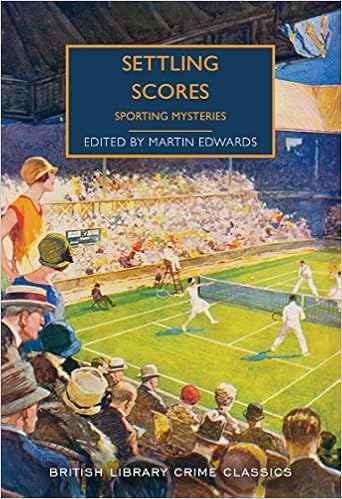
Settling Scores


Tomorrow sees the publication in the UK of my latest anthology in the British Library's series of Crime Classics. The unifying theme of Settling Scores is not revenge, but sport. Each story is not only by a different author, but it features a different sport. I'm not aware of any other crime anthology which is quite the same; there was a splendid book edited almost 80 years ago by Ellery Queen, Sporting Blood, but that one included poker, chess, and butterfly collecting.

I'm often asked what my favourites are among my own books - assuming that I do have favourites. Well, I never release a book on an unsuspecting world unless I'm happy with it, and it seems worthy of publication. And naturally it's a matter of personal and professional pride to try to make sure that each book is as good as it possibly can be. That said, inevitably there are books which give rise to different feelings - especially after a lapse of time. And different levels of satisfaction too.

Among my British Library anthologies, I'm especially proud of Foreign Bodies, because of its ambition, and several others, such as The Measure of Malice, strike me as interestingly different from the general run of anthologies. And Settling Scores is right up there, partly because there are some fascinating stories, and partly because I find it intriguing to see how different authors have set about integrating a sporting background into their narrative. I'm hopeful the book will do well.

So what of the specific contents? There's a long story by Julian Symons, set around Wimbledon, and a characteristically accomplished one by Celia Fremlin which is a bit different because it concerns a school sports day. And then there are stories by little-known figures such as F.A.M. Webster, David Winser, and Gerald Verner. Each of these three men, by the way, had a very interesting life, and I recently read a biography of Verner by his son Chris which I'm hoping will be published fairly soon. In the meantime, if you like sport, or if you hate sport but love crime fiction, do consider giving Settling Scores a try...


Sunday, 29 December 2019

2019: Publications


Image result for measure of malice martin edwards


Image result for deep waters martin edwards


Image result for gallows court martin edwards

It doesn't feel like it, but this year I didn't bring out either a brand new novel or a new non-fiction book. There was, however, a lot to celebrate in publication terms, starting with the UK paperback edition of Gallows Court, which was nominated for the eDunnit award and longlisted for the Historical Dagger, and subsequently published in the US, with sought-after starred reviews in Publishers' Weekly and Booklist. At the moment, the book is part of the December Kindle Deal promotion and all in all it's been my most successful novel to date. Next year will see the publication of the sequel to Gallows Court, a book I spent the first half of 2019 writing, Mortmain Hall.

Writing intros for the British Library kept me quite busy. In addition I edited two anthologies for the British Library's Crime Classics series. Deep Waters gathered 'mysteries on the waves' while The Measure of Malice was a collection of scientific mysteries. I've been pleasantly surprised by the success of the themed anthologies I've put together for the BL. In sales terms the figures are startling, while the books have introduced some interesting writers to a new generation of crime fans.

I wrote a handful of short stories during the year, some of which will come out in 2020. "The Girl on the Bandwagon", a satire on so-called domestic noir, was published in Ellery Queen's Mystery Magazine. It's a story I enjoyed writing enormously. "The Sound of Secrecy" appeared in Maxim Jakubowski's anthology of historical mysteries, while "The Cap of Liberty", set in the first part of the 19th century, was included in Ra Page's book Resist, a collection of stories about protest. And I was thrilled that last year's "Strangers in a Pub" was shortlisted for the Short Story Dagger. Those four stories constitute a very diverse bunch indeed in terms of subject matter and style, and their range illustrates what I love about the short story form - its boundless possibilities.

In terms of non-fiction, I contributed various pieces to blogs and online forums, as well as a longish essay about Dr Harold Shipman, "The First of Criminals", which appeared in Mitzi Szereto's anthology of true crime essays. I also wrote an essay which is to be a chapter in an academic book, on "Plotting". This was a fascinating exercise to undertake, although the nature of academic writing, with its emphasis on footnotes and bibliographic references, doesn't greatly appeal to me. My preference when writing non-fiction is to tell a story, uncluttered by minutiae. And that's where my focus will be in future. More on that subject another day... 


Monday, 30 September 2019

The Measure of Malice


Image result for measure of malice martin edwards

Life is pretty hectic at the moment, and as a result I've been rather tardy in talking about my latest UK publication! This is another anthology in the British Library Crime Classics series, The Measure of Malice. The theme here is scientific detection. I've been keen with the story collections in this series to ring the changes in terms of theme, as well as trying to ensure diversity of content.

An anthology of short stories needs to have a distinctive personality, I think. On the whole, readers tend not to be tempted by random assortments of stories in a book, however good the individual stories. It's a given, in almost all cases, that different readers will respond differently to particular stories in an anthology, and that they won't like each story equally. That doesn't seem to me to be a problem. The real joy of anthology often lies in a discovery of the unexpected. One buys the book because one is tempted by the theme, or by the inclusion of a favourite story or author, and then one stumbles across something unfamiliar that is, perhaps unexpectedly, highly enjoyable. That's what I find as a reader of anthologies; it's what I love about them. And it's what I aim for when editing an anthology myself.

I'm no scientist, as my miserable Grade 5 in Physics O Level attests (and weirdly, I have never had a single chemistry lesson in my life), but science does interest me, and its application in detective work is of course of great importance. The focus of The Measure of Malice is on early examples of scientific detection - no DNA fingerprinting, CCTV surveillance, or mobile phone tracking here! But although some of the technology now seems quaint, it also has a considerable appeal as well as historic significance.

For this book, I've rounded up the usual suspects, such as R. Austin Freeman, creator of Dr Thorndyke, and J.J. Connington, in real life a distinguished professor of chemistry. And there are great names such as Arthur Conan Doyle and Dorothy L. Sayers, the latter making a venture into forensic dentistry in a story that I really like. But there are also less familiar names, such as Ernest Dudley, creator of  Dr Morelle, C. J. Cutcliffe Hyne, and Carl Bechhofer Roberts. Who knows, it may be that some readers tempted by Doyle and Sayers find themselves drawn to Dudley and his lesser known colleagues. I hope so, and I hope that crime fans find plenty to enjoy in this new collection. 

Wednesday, 6 March 2019

Forthcoming Crime Classics


The British Library has just issued its catalogue of publications for the second half of this year, and there are many good things in store. And of course that includes the forthcoming Crime Classics. Among notable features of the list is another novel written by E.C.R. Lorac, whose work has proved extremely popular with fans. This is Fell Murder, set in Lunesdale, where she made her home. It is a lovely part of the world, and this is a book with an exceptionally strong sense of place, and a sense of the intimacy of the rural community.

I'm especially thrilled that the series will, for the first time, include a novel by John Dickson Carr. This is It Walks By Night, which was his very first novel, set in Paris and featuring his first major series detective, Henri Bencolin. I've been hoping for some years that it would be possible to include Carr in the series, but it has proved tricky, because the rights position is extremely complicated. But the Library team has done great work in finally overcoming the obstacles and achieving success. Although Carr was American, his work seems to make a very natural fit with the series; he was an Anglophile who lived in England for many years and was Secretary of the Detection Club and a gifted practitioner of the "fair play" whodunit. This book also includes a Bencolin short story.

Anne Meredith's Portrait of a Murderer was a very successful book the Christmas before last, and Lucy Malleson who wrote under the Meredith name returns to the series with a book written under her best-known pen-name, Anthony Gilbert. This is Death in Fancy Dress, a country house mystery very much in the classic tradition. The book will also include a couple of Gilbert short stories.

Talking of short stories, there will be another anthology, The Measure of Malice, which is a collection of tales of scientific detection that I've put together. I'm delighted that the British Library anthologies have done so well in terms of sales and reviews, and I can also commend their "weird tales" collections, some more of which will be forthcoming (I like the sound of a collection of "killer tales of the botanical Gothic"!)

Other crime titles include another novel by George Bellairs, who is back by popular demand, Mary Kelly's The Christmas Egg, and a second Pocket Detective puzzle book by Kate Jackson. Something for everyone, in other words! And I can assure you that plans for 2020 are already making good progress. At least one more Carr title is on the way...