Why haven't I made the rapid progress with the next Lake District Mystery that I intended a few months ago? Well, my tardiness is a cause for regret, of course, but I can come up with a few excuses. Among them are a number of other writing projects that I've felt the urge to squeeze in. These include writing two more book introductions - more details of these soon.
I was also pleased to be asked to contribute to a collection of essays called Morphologies. The sub-title is "short story writers on short stories", though it's fair to say that most if not all of the contributors are best known for their novels. A large part of the attraction of accepting the commission was the glittering list of fellow contributors - it includes notable writers such as Frank Cottrell Boyce, Ramsey Campbell, Toby Litt, Sara Maitland, and Jane Rogers Who would not want to be in such company? .
One of the other contributors was Brian Aldiss. Now I've never met him, but I have a vivid memory of attending a talk about writing given at the Oxford Union almost forty years ago, when I was a student, dreaming of one day publishing a novel. The other speakers, if memory serves, included Kingsley Amis, John Braine, Angus Wilson and Thomas Hinde. However, to be brutally honest, the only one who struck me as a remotely viable role model was Brian Aldiss. The others were not, I felt, at their best - which was disappointing as this was the first event featuring a number of leading novelists that I'd ever attended in my life. So I'm glad to have this slender literary connection with Mr Aldiss. If you'd told me it would happen when I was a student, I would have been absolutely thrilled.
Anyway, I digress. The (very nicely produced) book is published by Comma Press, and edited by Ra Page, who provides a good introduction.. Authors covered include Kafka, D.H. Lawrence, Kipling, Poe, Hawthorne and Dostoyevsky. My subject was Conan Doyle's short stories, but I did not by any means confine myself to Sherlock. Conan Doyle wrote some excellent stories about other characters, and I find some of his horror stories highly effective - for instance, "The Case of Lady Sannox." It was, admittedly, time-consuming researching and writing the essay, but I'm proud to be part of this fascinatinag project.
Wednesday, 18 December 2013

Monday, 16 December 2013
Lucan - ITV review
Lucan is a two-part ITV programme about one of the most renowned murder cases of the Seventies and I've just caught up with the first part. Nobody has ever been put on trial for the murder of the Lucan family nanny, Sandra Rivett, but Lord Lucan's disappearance meant that he has always been prime suspect. And the makers of this programme made it clear that they considered him guilty. Unjust? Well, Lucan was, by all accounts, a vile man. The great mystery is what happened to him after the killing.
This version of the story is based on a book by John Pearson, and follows his attempts to find out about the closed circle of rich men who were members of Lucan's clique at the Clermont Club, where he gambled away the family fortune. Pearson is played by the always impressive Paul Freeman. Lucan, as played by Rory Kinnear, is not just posh and rich, but vicious and very, very stupid. The other main villain of the story is the weird John Aspinall, played with his customary excellence by Christopher Ecclestone, who exploits Lucan, and eggs him on to dark deeds. He also appears to be an advocate of eugenics.
The rich are different, we are often told. Not in a good way, though, if Lucan is any guide. The murder of Sandra Rivett, a poor woman who was just in the wrong place at the wrong time, was a repellent crime committed by a repellent person. In fact, the main weakness of this well made and well cast programme was that it took ninety minutes to tell a depressingly straightforward story. I shall watch the second part, in the hope of a credible explanation for Lucan's fate. Is he still alive? I can't imagine it. You'd surely have to be much more intelligent than Lucan to evade attention for forty years.
One of the reasons why stories like the Lucan case appeal so widely, of course, is that most people have an instinctive desire to believe that wealth does not equate to happiness. Lucan certainly supports this view, but there is a legitimate question as to whether it is right to dramatise the case when some of the innocent people involved are still alive. It must be painful for Lady Lucan and her children, and the story makes it clear that she and they deserve sympathy. But after forty years, surely it's fair enough to make a programme about the case, provided every attempt is made to stick to the facts.
This version of the story is based on a book by John Pearson, and follows his attempts to find out about the closed circle of rich men who were members of Lucan's clique at the Clermont Club, where he gambled away the family fortune. Pearson is played by the always impressive Paul Freeman. Lucan, as played by Rory Kinnear, is not just posh and rich, but vicious and very, very stupid. The other main villain of the story is the weird John Aspinall, played with his customary excellence by Christopher Ecclestone, who exploits Lucan, and eggs him on to dark deeds. He also appears to be an advocate of eugenics.
The rich are different, we are often told. Not in a good way, though, if Lucan is any guide. The murder of Sandra Rivett, a poor woman who was just in the wrong place at the wrong time, was a repellent crime committed by a repellent person. In fact, the main weakness of this well made and well cast programme was that it took ninety minutes to tell a depressingly straightforward story. I shall watch the second part, in the hope of a credible explanation for Lucan's fate. Is he still alive? I can't imagine it. You'd surely have to be much more intelligent than Lucan to evade attention for forty years.
One of the reasons why stories like the Lucan case appeal so widely, of course, is that most people have an instinctive desire to believe that wealth does not equate to happiness. Lucan certainly supports this view, but there is a legitimate question as to whether it is right to dramatise the case when some of the innocent people involved are still alive. It must be painful for Lady Lucan and her children, and the story makes it clear that she and they deserve sympathy. But after forty years, surely it's fair enough to make a programme about the case, provided every attempt is made to stick to the facts.
Friday, 13 December 2013
Forgotten Book - Follow, as the Night...
I was encouraged to read today's Forgotten Book by an interesting post in that excellent blog Beneath the Stains of Time. Follow, as the Night..., also known as Your Loving Victim (a title that verges on a spoiler) was published by Patricia McGerr in 1951. Three years later, it was made into a film in France, the English title being One Step to Eternity. Sadly, there does not seem to be any DVD version on the market. If I could find a copy, I'd certainly want to watch it.
I say 'sadly' because this is a story that I found very enjoyable. As with McGerr's earlier books, notably Pick Your Victim, this is a "whowasdunin" type of story. At the outset, someone plunges from a balcony to their death. We then learn that a newspaper columnist, Larry Rock, invited the four women in his life to a party, intending to kill one of them. But which person did he have in mind to kill?
The story is essentially told in flashback, as we see how Larry met and then messed about his first wife, his second, his mistress and the girl he now plans to marry. Why would he wish to kill any one of them in particular? We soon see that Larry is a very nasty piece of work indeed, while some of the women aren't much better, though one of them is decent and likeable.
Very early on in this book, I asked myself how I would have tackled such a story if I'd had the same scenario idea as McGerr. I came up with an idea for a plot twist, and then set about trying to figure out an appropriate murder motive. By using this method, I did manage to anticipate what was going to happen, but it didn't spoil my enjoyment in any way. This is a short, snappy novel and it kept me entertained. No question in my mind, McGerr was a talented and inventive writer.
I say 'sadly' because this is a story that I found very enjoyable. As with McGerr's earlier books, notably Pick Your Victim, this is a "whowasdunin" type of story. At the outset, someone plunges from a balcony to their death. We then learn that a newspaper columnist, Larry Rock, invited the four women in his life to a party, intending to kill one of them. But which person did he have in mind to kill?
The story is essentially told in flashback, as we see how Larry met and then messed about his first wife, his second, his mistress and the girl he now plans to marry. Why would he wish to kill any one of them in particular? We soon see that Larry is a very nasty piece of work indeed, while some of the women aren't much better, though one of them is decent and likeable.
Very early on in this book, I asked myself how I would have tackled such a story if I'd had the same scenario idea as McGerr. I came up with an idea for a plot twist, and then set about trying to figure out an appropriate murder motive. By using this method, I did manage to anticipate what was going to happen, but it didn't spoil my enjoyment in any way. This is a short, snappy novel and it kept me entertained. No question in my mind, McGerr was a talented and inventive writer.
Wednesday, 11 December 2013
Gone Girl by Gillian Flynn
It's taken me a while to get round to reading Gillian Flynn's massively successful best-seller Gone Girl, but I was finally prompted to do so when it was chosen by my firm's book group as our book of the month. And the first thing to say is that I can certainly see what all the fuss has been about. I read Flynn's excellent debut novel, Sharp Objects, and this story, although very different, is even more compelling.
Flynn has written a psychological suspense novel with a story told from (at least) two different perspectives, a man called Nick Elliott, and his wife Amy. The subject matter is their complex relationship, and a sequence of disastrous events which spirals out of control. There's a major twist half way through the book, and I must say that I was pleased to recognise it as a device that was also used, although in a different way, by two Golden Age books that I've covered on this blog in the past year - one by Richard Hull and one by Nicholas Blake. To say any more would be a spoiler, but I am sure Flynn won't have read Hull's very obscure book, and is probably unlikely to have read the Blake In any case, her use of the device is different and distinctive.
There are as many twists and turns as you'd find in a classic whodunit, and this is part of the book's appeal. The personalities of Nick and Amy are, in many ways, unappealing, but that is often the case with characters in books of this kind, and for me it was not an obstacle to enjoyment. There are also plenty of witty lines, as well as a withering portrayal of the way the media treat a cause celebre.
I know some people, including my colleagues at work, found the ending of the book unsatisfactory. Since I am not, of course, going to give anything away about what happens, I will simply say that I agree that the quality of the ending was not in my opinion quite up to the standard of the rest of the book. But I could see what Gillian Flynn was trying to do (although in the lead-up to the finale, I thought she had a different outcome in mind). Some of my colleagues gave it lowish marks (I've begged them not to subject my own novels to their very demanding scrutiny!), but I rate it highly. Overall I must say that for me, this novel lives up to all the hype.
Flynn has written a psychological suspense novel with a story told from (at least) two different perspectives, a man called Nick Elliott, and his wife Amy. The subject matter is their complex relationship, and a sequence of disastrous events which spirals out of control. There's a major twist half way through the book, and I must say that I was pleased to recognise it as a device that was also used, although in a different way, by two Golden Age books that I've covered on this blog in the past year - one by Richard Hull and one by Nicholas Blake. To say any more would be a spoiler, but I am sure Flynn won't have read Hull's very obscure book, and is probably unlikely to have read the Blake In any case, her use of the device is different and distinctive.
There are as many twists and turns as you'd find in a classic whodunit, and this is part of the book's appeal. The personalities of Nick and Amy are, in many ways, unappealing, but that is often the case with characters in books of this kind, and for me it was not an obstacle to enjoyment. There are also plenty of witty lines, as well as a withering portrayal of the way the media treat a cause celebre.
I know some people, including my colleagues at work, found the ending of the book unsatisfactory. Since I am not, of course, going to give anything away about what happens, I will simply say that I agree that the quality of the ending was not in my opinion quite up to the standard of the rest of the book. But I could see what Gillian Flynn was trying to do (although in the lead-up to the finale, I thought she had a different outcome in mind). Some of my colleagues gave it lowish marks (I've begged them not to subject my own novels to their very demanding scrutiny!), but I rate it highly. Overall I must say that for me, this novel lives up to all the hype.
Yesterday's Papers Once More

This week sees the publication of Yesterday's Papers, my fourth Harry Devlin novel, as an Arcturus Crime Classic, not quite twenty years after its first appearance. Unusually, the book has been published by three different publishers as a mass market paperback over the years (there is also an ebook version with a wonderful intro by Peter Lovesey, as well as a paperback print on demand version.) Originally the publisher was Bantam. Later, when I moved publishers to Hodder, they reprinted the earlier titles including this one. It's also, in a way, a "cold case" story that anticipates elements of my Lake District Mysteries.
I'm especially gratified because this is a book for which I've always had a soft spot. If pushed, I'd say it's probably my personal favourite among the Devlin titles. I'm not one of those authors who disowns his earlier books, or feels unduly embarrassed about them - even though I'm the first to admit that I'd write them differently (in some respects) if I were writing them today. I must say that it's rare for me to re-read my earlier work, though I do have to do so occasionally (for instance, when checking proofs of new versions or checking facts for an article.) But the early books provide, in some ways, a snapshot of ideas and issues that were interesting me or concerning me at the time I wrote them. That's true of most novels, of course, and it's one of the reasons I find it so fascinating to investigate books of the past. They cast a light on the times when they were written, even if the author didn't intend to do so.
The story of my career as a writer is illustrated (or so I might think in darker moments0 by the story of Yesterday's Papers. I felt it was the most successful book I'd written to date, with lots of twists and quite a bit of humour, as well as a glance at the era of the Mersey Sound in Liverpool during the Sixties. Bantam had tried to promote me by pricing the books very competitively. But it didn't result in mega-sales, and a complication was that I had a separate hardback publisher, Piatkus. Yesterday's Papers, however, earned numerous glowing reviews in Britain and elsewhere, and was even one of only a couple or so of crime novels featured in The Sunday Times Paperbacks of the Year. I dreamed that this would boost sales - only to be told that Bantam had already decided not to publish me any more. A shame, because they are a top publisher, and I had a really nice editor, Francesca Liversidge. But these things happen in a writer's career, and one of the most corrosive emotions is self-pity. Frustrating as the writing life can be, it's also a great life. You have to get on and make the most of it. And before long, as I say, another good publisher, Hodder, and an excellent editor, Kate Lyall Grant, came along..
Against this background, the revival of Yesterday's Papers is really rather a Christmas treat for me. I still think the plot-lines are among the best I've managed to come up with. And I'm hoping that a new group of readers will enjoy discovering Harry Devlin, and will be entertained by a story that reaches back to a time when the songs of Liverpool were being sung the world over.
Monday, 9 December 2013
Why Re-Read a Detective Story?
What is the point of re-reading a detective story? After all, if you know whodunit, surely it's a waste of time? This is an argument I've come across a good many times over the years. And there are certainly plenty of detective stories that most readers may doubt were worth reading once, let alone twice. (Mind you, that's true of plenty of books outside the crime genre, as well.) But I think a great deal of pleasure may be gained from re-reading a good whodunit, even if you can still remember who committed the crime and why.
A case in point is Death Walks in Eastrepps by Francis Beeding. I first read this novel in my twenties, but it has stuck in my mind ever since, and its reappearance as an Arcturus Crime Classic prompted me to give it another go. I knew the identity of the surprise culprit, and the even more surprising motive, but I was interested to see how the two authors who co-wrote under the Beeding name handled their tricky plot.
In this book, as in their The Norwich Victims, which I also re-read recently, they shift scenes and viewpoints regularly, giving the story a filmic quality. (Unsurprisingly, Alfred Hitchcock adapted another of their novels, which became Spellbound.) Even by today's frenetic standards, the book does not lack pace. It's an early serial killer novel, and there are half a dozen victims, before the culprit (or apparent culprit) is finally tracked down - after the original prime suspect had turned out to be innocent, if deranged.
There is a good courtroom sequence before a series of short and snappy scenes lead up to the final dramatic revelation. I was impressed by the way Beeding orchestrated a complicated storyline, and admiration of authorial craft is in itself a good reason to give a book a second reading. There are so many books I'll never read even once that I suppose I ought to feel guilty about spending time on a story I remembered pretty well. But I don't regret it at all, because I found it just as enjoyable the second time around as the first.
A case in point is Death Walks in Eastrepps by Francis Beeding. I first read this novel in my twenties, but it has stuck in my mind ever since, and its reappearance as an Arcturus Crime Classic prompted me to give it another go. I knew the identity of the surprise culprit, and the even more surprising motive, but I was interested to see how the two authors who co-wrote under the Beeding name handled their tricky plot.
In this book, as in their The Norwich Victims, which I also re-read recently, they shift scenes and viewpoints regularly, giving the story a filmic quality. (Unsurprisingly, Alfred Hitchcock adapted another of their novels, which became Spellbound.) Even by today's frenetic standards, the book does not lack pace. It's an early serial killer novel, and there are half a dozen victims, before the culprit (or apparent culprit) is finally tracked down - after the original prime suspect had turned out to be innocent, if deranged.
There is a good courtroom sequence before a series of short and snappy scenes lead up to the final dramatic revelation. I was impressed by the way Beeding orchestrated a complicated storyline, and admiration of authorial craft is in itself a good reason to give a book a second reading. There are so many books I'll never read even once that I suppose I ought to feel guilty about spending time on a story I remembered pretty well. But I don't regret it at all, because I found it just as enjoyable the second time around as the first.
Friday, 6 December 2013
Forgotten Book - Accessory to Murder
Do you know the work of Pamela Barrington? I didn't until recently. But I have now read her 1968 novel Accessory to Murder, and really enjoyed it. What is more, I would not have come across either Barrington or her Forgotten Book had it not been for one of the knowledgeable readers of this blog. Kacper contacted me a while ago and suggested I might be interested in Barrington. He said he'd been impressed with some of her work and thought I might like it too. He was quite right, and I'm really grateful to him for pointing me in her direction.
This little anecdote is an example, of course, of one of the very happy consequences of blogging. As a result of my posts here, I've come into contact with a wide range of people - some of whom I've been able to meet in person, many of whom I haven't - who have certainly proved delightful to talk to, either face to face or via email. And I've learned a good deal from these contacts, as well as benefiting from many kindnesses. It never ceases to amaze me how wonderfully the internet - whatever people say about its shortcomings- has opened up new horizons for us all.
Anyway, back to Barrington - whose real name, Kacper tells me, was Muriel Vere Mant Barling. She wrote about two dozen novels, with this one coming at the end of her career. It's a fast moving story, which opens with a man called Henry Deek, who seizes the chance to blackmail a rich local woman when he discovers a missing will. A legal point cropped up concerning the will, which I thought would be relevant, but was never mentioned again - one of the few flaws in an otherwise neatly constructed story.
When Henry is found murdered, there are a number of potential suspects, and Barrington does a good job of switching suspicion around. The twist at the end was, I felt, a bit weak, but all in all this was a lively and entertaining book. It reminded me of some of Margaret Yorke's early stand-alone crime novels. Margaret, of course, went on to win the CWA Diamond Dagger, whereas Barrington is now neglected. But as Kacper rightly said, she does not deserve to be. Incidentally, just as I was about to post here, Kacper has emailed me again with fresh information about Barrington (including the fact that she was born in Cheshire,which gives me a certain fellow feeling for her), and I hope to feature her again in this blog before too long.
This little anecdote is an example, of course, of one of the very happy consequences of blogging. As a result of my posts here, I've come into contact with a wide range of people - some of whom I've been able to meet in person, many of whom I haven't - who have certainly proved delightful to talk to, either face to face or via email. And I've learned a good deal from these contacts, as well as benefiting from many kindnesses. It never ceases to amaze me how wonderfully the internet - whatever people say about its shortcomings- has opened up new horizons for us all.
Anyway, back to Barrington - whose real name, Kacper tells me, was Muriel Vere Mant Barling. She wrote about two dozen novels, with this one coming at the end of her career. It's a fast moving story, which opens with a man called Henry Deek, who seizes the chance to blackmail a rich local woman when he discovers a missing will. A legal point cropped up concerning the will, which I thought would be relevant, but was never mentioned again - one of the few flaws in an otherwise neatly constructed story.
When Henry is found murdered, there are a number of potential suspects, and Barrington does a good job of switching suspicion around. The twist at the end was, I felt, a bit weak, but all in all this was a lively and entertaining book. It reminded me of some of Margaret Yorke's early stand-alone crime novels. Margaret, of course, went on to win the CWA Diamond Dagger, whereas Barrington is now neglected. But as Kacper rightly said, she does not deserve to be. Incidentally, just as I was about to post here, Kacper has emailed me again with fresh information about Barrington (including the fact that she was born in Cheshire,which gives me a certain fellow feeling for her), and I hope to feature her again in this blog before too long.
Wednesday, 4 December 2013
The Wallace Case - Alan Hamilton's perspective
My blog about P.D. James' essay on the legendary Wallace case prompted some very interesting comments and emails. One of them came from Alan Hamilton, who has just written a novel, Stalemate, which draws on the case (and which I very much look forward to reading.) Alan's research has been impressive, and I invited him to contribute a guest blog setting out some of his thoughts, which I hope will also whet readers' appetites for his novel.
"James Agate, a critic famous in his day, wrote,
‘either the murderer was Wallace or it wasn’t. If it wasn’t, then here at last
is the perfect murder.’
Let’s start with what we know.
We know that at the time of the murder Wallace was
terminally ill. He’d spent a month as an in-patient in a Liverpool hospital in
mid-1930 and had it made clear to him that his remaining kidney was diseased
and malfunctioning and that nothing could be done to reverse or even arrest
that. We also know he was a deeply introspective, introverted, and cerebral man.
Wholly self-taught, his interests covered chemistry, science in general,
philosophy, chess, music, and literature – interests that, together with his
psychological traits, tended to cut him off from those among whom he lived and
worked.
We know, and this knowledge is only about fifteen
years old, that Julia Wallace was nearly twenty years older than her husband
and yet had got away with claiming to be the same age as him. No one at the
time suspected it. She did not look her age. She had lied persistently on
official documents about her age, parentage, place of birth and even her first
name, and did so too with her marriage certificate. We know she rented and did not own the house
she lived in when she met Wallace. We know she had today’s equivalent of £2340
in her Post Office account and on the night she was killed about £40 in cash in
a pocket applied to the inside of her corset. She would have had to undress to
get at the money.
We know that when Wallace arrived home from his
wasted trip to Mossley Hill in pursuit of business from Mr Qualtrough, he was
able to enter his back yard through the door in the wall. He said he’d told his
wife to bolt it after him. If she had, he wouldn’t have been able, or expected,
to get in.
We know that Julia was killed around 8pm.
Professor McFall wrote that in the first report he made to the CID. He later
changed his mind although he had no better evidence than he had had when he
made that first report.
And finally we know that, contrary to PD James’s
theory, Wallace did not cost Parry his job by reporting him to the Pru for
paying-in less than he collected. It was more than a year after Wallace caught
Parry out that Parry left the Pru of his own accord. About a month before the
murder, Parry gave Wallace a calendar from his new employer. It was Wallace’s
supervisor who told him later that Parry’s father had made good shortages in
his son’s accounts.
So, given what we know, what might have happened?
Someone killed Julia and with a degree of violence of which Wallace, given his temperament
and physical condition, was probably incapable. What’s more, whoever it was did
it when Wallace was several miles from home. Someone who was let into the house
by Julia; someone she either knew or thought she knew. Someone who intended from
the start, or was provoked, to kill her. Someone from her distinctly strange
past, perhaps, or someone who wanted her out of the way? Or someone who was
persuaded, rewarded, or pressured to kill her so someone else could benefit?
Someone else who might then feel that at the end of a lifetime of frustration
and disappointment he (or she) had organised ‘the perfect murder’".
Monday, 2 December 2013
The Good Doctor - film review
In real life,and in fiction, doctors have a disturbing track record when it comes to homicide. My own favourite medical murderer (or was he simply unlucky and much misunderstood?) is Dr Crippen, while the terrible crimes of Harold Shipman undoubtedly rank among the most chilling murders Britain has ever experienced. Detective novelists have often featured doctors as culprits (as I myself have done.) Accountants and even rascally lawyers seem to get off relatively lightly in comparison.
Why is this? One reason, perhaps, is the trust that we place in members of the medical profession, and the fear we have that in certain circumstances that trust might be betrayed - though I hasten to add that every single doctor I've ever met in person has struck me as decent and caring. This mix of trust and fear underpins a 2011 movie, The Good Doctor.
Orlando Bloom plays Martin Blake, a young and rather lonely British guy who has moved to the States to pursue a medical career. He treats a very pretty young woman, and is soon tempted into behaving appallingly in order to maintain his connection with her. She is played by Riley Keough, who is the grand-daughter of Elvis Presley, no less. Needless to say, things do not turn out as Blake had planned, and there's some uncomfortable watching in the hospital scenes for any hypochondriac.
The prime requirement of a story of psychological suspense, though, is that it must be psychologically convincing. The script simply doesn't tell us enough about Blake's personal history to make us empathise with or really understand him, and I felt this was a major flaw. As a result, the film frustrated me. It had the potential to be gripping, but eventually I became not only queasy but restless, and the final scenes struck me as artistically unsatisfactory. In fairness, I should add that The Good Doctor has had some positive reviews, but there is something cold about it that I am afraid I found rather unappealing.
Why is this? One reason, perhaps, is the trust that we place in members of the medical profession, and the fear we have that in certain circumstances that trust might be betrayed - though I hasten to add that every single doctor I've ever met in person has struck me as decent and caring. This mix of trust and fear underpins a 2011 movie, The Good Doctor.
Orlando Bloom plays Martin Blake, a young and rather lonely British guy who has moved to the States to pursue a medical career. He treats a very pretty young woman, and is soon tempted into behaving appallingly in order to maintain his connection with her. She is played by Riley Keough, who is the grand-daughter of Elvis Presley, no less. Needless to say, things do not turn out as Blake had planned, and there's some uncomfortable watching in the hospital scenes for any hypochondriac.
The prime requirement of a story of psychological suspense, though, is that it must be psychologically convincing. The script simply doesn't tell us enough about Blake's personal history to make us empathise with or really understand him, and I felt this was a major flaw. As a result, the film frustrated me. It had the potential to be gripping, but eventually I became not only queasy but restless, and the final scenes struck me as artistically unsatisfactory. In fairness, I should add that The Good Doctor has had some positive reviews, but there is something cold about it that I am afraid I found rather unappealing.
Sunday, 1 December 2013
What I Didn't Do On My Holidays
I've just returned from a week away - and a week away from internet access, other than a five minute window which just gave me the chance to publish the comments several of you had kindly made on posts I'd scheduled to appear in my absence. A week without emails - that's the first time I've been so out of touch (well, in terms of technology, anyway) since the mid 90s.
It was certainly an eventful week. The plan was to go on a cruise focusing on the Azores. I'd never been there, but a late impulse decision to give the little islands a go was thwarted within an hour of stepping on board ship. The weather forecast was appalling, and the news was that we would be unable to dock. Very sensibly, the captain changed the itinerary, and apart from one day of rough seas, the weather was fantastic. So despite the disappointment of missing out on the Azores, it all worked out for the best. And by a pleasing coincidence, the very first song in the first night's evening show was "Magical Mystery Tour".

Mind you, within hours of returning, I had a phone call from a crime writing friend, Eileen Dewhurst, who broke the news that she'd actually made it to the Azores a week earlier - and loved them. So I'll have to give them another try one day. And when I finally had the chance to skim through my emails, I was delighted to read one notifying me of acceptance of a new short story for a very interesting-sounding international crime anthology, commissioned as a result of my involvement in the international writers' conference at Oxford back in August.
During my unexpectedly Azores-less and internet-less week, I did find plenty of time both to read and to think about my new Lakes book. Work on this has been delayed for various reasons, but I enjoyed having the chance to think out my characters in more detail and I hope to get cracking again any day now. As for reading, the books were chosen for variety, and did not disappoint (except for one surprisingly weak Patrick Quentin.) More of them in future blog posts.
The revised itinerary took in La Palma, Madeira, Rabat and Lanzarote, and I became fascinated by the volcanic nature of the Canaries. This has prompted a new idea for a short story, although I only have the idea rather than the detail of the storyline at present. And among other things, I went for a ride on a camel. Photographic evidence of this does exist, but I don't think the internet is yet ready for the pictures! However, here are some of the other sights that I found so appealing.

La Palma - a pretty island, home to the biggest volcanic crater in the world, so it was said, but regardless of statistics, quite breathtaking

The Nuns' Valley in a remote corner of that wonderful island Madeira - perhaps the most stunning vista of the entire week


The kasbah in the imperial city of Rabat, a much more fascinating place, in my opinion, than the port where we landed, Casablanca. Morocco is a remarkable country, which I've now visited (although quite briefly) five times in the past couple of years, and one of the things that has impressed me most about it is the way that Muslims, Christians and Jews appear to live in harmony.
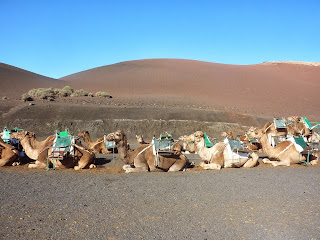
Camels in Lanzarote, ready for action....


The volcanic area of the national park in Lanzarote. The geysers of Fire Mountain, and the restaurant where food is cooked by the heat of the volcano are truly extraordinary.

And finally, the stunning lunar landscape near Mount Teide in Tenerife. The first Planet of the Apes movie was filmed here, and no wonder. The beach resorts of the island hold no great appeal for me, but Tenerife's dramatic scenery is worth travelling a long way to see.
It was certainly an eventful week. The plan was to go on a cruise focusing on the Azores. I'd never been there, but a late impulse decision to give the little islands a go was thwarted within an hour of stepping on board ship. The weather forecast was appalling, and the news was that we would be unable to dock. Very sensibly, the captain changed the itinerary, and apart from one day of rough seas, the weather was fantastic. So despite the disappointment of missing out on the Azores, it all worked out for the best. And by a pleasing coincidence, the very first song in the first night's evening show was "Magical Mystery Tour".

Mind you, within hours of returning, I had a phone call from a crime writing friend, Eileen Dewhurst, who broke the news that she'd actually made it to the Azores a week earlier - and loved them. So I'll have to give them another try one day. And when I finally had the chance to skim through my emails, I was delighted to read one notifying me of acceptance of a new short story for a very interesting-sounding international crime anthology, commissioned as a result of my involvement in the international writers' conference at Oxford back in August.
During my unexpectedly Azores-less and internet-less week, I did find plenty of time both to read and to think about my new Lakes book. Work on this has been delayed for various reasons, but I enjoyed having the chance to think out my characters in more detail and I hope to get cracking again any day now. As for reading, the books were chosen for variety, and did not disappoint (except for one surprisingly weak Patrick Quentin.) More of them in future blog posts.
The revised itinerary took in La Palma, Madeira, Rabat and Lanzarote, and I became fascinated by the volcanic nature of the Canaries. This has prompted a new idea for a short story, although I only have the idea rather than the detail of the storyline at present. And among other things, I went for a ride on a camel. Photographic evidence of this does exist, but I don't think the internet is yet ready for the pictures! However, here are some of the other sights that I found so appealing.

La Palma - a pretty island, home to the biggest volcanic crater in the world, so it was said, but regardless of statistics, quite breathtaking

The Nuns' Valley in a remote corner of that wonderful island Madeira - perhaps the most stunning vista of the entire week


The kasbah in the imperial city of Rabat, a much more fascinating place, in my opinion, than the port where we landed, Casablanca. Morocco is a remarkable country, which I've now visited (although quite briefly) five times in the past couple of years, and one of the things that has impressed me most about it is the way that Muslims, Christians and Jews appear to live in harmony.

Camels in Lanzarote, ready for action....


The volcanic area of the national park in Lanzarote. The geysers of Fire Mountain, and the restaurant where food is cooked by the heat of the volcano are truly extraordinary.

And finally, the stunning lunar landscape near Mount Teide in Tenerife. The first Planet of the Apes movie was filmed here, and no wonder. The beach resorts of the island hold no great appeal for me, but Tenerife's dramatic scenery is worth travelling a long way to see.
Subscribe to:
Posts (Atom)