Monday, 4 September 2023

The Mercy - 2017 film review


The Mercy is a film which tells the story of Donald Crowhurst, which caused quite a sensation back in the late 60s. It's a story I remember from the time, but I've never studied it in detail and this version - very sympathetic towards Crowhurst - puts an interesting spin on a tale about a man who, with minimal experience, decides to go in for a solo round the world boat race, taking inspiration from the exploits of Sir Francis Chichester (played in the film by Simon McBurney).

The received wisdom has always been that Crowhurst was a fantasist who was simply incapable of achieving his goal and, due to fear of being found out (and financially ruined) set out to make false claims about his trip. For a while, it seemed as though he would return to Britain a hero. But then he lost radio contact and his boat was eventually found - but not Crowhurst. After that, it emerged that he hadn't travelled as far as he'd claimed. But an air of mystery has always clung to the case, and that in part explains its fascination.

The excellent Colin Firth plays Crowhurst as a decent family man with three young children (although in real life he had four) and a devoted wife, Clare (played by Rachel Weisz). We see him as an inventor and small businessman who is not particularly successful. When the race is announced he sees a chance of obtaining fame and fortune.

He acquires a press agent (David Thewlis) and a financial backer (Ken Stott) and, despite Clare's doubts, sets about raising funds for his epic voyage on the trimaran Teignmouth Electron. The picture created of Teignmouth society is appealing and made me want to spend more time there on my next visit to the south west. Director James Marsh and writer Scott Z. Burns get over the risk of endless scenes on the ocean by intercutting those scenes with what is happening back home and also scenes involving the Crowhursts.

This is a good film, which captures the enigma of Donald Crowhurst quite well, although I'd have liked a bit more insight into his background - what made him the man he was? Ultimately, despite the fraud element, it's a drama about a man with a dream that he's incapable of fulfilling, and the disaster to which that leads. Recommended.

Saturday, 2 September 2023

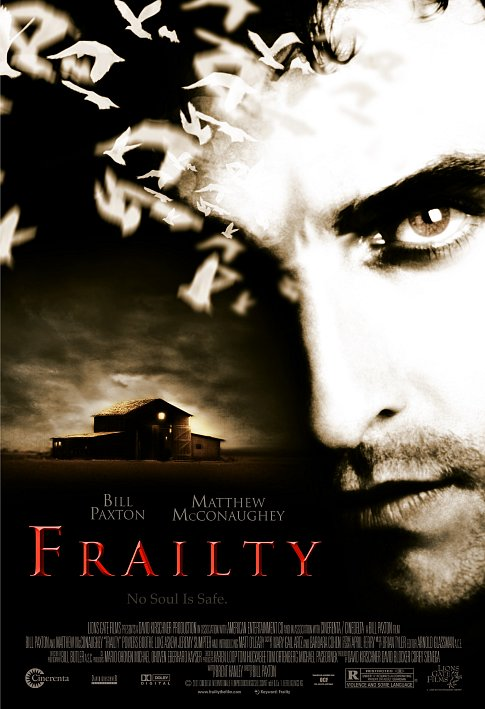
Frailty - 2001 film review


Frailty is not an especially well-known film, but it seems to have developed an increasing reputation since its original release in 2001 and I think this is well-merited. It's a dark film, with likeable characters in short supply, but it's gripping and the plot twists are, in my opinion, highly effective. It's a crime film with horror overtones (although there's plenty of violence, it's not really graphic) and arguably elements of the supernatural. 

On the surface, the story seems quite straightforward. A man visits police HQ in Dallas, Texas and insists on seeing the cop in charge of the 'God's Hand' serial killings case. He gets his wish and is duly interviewed by Wesley Dixon, a senior detective whose own mother was a murder victim (and the murderer was never caught). Dixon (Powers Boothe) learns that his visitor (Matthew McConnaughy) is Fenton Meiks, who has come to report that his brother Adam, who has just shot himself, is the God's Hand Killer.

His story, told via extended flashbacks, is a grim one. The two brothers were brought up by a loving father, a garage mechanic (very well played by Bill Paxton, who also directed the film). However, an apparent vision of an angel persuaded their father that it was God's will that he should track down and kill various individuals who were demons in human form. The two young boys witnessed their father's crimes. Young Adam shared his father's beliefs, but Fenton rebelled and tried to tell the truth about their father, with unhappy results.

To say more would be a spoiler. Suffice to say that this is a film that repays watching more than once. I was very impressed by Brent Hanley's script, and the quality of the acting (the cast includes Melissa aka Missy Crider, in a small role that is nevertheless crucial to the plot). The music is pretty good, too. Whatever one makes of the quasi-religious elements of the storyline, this is a film which I think deserves to be much more highly regarded than seems to have been the case twenty-two years ago.  

Friday, 1 September 2023

Forgotten Book - Message from Sirius


Message from Sirius by Cecil Jenkins was the joint winner (with R.J. White's The Smartest Grave) of a competition organised by Collins Crime Club in 1961 for the best crime novel to be written by a university don. In fact, the original choice was the debut novel of Dominic Devine, only for it to turn out that, although Devine worked in a university, he wasn't a don and was thus ineligible. Ironically, he proceeded to enjoy a more significant crime writing career than either White or Jenkins. Indeed, Jenkins never published another detective novel.

The competition had three big name judges, although I suspect the hard work of sifting through the manuscript was handled within Collins. But the trio are all quoted on the back of the book and their praise is unstinting. So Agatha Christie: 'both exciting and original'. Cecil Day Lewis: 'A really intelligent and thrilling thriller.' And Julian Symons: 'A truly original crime novel.'

Wow! These are extremely impressive endorsements. And the paperback edition notes that the book has already been published 'in seven countries around the world'. So the question is - does the book live up to its advance billing? I'm afraid it's time for a spoiler alert. The answer, in my opinion, is a definite no.

It's certainly true that Jenkins was trying to do something ambitious here, and that's praiseworthy, but there's a definite whiff of the pretentious about his writing. A celebrity is murdered in public and the police receive a letter signed Sirius, claiming that the crime was committed for some kind of (pretty incoherent) moral purpose. The opening paragraph, complaining about the state of the world, could actually be written today ('In an age which should be one of great hope, civilisation on our planet is threatened with physical destruction and, if only for this reason, with moral collapse'). There's quite a lot of Cold War angst in the story, and that's one of the book's interesting features, but I'm afraid I struggled to work up much interest in what was going on or whodunit.   

Wednesday, 30 August 2023

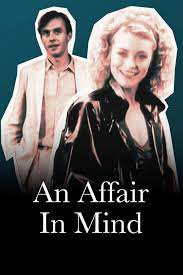
An Affair in Mind aka The Face of Trespass - 1988


I recall reading Ruth Rendell's The Face of Trespass one rainy weekend back in the 1980s. It was one of the first books of hers that I read and I enjoyed it. At the time, I was dreaming of becoming a writer and I was very struck, if not alarmed, by Rendell's description of her protagonist, a writer, whose royalty cheques start to dwindle. In fact, the notion that writing is a tough game in financial terms is the main thing I now remember about the story!

So when I came across a TV movie version of the book that I'd been previously unaware of, I was glad to have the chance to watch it. The new title was An Affair in Mind, which is rather less cryptic than Rendell's title. The screenplay was written by Michael Baker, whose CV includes a few episodes of Poirot. 

Stephen Dillane, a good actor, plays Gray Harston, the extremely naive protagonist. He goes to a literary party and is bored by his fellow guests until he spots a beautiful blonde-haired woman. He follows her and picks her up and without more ado they embark on a torrid affair. She is Drusilla Janus (played by Amanda Donohoe) and she's married to a rich man but bored with him.

Soon we stray into Double Indemnity territory as Drusilla seeks to persuade Gray to kill her husband so that the two of them can be together. The script requires suspension of disbelief on rather a massive scale. As far as I can recall, the novel seemed more plausible. But the story is good enough to keep one entertained, despite the various improbabilities.


Monday, 28 August 2023

Rachel Savernake in China and Japan


It's a surreal yet fascinating experience to see a novel that one has written published in a language that one doesn't understand. At one time, my overseas translations were confined to Germany and Italy, and even though my German is rusty and my Italian very limited, at least if I opened the book I would have a rough idea of the translation. It's rather different with the new Chinese and Japanese editions of Gallows Court.


I'm excited that the book is being published in both countries. I've never had a novel published in either country before, though The Story of Classic Crime in 100 Books and The Golden Age of Murder have appeared in Korean and Chinese editions, while The Life of Crime is due to be published in both China and Japan in due course.

The cover artwork, as you can see, is distinctive in each case. It's interesting to me that both publishers have focused on an image of Rachel Savernake (and the same was true of the US edition). It's been different in the UK, where three different types of cover artwork have been used already - the third being a design by Ed Bettison which is in the same style as the very successful cover he produced for Mortmain Hall. Speaking of which, I've also just received my author copies of the Chinese edition of Mortmain Hall, and the artwork is equally striking:


I find it interesting that it's Rachel Savernake, rather than any of my earlier protagonists, who has achieved a breakthrough in two important markets. There are probably a number of reasons for this, among them the fact that the Golden Age ingredients seem to appeal to Chinese and Japanese readers. Of course, it's not easy to do much in England to promote the book to readers in such distant lands, but  I'm keeping my fingers crossed that the publishers' PR efforts are sufficiently successful to prompt them to acquire more Rachel Savernake books. Time will tell!


Friday, 25 August 2023

Forgotten Book - The Schoolmaster


W.J. Burley published The Schoolmaster in 1977. By that time he was a well-established crime writer. Having started out with an amateur detective, Henry Pym, he'd begun to focus on a series about a cop based in Burley's native Cornwall - Charles Wycliffe, later a telly cop. Clearly he wanted to spread his wings further (in 1978 he'd venture into science fiction, an experiment he didn't repeat). So he wrote a stand-alone novel whose protagonist was a teacher - as was Burley.

The Schoolmaster is a book that juggles with the reader's expectations. At first it seems as though it may develop into a conventional inverted mystery, as introverted Arthur Milton is deserted by his wife, who goes to live with another man and takes their teenage daughter with her. Milton seems bent on revenge - but this impulse quickly fizzles out.

Then it seems that we may be dealing with a cold case story of psychological suspense as Arthur's connection with a crime of the past gradually emerges. Or is the story a whodunit? Or essentially a character study? It is a fairly short novel, but Burley kept me interested from start to finish.

So this one gets a thumbs-up from me. My main reservation is that Arthur isn't an easy man to warm to. The urban setting is drab, deliberately so, and the same is largely true of the characterisation. I would have liked to care more about Arthur's fate and his prospects - if any - of redemption. Burley admired Simenon, and one can detect the great Belgian's influence in this story, as one can in the Wycliffe series. Burley would go on to write two more crime stand-alones, Charles and Elizabeth and the excellent The House of Care. Each has merit, each remains well worth reading.

Wednesday, 23 August 2023

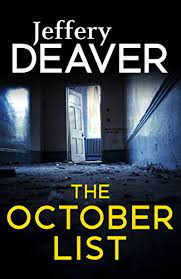
The October List by Jeffery Deaver - review


I've become increasingly interested in reverse chronology as a method of storytelling - so much so that these past few days I've been writing a short story in this style, just to see if I can do it. There are some fascinating examples of this kind of writing out there and I discussed the TV series Rellik recently; I thought it well-written and effective. So I was prompted to pick up a copy of Jeffery Deaver's The October List, billed as 'a novel in reverse with photographs by the author'. 

In a very helpful short preface, Deaver explains how he drew inspiration from Stephen Sondheim's Merrily We Roll Along. The timeline he opted for was just two days and he took photographs to illustrate each chapter: some are intended as clues, while others are not significant to the plot. He says the book was the most challenging he has written.

Jeffery Deaver is a brilliant mystery plotsmith, one of the best America has produced, and if anyone can pull off such an ambitious project, it is him. Yet as I read the early chapters, I felt curiously unengaged. The story didn't seem to work for me, as I couldn't get involved with the characters or the situation. Nor did I 'get' the photographs. The writing was also unexpectedly flat, which was a disappointment. So I could easily have given up half-way through.

Thank goodness I didn't lose faith. The story really warms up towards the end as one realises what Deaver is really up to. The twists that come in the closing chapters are marvellous. It's a very clever piece of writing indeed. In order to achieve his effects, he has made some sacrifices, and clearly some readers haven't been impressed. However, for me this is a novel which is definitely worth investing the time in, even if you don't care for the first half of the book. I've been interested to see online reviews from commentators whose reaction to the story was much the same as mine. If you like tricksy stories, this one is definitely worth considering. 

Monday, 21 August 2023

Still Writing Under My Own Name - marking the 3 million milestone


A while ago, I've only just discovered, this blog passed 3 million pageviews and is now at around 3.2 million. So it's only right that I should express my gratitude to everyone who has taken the trouble to read these posts, with particular thanks to those many people who have got in touch with me over the years as a result of the blog, and who - I'm delighted to say - continue to do so.

The blog sprang into life on Saturday 13 October 2007 - nearly sixteen year ago, yikes! - only a few weeks after the above photo was taken at the 20th anniversary celebrations of the northern chapter of the CWA. I said back then that my aim was 'to share my enthusiasm for crime fiction and the craft of writing'. More than 3,500 posts later (blimey...) that certainly remains the case and you can rest assured that even if my hair is greyer now, my enthusiasm remains absolutely undimmed.

When I started the blog, I'd been a published novelist for sixteen years, and had just completed the eighth Harry Devlin novel, Waterloo Sunset. But although I'd mustered a couple of nominations, I hadn't won a single award. I was still a full-time partner in a law firm, and I was a member of the CWA but with no ambitions to join the committee, never mind become its Chair. I hadn't been elected to the Detection Club let alone to its Presidency. 

To say that a lot has happened since 2007 is an under-statement. Lots of books, translations into numerous languages, even more short stories and anthologies, an audio drama (more news about that soon), and writing-related trips around the world, as well as three series of lectures on the Queen Mary. Sixteen awards and membership of the CWA's Hall of Fame. And I've met so many truly wonderful people in that time. To confess that I find it almost impossible to believe is no less than the truth. If you'd told me back in October 2007 that all this would happen, I would probably have fainted with shock. Of course, there have been some tough times as well, because that's life, but I do feel very happy with the way my writing career has gone, and this blog has definitely played a very positive part in it.   


Friday, 18 August 2023

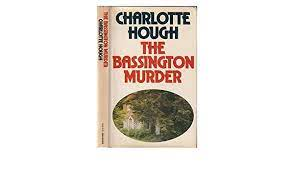
Forgotten Book - The Bassington Murder


Charlotte Hough's The Bassington Murder, published in Britain and the US in 1980, is a curiosity. It's the only crime novel of an author (1924-2008) who had previously achieved success as an illustrator and author of children's books. There are a number of reasons why authors desert crime writing after a solitary effort, as Christine Poulson and I discussed at Bodies from the Library in June. Charlotte Hough was perhaps unique in that her literary career was killed off by the fact that she served a term in prison for attempted murder.

I first heard of Charlotte Hough from Eileen Dewhurst, who met her the first time she attended a CWA conference in 1980, and was greatly charmed by her. This was at the time shortly after Charlotte's marriage had ended and when The Bassington Murder was just about to be published. Charlotte was evidently a funny and endearingly eccentric woman, who was a great friend of that fine writer Celia Fremlin. The three women became good friends and Eileen visited Celia and Charlotte in London from time to time. 

Like Celia, Charlotte believed in allowing people to die with dignity, but in 1984, she was arrested for assisting another woman to take her own life. Eileen noted in her diary that Charlotte was 'without a grain of self-pity', but she served six months in jail, a terrible ordeal. Charlotte remarried in 1997, but by that time she seems to have left the literary world far behind her. Although I met Celia, I never came across Charolotte. She never wrote about her experience in prison, and one of her children, that fine writer Deborah Moggach, has when interviewed expressed regret about this. 

There are some good ingredients in The Bassington Murder. It opens on Harriet Charles' 60th birthday. She is beginning a new life after a career as a head teacher, moving to a cottage in the village of Bassington. Eileen speculated that Harriet was based on Charlotte's friend, and fellow children's writer Winifred Lear. 

The story begins enjoyably, but is overcrowded with characters and there's a lack of focus which means it's not as easy to care about them as it should be. It's hard to disagree with the stern verdict of Kirkus Reviews, that after murder is done, the story 'collapses into silliness'. A shame, because there are some nice touches. Would Charlotte Hough have developed into a significant crime writer, had personal traumas not got in the way? To be honest, I doubt it, but it's clear that she was an extraordinary woman who does not deserve to be remembered solely because of the crime of which she was convicted.


Wednesday, 16 August 2023

Let Him Go - 2020 film review


Let Him Go is an uneven but very watchable film starring Kevin Costner and Diane Lane as grandparents desperate to restore contact with their grandson. This has the makings of a weepie or perhaps a socially conscious drama but the film, based on a novel by Larry Watson, is rather more ambitious. There are some langourous moments but there's plenty of action in the later stages, some of it quite shocking.

At first, the Blackledges seem to lead an idyllic life. George (a low-key but impressive Costner) is a retired sheriff, happily married to the forceful Margaret (Lane). Their son James is married to Lorna (Kayli Carter) and they have a small child, Jimmy. But then James dies in a tragic riding accident. Lorna remarries but her new husband Donnie Weboys is cut from different cloth and it's soon apparent that he's violent towards both his wife and step-son.

One day, Lorna and her new family vanish. Margaret is determined to get her grandson back. At this point, you might wonder whether her behaviour and sense of entitlement is over the top. Grandparents' rights tend to be under-valued by society, but George's anxiety about her plans is understandable - and it's reinforced when he discovers that she has brought a gun with her....

To say to much about what follows would be unfair. Suffice to say that Lesley Manville gives a truly memorable, if perhaps over-the-top, performance as a matriarch you really don't want to mess with. There are flaws in this film, but the quality of the acting is a major asset, as is the evocative rural camera work.