Ever heard of the crime writer Mavis Doriel Hay? Neither had I until I received a review copy of a book she published in 1936 and which has just been reprinted by the British Library, as part of its rather exciting programme to make available again some very rare crime stories from the Victorian era and also the Golden Age between the wars.
The Santa Klaus Murder is one of three novels she published, although she also wrote non-fiction on the subject of rural handicrafts. On the evidence of this novel, I'm guessing that she enjoyed the conventions of the Golden Age and in the post-war era did not feel tempted to return to the idea of game-playing mysteries. But I'm guessing, as I know very little about her.
So what of The Santa Klaus Murder? The first thing to say is that it's a nicely produced book, as you'd expect from the British Library. And it also ticks a number of Golden Age boxes - the setting is Flaxmere, a country house, a floor plan is provided, and a Chief Constable is heavily involved in the detective work in the way typical of the period (think J.J. Connington in particular) but would now seem rather extraordinary.
One very strong positive about the book is that the story is told from multiple points of view, almost like The Moonstone, though the Chief Constable's perspective predominates once murder is done. The victim is Sir Osmond Melbury, the wealthy patriarch. Agatha Christie had a similar victim in a Yuletide mystery that post-dates this one, Hercule Poirot's Christmas. Each member of the large cast of characters has a motive for murder, and my one reservation about the book is that there are too many people, so that focus blurs after the crime is committed, with too much space is devoted to the question of means and opportunity. But Hay could write, and her other two novels are to be published by the British Library next year.
Sir Osmond has proposed to change his will - a Golden Age stand-by - and of course this impacts on motive, and a fragment of a piece of paper about the legacies is again included, another element that you just don't find that often in modern books, but which is the sort of device that Christie used to love to play with. Overall, I found this an enjoyable novel, and the familiar ingredients are lifted out of the ordinary by a pleasing touch of humour. Mavis Doriel Hay may not have made a great name for herself in the genre, but this book shows that she does not deserve to be forgotten. A nice Christmas gift for a Golden Age fan.
Monday, 11 November 2013

Sunday, 10 November 2013
The Riddle of Sphinx Island and The Cheshire Sect
Like many crime fiction fans, I find that life is just too short to read all the books, and attend all the events, that I would enjoy if time was no object. This is why our to-be-read piles keep growing. Of course, one solution is to stop acquiring books. But it's not that easy! When intriguing titles come on the market, how can one resist? Maybe the chance won't come your way again....
And in any event, for many years I've been inundated with review copies. I'm certainly not complaining about this, as it's led to my discovering many books that otherwise I'd never have bothered with. But here again, it's impossible to read, let alone review, all the books I'm sent. And this is a pity (just as I sometimes dare to flatter myself that those reviewers who don't read my books might just be missing a treat!)
With all this in mind, I want to mention,while they are still hot off the press, a couple of recent books by unfamiliar names which deserve a plug, and which I am definitely aiming to read -but haven't got round to yet. The first is a book with a contemporary story yet which is, I think, firmly in the Golden Age tradition - The Riddle of Sphinx Island, by R.T. Raichev. It's published by The Mystery Press, and the author, who grew up in Bulgaria, has lived in London for many years. It looks very good to me.
The other book is The Cheshire Sect, by Dan Frazer - a name used by a writing duo, Dan Smith and Frazer Fearnhead. Again this is a 21st century book that pays respect to detective fiction in the past, as the hero is said to have a touch of Sherlock about him. I'm interested in the fact that the setting is Alderley Edge,not too many miles away from where I live. It's one of the most affluent towns in England, I'd guess, famous as footballers' wives territory. And you can't have too many novels set in Cheshire's green and pleasant land. I look forward to reading both these book.
Friday, 8 November 2013
Agatha Christie, Poirot and The Labours of Hercules
The Labours of Hercules was perhaps an odd choice for the penultimate instalment of Agatha Christie's Poirot, a rather dark rendition of elements from the book of the same name,which in fact brings together a dozen collected short stories. The screenplay by Guy Andrews was well-crafted, especially given the challenge of the task facing him. The production was atmospheric and the cast (as ever) impressive, with Simon Callow really enjoying himself, though the story almost inevitably lacked the tight-woven texture of the best Poirot mysteries.
All the same, it's been quite a week for Christie fans. The CWA celebrated 60 glorious years on Guy Fawkes Night with an event at Foyles, announcing the results of its "Whowunnit" poll of members. And Christie was voted best ever crime novelist, and her The Murder of Roger Ackroyd was best detective novel. Best detective was Sherlock Holmes, and given that Poirot, in his early days, was rather derivative of Sherlock, this seems fair enough.
Unfortunately, due to pressure of work, I wasn't able to make it to London for this event, but I agree with the view expressed by Alison Joseph, chair of the CWA, that the result reflects the long and distinguished history of crime writing. There are those who argue that the likes of Jo Nesbo (good writer as he is) should be ranked with the all-time greats, but it's very difficult to make a sensible evaluation of the potential longevity of present day best-sellers. Some of the stars of previous generataions simply haven't lasted well (a great shame, in some cases.) Anyway, the best of Nesbo and other writers of today may still be to come. Christie and Conan Doyle have unarguably stood the test of time .So although all polls like this one have their limitations, because inevitably, one tends to be comparing apples and pears, the results seem to me to make sense.
Having said that, my own feeling is that the best classic whodunit of all wasn't even on the shortlist. My choice would be another Christie novel - And Then There Were None.
Forgotten Book -Death Has a Past
It's not unfair to call Death Has a Past a Forgotten Book, nor its author, Anita Boutell, a Forgotten Author. I had never heard of either of them until I saw a copy of this book in a dealer's catalogue, at quite a hefty price. It was snapped up quickly by someone, and the plot summary seemed intriguing. So I tracked down a cheapish paperback copy to see whether the nice concept was well executed. Short answer - yes, definitely. Boutell seems to me to be a real find.
Death Has a Past was published shortly before the war, and I'm guessing that timing was against Anita Boutell in making a name for herself in the genre. Yet Milward Kennedy, Torquemada and other good judges admired her writing,and I can see why. Boutell was an American who obviously knew England very well,as the English background struck me as entirely credible.Otherwise, I know nothing about her life, and would be glad of further information. And what of her other books - are they as good as this one? And why did she stop writing?
The set-up is this. Claudia Hetherton, a ghastly but rich woman, summons five female family members to her country home She hates them, and they have good reason to hate her. And there are various other hatreds within the group. We know from the start that one person is shot, and that the culprit commits suicide and writes a short confession. But who shot whom, and why?
Boutell maintains the tension very well. This sort of story can become irritating, with lots of neurotic characters getting on each other's nerves, but on the whole she avoids that mistake, and there are several pleasing plot twists. The ending was not what I expected, and I needed to read it again carefully to figure out exactly what had gone on, and to appreciate the subtlety of the wording of the confession. I enjoyed it, and I can recommend it as a rather refreshing book with a difference.
Wednesday, 6 November 2013
The Death Cap by R.T. Campbell
There's a good deal of exciting contemporary crime fiction being written these days, but I'm equally excited by the way that advances in publishing, including but not limited to the digital revolution, have made a great many wonderful books from the past available for 21st century readers. A splendid new example is The Death Cap, by R.T. Campbell, just published by Lomax Press,a very interesting independent publisher based in one of my favourite places in Scotland, namely Stirling.
The title, a play on the judge's black cap, and a form of deadly mushroom, is one that was considered by Robert Eustace and Dorothy L. Sayers for their joint novel, a few years earlier. They rejected it in favour of The Documents in the Case, but I think The Death Cap is a better title. This book has an introduction by Peter Main and extensive annotations. It's beautifully produced with great jacket artwork, and is available in a limited edition of 300 copies. My copy arrived just today, and I'm really looking forward to reading it.
The title, a play on the judge's black cap, and a form of deadly mushroom, is one that was considered by Robert Eustace and Dorothy L. Sayers for their joint novel, a few years earlier. They rejected it in favour of The Documents in the Case, but I think The Death Cap is a better title. This book has an introduction by Peter Main and extensive annotations. It's beautifully produced with great jacket artwork, and is available in a limited edition of 300 copies. My copy arrived just today, and I'm really looking forward to reading it.
In a Word: Murder
Margot Kinberg, whose admirable blog will I'm sure be known to everyone who reads Do You Write Under Your Own Name? has done a great job in putting together In a Word: Murder, an anthology which is designed as a tribute to another fine blogger,the much-missed Maxine Clarke, alias Petrona. Proceeds go to the Princess Alice Hospice, which cared for Maxine during her illness. This seems to me to be a great idea and very fitting. I have a long-standing connection with the hospice movement in the north west of England, and coincidentally I'm discussing a literary project with one of the hospices local to me at the moment. To my mind, there are few worthier causes.
Margot suggested that contributions to the anthology might touch on subjects close to Maxine's heart, and this gave me the idea for a storyline connected with....blogging. At about the same time, I had a very enjoyable trip to Whitby, and that provided me with a highly suitable setting for the tale that was buzzing round in my mind. The result was a brand new short story called "The Killing of Captain Hastings." It's a more light-hearted piece than many of my stories, and I had fun writing it. This is the great joy of having the opportunity to write a short story for an anthology or magazine - part of the pleasure lies in the chance to do something a bit different.
There are some very interesting contributors to the book, including, I was delighted to see, Sarah Ward, whose blog Crime Pieces is another must-read, and Elizabeth S. Craig, whose blog probably contains more helpful tips and suggestions for writers than almost any I've ever read. The other contributors include Paula K.Randall, Pamela Griffiths, and Jane Risdon.
The book is now available from Amazon, and I gather that a print version will be available in 2014. Margot's hard work (and believe me, putting an anthology together is not as easy as it may look!) deserves the highest praise. I count it a real privilege to have had a story of mine included in a tribute to Maxine. Her kindness and astute critiques of the crime fiction scene will long be remembered by those of us who knew her.
Sunday, 3 November 2013
The Wrong Mans - BBC 2 TV review
I've just caught up with the final episode of The Wrong Mans, a BBC 2 TV comedy thriller starring Matthew Baynton and James Corden, who were also involved in dreaming up the story of two innocent young men, Sam and Phil, working at the offices of Berkshire County Council (though only Sam was a council employee, as we were constantly reminded, Phil was simply based in the building).
I've deferred commenting on this series until now because the comedy thriller is a very, very difficult type of crime story to pull off successfully, especially over half a dozen half-hour television episodes. Plots can become overly thickened, jokes can become very laboured. It began well, but I wasn't sure whether the same standard would be maintained to the end. Happily, it was. What was striking about The Wrong Mans was how well it overcame the usual obstacles and maintained my interest throughout. This is a sign of very strong writing.
Baynton and Corden make a very engaging pair of heroes, who innocently stumble into a complex conspiracy involving such diverse elements as double agents and high speed rail. Emilia Fox was a suitably sultry temptress who was lined up with the Bad Guys, and there were a host of funny moments. I also liked the nods to other thrillers - one or two Hitchcock-style scenes, for instance.
The very last scene suggested that there will be a follow-up series. I hope so, but it will have to be good to match the success of this one. Whether the writers' inventiveness will flag or not, we'll have to wait and see, but in the meantime, I can recommend this show to anyone who hasn't seen it and could do with a bit of light relief.
Saturday, 2 November 2013
Agatha Christie's Poirot - Dead Man's Folly - ITV review
Dead Man's Folly, the second in the current series of Agatha Christie's Poirot, was based on a novel from the 50s, when the Queen of Crime's work was rather more variable than it had been a few years earlier. The book has some delicious elements, although the solution has always struck me as rather contrived. The ITV version with David Suchet made the most of the story's merits, notably the marvellous country house and village fete settng.
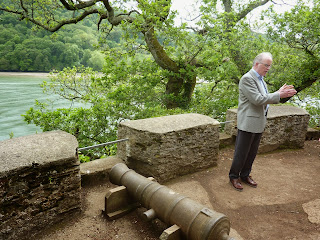
And to make things even better, a very good decision was taken to film the story at Greenway. Christie used her own home in Devon, and its marvellous grounds, in fictional form for the book, so this was a very appropriate homage. I was also reminded strongly of a marvellously sunny day last year, when I had the memorable experience of revisiting Greenway in the company of that great Christie expert John Curran.


Zoe Wanamaker was an effervescent Mrs Oliver as usual, with Sinead Cusack very good in the important part of Mrs Folliat. The early scenes, when Poirot arrives at Nasse House and meets the house guests, and when the fete takes place, were very well done. As in the book, things faltered slightly after the discovery that a teenage girl has been murdered, and the suspects were not perhaps as strongly developed as they might have been. Overall, the screenplay was faithful to the original both in its strengths and its shortcomings, with a slight change to the ending. Verdict - not a classic,but good light entertainment.
And to make things even better, a very good decision was taken to film the story at Greenway. Christie used her own home in Devon, and its marvellous grounds, in fictional form for the book, so this was a very appropriate homage. I was also reminded strongly of a marvellously sunny day last year, when I had the memorable experience of revisiting Greenway in the company of that great Christie expert John Curran.


Zoe Wanamaker was an effervescent Mrs Oliver as usual, with Sinead Cusack very good in the important part of Mrs Folliat. The early scenes, when Poirot arrives at Nasse House and meets the house guests, and when the fete takes place, were very well done. As in the book, things faltered slightly after the discovery that a teenage girl has been murdered, and the suspects were not perhaps as strongly developed as they might have been. Overall, the screenplay was faithful to the original both in its strengths and its shortcomings, with a slight change to the ending. Verdict - not a classic,but good light entertainment.
Friday, 1 November 2013
Fogotten Book - Verdict of Twelve
I've mentioned before Raymond Postgate's Verdict of Twelve, but I wanted to read it again before featuring it as a Friday Forgotten Book, and this I've now done. In all, I've read it three times - first in an edition with an excellent intro by Michael Gilbert, who selected some splendid crime classics for a series published by Hodder. He is far from alone in admiring Verdict of Twelve. Postgate was the brother in law of G.D.H. Cole, but his novel was very different from Cole's work - it owed much more in its ironic style to Anthony Berkeley.
The book has three parts plus an epilogue. In the first part,we are introduced to members of a jury about to hear a murder case. One or two of the jurors have dark secrets of their own, and Postgate provides a series of vivid portraits that I found gripping. One character, a dry academic, reminded me a bit of Douglas Cole, actually, though Postgate wisely made sure that there were differences as well as similarities in the man's CV and personality.
The second part of the story tells us about the murder. But who is to be the victim, and who the killer? It's a rather grim story about cruelty to a child, and it has a literary inspiration that is not explained until the later stages of the book. Then comes the third part, which takes us inside the jury room,and shows how the debate about guilt and innocence shifts - often according to prejudice, rather than reason. If you are sceptical about juries - and I always have been - this book does nothing to make you share the view of such great lawyers as Lord Denning and Lord Devlin that the jury is an essential bulwark of freedom and justice.
There is a nice twist in the epilogue, but I guess the big question about this novel is - what does it tell us about justice? Nothing comfortable, that's for sure. Postgate's Marxist take on things won't be to everyone's taste, but I enjoyed this book as much on a third reading as I did previously. I really must try again Postgate's two later crime novels - when I first read them, I felt they were a let-down, but maybe they are worth another look. In any case, Verdict of Twelve remains a must-read for any fan of classic crime.
Tuesday, 29 October 2013
The Escape Artist - BBC 1 TV review
The Escape Artist, which began on BBC 1 tonight, was always likely to appeal to me. A three-part thriller with a barrister as the main character, and David Tennant (fresh from the excellent Broadchurch) cast in the lead role, what could possibly go wrong? What is more, the script is by the highly regarded David Wolstencroft. So I sat down to watch with high expectations.
Of course, the TV legal thriller is fraught with pitfalls. Most lawyers, I think it's fair to say, are deeply unconvinced by the majority of lawyers who appear on the screen - I suppose police officers know that feeling all too well. It's not easy to strike a balance between credibility and good entertainment. Years ago, I recall a series about an employment lawyer which rejoiced in the name Fish. The verdict in the Liverpool employment tribunal the following day was damning, I'm afraid.
On the whole, the better shows have tended to showcase barristers rather than solicitors - I'm sure this is because of the lure of courtroom drama rather than because solicitors are less interesting people! (And Kinsey and The Main Chance were among the notable exceptions to the general rule.) At one time, I thought the two legal professions would one day merge - quite a widely held view - but now I'm less sure. The criminal Bar is suffering because of cuts in legal aid, yet many solicitors' firms have run into difficulty too. But a show dealing with the realities of legal life at a time of economic difficulty would hardly be a ratings winner, and here, as usual on telly, the lawyers (including Roy Marsden, playing a veteran solicitor in his customary suave manner) are all rich and mostly on the top of their game.
Tennant plays Will Burton, a lawyer so good at getting his clients off that he is known as the Escape Artist. He is a good husband and father (except for his horrible habit of shouting from the touchline when his son plays football) and he never loses a case, which must make him unique. When an apparent sociopath (spookily played by the excellent Toby Kebbel) hires hiim when he needs a good defence to a charge of a very gruesome murder, Will wins again, after one or two rather improbable moments in court. But Will and his client haven't bonded, and Bad Things start to happen.
This was a very striking start to the story, and I was gripped from start to finish. Tennant is a great actor, but the supporting cast was also very, very good. Episode two is a must-watch for me.
Subscribe to:
Posts (Atom)