Wednesday, 31 May 2023

Framed - 2021 film review


Framed is a new film, flawed and low-budget, but quite interesting as an example of an attempt to rewrite Rear Window as a story about moral dilemmas. Thomas Law plays Karl, who quits his job in order to pursue his dream of becoming a photographer. He becomes intrigued by an attractive female neighbour, and starts to take pictures of her from his London flat, as she appears at her own window in various states of undress.

Karl has a good friend in Virginia (Lottie Amor), who works for a law firm (although she doesn't display in-depth legal knowledge, to put it kindly). She finds out about Karl's photographic pastime and disapproves. Things become a little more complicated when Karl not only keeps snapping pictures but finds himself encouraged to do so by the neighbour. She sends him encouraging messages and starts to pose for him. Then Karl sees a man appearing in the neigbour's flat.

There's quite a bit of discussion about personal privacy in this film, although I think some reviews have been over-generous about the merits of that discussion: it's conducted on a pretty unsophisticated level and doesn't strike me as being as intelligent or as thought-provoking as some have claimed. The storyline of the film simply isn't strong or smart enough to enable writer-director Nick Rizzini to make many particularly meaningful or memorable points. 

There are thrillerish touches in the film, and an obviously phoney policeman makes an appearance at one point. Judged as a mystery, Framed doesn't succeed, but I don't think it should be judged as a mystery. Karl's naivete and foolishness are irritating, but the two lead actors are an appealing couple, and the real strength of the film lies in the depiction of the way their stuttering relationship develops, despite their disagreements about Karl's voyeuristic behaviour. And because of that focus on character, despite having numerous reservations, I did quite enjoy Framed.     

Monday, 29 May 2023

Where the Crawdads Sing - 2022 film review


Where the Crawdads Sing is a film based on Delia Owens' book of the same name - a first novel published by an author in her late 60s which became an international bestseller. I haven't read the book, and I've read some reviews which suggest that the film is inferior - but in that case the novel must be exceptional, because I thought the film was very good. 

The setting is an American marshland. Not a locale that I'm familiar with, but I did once go on a boat trip around the marshes of Grand Cayman which reminded me a little of the film's setting, despite being on a smaller scale. It's an evocative background, and makes for very attractive cinematography. 

At the start of the story, a young man's body is discovered by two cops. He has fallen from a fire tower and soon murder is suspected. The victim has been seen around with a local girl known as 'the marsh girl'. When the cops approach her she flees, only to be caught. What is more, she is then put on trial - on evidence that seemed to me rather flimsy, to say the least.

Most of the film takes the form of an extended flashback, with scenes from the trial intercut. We learn the story of Catherine 'Kya' Clark, who was abandoned by both her parents and her brother and grew up on her own in the marshes. A relationship with a young man peters out and she gets involved with the murder victim, a much less appealing character.

It's really quite a straightforward story, but so well directed by Olivia Newman that the film's length didn't bother me. The locale is terrific and so too is the performance of Daisy Edgar-Jones as Kya. Astonishingly,  Daisy is English. A glittering future beckons for her.

Friday, 26 May 2023

Forgotten Book - A Crime of One's Own


Edward Grierson's A Crime of One's Own has been sitting quietly in my TBR pile (mountain range would be nearer the mark) for quite a few years. I greatly admire his first crime novel, Reputation for a Song, and his award-winning second mystery, The Second Man, was also very good, but this one, published in 1967, is much less well-known. I'm not sure it even made it into paperback in this country.

Grierson was a barrister and a magistrate who wrote a varied mix of books. I get the impression of someone who, admirably, wrote to please himself rather than publishers, but despite his considerable talent this may have led to his work being neglected since his death in the mid-70s. This novel was his fourth foray into the mystery genre and he never returned to it.

Possibly he was disappointed by the book's lack of commercial success, but it's a story that I found very enjoyable. And it is a bibliomystery. The hero is Donald Maitland, the young and rather naive owner of a provincial bookshop and lending library. He begins to suspect that customers are using his books as a means of passing secret messages. Is there a link to a local high-security establishment? He soon has spies on the brain.

There are plenty of witty references to the world of authorship and publishing. I loved the satiric account of a publisher's letter breaking bad news to the hapless author Bernie Stredder, a splendid comic character with a darker side. The plot is rather wacky, but there's a good trial scene and plenty of swift but engaging characterisation. John Cooper, no mean judge, rates this book highly. And now I've finally read it, so do I. 


Wednesday, 24 May 2023

Disappearance at Clifton Hill - 2019 film review


I have vivid memories of my one and only trip to Niagara Falls. It was on a coach trip from the Toronto Bouchercon a few years back and although the weather was a bit iffy, the company was splendid and the Falls were magnificent. Since then I've enjoyed watching the old film Niagara and now I've also taken a look at a recent movie set around the Falls - Disappearance at Clifton Hill. 

The story begins with a family outing in rural Canada. A young girl is shocked to see a boy with a patch over one eye, who is clearly terrified. Then she witnesses his abduction. She tells the story, but nobody believes her. We then fast forward to the present. The girl is Abby, played by none other than Tuppence Middleton. Her sister is Laure (Hannah Gross). Their parents have died and a rather slimy lawyer has brokered a deal under which they sell their failing motel to a family called Lake, who own most of the little town.

Abby has gained a reputation, not least with her sister, for being a compulsive liar, so when she starts to reinvestigate the mysterious abduction, she gets little sympathy from anyone. A local conspiracy theorist called David Bell (David Cronenberg, perhaps better known as a director), seems more helpful. He is deeply suspicious of the Lakes and soon Abby discovers a connection between the boy she saw and a pair of stage magicians called the Magnificent Moulins.

The plot thickens nicely from then on. This is a well-made film and it boasts a final twist that came as a genuine surprise to me. Often these days, movie twists of that kind are rather meretricious but on the whole I think this one works well. This isn't as renowned a film as, say, Shutter Island, but I enjoyed it at least as much.

Monday, 22 May 2023

Glass Onion: A Knives Out Mystery - 2022 film review


I enjoyed Knives Out, a nice escapist whodunit. In commenting on my blog post about the film, the eminent critic Michael Dirda made some accurate criticisms of the plot, but like me he didn't let them spoil his pleasure too much. The success of the film meant that a sequel was inevitable and this takes the form of Glass Onion, in which Daniel Craig reprises his role as Benoit Blanc, the greatest detective in the world.

I feel that Glass Onion differs from Knives Out in two key respects. First, the set-up is even better. I was definitely gripped. Second, the film loses its way badly - in my opinion - in the latter stages. The mystery was easy to solve and the resolution excessively drawn out. 

Miles Bron, a tech billionaire, invites five associates to a murder game party on his private Greek island. Their challenge is to solve his murder. Blanc also turns up, but Bron denies having invited him. Another guest is Cassandra, whom Bron removed from the business and subsequently defeated in litigation. It's clear from the outset that he cheated her and it also emerges that the other guests have motives to commit murder. However, when someone dies, surprise, surprise (or perhaps not!) - the victim isn't Miles. And then someone else is shot...

So far, so good. Edward Norton, as Bron, is convincingly odious. But we then get a very extended flashback which gives a very different perspective on the events as they have been presented to us so far. To a degree, this is quite clever, but it also tests credulity to the limits and beyond. Given that, at this point, most mystery fans will have figured out what is really going on (the central trick can be found in a couple of Agatha Christie novels), I began to lose interest. A pity, but perhaps writer and director Rian Johnson simply got carried away. 

Friday, 19 May 2023

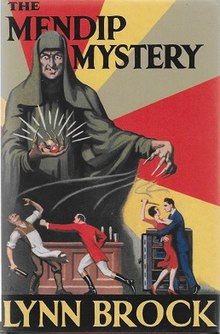
Forgotten Book - The Mendip Mystery


Lynn Brock (the main pen-name of the Irish novelist and playwright Allister McAllister) was a major figure in Golden Age detection and his character Colonel Wyckham Gore was, for a time, one of the leading fictional detectives in a crowded field. Brock's mysteries were convoluted and often ingenious, but although the quality of his writing was a cut above the average, his work soon faded from sight.

His strengths and his weaknesses are on display in The Mendip Mystery, published in 1929 and known as Murder at the Inn in the United States. Gore is asked by a chap called Stanton to look into the whereabouts of a woman who has been missing for many years. I found it rather astonishing that Gore didn't press for an explanation as to why his client wanted to track her down and this omission does rather haunt the story.

Anyway, off he goes to the south west, only to pick up another job. He stays at a very seedy inn, the sardonically named Bower of Bliss, and encounters two beautiful young women. Before long, all manner of dark deeds are taking place. At times it isn't easy to keep track of what's going on, and in due course some very lengthy explanations - a Brock trademark - are required, in order for us to understand fully all that has occurred.

There are some unorthodox ingredients, including a rare example of the murder of a child (rather horribly suffocated under a load of gravel - Brock was quite a tough writer) as well as some that are more commonplace and some (notably an account of escapees from an asylum) that definitely haven't stood the test of time. In particular, the ending is highly unusual. 

It's not really a spoiler to say that the main culprit gets away with it, because Brock wrote a follow-up novel called Q.E.D., aka Murder on the Bridge, in which he revealed all. This was a daring experiment, followed up in rather lamentable fashion, a few years later by G.D.H. and Margaret Cole in another pair of novels, 'the Pendexter Saga'. Brock's endeavour is more successful, and I admire his ambition. He is one of those authors whose books are flawed but more interesting than many a smoothly accomplished formulaic whodunit.

Thursday, 18 May 2023

Sepulchre Street - the first week's reviews


Many thanks to all the bloggers who took part in the blog tour organised by my publishers to celebrate the arrival of Sepulchre Street. When a reviewer takes the trouble to try to understand what an author is trying to do, and then expresses approval, it's hugely rewarding for an author. I'm also glad that the general view is that this story offers plenty of enjoyment even for readers who haven't read the previous books in the series. So I'm very happy. Here is a selection of comments:

‘A fascinating book…Martin has done something rather magnificent here. If this was written as a pure thriller, it would be a deeply satisfying book, but woven throughout the thrills is a cleverly plotted mystery – with a cluefinder at the end to prove it. It’s worth reading, but I do warn the reader that they’ll end up repeatedly kicking themselves at the things that they missed…All in all, this is an absolute triumph…The best book so far in an outstanding series.’

In Search of the Classic Mystery Novel


‘The opening of the book is one of the most inventive I have read, perfectly setting up what is to follow…Martin Edwards poses many questions, with a wonderfully inventive plot, the writing combines all that is good with the golden age but with a modern day twist. The plotting is superbly thought out, constructed in a way that leaves a few clues along the way, though you may not always pick them up, the book is paced perfectly for the period and just flows along. There are touches of the gothic which only heightens the reading enjoyment. In parts there is a conspiracy taking place with some definite unsavoury characters who act first then ask questions later, overall a slick and taut plot knitted together by the quality of the writing.

Plotting though on its own is nothing if you don’t have the characters to match, this is another area where the book shines, it is hard not like Rachel Savernake, strongly and fiercely independent she comes across as a no nonsense person not averse to taking a risk or two...Martin Edwards writes characters that are relatable, you get a real sense of who each are and the period in which they live.

There is a certain humour within the book, equally its drips with tension and drama, as it races towards the ending. Location plays its part, the story moves seamlessly around, the way the book is written you can feel yourself there…a superb read, by a writer who knows how to engage with the reader, I was captivated throughout, the pace of the book perfect for the times. It takes the best of the golden age and combines it with a read for today…

Martin Edwards is a favourite author of mine, writing, plotting, character, location, setting his books have it all.’

Amwbooksreviews


‘A complex and deeply satisfying mystery…Martin Edwards really can write. His plotting and narrative are brilliantly done, and he weaves together marvellous threads which culminate in some wonderfully dramatic climaxes throughout the book…There are multiple plot elements but Edwards never loses his grip on these, and the final resolution is one I would never have guessed!

…The settings are vividly drawn and atmospheric, and I really felt I was inside the action – the book is quite a page-turner…As well as plot and setting, Edwards really excels when it comes to characters. His players are lively, entertaining and very well conjured; I was particularly impressed by his ability to draw such strong female characters, and also to weave some of those issues women face into his plot without them ever sounding forced…I thoroughly enjoyed this clever, absorbing and entertaining book…a wonderful read!’

Kaggsy’s Bookish Ramblings


‘Sepulchre Street is another fantastic, intriguing detective story from one of my favourite series…This book has a great pace to it…The author drops lots of clues throughout the book so you have to pay attention to everything…There is also a cluefinder at the back…I loved this idea and enjoyed going back to see the (many) clues I missed…this is a fantastic series!’

Over the Rainbow blog


‘Sepulchre Street is the fourth in the Rachel Savernake series and I think it is the best so far. It grips from the start…I loved the nods to Golden Age crime fiction, the cluefinder, the map. A lot of the fun of the novel lies in the period details and the way in which the 1930s are lovingly evoked: the clothes, the nightclubs, the songs (some invented, but very much in the spirit of the time). Cocktails were all the rage and their appearance is something of a running joke…I romped though the novel far too quickly and didn’t want it to end. All in all a splendid read.’

A Reading Life

‘Edwards has written another corker of a thriller/detective story set in 1930’s London…a puzzle Poirot himself would be proud to have solved! You will need to pay attention to every word to try to work out the ending…I thoroughly enjoyed it and would recommend it to fans of Agatha Christie who like a good puzzle to solve.’

Two Heads are Better Than One blog


‘Mystery and intrigue aplenty fill the pages of this brilliant who-dunnit…I love the character of Rachel - clever, strong and someone who doesn’t suffer fools gladly…A wonderful nod to the Golden Age of crime and mystery writing, this is a series of recommend over and over.’

Wendy Reads Books blog

‘I absolutely love this series…Rachel Savernake is an excellent protagonist. No nonsense, clever, tough, and mysterious herself, she loves a challenge…A twisting piece of thrilling golden age crime fiction to get your teeth into!’

Travels along My Bookshelf

‘Sepulchre Street is very well-written and has a great storyline and has you hooked from the start…Another brilliant book in the series and I can’t wait to see what Rachel is up to next!’

Murder Jo Wrote

‘The author has created yet another immersive mystery that pulls you in and enthrals you with its surprising twists and turns! Enjoyably there is also a touch of the macabre and matched with a fast-paced, chic and sophisticated setting of the 1930s…Rachel is the perfect leading lady…witty, clever, intriguing and…thrilling.’

Secret World of a Book

‘Sepulchre Street is probably my favourite to date; four books in the characters are developing nicely… There's a lot going on in here with all sorts of twists and turns, some interesting hints for future directions the series might take, as many easter eggs as a dedicated classic crime fan could hope for, and a host of other fun references to chase up. It's no easy thing to build a convincing past but I think Edwards does a really good job of it. It's his obvious knowledge of and affection for Golden Age crime that makes it work for me, coupled with a cast of characters who are neither self-consciously old fashioned, or entirely modern but stuck in fancy dress. Add the gothic atmosphere (John Dickson Carr would be proud) and character development to the other elements here and it's a hard to beat series.’  

Desperate Reader blog                                                                                    

‘Intriguing, clever, entertaining.’

What Cathy Read Next     

‘A thrilling and haunting read that is perfect for fans of historical crime and detective fiction.’

A Cottage Full of Books


Wednesday, 17 May 2023

Eye in the Sky - 2015 film review


Eye in the Sky is an outstanding action film, much of its strength deriving from the way it balances high-stakes drama with an exploration of almost impossible ethical choices. The director, Gavin Hood, and the writer, Guy Hibbert, do sterling work and the acting is excellent. You'd expect that from the charismatic leads, Helen Mirren and Alan Rickman (whose last screen role this was) but a special word of praise must also go to Barkhad Abdi, who is brilliant as an undercover Kenyan agent, a testing role that he handles with aplomb.

The set-up is that Mirren is a tough British colonel who has been tracking a female terrorist for years. Intelligence has now been received that this woman and a group of other terrorists are gathering together. A joint operation between the Americans, British and Kenyans is to capture the targets. In London, Rickman is the deputy chief of the Defence Staff and he is in a COBRA meeting with top politicians. They all watch footage filmed via drones operated skilfully by Farah (Abdi) and this reveals that in fact the terrorists are plotting a suicide bombing mission. We see them strapping on the suicide belts. Capturing them is no longer a realistic option. If they are not killed by a remote-controlled missile, then a large number of people will die.

But there is a big problem. A small girl is selling bread just outside the compound where the terrorists are preparing. A missile strike may kill her too. Mirren is intent on eliminating the threat and Rickman, although less ruthlessly focused, concludes that is the right thing to do. But the politicians and lawyers waver. They are agonised by the choice and I can understand why.

The central difficulty in these terrible dilemmas, I think, is that we are human beings who look to humanise situations. We see the lovely and totally innocent girl, so any decent person will want to save her. But shouldn't a decent person also use their imagination to try to picture the significant number of other people who will suffer and die if no action is taken? It's easy to understand why decision-makers want to shuffle off final responsibility, but one of the most chilling - yet entirely believable - moments in the film comes when the politicians start thinking about the dilemma in terms of propaganda rather than humanity. I'm thankful that I've never been involved in any comparable life or death decision-making. But I have taken part in meetings to discuss high-stakes issues involving many people's livelihoods and futures and at such times, you see human nature in the raw. It's seldom a pretty sight, and this is made clear, compellingly, by Eye in the Sky.

This film also makes it clear that there are no easy answers, no consequence-free decisions. Balancing risks is crucial. But it's also very painful. A superb film, strongly recommended.  


Monday, 15 May 2023

Celebrations and CrimeFest


CrimeFest was a wonderful weekend of celebrations and catching up with old friends as well as meeting some very pleasant new people. For me, it was an occasion of great good fortune, so much so that even a long and tortuous journey home felt pleasant and relaxing! The highlight was undoubtedly the banquet on Saturday evening, when The Life of Crime was awarded the CrimeFest H.R.F. Keating prize for best non-fiction book about the genre, but there were many other great moments.


Not long after checking in and registering, I moderated an Authors Remembered panel, with an excellent group of colleagues covering an eclectic mix of authors: John Lawton (on Stanley Ellin), Peter Guttridge (Donald Hamilton), David Beckler (Friedrich Durrenmatt) and Chris Curran (VeraCaspary) - my own choice was Margot Bennett. After a pub meal with Simon Brett and other friends, some of us got together as a team for the annual pub quiz (not held in a pub, but in the hotel), and after a recount we managed to win, by a narrow margin. So prizes of books and DVDs - very nice.


On Friday I took part in a panel moderated by the editor of The Life of Crime, the wonderfully cool David Brawn, along with Mark Billingham and Vaseem Khan; sadly, Covid meant that Janice Hallett couldn't join us, a real shame. In the evening, there was a very pleasant dinner hosted by the publishers Severn House, and talk about a possible book project. Before then, there had been a great moment when it was announced that The Life of Crime had been shortlisted for the Gold Dagger for non-fiction. The award has never been won by a book that isn't true crime, but it's great to see it in the list of finalists.


I was lucky to have three panels, concluding with one chaired by Maxim Jakubowski, and along with Mason Cross, Vaseem, Samantha Lee Howe, and Donna Moore we discussed our stories inspired by Cornell Woolrich for the Black is the Night anthology. On a sunny afternoon I enjoyed walking along the river with Jason Monaghan and Dea Parkin before the drinks reception which preceded the banquet and the great moment when I was presented with the award. After that I was quite happy to go along with others to watch the conclusion of Eurovision!

It was wonderful to see people again and also to catch up on some lovely reviews of Sepulchre Street on the blog tour. All the copies on sale in the book room were snapped up, which is always gratifying. As ever, huge thanks go to Donna and Adrian Muller for all their hard work in making CrimeFest such a great event. It was very memorable for me and I'm truly appreciative.


Friday, 12 May 2023

Forgotten Book - Deadly Pattern

I enjoyed Douglas Clark's The Libertines sufficiently to seek out another in his long series of police procedurals featuring Masters and Green, which encompassed no fewer than 27 books appearing between 1969 and 1990. The premise of Deadly Pattern, which dates from 1970, intrigued me, as did the setting - a rather bleak bit of the seaside on the Lincolnshire coast. It's a short book, with interesting elements but regrettable flaws.

Five women in their forties have gone missing from the area and recently the bodies of four of them have been found, buried in rather shallow graves in the sand dunes. The local police are baffled, so Masters and Green are called in to solve the mystery. And finding this particular serial killer involves not only finding the fifth body but also figuring out a motive - what is the pattern that connects the victims?

I imagine that, when this book came out more than half a century ago, serial killer novels were quite a novelty. When we read the story today, having probably read lots of books of this kind, we hope for some degree of originality in treatment. The setting appealed to me - I'm not sure where it's modelled on, but Cleethorpes may be a possibility - as did some elements of the plot. However, in some respects I found the story lacking.

Why? Clark's style is pleasingly readable, but it has irritating features - for instance, anybody who can't tolerate casual sexism should probably give it a miss, because by any standards the relentless chauvinism does become wearisome. Green, the sidekick, is a bolshie radical of sorts, and I'm not clear from the books I've read what Clark was trying to do with the character, I can see there's a contrast between him and Masters, but it's too crudely done for my taste. Above all, the book disappointed me because - even though the connecting link in the pattern seems relatively feeble to a modern reader - there are good ingredients in the storyline, but I think Clark could have made much more of them. This was either a short story idea or one that could have been developed with more attention to characterisation and mystification - as it is, the serial killer is screamingly obvious. I did entertain some hope that I might have been cunningly misled about his identity - but no such luck. However, as Jamie Sturgeon helpfully pointed out when commenting about The Libertines, Clark got into his stride with his later books.