Monday, 30 October 2023

Marv Lachman R.I.P.

I was very sorry to learn a few days ago that Marv Lachman, the highly respected American author and commentator on crime fiction, has died. A few weeks ago, Marv sent a poignant email to a number of his friends in the crime writing world, indicating that he was in a poor state of health and didn't expect to live much longer. I was truly saddened to receive it, because we have known each other for the best part of 30 years and have had some good times together at conventions. He was also extremely supportive of my own writing, both the novels and the non-fiction. Like all the best critics, he was constructive, insightful, and shrewd, but also generous when he judged it appropriate.

One of our very first encounters in person was at the Nottingham Bouchercon in 1995, when Marv and I, along with the great short story writer Ed Hoch and my fellow Brit Sarah J. Mason took part in a Mastermind quiz (Sarah and I had previously taken part in one at the London Bouchercon in 1990, along with Jim Huang and Tony Medawar). The above photo is taken from Marv's book about crime fandom, The Heirs of Anthony Boucher; he noted wryly in the caption that he only appears to be asleep!

That book is excellent, and so are his books about mystery plays and the American Regional Mystery (he inscribed the latter to me, saying that I should write the British Regional Mystery - maybe one of these days!) He was also an incisive commentator, not least for Janet Rudolph's Mystery Readers Journal and George Easter's Deadly Pleasures. At Bouchercon in San Diego, just a day or so after Marv had sent us his email, George paid a marvellous tribute at the opening ceremonies to Marv which was absolutely spot on. See also George's online tribute here and Janet's here

I enjoyed all my conversations with Marv, and also met his wife Carol once or twice. The last time we met was at yet another Bouchercon, in Dallas. He was in good form, then, and I have a number of happy memories of our various encounters. He will be sadly missed.


Friday, 27 October 2023

Forgotten Book - Crack of Doom


Leo Bruce's Crack of Doom is a Carolus Deene story dating from 1963. When published in the USA, it was retitled Such is Death - I can't imagine why. I'm working my way slowly through quite a number of the Deene books and this one boasts his trademarks - heavy on dialogue and with some nice, if light touches of characterisation. I particularly enjoyed a vicar who is keen on criminology and wants to assist Carolus.

There are two features of the book which make it especially worthy of note. First, some of the action takes place at Christmas. Second, and perhaps more significantly so far as the storyline is concerned, the setting is one that always exerts a great appeal to me (and, I guess, many othe readers) - an out-of-season English seaside resort.

The story opens with an extract from the journal of someone who wants to commit a motiveless murder. The idea of the motiveless murder has long appealed to me and it can work very well in a crime novel. Here, I think Bruce came up with a very neat plot idea, but although this novel has quite a bit of merit, I'm not sure he made the best possible use of it. 

One reason why I was slightly disappointed is this: I don't think that the culprit, as presented in the novel, is easily reconciled with the author of the journal. Another reason is that the solution is presented in a rather tame way, and the coda to the story isn't quite as effective as it might have been. Both these flaws could, I believe, have been addressed by strong editing. Perhaps Bruce was in too much of a rush. However, it's still quite an entertaining story, even if - with such  pleasing ingredients - it could have been more powerful. 

Wednesday, 25 October 2023

The Life of Crime wins the Macavity Award


I'm delighted to report that The Life of Crime has won the Macavity award, given by Mystery Readers International, for the best critical/non-fiction book. This is the third time I've won a Macavity and The Life of Crime has received four awards in all (the others are the Edgar, the Anthony, and the CrimeFest H.R.F. Keating award) as well as being shortlisted for two more. 

It's been a unique year for me in terms of honours of this kind. It feels quite surreal, so much so at the moment that I'll save further comment for another day, when I've had time to think about everything that has happened. But I must say right now how grateful I am to those who have voted for The Life of Crime as well as to those who have given it such wonderful reviews - and of course, everyone who has read it! 

The paperback edition will come out next May. More about that on another occasion. Meanwhile, I'm off to celebrate!

Monday, 23 October 2023

All the Lonely People - in Spain and elsewhere...


All the Lonely People
is a book that has a special place in my affections, as its appearance way back in 1991 marked the fulfilment of a lifelong ambition to become a published crime novelist. And now, 32 years later, the novel is due to appear in a Spanish translation, published by Who Editorial. I've written a new intro for this edition.

I always hoped that my novels would have staying power, and this book has done very well for me over the years, starting with reviews in The Times and elsewhere and a nomination for the CWA award for best first crime novel. There were, if I remember rightly, seven nominees and the ultimate winner was Walter Mosley's Devil in a Blue Dress - not bad company to be in. In the UK alone, it's been published over the years by Piatkus, Transworld, Hodder, Andrews/Acorn, and Arcturus, so it's certainly had longevity.

Of course, one's writing changes (and, with any luck, improves) over the years, and there's no doubt that if I were writing the story today I'd write it a bit differently. But I like to think that in some ways ahead of its time, both in its focus on minority characters and on Golden Age plotting and references. Not that these features attracted any attention back in the 1990s! One thing that gratified me enormously a while back was when a school librarian told me that the book had become very popular at the school. Given that the pupils were born many years after the book was written, I felt this said something about the story. It's a young man's book, and imperfect, but I remain very glad I wrote it. 

So my sincere thanks go to the Who team for showing faith in Harry Devlin's relevance to their readers in the 21st century. In case you're wondering, the English language edition of the book (see the cover image below) is very much available in print or as an ebook And in answer to a question I'm often asked - will Harry ever return? My answer is - you never know!


Word Monkey by Christopher Fowler


Regular readers of this blog will know I was saddened by the death, far too young, of Chris Fowler , who was as entertaining a companion in real life as he was on the page. However, he did leave, in addition to a notable body of work, quite a bit of material that was still to be published. And I was delighted to read his final memoir, Word Monkey, posthumously published a short time ago.

There is so much here to enjoy. It's not a short book, but it's immensely readable and I devoured it quickly. It's a very poignant read, because among other things it deals with Chris's cancer diagnosis, but it's definitely not a misery memoir. 'Life-affirming' is a cliche, but it suits this book well.

Chris was very widely read and there's a lot of stuff here about books, including quite a lot I didn't know and was glad to learn. There are also some fascinating observations about the writing life, a subject naturally of great interest to both of us.

For Golden Age fans, there is an extremely enjoyable chapter titled 'In the Library with a Candlestick' (disclaimer: I get a mention in it)  One doesn't have to share all Chris's opinions to find his views on this subject, as on many others, interesting and often persuasive. I was reminded again of my regret that, although he and I had quite a number of conversations, there weren't many more. Strongly recommended.

Friday, 20 October 2023

Forgotten Book - The Westwood Mystery


A. Fielding was a mystery writer who was very, very mysterious. He (or she) wrote more than twenty detective novels, published by Collins (who didn't bother with minor writers) between 1924 and 1937 yet nobody seems to know who he (or she) was. Even the ace researcher John Herrington, who has investigated Fielding extensively, ran into a series of dead ends. The consensus seems to be that Fielding was a woman, although on the evidence of the 1932 novel The Westwood Mystery, I wouldn't be startled to learn the author was in fact a man.

I haven't bothered with Fielding until now, because I had a feeling that the books were of a second-rate humdrum type. However, I came into possession of Anthony Berkeley's own copy of this book, and thought I must give it a go. This novel definitely has a number of pleasing ingredients. The concept for the plot is pretty good and there are a few nice touches of wit. Overall, though, I found the story frustrating because I didn't feel the ingredients were mixed with sufficient skill. 

There are two strands of story. The first involves a barrister, Sir Adam Youdale, who is skilled at defending people who are apparently guilty. The second involves a dodgy businessman called Fox, who specialises in exploiting gullible women for financial gain. Youdale is found murdered at his home, Westwood, but for some time Fox drops out of our sight as Inspector Pointer pursues his inquiries.

Berkeley pencilled some notes in the book and it's clear that he had reservations similar to mine. 'Rather heavy going in the middle', for instance, is spot on. I'm rather baffled as to why the book is so disjointed, because it does seem to me that Fielding could have improved this story by structuring it differently. Possibly it was written in too much haste. Yet there is enough merit in the writing for me to be interested in reading more of Fielding's work.   

Wednesday, 18 October 2023

The Long Shadow - ITV review


The Long Shadow
is hardly an original title - I reviewed Celia Fremlin's novel with the same title earlier this month - but it's apt for the seven-part 'true crime drama' which is currently showing on ITV. It deals with the serial killings of Peter Sutcliffe, who was known as 'the Yorkshire Ripper', but George Kay's scripts focus very deliberately on the victims and the investigators (some of whom, for all their failings, might also be described as victims of Sutcliffe) rather than on the killer himself.

I have a special interest in this case because I lived in Leeds at the height of the crisis over the murders. They overshadowed everything, and affected everyone. An old schoolfriend of mine, one of the gentlest people you could meet, who had moved to the area, told me he was interrogated by the police - not once ,but twice, which must have been frightening. This was because he was gay and he'd been visiting gay clubs and bars in Leeds, which were in the 'red light' district being targeted for intensive surveillance. There's no doubt that the police worked very hard at trying to solve the crimes. But their approach was flawed in several respects and as a result, although Sutcliffe was interviewed several times, he slipped through the net. The Long Shadow highlights this mercilessly but, I think, fairly.

The biggest mistake was to believe that the hoax letter and tape purporting to be from the Ripper were genuine. An advertising agency for which my firm acted gave the police a vast amount of free advertising to make sure everyone heard the tape. Sadly, it helped Sutcliffe to continue with his crimes. The hoaxer was discovered many years later thanks to DNA testing. He was a pathetic alcoholic called John Humble, and he went to prison and subsequently died. What he did was truly appalling. Humble, not the misguided detectives, was in effect Sutcliffe's accessory.

Any show that dramatises real life needs to be treated with caution. But from my experience, I'd say The Long Shadow gets most things right. If anything it underplays the fear that everyone felt. I remember getting off the bus home one night, and a middle-aged woman I didn't know begged me to walk her home because she was afraid of the Ripper. For a moment, she wondered if I was to be trusted (though Sutcliffe's crimes began when I was still at school) and I could imagine how many innocent people, like my gay friend, must be coming under suspicion. I became friendly with her and saw how deeply affected she was by the murders. On another occasion, I arrived back in Leeds after a train trip to see my girlfriend to find that a bus strike had begun. I couldn't afford a taxi, so I found myself walking home through the dark streets of Harehills and Chapeltown, wondering if the Ripper was anywhere near. It was eerie and unsettling and I'll never forget it. The sheer uncertainty about what might happen wore down everyone in the city, and indeed much further afield.

Sutcliffe and his enigmatic wife Sonia, who is still alive, hardly feature in the TV series. There is proper and respectful focus on the victims and the senior police officers are key to the storyline. Toby Jones is as good as ever as the honourable Dennis Hoban, while David Morrissey tackles the challenging role of Norman Oldfield with his customary brilliance. It is a really nuanced performance, because Oldfield was not a bad man, even if he did make serious mistakes. Michael McElhatton is excellent as Ronald Gregory, the chief constable who was again well-intentioned, but didn't cover himself in glory, to say the least. I wonder what the families of the police officers made of the show - this hasn't been the subject of as much discussion as the impact on the families of the murder victims. Those victims are, as far as I can judge, very well portrayed, with Katherine Kelly outstanding as Emily Jackson.  

It's not easy to handle material like this sensitively and yet make a series compelling viewing. But I think The Long Shadow succeeds.


Monday, 16 October 2023

Berwick Literary Festival


I enjoy taking part in literary festivals. Each one has its own personality and special form of appeal, and that was certainly true of the Berwick Literary Festival, which was held this past weekend. I was invited last year, but wasn't able to attend, so I was very glad to be able to make it this year. Glorious weather was a real bonus for such a long trip to a very interesting part of the world.


I was interviewed by Lindsay Allason-Jones, an eminent archaeologist with a taste for classic crime fiction and although we'd never met before, I felt the conversational approach worked really well and made for a truly enjoyable experience. Lindsay kindly invited us to her home for a cup of tea and told a fascinating story about a mysterious shelter in her garden which, she discovered, was used by a former resident to intercept signals during the war, which he then passed via London to Bletchley Park. An extraordinary bit of domestic history.


The weather meant that it was possible to see Berwick at its very best. I've visited briefly before, but this time we were able to get a proper feel for the town's character and incident-packed history. Needless to say, I'm now wondering about setting a short story there. The local element may kick-start a story idea that I've been wrestling with for several weeks without any progress!


We were fortune to be given wonderful hospitality by Sophie and Angus Hamilton in their marvellous home, perched above the River Tweed. Spending time with them really gave the trip an added element of memorability. En route, I called in at Cogito Books in Hexham, a splendid shop. And on the long return journey there was time to explore Cragside, an impressive National Trust property. A great trip. 


Friday, 13 October 2023

Forgotten Book - The Four False Weapons


Henri Bencolin, the Great Detective who appeared in John Dickson Carr's first four novels returns in The Four False Weapons, a story written a few years later and offering a modified presentation of the character. I gather from Doug Greene's biography of Carr that he felt the detective was, in effect, too dark, and here he's retired and in lighter and less devilish form than in the earlier books. 

The story begins, however, with Richard Curtis, a young partner in a London law firm who dreams of adventure being summoned to France to assist a client who is caught up in a very difficult situation. Ralph Douglas wants to marry Magda Toller, but his former mistress, Rose Klonec, has been found murdered in the villa where he had 'installed' her. Soon Richard is getting all the adventure he could ever have wished for. Such assignments never came my way during my legal career, I have to say!

Rose's body has been surrounded by weapons, but it's not clear how, let alone why, she came to die. I did wonder if this scenario was a distant inspiration for Agatha Christie's The Clocks, which name-checks Carr, whose storyline does actually feature a clock. Christie was a friend and admirer of Carr and inscribed at least one book to him, which is still in the family's possession.

Even more so than The Clocks, I'm afraid the brilliance of the set-up is not maintained throughout the story and I agree with Doug Greene that it's a minor work. I think the changes to Bencolin's character are not for the better while Curtis is simply a substitute for Jeff Marle in the earlier books. The plot and indeed the motive disappointed me. Yet there are occasional flashes of Carr's customary zest which make the book worth reading as long as you're not hoping for one of his masterpieces. 

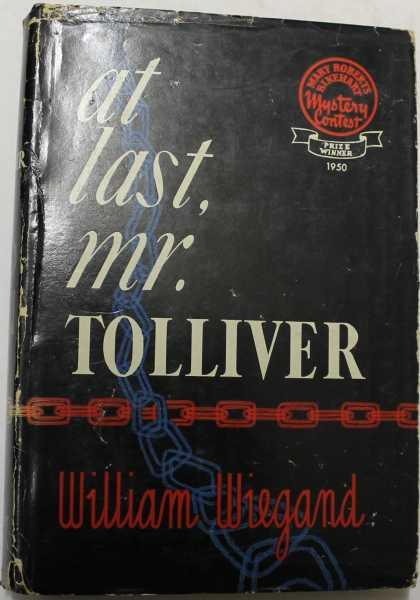
Forgotten Book - At Last, Mr Tolliver


At Last, Mr Tolliver by William Wiegand won the Mary Roberts Rinehart Prize in 1950 (ahead of books by Fay Grissom Stanley, Thaddeus O'Finn, and Maude Parker, none of whom, I must admit, I've ever heard of). It's a book that achieved widespread acclaim in its day, and remarkably the author - a student at Michigan University - was only 21 years old. Impressive!

William Wiegand went on to have an illustrious career in academe, teaching creative writing in California. However, despite making such a successful start as a novelist, he only published one more crime novel, which appeared ten years after his debut, plus a few other books. I've read some of his correspondence - with fellow academic and mystery expert Donald Yates, to whom my copy is inscribed by Wiegand - and it's not entirely clear to me why he didn't pursue a career in fiction with more vigour. Perhaps he didn't find it financially rewarding, despite the advantage of a prize-winning start at a young age. His correspondence with Yates, although sporadic, spanned thirty years and he lived until 2016.

So what of the book itself? It's a kind of locked room mystery, but as the dust jacket blurb of the first edition says, 'The intricate solution...is only one of the suspense elements'. The eponymous Tolliver is a tenant in a boarding house and is confronted by the mysterious death of a fellow tenant. It becomes clear that Tolliver's own background gives him criminal connections and he investigates the puzzle for his own purposes.

I think it's fair to say that this is a Marmite sort of book. Readers seem either to love it a lot (Nick Fuller, a good judge, is among them) or find it rather on the pretentious side. To my surprise and regret, I'm afraid I found myself in the latter camp, partly because I never quite warmed either to Tolliver or the situation with which he is confronted. Maybe I was in the wrong mood to enjoy it. It is certainly 'different', and I can understand why it earned critical praise. So maybe I'll revisit it another time.