Showing posts with label A Talent to Deceive. Show all posts

Monday, 20 June 2016

Robert Barnard is Back


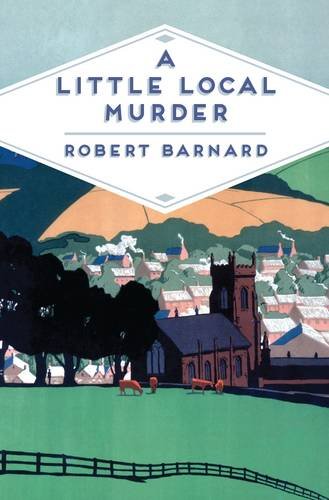
Less than three years after we lost that fine crime writer Robert Barnard, it's good to see that Bello are making a bit of a splash with his extensive backlist. In particular, they have reissued two of this books in attractive paperback editions, which have some of the nostalgic feel associated with the cover artwork of the British Library's Crime Classics series.

There's no doubt that the success of the British Library series has been enormously influential -it's the reason why you will again see plenty of crime books with seasonal covers this year, as you did last, and why so many traditional mysteries are now being reissued with lovely covers that cater for a touch of nostalgia among readers.

Bob was a witty exponent of the traditional mystery, and had strong views about it. "Second murders are always vulgar", he once said, with tongue perhaps slightly in cheek. He deplored formulaic writing, and although he did have series characters, such as Perry Trethowan and Charlie Peace, they were not as memorable as, say, Dalziel and Pascoe, but really represented a convenient way of tackling the business of solving a  murder puzzle.

A Little Local Murder, one of the two new paperbacks, is characteristically clever, not least because Bob toys with his reader's expectations. It seems to be predictable who will be murdered - but he turns the tables on us very neatly. This is a village mystery somewhat in the Christie vein (and Bob was a great admirer of Christie; I heard him give two excellent talks about her, and his book A Talent to Deceive remains an excellent study of her work) but with a character of its own.

I'm sure that Bob, mischievous as he was, would be greatly amused to see that The Case of the Missing Bronte is also being highlighted in the new edition. He once told me it was his worst book, and then relented slightly when inscribing a copy to me - describing it as "my second worst book". He was a harsh judge of his own work, but I must admit it's not one of his best. This is so despite the fact that he was a great expert on the Brontes, and once led a fascinating tour for fellow crime writers around Haworth Parsonage: a memorable afternoon indeed. So which Barnard title is my favourite? I'd probably plump for A Scandal in Belgravia.

Saturday, 21 September 2013

Robert Barnard R.I.P.

I am very sorry to break the news that Robert Barnard, one of the most notable British detective novelists of the past forty years, has died at the age of 76. He was a winner of numerous awards, most notably the CWA Cartier Diamond Dagger, in recognition of the sustained excellence of his crime writing. He was a distinguished academic, a former worker for the Fabian Society, an expert on the Bronte family and their writings, a passionate opera fan, and the author of a definitive study of Agatha Christie's crime writing, A Talent to Deceive.

Bob Barnard was also one of the first friends I made in the crime writing world. When I attended the inaugural meeting of the northern chapter of the Crime Writers' Association, I was an unknown, whereas people like Bob, Reg Hill and Peter Walker were very well established authors. But from our very first lunch together, those three men (and their lovely wives, Louise, Pat and Rhoda) made me feel welcome and part of the crime writing fraternity. They became good friends, and I owe them a great deal.

I've written about Bob's work on a number of occasions (for instance, I wrote an article about him for that fine American magazine Mystery Scene - his books were enormously popular in the US), but in this short post I'd like to focus on Bob the man - and above all his sharp and mischievous sense of humour. His wit was as evident in his writing as in his conversation, and he was unfailingly entertaining company. A good many years ago (in the mid-nineties, as I recall) someone suggested he had died, a story which he found highly amusing, as he was in perfectly good health. How this bizarre mistake arose, I simply don't know.

I also found Bob personally very generous. It was typical of him that he took me as his guest to a Detection Club dinner at the Savoy nearly twenty years ago, a memorable occasion at a time when I never dreamed that one day I'd become a member of the same Club. He did me this kindness simply because he knew how much I would love the occasion. I will never forget it.

In fact, one of the last times I saw him was at the Detection Club's annual dinner in the Temple. By this time, he was becoming troubled by memory problems. For an intellectual whose memory had always been fantastic, this was a dreadful blow,and he felt unable to continue with his public speaking, something in which he excelled. I went to visit him and Louise at their home in Leeds last year, and we had a pleasant time together, but his health began to deteriorate, and this year the decline had been steep.  For Louise, who has coped with great courage during the past difficult months, the loss is profound.

As I write these words, I feel very sad indeed that he and I will not be teasing each other again -our views diverged on a handful of issues (not least pop music!), but this never mattered a bit, as it never should in any genuine friendship; in fact, I tend to think that friendships are often all the stronger when they are between people with contrasting outlooks and personalities. Mind you, amongst many other things, we shared a great admiration for Christie, and I heard him speak with considerable insight about her work at crime conferences on a couple of occasions. I also recall a fascinating tour of the Bronte House in Haworth, led by Bob during a CWA annual conference. Above all, it was a great privilege as well as a pleasure to have known Bob, and to have been lucky enough to enjoy his company on countless occasions. He has left me many memories to treasure, and I'm sure the same is true of his many other friends.

I thought I'd illustrate this blog post with a photo that reminds me of a happy occasion we shared. It was taken at the 20th anniversary lunch of the Northern Chapter. It shows Bob in conversation with Meg Elizabeth Atkins, another friend who attended that inaugual lunch, and who also died recently, and Kate Ellis's husband Roger. Both Meg and Bob were in great form that Sunday. In fact,whenever I met either of them over the past quarter of a century, they seemed to be in great form. Bob, like Meg, will be very much missed.


Monday, 12 March 2012

Rogue's Gallery

One of the finest writers of short mystery stories is Robert Barnard, who recently published Rogue’s Gallery, the third collection of his short stories to have appeared over the years. Single-author story collections are rare, and it’s a real tribute to both author and publisher (Allison & Busby) that this enjoyable gathering has made it into hard covers.

In these stories, Bob pokes fun at some of his favourite targets – Tory politicians, members of the Royal Family (with special reference here to the marriage of Charles and Diana) and religion. “Sins of Scarlet”, a story set in the Vatican, won the CWA Short Story Dagger in 2006, a source of particular pleasure to me, as it had originally featured in a CWA anthology that I edited.

A couple of the other stories here also featured in CWA collections, although Bob’s most recent story, “Just Popped In”, which appears in Guilty Consciences, was not available. One of the most interesting stories, “The New Slavery”, deals with an important yet under-discussed topic – the way grandparents may be exploited as no-cost child-minders by their own children. It’s clear from the story what Bob’s own views are.

I’m a long-time admirer of Bob Barnard’s work, and a few weeks ago I had the pleasure of visiting him, and his wife Louise, at their home in Armley, Leeds. One of the outcomes will be an article about his career for the US magazine “Mystery Scene”. He’s one of the wittiest of writers, and if you are a Christie fan, I can also recommend his excellent study of the Queen of Crime, A Talent to Deceive.

Sunday, 17 January 2010

Robert Barnard


I mentioned recently that 1936 was the year in which three of Britain’s finest crime writers were born: Peter Lovesey, Reginald Hill, and Robert Barnard. They are three writers whom I admired long before I had the pleasure of getting to know them personally. I still can’t quite believe that I’ve joined them in the Detection Club.

I’ve not had much to say on this blog about Bob Barnard, so it’s time to remedy the omission. He’s a witty writer, who crafts neat and sometimes highly ingenious plots. His gifts are often shown to advantage in the short story, a form at which he excels, and I’ve been lucky enough to include several of them in anthologies that I’ve edited.

Bob Barnard is also a keen student of the genre, and his study of the work of Agatha Christie, A Talent to Deceive, is widely acknowledged as one of the best books ever written about the Queen of Crime. His enthusiastic, yet clear-eyed assessment of her work, is highly readable, and his analysis of her main plot devices is especially interesting.

Yet it is for his novels that he is best known, and quite right too. He has employed recurrent detectives – Perry Trethowan and Charlie Peace in particular – but the main focus on his books is on the skewering of pretension, coupled with neat mystification. Death in Purple Prose pokes fun at romantic novels, while Political Suicide offers a highly entertaining, if now rather dated, glance at political shenanigans.

My favourite Barnard is probably A Scandal in Belgravia. The title suggests a Sherlock Holmes connection, but this proves to be a red herring. The focus is, again, on politics (Bob used to work for the Fabian Society), and there is a great final twist. A fun book from a writer whose own talent to deceive is of a high order.