Showing posts with label Alfred Hitchcock. Show all posts

Friday, 18 November 2022

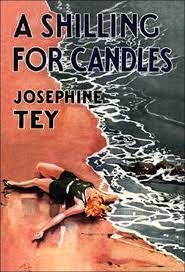
Forgotten Book - A Shilling for Candles


A Shilling for  Candles, published in 1936, was Josephine Tey's second detective novel to feature Inspector Alan Grant. I've mentioned it a couple of times on this blog, in connection with Nicola Upson's novel Fear in the Sunlight, and also as the basis for Alfred Hitchcock's film Young and Innocent, which as I said in a review way back in 2010 is very different from the book - even the murderer and motive are changed!

I first read this novel many, many years ago. I 'm a Tey fan, but I was disappointed with it overall. I think that was because she didn't, in my opinion, pay enough attention to characterising the killer or making the motive credible - and this helps to explain why Hitchcock made so many changes. It's certainly not a 'fair play' novel. However, I decided to give it another try and consider the story in part from a technical perspective - why did Tey make the choices she did, and which of them worked?

The fact that I knew what to expect didn't lessen my enjoyment and the first thing to say is that Tey, as always, writes very well and engagingly. The opening scene, where a coastguard discovers a body on a beach, is very well done. The 'man on the run' aspect of the story, which Hitchcock focused on, is also quite good. The title is intriguing and it refers to a mocking bequest in Christine's will. However, this part of the story rather fizzles out as Tey tries to draw the various strands together. 

The central problem, I think, is that although she came up with some wonderful story ingredients, she didn't think hard enough about how to integrate them into a satisfactory whole. Probably she was writing in a rush, and wanting to get back to her work in the theatre. I suspect she became worried about the thinness of the motivation and as a result decided to portray the killer, in the closing pages, as deranged. I feel that, despite an element of outlandishness, more could have been done to make this crucial part of the story plausible. But the book is not only worth reading - I was very happy to have read it for a second time, despite my reservations.  

Monday, 5 December 2016

The Girl on the Train - book review

Paula Hawkins' thriller The Girl on the Train has become perhaps the most successful book in roughly the same vein as Gillian Flynn's bestseller Gone Girl. (Perhaps I should have called my last book The Girl from the Dungeon House). It's an example of domestic suspense, an update of the woman-in-jeopardy type of novel that has been around for many years, but which has in recent times had a fresh lease of life.

Hawkins' book, like Flynn's, features unreliable narrators, and marriages tested to destruction. Like Flynn, she uses first person narratives cunningly; they give the story immediacy (even though some of the sections are set before the crucial sequence of events begins) and they conceal as much as they reveal. These are powerful techniques if used well, and I feel that Hawkins handles the material expertly. I was not surprised to learn that, although this is the first Hawkins novel, she has previously published fiction under a pen-name as she learned her craft. There is something highly professional about the storytelling.

The principal narrator (there are three in all) is Rachel, an alcoholic who becomes obsessed with the lives of a seemingly happy couple whose house is on her train route. Hawkins has acknowledged her debt to Rear Window (the film, perhaps, rather than Cornell Woolrich's excellent novella) and is evidently an Alfred Hitchcock fan, but makes inventive use of the idea of a voyeur watching a crime scene. Rachel behaves crazily, involving herself in lives that are no business of hers, with dangerous results. It's all very gripping.

An interesting feature of the book is that there are only six main characters, three men and three women. Suffice to say that none of them is likeable, and if you prefer your novels to have at least one character you can love, you may not find this book to your taste. Yet Hawkins has argued that there is something appealing about Rachel, and I certainly found myself wanting to know what fate she would meet. Gone Girl set a high standard for domestic suspense novels, but Hawkins' book is a worthy example of the form, and deserves its success..

Wednesday, 4 November 2015

The Paradine Case - film review

The Paradine Case is a 1948 film by Alfred Hitchcock, in which the Master of Suspense tried his hand at a courtroom drama. It's an American film, with notable American actors in two of the leading roles, but it's set in Britain, mainly at the Old Bailey and in a somewhat thinly evoked Cumberland (where one of the locals speaks in a bizarre mixture of cod-Northern accents - dear old Hitchcock may have been a Brit, but I don't think he had much of a clue about the North of England.)

The set-up is this. A wealthy blind man has been poisoned. His attractive foreign wife (played by Alida Valli, credited simply as Valli) is charged with his murder. Charles Coburn is her solicitor, and he hires Tony Keane (Gregory Peck), a top defence barrister, to represent her. Things start to go awry when Tony unwisely falls in love with his client, much to the distress of his wife. She is played by Ann Todd, who was born in Hartford, thus making her one of the very few famous actresses to hail from my old stamping ground, Northwich!

Tony travels to the scene of the crime in the Lake District, where he encounters the deceased's moody valet (Louis Jourdan), whose bizarre behaviour seems highly suspicious.  There are various possibilities. The accused may be guilty, she may have conspired with the valet, the valet may be guilty, or the dead man may have committed suicide. The main focus, however, is not really on whodunit but on Tony's conduct of the case, and his handling, or rather mishandling, of his relationships with his client and his wife. I'm afraid, though, that I found Tony rather irritating.

The cast includes Charles Laughton as the satyr-like judge, and Leo G. Carroll (whom I  remember rather fondly from The Man From UNCLE) as counsel for the prosecution. It's quite a good film, but for me, there was far too much soap-opera standard emoting, and not enough suspense. Not typical Hitchcock, by any means. I'm glad I've seen it, but give me North by North West, Rear Window or Vertigo any day..

Wednesday, 2 July 2014

Frenzy - film review

Frenzy was Alfred Hitchcock's penultimate film. It dates from 1972, and boasts a fine cast and a screenplay by Anthony Shaffer, based on the book Goodbye Piccadilly, Farewell Leicester Square by Arthur La Bern, whose work I have not read (but I don't think he specialised in crime.) It's a story about a psychopathic serial killer, and Hitchcock tried a number of tricks with the movie, as well as combining black humour with a very dark subject. The result is a curious mish-mash, which has some strengths - yet one feels it could and should have been better.

Hitchcock returned here to his native London, and much of the action takes place around Covent Garden, just before it ceased to be a traditional market. Women are being strangled by a "necktie killer", and a bad-tempered loser called Blaney (the charismatic Jon Finch, an actor who never quite achieved as much as he seemed capable of) becomes the prime suspect. But the suspense derives from the fact that the audience soon realises that he is being set up by a false friend, played by Barry Foster.

Other members of the cast include Barbara Leigh-Hunt, whom I once saw on stage in the 80s, Anna Massey, Jean Marsh, Vivien Merchant and Alec McCowen. All very good actors, and there is one superb moment of film-making when we see Marsh enter the office of her boss, Leigh-Hunt. We know the latter has been murdered, but are made to wait before Marsh discovers the body, and we hear her scream. Very clever, but there are also some lapses of taste (I know taste is very subjective, but I don't think the women characters would be treated in the same way today). There's some nudity and the overall feeling I had is that Hitchcock was trying to "get with it", but with only limited success.

Apparently La Bern hated the film, which was not an uncommon reaction among writers whose work Hitchcock adapted. I felt the film was too long, and that its length blunted its edge. We also never really understand the killer's psychology. But - and it is a big but - I also feel it would be a mistake to dismiss this film as a failure. It's interesting and watchable even with its faults.

Monday, 9 December 2013

Why Re-Read a Detective Story?

What is the point of re-reading a detective story? After all, if you know whodunit, surely it's a waste of time? This is an argument I've come across a good many times over the years. And there are certainly plenty of detective stories that most readers may doubt were worth reading once, let alone twice. (Mind you, that's true of plenty of books outside the crime genre, as well.) But I think a great deal of pleasure may be gained from re-reading a good whodunit, even if you can still remember who committed the crime and why.

A case in point is Death Walks in Eastrepps by Francis Beeding. I first read this novel in my twenties, but it has stuck in my mind ever since, and its reappearance as an Arcturus Crime Classic prompted me to give it another go. I knew the identity of the surprise culprit, and the even more surprising motive, but I was interested to see how the two authors who co-wrote under the Beeding name handled their tricky plot.

In this book, as in their The Norwich Victims, which I also re-read recently, they shift scenes and viewpoints regularly, giving the story a filmic quality. (Unsurprisingly, Alfred Hitchcock adapted another of their novels, which became Spellbound.) Even by today's frenetic standards, the book does not lack pace. It's an early serial killer novel, and there are half a dozen victims, before the culprit (or apparent culprit) is finally tracked down - after the original prime suspect had turned out to be innocent, if deranged.

There is a good courtroom sequence before a series of short and snappy scenes lead up to the final dramatic revelation. I was impressed by the way Beeding orchestrated a complicated storyline, and admiration of authorial craft is in itself a good reason to give a book a second reading. There are so many books I'll never read even once that I suppose I ought to feel guilty about spending time on a story I remembered pretty well. But I don't regret it at all, because I found it just as enjoyable the second time around as the first.

Monday, 6 May 2013

Portmeirion and Crime Fiction


I was lucky enough to spend a night recently at one of my favourite places, Portmeirion, on the Dwyryd Estuary in North Wales. I first visited Portmeirion as a child, and this extraordinary Italianate village, created by a brilliant if slightly eccentric architect, Clough Williams-Ellis, made a great impression on me. I've returned many times since, and I still find it as entrancing as ever.

Because Portmeirion is so exotic,and so unexpected, some people think it outlandish, but not only is the setting lovely, there is a sense of fun and joyfulness about Clough's creation that makes a great many people feel good, simply by being there. And when the weather is excellent, as it was on this visit, it really is a terrific place to be.

Yet Portmeirion's strangeness did make it the perfect setting for that classic cult TV series The Prisoner, and it's also the setting for a recent crime novel, Fear in the Sunlight, by Nicola Upson. This is the latest in her series featuring the writer Josephine Tey as a character. Her version of Tey differs from the description of Tey given to me by a family member who knew her, but is nevertheless appealing.

In this story, Tey is staying at Portmeirion along with Alfred Hitchcock and his wife Alma, to negotiate a deal that will see Tey's novel A Shilling for Candles adapted into the film Young and Innocent. The Portmeirion meeting did not happen in real life, but it's a great idea, and Upson's evocation of the fantasy village is probably the strongest part of the book. Murder does not happen for about 200 pages, and some readers may feel that this was too long to wait. But the trip to Portmeirion was the ideal time to read the book, and I have little doubt that Nicola Upson likes the place as much as I do.


Wednesday, 9 May 2012

Rope

I’ve watched Alfred Hitchcock’s movie Rope again, for the first time in twenty-five years, and found myself admiring it rather more at a second viewing than I did originally. The film dates from 1948 and was based on a play written almost two decades earlier by Patrick Hamilton. The play in turn was inspired by the true crime case of Leopold and Loeb.

At the start of the film, two young aesthetes strangle a friend to death – they want to commit the perfect murder as a sort of experiment. John Dall and Farley Granger play Brandon Shaw and Phillip Morgan; Brandon is the leader, Phillip the weak link. Brandon amuses himself by arranging a party to be attended by their luckless victim’s father and girlfriend., while the body is kept inside a chest from which refreshments are served. He also invites his former teacher Rupert Cadell, played by James Stewart, with whom he’d talked in the past about Nietzsche and the idea of the perfect crime.

Needless to say, there’s really nothing very perfect about Brandon’s plan, and I suppose that on first viewing I felt a bit frustrated because the story-line and its development seemed relatively obvious. Watching it again, in more tolerant mood, I did admire the way Hitchcock built the tension. His long camera takes, and the idea of a movie story told in real time are much admired by film buffs, but although it’s not a masterpiece when compared to his best work, it’s still very watchable.

The Leopold and Loeb case is a truly extraordinary one, which has sourced other works of crime fiction. And it’s interesting that Hitchcock used a play by Hamilton – I’m rather sorry that he never adapted Hamilton’s books about Gorse for the silver screen, though those stories were eventually transformed, in the late 1980s, into a good TV series, The Charmer.

Thursday, 11 August 2011

Murder! - review


I have just watched a DVD of an Alfred Hitchcock rarity - a whodunit, rather than a thriller. Murder! was an early talkie from 1930, and it was based on a novel by Detection Club members Clemence Dane and Helen Simpson, Enter Sir John. In the film, Sir John Samaurez, an actor-manager, is renamed Sir John Menier, and is played by Herbert Marshall.

Sir John is a member of a jury which convicts an actress of murdering a colleague. However, he repents of his part in the verdict and sets about finding out what really happened. Suffice to say that the mystery is easily solved, but that there is a memorable finale involving a half-caste transvestite trapeze artist, the kind of character you don't find everyday in crime stories.

Marshall's performance is not very compelling, but the film, despite creakiness, does show us some of the Master's touches at a formative stage in his career. He didn't really care for whodunits, reasoning that they didn't work as well in film as thrillers, and probably he was right.

I haven't read the book, so I'm not sure how faithful the film was to the plot. But Dane and Simpson were interesting characters and I hope to write some more about them in the future. Simpson, by the way, was a very glamorous woman who also became a close friend of Dorothy L. Sayers before her death at a young age from cancer.

Friday, 26 November 2010

Forgotten Book - Before the Fact


Francis Iles’ second book, Before the Fact, is my latest contribution to Patti Abbott’s series of Forgotten Books. In truth, I hope it isn’t a forgotten book, and it certainly should not be, but the reality is that it hasn’t been available in the bookshops in the UK for far too long – my reprint dates from 1991 and may have been the last mainstream edition here.

Francis Iles was the name of a notorious smuggler, an ancestor of Anthony Berkeley Cox, who first found fame as the innovative Anthony Berkeley. The first Iles book, Malice Aforethought, was hugely influential. Before the Fact is also much admired, and it is memorable, although flawed.

It is the story of Lina Aysgarth, a born victim. She marries the charming Johnnie, but slowly becomes aware that he is a rogue. In time, she realises that he does not scruple at murder. And in the end, she discovers that he means to kill her.

This book was filmed by Hitchcock as Suspicion, but the master of suspense bottled out and changed the ending. It is a very bleak story indeed – the flaw, though, is that Lina is maddeningly passive. You end up wanting to scream at her to save herself. Even so, this is a remarkable story by a unique innovator.

Sunday, 19 September 2010

Le Boucher and Chabrol


A week after the death of the eminent film-maker, Claude Chabrol, I’ve watched one of his most famous movies, Le Boucher. It’s not exactly a homage to Hitchcock, but the influence of the master of suspense is evident in a various ways, most notably in the appealing yet repressed blonde heroine, played by Chabrol’s wife, Stephane Audran.

At a wedding in the idyllic village where she is in charge of a small school, she meets a butcher called Popaul, who has returned after 15 years in the army. They strike up a slow-burning friendship, but the community is rocked when a woman is murdered in a nearby wood. A tramp is suspected, but there are no real clues.

Soon, in a very memorable scene, a second woman’s body is discovered, during the course of a school outing. Near the corpse, the teacher discovers a lighter that she gave to the butcher. She hides it, but her trust in him is destroyed and the story develops from there through a doom-laden sequence of events.

Chabrol, who also wrote the screenplay, favoured simple plots and complicated characterisation, and this film demonstrates his approach well. It’s not in any sense a whodunit, but it is a disturbing and noteworthy example of French film. No wonder Hitchcock said he wished he’d made it.

Thursday, 4 March 2010

Strangers on a Train


I’ve watched Hitchcock’s classic movie Strangers on a Train more than once, as well as reading the book by Patricia Highsmith on which it was based, but this is a film which is so masterful that it was good to see it again the other day. And as I watched, I reflected that, after almost half a century, it has lost little of its power.

The story-line of the ‘exchange of murders’ is now very familiar, and it has been referenced countless times subsequently (my favourite is the Peter Lovesey story called ‘Strangers on a Bus’). As with many of Highsmith’s plot ideas, the material is melodramatic, but the story is developed brilliantly, and although Hitchcock made some changes for the film, he was able to capture, in his own way, the chilling, obsessive atmosphere of the literary source. Apparently he approached Dashiell Hammett to write the screenplay at first, then gave the job to Raymond Chandler, but the pair did not get on, and little of Chandler’s writing survived in the final version. Famously, Highsmith was only paid $7,500 for the rights - not much for one of the classics, really.

Farley Grainger plays Guy, the likeable tennis player with a faithless wife, and Robert Walker is the superficially charming but sociopathic Bruno, who wants his own father dead. Ruth Roman does a decent job as Guy’s girlfriend, and her younger sister is played by Hitchcock’s own daughter, Pat. I was sorry to learn that Walker, whose performance is quite brilliantly spooky, died not long after the film was screened; he suffered serious psychiatric problems. Grainger, however, is still alive.

There are lots of wonderful touches in this film, and the climactic scene on a merry-go-round is superb. This is one of the best Hitchcock films, which means, quite simply, that it is one of the best crime films ever made.

Wednesday, 16 December 2009

Trap for a Lonely Man


One of the stand-out memories of my teenage theatre-going was a trip to Chester’s Gateway Theatre to see a production of a play called Trap for a Lonely Man, involving a chap whose wife disappears and is replaced by a stranger. It proved to be an excellent thriller, with a classic final twist. Fast forward to the present, and I’ve tried to find out more about the play. It seems that it is something of a staple of provincial theatre even now, and it was written by a Frenchman, Robert Thomas.

A little more digging revealed that the play has been adapted into no fewer than four films. I haven’t seen any of them, although I’ve put in an order for Chase a Crooked Shadow, a version starring the young Richard Todd, who died recently. It also seems that Hitchcock planned to film the play, and I can well imagine that the premise would appeal to him, although he was evidently beaten to it.

The story-line is strongly reminiscent of the work of those French masters Boileau and Narcejac. I’ve mentioned before that group of writers, including Montheilhet, Arley and Valmain, who followed in the footsteps of Boileau and Narcejac, and this notable play suggests that Robert Thomas should be added to the list.

But who was Robert Thomas and what else did he write? So far, I’ve not come up with any detailed information about him, but surely he wasn’t just a one-hit wonder?

Wednesday, 5 August 2009

One Missed Call


One Missed Call is a 2008 movie with a cast unknown to me, but a screenplay written by that very accomplished thriller merchant Andrew Klavan. The film is, in fact, a re-make of a successful Japanese movie of a few years earlier called Chakushin Ari.

The premise is gripping. A young woman called Beth is terrified by the deaths of a group of friends, all of whom suffer unpleasant fates after receiving phone calls, apparently from themselves in the future, showing the precise times of their demise. Beth’s attempts to convince a senior police woman of the connection between the fatalities get nowhere (bizarrely) but a detective whose sister has died in similar circumstances is more willing to listen.

From that point, it has to be said, the plot descends into horror-hokum. We aren’t talking Alfred Hitchcock or Claude Chabrol here. There’s something slick and superficial about the way the story unfolds – we’ve been here a good many times before. It isn’t a truly sophisticated genre.

Nevertheless, the pace and confidence of the script is a reminder of Klavan's expertise. These qualities carry the viewer along, without the need to delve too deeply into character or motive. I found the movie entertained me satisfactorily on an evening when I was more than ready for a bit of mindless time-passing.

Tuesday, 23 June 2009

Marie Belloc Lowndes


Mrs Belloc Lowndes (1868 – 1947) was a prolific novelist who came from a famous and socially well-connected family – her brother was Hilaire Belloc and Joseph Priestley was an ancestor. She is remembered today, however, for just one book. The Lodger (1913) is a fictionalised account of the Jack the Ripper murders, which was filmed by Alfred Hitchcock, and then on no fewer than three further occasions.

I thought it would be interesting to pick up a copy of a book I saw in a catalogue from Jamie Sturgeon, compiled by her daughter Susan (and including a selection of her letters from 1911 to the year of her death. Very few crime writes have had collections of their letters published. The only name that springs to mind is Dorothy L. Sayers – no fewer than five collections of her letters have been published; she must have spent a fortune in stamps.

What is striking about the Belloc Lowndes letters is how little reference is made to crime writing.and crime writers. Christie and Sayers don’t get a mention. She wasn’t a member of the Detection Club, and she seems to have spent more time mixing with politicians and ‘the great and the good’. But is clear from the letters I’ve read so far that she was a fascinating and sociable woman with an inquiring mind.

Lowndes, by the way, created a detective called Hercules Popeau. Some people say that he was the inspiration for Hercule Poirot, and they certainly have some things in common, not least their vanity. But just to illustrate how unreliable some information is, I’ve seen at least one suggestion in print that Popeau was conceived as a parody of Poirot. But this suggestion seems to do a disservice to the originality of Lowndes’ creation..

Thursday, 18 June 2009

Notorious


My recent post about Alfred Hitchcock prompted comments encouraging me to watch his 1946 film Notorious, and a sensible blogger always pays heed to people who take the trouble to offer constructive comments. So I’ve now seen Notorious, and on the whole I enjoyed it.

I say ‘on the whole’ because it got off to a very slow start. In fact, watching it after a very long day at the office, I was on the verge of going to sleep after quarter of an hour. But then the story warmed up, and so did my enthusiasm for the movie.

Ingrid Bergman is the patriotic American daughter of a traitor who is persuaded by secret agent Cary Grant (playing T.R. Devlin – no relation to Harry) to infiltrate a group of German sympathisers based in Brazil. She takes the job so seriously that she marries wealthy mummy’s boy Claude Rains, and duly discovers the wherewithal for a uranium-based bomb in his wine cellar. Rains discovers her duplicity, and he and Mum start to poison her, but of course they haven’t reckoned on Grant’s devotion to Ingrid.

There are several neat Hitchcockian touches in the film, and the ending is genuinely chilling – not least because Rains makes the bad guy rather sympathetic. He was an interesting and talented actor, whose CV includes not only a famous role in that great movie Casablanca, but also teaching Gielgud and Oliver, and somehow finding the time to marry no fewer than six times.

Tuesday, 26 May 2009

The Influence of Hitchcock


The Bank Holiday weather was excellent, so I spent a good part of it outdoors, but I still managed to catch the Sky documentary about Alfred Hitchcock, introducing a season of his films. In half an hour, the programme provided a good summary of some of the reasons why the portly film director was one of the most influential movie-makers of the twentieth century.

Film pros such as Stephen Frears waxed lyrical about the way in which Hitchcock’s visual imagination, coupled with his artistic and technical skills, enabled him to create so many suspenseful scenes. The point was made that Hitchcock didn’t bother much with dialogue, but rather focused on set pieces – the crop-dusting sequence in North by North West and the shower scene in Psycho are classic examples. This is something which perhaps differentiates the thriller from the conventional mystery, where dialogue is often highly important (yes, it’s a generalisation, but I think it’s broadly true.)

Another key point was that humour played an important part in many Hitchcock films. Thrillers which are unrelentingly bleak can be wearisome, and I'd guess that the wit of the films is one of the reasons why they have lasted so well.

It isn’t just movie-makers who can learn from the Master of Suspense. Novelists keen to fathom the craft of building tension (and I’m one of them) can hardly fail to benefit from studying Hitchcock’s techniques. Even in his supposedly weaker films, such as Frenzy and Family Plot, there are many clever touches. I’m planning to record one of the Hitchcocks I’ve managed to miss over the years, Notorious, and another that I haven’t seen for a very long time, To Catch a Thief. Something to look forward to.

Thursday, 26 March 2009

Stage Fright


Stage Fright is a Hitchcock film of 1950, boasting a mixed and noteworthy bag of ingredients. A young man who has become embroiled in the murder of his actress lover’s husband flees from the police and seeks help from a much more dependable woman, Eve Gill. It’s a neat and suspenseful situation which results in a watchable movie. There are, however, two flaws. First, the story sags in the middle – a shortage of meaningful plot, I felt, although the ending is strong. Second, the flashback which opens the film turns out to be a bit of a cheat.

The cast is impressive, and makes the very best of the material. Marlene Dietrich is suitably sultry and malevolent as the scheming actress, and sings a Cole Porter song during that rather laboured middle section of the film. Richard Todd, a heartthrob in his day, is her neurotic and unreliable stooge. Eve Gill is played by Jane Wyman, whose greatest claim to fame is that she was President Reagan’s first wife. He was her third husband. Jane, a pretty woman, was obviously quite a character; she later married yet again, divorcing only to re-marry the chap before divorcing again, finally abandoning marriage, no doubt exhausted, and turning to religion.

Eve’s father was played by Alastair Sim, and there were minor parts for Miles Malleson, omnipresent in films of that period, and Ballard Berkeley, who is now remembered by many as the Major in ‘Fawlty Towers’.

The story comes from a novel called Man Running, one of six books featuring Eve Gill and written by Selwyn Jepson. His reputation has not survived the passage of time too well, but he was prolific as a novelist and screenwriter, and came from a literary family. His father, Edgar Jepson, was an early member of the Detection Club, and co-author of a legendary detective story, ‘The Tea Leaf’. And Selwyn’s niece is the notable author Fay Weldon.

Monday, 2 March 2009

Paul Merton Looks at Alfred Hitchcock


The British comedian Paul Merton isn’t exactly renowned as a film critic, but I found his BBC 4 documentary about the films that Alfred Hitchcock made in the UK to be eminently watchable. I’m a long-time admirer of the Master of Suspense, and I wasn’t sure about how Merton would tackle the subject, but a love of humour unites the two men and Merton’s analysis was amiable and interesting in its focus on some of Hitch’s less celebrated films (many of which I must admit I’ve never seen.)

Hitch was seen explaining that he only ever filmed one ‘whodunit’, because he didn’t find it satisfactory to have his audiences concentratiing on the solution to a puzzle, rather than on emotional engagement with the characters. I think he had in mind some of the highly cerebral detective stories of the Golden Age (step forward Ronald Knox?) but I’d take issue with the suggestion that all whodunits of the past, let alone the present, lack an emotional pull.

However, there’s no doubt that the key to Hitchcock’s genius is his ability to involve viewer in the build-up of suspense. So often we know something that the protagonist does not. I was interested by his statement that he erred in Sabotage (one of the movies I haven’t seen) by having the bomb actually go off and kill someone, rather than being discovered in the nick of time. Among the other films mentioned was Young and Innocent – I own an omnibus DVD which includes this one, but have never got round to watching it, perhaps because the title put me off. I ought to give it a chance.

Hitch’s use of dramatic settings for climatic scenes was emphasised, as was his range of camera tricks and techniques. I learned that many of his early ‘talkies’ were based on stage plays, until his career took a leap forward with the first version of The Man Who Knew Too Much. Among the movies that this programme has encouraged me to seek out is his first ‘talkie’, Blackmail. And the witty script made it good viewing for its own sake.