Showing posts with label Andrew Garve. Show all posts

Friday, 10 December 2021

Forgotten Book - No Tears for Hilda


No Tears for Hilda was Andrew Garve's first book to be published by Collins Crime Club. This was in 1950, and Garve was a new pen-name for Paul Winterton, a journalist who had previously published crime novels under the name Roger Bax (he'd later write a few books under another name, Paul Somers). Garve novels would appear regularly until 1978, when Winterton was 70. After that, he retired from the scene, although he lived until just short of his 93rd birthday. 

Garve was evidently an interesting individual, a member of the Detection Club and a founder member of the CWA. He stood for election to Parliament in 1931 as a Labour candidate, but since that was the year that Labour were wiped out in a landslide, his political career never got going. It's not easy to find out much about his personal life, though I understand that he wrote a (regrettably unpublished) autobiography. Signed Garve books are hard to come by, and when I came across his personal copy of this title on eBay, I was keen to snaffle it. Now I've read it, I'm glad I did. 

This is one of those novels in which a man is charged with murder, but someone close to him insists that he is innocent, and tried to prove it. A familiar scenario, but Garve handles it with a touch of originality, focusing on the psychological make-up of the victim. Although Francis Iles had focused on a 'murderee' almost twenty years earlier, in his extraordinary novel Before the Fact, Garve's approach is very different. The setting and storyline are in keeping with the rather grey mood of the post-war austerity era.  

George Lambert's wife Hilda is found dead. At first sight it looks as though she has gassed herself, but it's soon evident that someone killed her. George appears to be the only suspect. He has no alibi, while an affair with a young nurse gives him a motive. His war-time pal Max Easterbrook can't believe that good old George could have committed such a crime. But there are no other suspects.

To find the truth, Max needs to learn more about Hilda's personality. It soon becomes evident that nobody did shed any tears after her death and Garve's attempt to present a rounded psychological portrait of an unpleasant woman is interesting if not, to my mind, wholly successful. But Max's search for the real culprit is interesting and Garve's smooth and accessible prose style kept me turning the pages. 

Monday, 10 June 2019

Deep Waters - Publication Day!


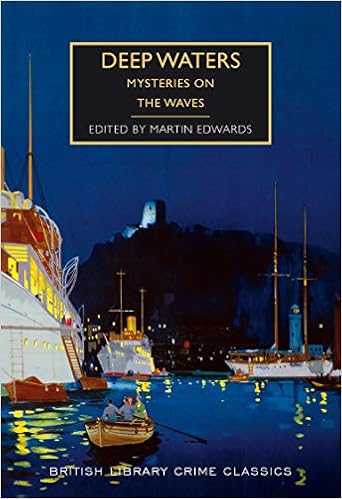
Today sees the publication of my latest anthology for the British Library. Deep Waters is subtitled Mysteries on the Waves, and boasts a rather good cover which for me represents a pleasant reminder of my recent Atlantic crossing. I've talked about cruise mysteries on this blog recently, and there's no doubt that stories set around the sea, or indeed rivers, canals or lakes offer a lot of potential for the crime writer. 

This is, I think, the chunkiest of all my British Library anthologies, running to no fewer than 364 pages, and I'm pleased about this. I do think that it's good to offer readers plenty of value, and my only regret is that it wasn't possible to find space for a long-time favourite of mine, "Three Miles Up" by Elizabeth Jane Howard, a terrific story. I have to admit, however, that it's a bit of a stretch to call it a crime story, even though it's very mysterious indeed.

So what of the stories that did make the cut? We kick off with a case for Sherlock Holmes, and other eminent detectives who are featured include Reggie Fortune, Dr Thorndyke, John Appleby, and Gervase Fen. There are also some little-known names in the list of contributors, including Kem Bennett; I was introduced to his story, and another by Christopher St John Sprigg, by Jamie Sturgeon, one of a small group of friends who have given me valuable advice about possible stories for inclusion.

There is a story by Andrew Garve, a writer whose love of sailing is evident in many of his novels, and another by Phyllis Bentley, who is perhaps best remembered for her Yorkshire-based family saga novels. As usual, I'm aimed for variety in my selection, and I like to think that Deep Waters is a book which, whatever your preference in terms of classic crime, will offer plenty to enjoy.


Monday, 18 March 2019

A Golden Age week-end


I've just returned from a thoroughly enjoyable week-end at the Essex Book Festival. This is a very well-organised festival indeed. I've been lucky enough to attend for the past three years, and each time I've been impressed by the range and quality of the programme as a whole, as well as for the Golden Age week-end at Southend-on-Sea in which I've participated. Ros Green, Jo Nancarrow, and the team do a very good job.

Two years ago, in fact, my trip to Southend inspired me to use the resort as the setting for one of the chapters in Gallows Court. And this year, I had the very enjoyable experience of being interviewed by Seona Ford, Chair of the Festival, about the writing and publication of Gallows Court. When high winds caused the lights in the hotel venue to go out for a few moments near the end of the session, it really was suitably atmospheric! All in all, the session was great fun, and so was a panel about Queens of Crime, moderated by Seona, earlier in the afternoon. My fellow participants were Barry Pike and Geraldine Perriam, and it really was a terrific session as we debated the relative merits of Christie, Allingham, Sayers, Tey, and company.

Now Essex is a very long way from home, and I felt that as I was undertaking such an epic journey, it would make sense, weather permitting, to see something of a part of England that I'm not very familiar with. On the way down, therefore, I digressed to the old Roman city of Colchester, which I've never visited before. It was a fleeting stop, but I saw enough of the place to be rather taken with it. An excellent dinner in Southend with Seona and others rounded the day off nicely in good company.

On the way back to Cheshire yesterday, I decided that, as the sun was shining (well, intermittently; there was also hail and torrential rain), I'd take a look at the island of Mersea. I've come across the place in the fiction of Margery Allingham and Andrew Garve (The File on Lester), and  Seona told me it also features in a non-crime novel by Sabine Baring-Gould. As I am very keen on islands, I wanted to see what it was like in reality.


I liked Mersea, both the quiet east side, with its mud flats, and old gun emplacements, and the bustling west side, with all the fishermen's boats, oyster bars, and restaurants. You reach the island by a causeway known as the Strood and it's definitely worth a visit. Time didn't permit a visit to the little museum in West Mersea village, but Mersea is a place with a distinctive charm, and I'm glad I visited it. And on the way there and back, I passed through Tolleshunt d'Arcy, a village where Allingham made her home. How nice it was to see that she's remembered in a street name!


Friday, 21 September 2018

Forgotten Book - Murderer's Fen

Andrew Garve enjoyed a long and fairly illustrious career as a crime writer, as well as pursuing a successful career as a journalist under his real name, Paul Winterton. I tend to bracket him with Michael Gilbert, who was just a few years younger, because they were both versatile and highly professional writers whose books are invariably smooth reads. If I lean in favour of Gilbert, it's partly because he uses his legal expertise so brilliantly, and I think he was a slightly more gifted writer. But Garve was good, make no mistake about that.

Today I'm focusing on Murderer's Fen, a novel he wrote in the mid-Sixties and which is nowadays available again, thanks to Bello. If I didn't know Garve had written it, I could guess, because it features life on a boat as one of the elements in the story - Garve plainly loved sailing, almost to the point of obsession. It crops up time and again in his novels, and it's to his credit that although I'm not interested in the technical details of boats and sailing, this quirk doesn't irritate me at all.

Murderer's Fen is interesting as an example of the "inverted mystery". We're introduced to Alan Hunter, handsome and persuasive, while he's on holiday, eyeing up the girls. Before long we realise that he's actually a nasty piece of work, a sexual predator with little or no empathy for the girls he seduces. And soon, he has cause to contemplate murder.

Garve offers us a variation on the classic form of inverted mystery, by shifting the viewpoint from time to time between the culprit and the investigating detectives (a nicely contrasted pair). This device works well as a means of building suspense. An idea for a twist occurred to me which never materialised - perhaps I'll use it myself one day! Garve wasn't super-ingenious, really, but he knew how to tell a good story. And Murderer's Fen is a good read with an excellent setting in -naturally - Fen country.. 

Friday, 8 December 2017

Forgotten Book - The File on Lester

The name of Andrew Garve isn't as well-known today as it might be, despite the fact that Bello have made much of his work available again. I think that he, like his contemporary (and CWA and Detection Club colleague) Michael Gilbert suffered because of his refusal to be typecast, and his reluctance to write about series characters. He was a prolific and capable writer, who at his best was very, very good.

I've read a number of Garve's books, and I was tempted to try The File on Lester by an article that John Cooper contributed to the latest issue of CADS. John is an excellent judge, and he expressed great admiration for this book. Having read it, I can see why. It's extremely readable (smoothness of writing was something else Garve had in common with Gilbert) and the storyline is highly intriguing.

The eponymous Lester is a fast-rising star in the political firmament. He's just become leader of the Opposition, at a time when the government is unpopular, and facing a general election. Within a short time, Lester could be walking into 10 Downing Street. Then disaster strikes. An attractive young woman lets slip the information that, more than six months earlier, she and Lester had a brief affair. Lester is a widower, and there's nothing terribly scandalous about what happened. But Lester denies that he ever met the young woman, and his apparent deceit creates a furore.

The story is told in a series of documents, including reports from people working on a newspaper sympathetic to Lester. This method of story-telling can work very well, and Garve does a really good job of building the tension. There's an obvious explanation for what has happened to Lester, but it's not the right explanation. I enjoyed finding out the truth, and I now share John Cooper's enthusiasm for this highly entertaining novel.

Wednesday, 15 May 2013

The Galloway Case and Death Beneath Jerusalem

Andrew Garve is an author I've mentioned before on this blog, and a good example of someone, successful in his day, whose work is reaching a new audience through digital publishing. I had read a few Garves in the past, but I wasn't especially interested in his work. However, when Bello started to reissue his titles as ebooks, I took a closer look - and I've really enjoyed what I've discovered.

Many prolific writers are variable in the quality what they produce. It's almost impossible to write dozens of books of uniform quality. I think that in my earlier encounters with his books, I read a couple of relatively unsatisfactory stories. But, although it's tempting and almost inevitable, one should not judge an author on a brief acquaintance. I have been impressed by the last few Garves that I've read in Bello ebook editions.

He was primarily a thriller writer rather than a specialist in whodunits, but The Galloway Case is a very entertaining story about a young man who falls for an attractive but mysterious woman while in Jersey, and finds himself trying to prove the innocence of a man who has been accused of  murder. There's quite a bit of stuff about crime writing in this novel which made it especially appealing to me. A very good read with a number of neat twists.

Garve was a pseudonym - his real name was Paul Winterton, and he was a journalist. But Garve was obviously a name he liked, because in his very first book, writtten under the name of Roger Bax, he called his journalist hero Philip Garve. Death Beneath Jerusalem was published just before the Second World War and it presents Jerusalem at that time in a fascinating light. This is a thriller, pure and simple, but highly readable, and the background is evocative. So much so that it has made me hope that one day, I'll get the chance to visit Jerusalem.


Monday, 10 December 2012

A Touch of Larceny

A Touch of Larceny is a 1959 movie which remains hugely enjoyable and entertaining to this day. It is based on Andrew Garve's novel The Megstone Plot, but in the film the emphasis is on comedy  rather than suspense, although there is some of the small boat sailing that features so often in Garve's work. The director was Guy Hamilton, whose later work included Goldfinger, and the cast is superb. James Mason, Vera Miles and George Sanders take the lead roles, but the minor charactes are played by such notables as John Le Mesurier, Harry Andrews and a very young Peter Barkworth.

Mason, an actor I always enjoy watching, plays a rakish ex-submariner who is idling his time away in peacetime, working in the Admiralty and chasing pretty women. He bumps into an old acquaintance, played by Sanders (have there ever been two actors as suave as Mason and Sanders? I doubt it) and instantly falls for Sanders' American lady friend, played by Miles (who came to Hitchcock's attention, and had a role in Psycho).

Mason wants to get rich quick, and to get Miles, and so he conjures up a scheme whereby he will appear to be a traitor, causing the newspapers to libel him. He will then reappear and cash in with compensation claims. But of course, things do not turn out to be straightforward.

Amazingly, this is all still rather topical, given current debates about press freedom, and the ways in which reputations can be damaged (nowadays it's not just newspapers in the firing line, but bloggers and tweeters too.) As a lawyer, I'm fascinated by the law of libel. It does worry me that libel can be unintentional, and some compensation awards seem excessive. Equally, it's wrong to destroy people's reputations, and the law does need to protect individuals, not least those who don't have deep pockets enabling them to hire expensive lawyers. Any reform of the law needs to be focused on achieving quick solutions and the containment of cost.

Anyway, back to the film. The decision to concentrate on the comedy element of the storyline is extremely successful. The story moves along at a fast pace, and there are some very nice plot twists. The actors do a great job of making the most of the material. Heartily recommended.

Wednesday, 18 July 2012

Bello and a Murder Omnibus


The rapid growth of print on demand and digital publishing is having the happy effect of reviving all kinds of detective novels that were, until recently, hard to find. One of the most significant entrants in the market is Bello, an arm of Pan Macmillan, and I’ve been impressed with their enthusiasm for neglected gems o the genre.


I first came across them when I was asked to write an introduction to an omnibus of three revived mysteries. It turned out to be a pleasurable task. A Game of Murder, by Francis Durbridge, was one of the novels – it happens to be a book I’ve covered in this blog, and I still remember watching the original TV series on which the novel was based. A very entertaining and twisty story.


Murder in Moscow, by Andrew Garve, illustrates that author’s deep knowledge of Russia and the Russian way of life. Garve (real name, Paul Winterton) was a journalist who visited the country in the early 30s and he wrote factual books about the place, as well as novels set there. The final book in the omnibus was Prescription for Murder, one of the long series of novels that the late David Williams wrote featuring Mark Treasure -  a likeable banker, in the days when bankers were allowed to be likeable. The omnibus is due to be launched at the Harrogate Festival this week, and I hope that, even though the focus of the Festival is naturally on contemporary crime, there will be a chance to interest readers in worthwhile writers of the past as well.


From talking to people at Bello, I’m convinced that the imprint (can a digital publisher be said to have an imprint? I guess so) will become increasingly prominent. Among the other crime novelists they are bringing back into the limelight is Josephine Bell, a writer as reliable as Garve. There are a lot of unknown, but worthwhile, books from the 20th century waiting to be rediscovered, and I’m confident that Bello will be among the leaders in making sure that happens.


Friday, 9 September 2011

Forgotten Book - Blueprint for Murder


My choice for today's Forgotten Book is another entry in the impressive new series of classic crime novels published by Arcturus. This one is called Blueprint for Murder, and the author is Roger Bax. If the name of Roger Bax is unfamiliar to you, you might be familiar with the work of Andrew Garve. Both were among the pseudonyms used by the journalist and prolific author Paul Winterton, but it is as Garve that he carved out a considerable reputation.

I had never previously read any of the books he wrote as Roger Bax, but even if I had not known the identity of the author before reading the book, I might have guessed it because of the focus on small boat sailing – clearly this was one of Winterton's great passions.

The book changes character in its last quarter. It starts out as an "inverted" crime novel, tracing how a man made ruthless by his wartime experiences sets out to kill a wealthy benefactor, contriving an ingenious alibi so as to escape justice. But his plan has some rather obvious flaws, and after it falls apart, but the book is in the form of an adventure thriller as he tries to flee across the Channel.

The book is set in the immediate post-war period, and the horrors of the concentration camp that so corrupted the villain are conveyed tersely but well. This is a readable and entertaining story, and although the outcome is only foreseeable, I enjoyed it from start to finish. Had it not been reissued, I'm sure I would never come across it, and Arcturus are to be congratulated for publishing a novel that, although hardly well-known, deserves a new lease of life as a lively period piece.

Monday, 7 June 2010

Canals and Crime


A highlight of the week-end was a canal cruise with dinner on board, starting out from Bollington in Cheshire and organised by my friend from schooldays, Stephen, who is the dedicatee of The Cipher Garden. Among our fellow guests were Kate Ellis and her husband Roger.

The very agreeable trip reminded me of an article sent to me a while ago by that great crime buff, Philip L. Scowcroft. Philip contributes to many publications, including CADS and Deadly Pleasures, and this essay, ‘Canals and Waterways in British Crime Fiction’, which started life in an American canal history journal, is a very wide-ranging overview.

Philip identifies The Canal Mystery (1928) by John Remenham – an author unknown to me, I must confess – as the first British detective story with a canal setting; that is, if one discounts spy stories and books set around the navigable River Thames. He points out that the Grand Union Canal features in books by Margery Allingham and Harry Keating, while the Oxford Canal plays a part in two of Colin Dexter’s novels.

A good many other crime writers have used canal settings in their fictions. Examples that Philip gives include Andrew Garve, Marjorie Eccles, John Gano and Reginald Hill. And there’s a pleasing paradox about this, which struck me as we dined on Saturday evening. For to drift along an English canal in a comfortable narrow boat is one of the most peaceful experiences imaginable. It takes the imagination of a crime fan or writer to turn such tranquillity into something sinister!

Sunday, 7 June 2009

Canals and Crime


Yesterday evening we went on a canal cruise that involved a very good dinner, consumed in excellent company that included crime writer Kate Ellis and her husband Roger (picture getting on to the narrow boat). The round trip along the Macclesfield Canal began and ended at Bollington, on the Cheshire side of the border with Derbyshire. There can be few more restful or enjoyable ways to travel.

And yet. Canals have been a scene of fictional crime more often than you might guess. I’ve even been responsible for one short story myself, ‘To Encourage the Others’, which included a canal-side murder.

Philip Scowcroft, an indefatigable researcher and expert on the genre, recently sent me a copy of an article he wrote some years back on the subject of ‘Canals and Waterways in British Crime Fiction’. Classic titles cited include The Riddle of the Sands by Erskine Childers, the first great spy story of the last century, and The Pit-Prop Syndicate by the alibi king, Freeman Wills Crofts.

Among the many other titles Philip mentions are Death in Little Venice (2001) by Leo McNair, and Joan Lock’s historical mystery Dead Image, as well as a book I have read, Night’s Black Agents, by the under-rated David Armstrong. The Llangollen Canal features in Andrew Garve’s The Narrow Search, and a fictionalised Stourbridge Navigation in Marjorie Eccles’ Requiem for a Dove. The most famous book in this sub-genre is, though, surely Colin Dexter’s acclaimed The Wench is Dead, which is distantly based on a real-life case.

Wednesday, 11 March 2009

Andrew Garve


Andrew Garve was one of the pen-names used by a left-leaning journalist called Paul Winterton. His early publications included A Student in Russia and Eye-Witness on the Soviet War-front, but he became one of the most reliable purveyors of mysteries and thrillers in the immediate post-war era. A founder member of the CWA, he was also its first secretary, holding the office jointly with Elizabeth Ferrars. He also used the pseudonyms of Roger Bax and, later, Paul Somers. But Garve is the name associated with his most successful work.

This includes the first Garve book I ever read (because his friend, that great judge Julian Symons, rated it highly), The Megstone Plot. This story, with a nice fake-blackmail plan, was filmed as A Touch of Larceny, a movie that crops up on television from time to time, although I have never managed to see it.

In 1997, I was commissioned by Chivers to write an introduction for their reissue of Prisoner’s Friend, a lively if straightforward thriller Garve wrote 35 years earlier, in their excellent Black Dagger series. It was no masterpiece, but still a book that exemplified Garve’s competence as a story-teller.

When I attended the Las Vegas Bouchercon, a few years back, someone on a panel concerning the collecting of crime fiction suggested that Garve would become increasingly collectible in years to come. As far as I can tell from internet book prices, this has yet to happen. But Garve, who died in 2001 but gave up writing long before then, was a capable practitioner and I’ve bought a few more of his paperbacks to check him out in more detail.