No Coffin for the Corpse, first published in 1942, was the fourth and final novel of Clayton Rawson. Rawson, an advertising artist and semi-professional conjuror, was a specialist in impossible crime mysteries and a good friend of John Dickson Carr. His Great Detective was the Great Merlini, who has a shop which sells magic tricks and a 'Watson' in the shape of narrator Ross Harte.
Rawson's career as a novelist was brief, although he continued to write short stories with a locked room or impossible crime focus. In addition to Merlini, he created Don Diavolo (great name!), who makes a fleeting appearance in this book, although generally the Diavolo stories were published under the name Stuart Towne. No Coffin for the Corpse failed to find a UK publisher and did not appear in this country until Tom Stacey brought it out in 1972, the year after Rawson's death.
It may be that Rawson became disappointed and frustrated as a novelist (it happens!), or it may be that he struggled to find story ideas that would sustain a full-length novel. It may be relevant that this story begins quite brilliantly but does not, in its later stages, quite fulfill its early promise. I do think it is a real challenge to write a high-calibre impossible crime novel - the locked room is a trope that, I feel, tends to suit the short story form better (and yes, I know there are quite a number of excellent exceptions, not only by Carr but by others).
Here, Harte is frustrated when the rich but odious Dudley Wolff determines to nip his daughter's romance with Harte in the bud. Wolff has a fear of death which again is eminently suited to this kind of macabre mystery, and when he becomes embroiled in an attack on a blackmailer, he persuades others to help him to bury the blackmailer's body in the woods. But then the corpse appears to take on a life of its own...
A great premise, but the amount of space devoted to justifying the legitimacy of the explanation for the mystery seems rather like protesting too much. I suspect Rawson realised that the trick he used would frustrate some readers. However, he does a good job in terms of coming up with - and juggling - multiple solutions to the key murder in the story. Overall, even though this book is not his best, it's good light entertainment.
Showing posts with label Clayton Rawson. Show all posts
Showing posts with label Clayton Rawson. Show all posts
Friday, 23 October 2020

Wednesday, 27 November 2019
Bodies from the Library 2, edited by Tony Medawar
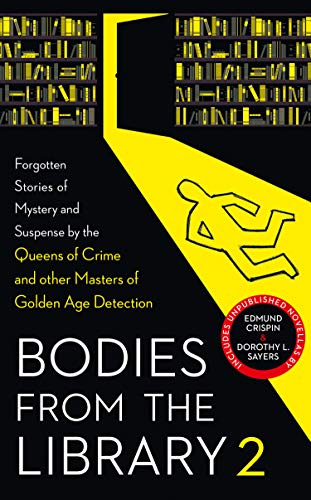
The title and contents of this HarperCollins anthology are inspired by the Bodies from the Library conference, which has for the past five summers been held at the British Library and brought together fans of Golden Age detective fiction from all over the world. Tony Medawar, who has been researching the genre for a good thirty years, has conceived the idea of a series of books gathering stories (and radio plays) which he has, in many cases, rescued from obscurity.
Tony is a particular expert on Agatha Christie and the first Bodies book included an excellent rare story by the Queen of Crime. She features again in this book, which I think represents an advance on its predecessor in terms of the overall range and quality of content. There are two particular stand-out contributions, one a long-lost Lord Peter Wimsey story and the other a novella by Edmund Crispin. Rare finds indeed.
The Dorothy L. Sayers story is called, simply and splendidly, "The Locked Room". There is, arguably, a question mark over one aspect of the plot, which may explain why the story (which evidently dates from the late 20s) wasn't included in the Wimsey collections. It's a mystery to me why Crispin's "The Hours of Darkness" disappeared from sight. It's a very pleasing case for Gervase Fen, which is not even mentioned in David Whittle's magisterial biography of Crispin.
The other contributions are a very diverse assortment. So there's a story by S.S. Van Dine,and three others by American authors: Clayton Rawson, Jonathan Latimer (not an author normally associated with the Golden Age, a term which has to be interpreted broadly in the context of this book), and Q. Patrick, whose work in various incarnations I've always enjoyed. The Patrick story is also a novella.
There are several other notable names in the book, such as Margery Allingham and E.C.R. Lorac, but I particularly liked "No Face" by Christianna Brand and the characteristically amusing "Before and After" by Peter Antony. There's even a previously unpublished play by John Rhode, "Sixpennyworth", which Tony speculates may have been written for a local am dram group.
Wednesday, 17 February 2010
The Mentalist
I have finally caught up with a successful, newish American crime series – well, by watching one episode of The Mentalist, anyway. And it was, I think, the first episode of the series proper following the pilot. The starting point is the discovery of a young woman’s murdered body, and the trail soon leads to the restaurant where she worked.
The mentalist of the title is Patrick Jane, played by Simon Baker. He is loosely attached to the California Bureau of Investigation, and uses his observation power sto assist in the detection of crime. The senior cop is Teresa Lisbon (Robin Tunney) and her team includes a young cop who understandably fancies a very attractive colleague. In this episode, the script was taut, although there was no real explanation of what motivated the crazed killers. The pace was brisk, and the characterisation of the detectives sound. Patrick hypnotised a witness into revealing information, whioch was a bit of a cheat, but overall, I enjoyed it and would be very glad to watch the show again in future.
What struck me most forcibly was the fact that the premise of the brilliant, wayward sleuth is essentially an updating of Sherlock Holmes – yet another tribute to the brilliance of Conan Doyle’s creation. We have seen so many of these maverick superstars of detection over the years, but their appeal never seems to fade, and why should it? My favourite in recent years has to be Jonathan Creek, but even he is, really, a modern version of earlier magician detectives such as Clayton Rawson’s The Great Merlini. Truly, with crime fiction, there is nothing new under the sun.
Subscribe to:
Posts (Atom)