Showing posts with label Jonathan Creek. Show all posts

Monday, 7 February 2022

Blackstone Fell


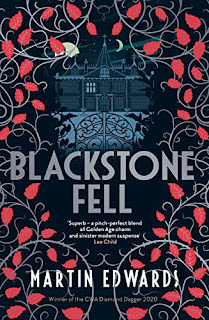
I'm delighted with the gorgeous cover that Ed Bettison has designed for my next Rachel Savernake novel, Blackstone Fell, which will be published in the UK by Head of Zeus in September. Ed was responsible for the covers of Gallows Court and Mortmain Hall, and there is a clear brand identity for the series now which appeals to me and, I hope, appeals to a lot of readers. The covers certainly seem to have contributed to sales growth over the past couple of years, and there is no doubt that Ed is very talented.

The central concept of Blackstone Fell came to me during 2020, when - after the easing of the first lockdown - I went on a trip to Hardcastle Crags, a National Trust site in Yorkshire and had a great day in a marvellous and evocative setting. It seemed to suit adaptation and the fictitious village of Blackstone Fell was the result. The village incorporates a dangerous stretch of water inspired by Bolton Strid, as well as a spooky tower which was largely the product of my imagination, but drew on a number of monuments in the real world.

At the time I was thinking about the book, I'd been watching again the complete run of episodes of David Renwick's Jonathan Creek, as well as working on John Dickson Carr titles for the British Library. So I decided it would be fun to have a genuine locked room mystery in the book - but as a sub-plot rather than the mainspring of the story. I've written locked room mysteries in the short story form but this is the first time I've incorporated one into a novel.

I won't say too much about the main plot-line since, as with Mortmain Hall, I've tried to disguise the nature of the over-arching puzzle. But suffice to say that this is a novel which offers all manner of Golden Age ingredients, including a sanatorium, a village pub, a church with a dodgy vicar - and a seance. Oh, and a cluefinder....

I'm really looking forward to publication and I hope that the cover artwork, at least, will whet the appetites of readers!


Wednesday, 8 July 2020

Jonathan Creek Revisited


Prime Video: Jonathan Creek, Season 1

For me, as for many people, the lockdown has (among other things) meant more time for writing, reading, and, to a lesser extent, watching television. As far as TV is concerned, I've caught up with a few recent series and also had another chance to enjoy some old favourites. I found, to my surprise and delight, that Ian Carmichael's Lord Peter Wimsey series from the 1970s held up much better than I'd expected, but the greatest pleasure has come from revisiting David Renwick's brilliant series Jonathan Creek.

I've rhapsodised about Renwick's writing and this series in particular on this blog in the past, but what strikes me on a second viewing is just how strong and tightly written the scripts are. One recurrent feature of many series nowadays is that they are excessively long and tend to drag. This is true even of strong series that I've watched lately, such as Sharp Objects, based on Gillian Flynn's novel, and The Hour (which I hope to blog about shortly). But with Jonathan Creek, there's never (or almost never) any padding.

The care with which Renwick writes is evident from the early episodes to the recent shows, such as The Curse of the Bronze Lamp, which I watched again last night. I'd forgotten the story, but on looking back at this blog, I see that I gave the episode a rave review on its original showing, more than six years ago. If anything, I enjoyed it even more the second time around, which is saying something.

I've found that I've forgotten the detailed plots of almost all the stories (except the brilliant Miracle in Crooked Lane) but that doesn't indicate a failure on the writer's part. Rather, I think that Renwick's command of detail is such that it compels attention at the time of viewing while not distracting from the overall pleasure of the character of Creek and the bizarre and deftly handled scenarios - and it's that overall sense of satisfaction and indeed delight that lingers in the memory.

I've been thinking about locked room mysteries a lot recently, partly because of the arrival of a new anthology (I'll talk more about this shortly), partly because I've been reading some more John Dickson Carr, and partly because I've been toying with an idea for a new locked room mystery of my own. Watch this space... 


Thursday, 29 December 2016

Jonathan Creek - Daemon's Roost - BBC TV review


Jonathan Creek returned last night with a brand new 90 minute episode, Daemon's Roost. David Renwick created Creek (Alan Davies) twenty years ago, and deserves a huge amount of credit for reviving interest in the locked room/impossible crime mystery. He did so by updating the form, combining clever plots with sharp humour and winning performances from Davies and his original partner in crime, Maddy, superbly played by Caroline Quentin.

It's often said that the law of diminishing returns applies to humorous crime stories. Creek is no longer a fresh face on the screen, and Maddy is long gone; her successors have all been very good actors (in fact Sheridan Smith is one of my top favourites) but none have quite been able to capture the same spark with Davies. The same is true of Polly, his wife, played by Sarah Alexander. Polly is beautiful, and she and Jonathan are happy together; perhaps the problem is that it's a relationship with insufficient conflict, other than Polly's determination to declutter Jonathan's life, and make a break with his past.

Daemon's Roost paid tongue-in-cheek homage to the Hammer Horror movie, in its opening scene and the plot as a whole. I was amused to see a film poster which gave, as the name of the schlocky screenwriter, David Wickren - one of those little jokes with which Renwick, a quite brilliant writer of comedy, likes to adorn his stories. We had a creepy old mansion, a mysterious old legend in the Baskerville tradition, and a sub-plot featuring a rather unlikely homicidal maniac, bent on murdering Jonathan.

There were some very good moments in the story - many of them featuring Warwick Davis, who was terrific as the cheery local vicar. (But might he also be a killer?) The clues varied from the unlikely to the obvious, but the method of murdering a rich wife was ingeniously contrived; John Dickson Carr would, I suspect, have enjoyed it. Because Jonathan Creek is now so familiar, this show won't have made the same impression as the early episodes - how could it? - but it was enjoyable seasonal fare.

Friday, 28 February 2014

Jonathan Creek - The Letters of Septimus Noone - BBC One TV review

Jonathan Creek returned tonight, and joy of joys, The Letters of Septimus Noone is not a one-off, but the first episode of a short series. Jonathan Creek's investigations, devised by the witty and clever David Renwick, revived interest in the locked room/impossible crime story in the nineties, a remarkable as well as welcome feat, at a time when the form seemed long past its sell-by date. It's a marvellous example of how a gifted writer can breathe fresh life into a traditional and apparently old-fashioned form, making it seem topical and great fun all over again.

Renwick has - wisely, I think - decided that he simply could not ignore the passage of time since Jonathan Creek first appeared on our screens. So Alan Davies, as Creek, still has a female "Dr Watson", but this time he's married to her: and the dynamic is very different to the tantalising relationship he had with Caroline Quentin in the early shows. Polly Creek is the most glamorous of Watsons, played by Sarah Alexander. The job as magician's assistant, the duffel coat and the windmill-house have gone too.

Renwick's sharp humour, and love of classic detective fiction, were very much in evidence. So we had a musical based on Gaston Leroux's once-celebrated locked room mystery, The Mystery of the Yellow Room (an excellent choice bearing in mind that Leroux's The Phantom of the Opera was immortalised by Andrew Lloyd Webber) and there were several neat word games, as well as sly nods to the success of Sherlock, a show written with the same appealing blend of playfulness and intelligence.

It's very, very difficult to write a locked room mystery that translates well to television, a point which I think some of those who have criticised recent one-off Creek stories tend to overlook. Here, Renwick offered a handful of small puzzles, rather than an over-arching mystery. This meant the story felt a little fragmentary, but it didn't matter too much. Jonathan Creek remains a show that has great appeal to all fans of classic detective fiction..

(By the way, there have been some excellent comments on this post but you may wish to avoid them until you have seen the show as they include observations on the plot.)

Monday, 1 April 2013

Jonathan Creek: The Clue of the Savant's Thumb: BBC TV review

Jonathan Creek returned tonight on BBC 1 with The Clue of the Savant's Thumb, a brand new episode written by David Renwick and starring Alan Davies as Creek and Sheridan Smith (whose acting career has been hitting the heights since we last saw her in this series) as his "Watson", Joey Ross. The supporting cast included Joanna Lumley, Nigel Planer and Rik Mayall, which indicates the focus of the show on "feelgood" television. And there's nothing wrong with the feelgood factor, especially after the winter we've had.

This story presented us with two mysteries. Fifty years ago, in a strict convent school, a young girl died in bizarre circumstances. Her death has haunted her old schoolfriend, played by Lumley, ever since. Now, Lumley is married to a terminally ill man (Nigel Planer) and is having an affair with her husband's GP. Her husband's blood-stained body is found by their adopted daughter. Lumley takes a photograph of the apparent crime scene. But by the time the emergency services arrive, the body has disappeared...

Meanwhile, Jonathan Creek has married and moved into the glitzy world of marketing along with his glamorous and wealthy wife. Joey tracks him down and persuades him to take an interest in the case, which is being investigated by Mayall, a brilliant detective in his own right, who is now confined to a wheelchair. There are plenty of clues, and even more red herrings, before first the old mystery is solved and then the puzzle of the disappearing corpse is explained, before a slightly cartoonish finale borrowed from a political conspiracy thriller.

David Renwick is a witty and clever writer, and his enthusiasm for the work of John Dickson Carr - which I share - is the key to what is most enjoyable about the Jonathan Creek storylines. Of course, you have to suspend your disbelief, but with Jonathan Creek, as with the Dickson Carr stories, the breezy writing means this is no hardship.

One of the great things about the success of Jonathan Creek is that it has shown that the classic elements of the traditional detective mystery can be adapted with great success for modern readers and audiences, if the writer is good enough, and shows respect for the form, rather than merely attempting pastiche (though I'd add that there have been a number of parodies and pastiches of Golden Age detective stories that I've really enjoyed.) This latest episode was entertaining, although I didn't think it was quite as effective as the last, The Judas Tree, but it may be that others will take a different view..

Impossible crime stories have long appealed to me, and I've written several over the years; short stories rather than novels, though. Just as Jonathan Creek tends to work better in a one hour episode than a ninety minute episode like this one, so do locked room tricks tend to be easier to pull off in short stories rather than novels. One of those stories, suitably adapted, forms the basis of my Victorian murder mystery event, "Who Killed George Hargrave?" This was performed a couple of weeks back at Holywell, in North Wales, by an excellent cast of library volunteers.

What interested me about this event (and another, at Knutsford a fortnight earlier) was that it was a sell-out, gaining much larger audiences than I find conventional talks or writers' panels tend to attract. In fact, I gave a talk about the locked room story as part of the event, and during the questions, again I was struck by the extent of people's enthusiasm for this type of story. As reaction to my Friday Forgotten Books posts shows, there is still a huge amount of interest in classic detective fiction - in fact, I'm certain there's more interest in it today than there was a few years ago. Jonathan Creek shows that this is not simply a matter of nostalgia. We still love a mystery, and there's plenty of room for the elaborate puzzle today, alongside all those relentlessly dark stories about autopsies and serial killers.

Tuesday, 25 October 2011

Death in Paradise - BBC TV review


Death in Paradise is a brand new BBC TV detective drama with some interesting ingredients, and I settled down to watch the first episode tonight with a good deal of optimism. Above all, I was intrigued by the fact that we were presented with – yes! – a 21st century locked room mystery. A sort of Guadeloupe-based homage to John Dickson Carr, if you can imagine such a thing.

A British cop who is working on a lovely little Caribbean island is found shot to death in a sealed panic room belonging to a millionaire. The only two people with access to the panic room are the millionaire and his wife, both of whom are conducting affairs. But which of them is guilty?

Another British cop, DI Poole (no relation to Henry Wade’s cop with the same name) is sent out to investigate. Poole is played by comedian Ben Miller, who is inexplicably grumpy about being posted to a truly beautiful place. The casting gives a clue to the fact that this is a light-hearted drama, a contrast to the bleak and gritty shows that have become over-familiar on our screens. 

The solution to the mystery has a clever twist, and although this show is certainly not in the same league as early Jonathan Creek – which provided a masterclass in scriptwriting -  I found it watchable. After all, given my enthusiasm for impossible crime stories, I’m naturally pleased to see that they are still finding favour with the TV programme makers. Admittedly, there were various flaws in the script, and some of the humour seemed forced. Nor was I really carried away by Miller’s performance, which struck me as less than subtle. I can imagine that some viewers will have been seriously unimpressed. But this was an establishing episode, with seven more to come. As for making a definitive judgment on the show’s  quality, the jury is still out.      

Monday, 2 August 2010

Sherlock: The Blind Banker - review


The Blind Banker, second episode in Sherlock, starring Benedict Cumberbatch and Martin Freeman as Holmes and Watson, was my first encounter with the 21st century version of Conan Doyle’s classic detective duo. I missed A Study in Pink last week, but reviews were very positive, and I can see why.

The idea of updating the characters but retaining key elements from the originals was the brainchild of Steven Moffatt and Mark Gatiss, two very good TV writers. Purists might wince at the idea, but it seems to me that, crucially, the series respects the aspects of Conan Doyle’s stories that made them so memorable. The Blind Banker, certainly, was much more than capable pastiche. The story was written and acted with a great deal of flair.

The story kicks off with the appearance of a mysterious cipher at a City bank. Shortly afterwards, one of the senior bankers is found dead. A journalist dies in similar circumstances. Both men, it turns out, had recently travelled to China. What is the connection, and how can the cipher be decoded?

The story contained various elements of Golden Age detective fictions – locked rooms, ciphers, mysterious foreigners – and the script was full of witty asides. The two leading men are splendidly cast and I love the idea of Una Stubbs as Mrs Hudson. Sherlock is different from Jonathan Creek, but not totally different. Again, we have the updating of traditional crime fiction, done with wit and ingenuity. I really enjoyed this episode. Recommended.

Sunday, 4 April 2010

The Judas Tree - a Jonathan Creek review


The Judas Tree was both written and directed by David Renwick, and for me, it was ninety minutes of TV heaven. A marvellously entertaining Jonathan Creek story, with that combination of wit and ingenious plotting which has become Renwick’s hallmark. John Dickson Carr would surely have loved it, and I think that any fan of classic ‘impossible crime’ mysteries would love it.

The opening is gripping – in 1988, two young women are driving in the windswept countryside, when one of them, Emily, sees a strange house in the fields. The house suddently disappears, and when she goes to investigate, she is almost seized by a mysterious old man who emerges from the undergrowth. But she fights him off and escapes.

Fast forward to the present day, and Emily takes a job in the household of a detective story writer with a glamorous wife and an enigmatic housekeeper. The wife tells her a story about a seemingly impossible crime, committed in the grounds of their house, Green Lanterns, in the nineteenth century. The timing of the victim’s death was foretold, to the very minute. And soon the wife receives a message, apparently in Emily’s hand, warning of her forthcoming death….

Jonathan investigates with his customary mixture of bewilderment and brilliance, aided by Sheridan Smith, from whom Emily has sought help. The initial mystery of the vanishing house is easily explained, but the crimes at Green Lantern, both ancient and modern, prove rather more complex. Quite a bit of information is concealed from the viewer until a late stage, which might have some purists shaking their heads. I was left with one or two unanswered questions (a second viewing might resolve them) but, most of all, with renewed admiration for Renwick’s gifts.

Alan Davies is excellent, as ever, as Jonathan Creek, while Sheridan Smith, Paul McGann and Ian McNiece (who has appeared in countless TV mysteries over the years) are also well cast. Natalie Walter, who plays Emily, is so very attractive that she can’t possibly be guilty – can she? And a special word for Doreen Mantle, who plays a key part in the story-line as the housekeeper at Green Lanterns. She appeared regularly as Mrs Worboys in Renwick’s One Foot in the Grave, and her interaction with McNiece is one of the many joys of this terrific mystery.

How does it compare to last year's enjoyable special, The Grinning Man? My instant reaction is - even better.


Saturday, 3 April 2010

Jonathan Creek and David Renwick

It’s hard to believe, but Jonathan Creek first aired as long ago as 1997. I watched that initial episode, and soon the series took over from Taggart as my favourite television crime show. The way in which classic ‘impossible crime’ plots were blended with humour and contemporary characterisation struck me as quite splendid.

And now there is to be a new episode, fifteen months after the last (The Grinning Man, which I thought was excellent.)  The Judas Tree is to be screened tomorrow, and I shall do a review. The only question is whether my expectations are so high that I’m likely to be disappointed. I hope not.

Jonathan Creek was created by David Renwick, who is also celebrated as the writer of One Foot in the Grave, and the creator of that grumpiest of old men, Victor (‘I don’t believe it!’) Meldrew. There are occasional references to detective fiction in One Foot in the Grave, and Renwick’s other works include some adaptations for Agatha Christie’s Poirot.

I’ve never met David Renwick, and the only slight link between us is that he wrote the introduction to Mike Ashley’s collection, The Mammoth Book of Locked-Room Mysteries and Impossible Crimes, in which my story ‘Waiting for Godstow’ appeared. ‘Waiting for Godstow’ was an enormously enjoyable story to write, and I’m rather sorry that it’s never attracted as much attention as some of my other work.

Here’s the closing sentence of that Renwick intro: ‘Like the spectral assassin who has miraculously vanished from the scene of the crime it’s comforting occasionally to give reality the slip and retreat into the more fantastical world of our imagination’.

 Couldn’t agree more!

Tuesday, 16 March 2010

Towards Zero


I was never wild about the version of Agatha Christie’s Marple starring Geraldine McEwan as the great detective, and so it took me a long time to get round to watching Towards Zero. The book is a Christie with a clever plot that I enjoyed a good deal when I first read it at a tender age. Jane Marple doesn’t even appear in it, so I rather feared the worst from Kevin Elyot’s adaptation. My expectations were low, but I resolved not to make too many comparisons with the original book, and in fact it proved to be an eminently watchable programme; Miss Marple fitted into it pretty well.

The key to the plot is the idea that the story of a murder occurs long before the commission of the crime, but the key question is: whose murder is being contemplated? There are plenty of red herrings, especially those arising from a story told by the old lawyer Mr Treves (here, he was a barrister rather than a solicitor) about a youthful criminal of long ago whom he had recognised again. Needless to say, Mr Treves is soon found dead.

The cast of this version was filled with famous names. Even Greg Rusedski appeared, as a Wimbledon opponent of tennis-playing Nevile Strange (played by Greg Wise.) Saffron Burrows was a glamorous former Mrs Strange, and Eileen Atkins played the invalid aunt whose lovely house accommodates the party of suspect. The cast also included Dr Who (Tom Baker, doing a roguish version of Mr Treves) and Jonathan Creek (Alan Davies, as the superintendent bemused by Jane Marple’s insights)

Elyot’s screenplay was pretty good, given the decision to introduce Jane Marple, which necessitated various changes of structure. The locations, on the Devon coast, were sumptuous and added to the pleasure of classic comfort viewing. Christie purists wince at some of the television versions of the books (the train wreck that was The Sittaford Mystery remains my pet hate) but events here moved Towards Zero in undemanding and rather agreeable fashion.

Saturday, 24 October 2009

Squeeze


The ‘impossible crime’ story is capable of infinite variations, and although some people think it’s a played-out sub-genre, confined to traditional Golden Age mysteries by the likes of John Dickson Carr, I disagree. The continuing popularity of ‘Jonathan Creek’ shows the potential for intelligently written impossible crime stories on television, while successful novelists as diverse as Stieg Larsson, Christopher Fowler and Jim Kelly have nodded in the direction of the impossible crime in recent times.

In the 90s, I watched quite a few episodes of ‘The X Files’, and I’ve just seen, for the first time, the third episode in series one, which is a very effective version of the impossible crime story. ‘Squeeze’ concerns a number of murders in Baltimore, where the victims were savagely murdered in rooms without an apparently viable means of entry – and their livers were ripped out. When Fox Mulder and Dana Scully come on to the scene, it emerges that the murders have eerie parallels with similar crimes that have occurred at 30-year intervals. But surely the invisible culprit cannot be over one hundred years old?

The solution to the mystery involves paranormal devices that would not be acceptable in a conventional Golden Age whodunit. But in the context of a sci-fi series, the plot is perfectly acceptable, and I enjoyed ‘Squeeze’. It was evidently a great success when first screened, as the initial ‘Monster of the Week’ episode in the long-running series.

‘Squeeze’ features a memorable character called Eugene Victor Tooms (needless to say, with a monicker like that, he is unlikely to be one of the good guys.) – so memorable that he returned for a future episode in the series. ‘Squeeze’ was entertaining enough to remind me why ‘The X Files’ enjoyed such excellent ratings, especially for the early series. I haven’t seen the film based on the series, and believe it met with a mixed reaction, but I’m tempted to give it a try.

Friday, 2 January 2009

The Grinning Man

No question about the highlight, for me, of the holiday season television schedules. It was last night’s episode of Jonathan Creek, a two-hour humdinger called The Grinning Man. It’s the first new Creek show for five years, but David Renwick, the brilliant writer who created Creek, has lost none of his flair for combining sharp wit with baffling murder mysteries. I’ve watched every Creek case, and I felt this was the best ever.

Alan Davies, of course, reprised the title role, but there was no sign of either Caroline Quentin or Julia Sawalha, his previous co-stars. No matter – he was soon involved in a complex puzzle involving the Nightmare Room in a spooky old mansion. Back in 1938, when the house was owned by one Jacques Futrelle, a Harvard professor spent the night in the Nightmare Room, which was duly padlocked and rendered totally inaccessible – but he disappeared, never to be seen again. It’s a classic set-up, which John Dickson Carr would have loved. Renwick also nods to one of the early masters of the locked room mystery by using the name of Jacques Futrelle – as fans of classic mysteries will know, the real Futrelle wrote a number of celebrated impossible crime stories featuring a cerebral sleuth known as ‘the Thinking Machine’.

The eponymous Grinning Man is a painting by Bosch, which hangs in the Nightmare Room. But even when the mystery of the fate of the professor (and of others foolhardy enough to overnight there) is solved, there is another apparently impossible puzzle to be unravelled.

For a 21st century television writer to display such mastery of the craft of the classic detective puzzle is in itself deeply impressive. But Renwick’s skill extends far beyond the technical – he knows how to entertain a modern audience and to keep viewers hooked from start to finish. This cunningly contrived story deserves to be recognised as a modern classic.

Wednesday, 10 December 2008

Jack in the Box

I’ve watched again a very early episode in the ‘Jonathan Creek’s series, featuring a mysterious death in a sealed underground tomb. It must have been suicide – yet there are reasons to suspect murder. The plot is pleasingly convoluted, with plenty of twists before the truth is finally revealed.

This is a first rate television mystery, with marvellous chemistry between Alan Davies and Caroline Quentin as the two lead characters. When Quentin left the series, she was replaced by Julia Sawalha, who is quite gorgeous – but I felt that Quentin’s wit and charm were irreplaceable.

One of the stars in this episode was Maureen O’Brien. Maureen, Liverpool born, is an accomplished actress who has appeared in many shows, including the wonderful early 'Taggart'. She is also a successful crime writer, and her novels, which come out rather sporadically due to her acting commitments, are well worth seeking out.

Some years ago, I had the pleasure of being on a panel with Maureen at the late lamented Crime Scene convention, conceived by Maxim Jakubowski and held at the National Film Theatre for a number of years. She is an extremely pleasant lady, and her success in two distinct careers in the creative arts deserves the utmost admiration.

Thursday, 30 October 2008

Gorgon's Wood

From the very first episode, I’ve been a huge fan of Jonathan Creek. David Renwick’s brilliant scripts are both very clever and very witty – and that’s a dazzling trick for any writer to pull off. The stories are updates of the classic ‘impossible crime’ mystery, and Renwick’s achievement is to show that even a supposedly ‘played-out’ type of story can be revived if the writer doing the reviving is gifted enough. I’ve never met him, but I much admire both this series and that superb, and equally original, comedy series ‘One Foot in the Grave’.

I’ve just taken another look at one of the later Creek shows, ‘Gorgon’s Wood’. A celebrity chef owns a priceless statue of a Chinese monk and is persuaded to lend it to a museum. But while the curator communes with the statue in private, it disappears – but where? Once Creek comes on the scene, the culprit is soon discovered, but that is far from the end of the story. As often in this series, there are several very dark twists as well as plenty of light moments.

I thoroughly enjoyed this episode on a second viewing. And – trivia alert! - I was intrigued to discover that actress who played the curator’s very glamorous daughter is Alice Patten, daughter of the former Tory MP and Governor of Hong Kong, Chris Patten.