Showing posts with label Margaret Lewis. Show all posts

Monday, 28 February 2022

Back to Boroughbridge


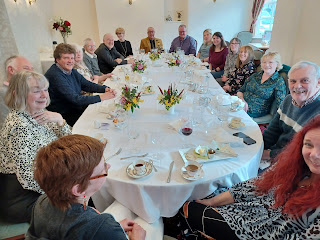
On Saturday I made a nostalgic pilgrimage to Boroughbridge. The Crown Hotel in the centre of the town was the precise destination. Matthew Booth, convenor of the northern chapter of the CWA had taken the very good decision to hold a lunch for members at the venue of the very first meeting of the northern chapter, way back in 1987. There have been many enjoyable lunches at the Crown since then, but it was my first visit for about five years.

That inaugural lunch meeting of 1987 was truly memorable as far as I was concerned. It was the first time I'd attended a social event with crime writers. I'd only recently joined the CWA, on the strength of my reviews and writing about the genre, and at the time I was working on my first novel. The chapter was the brainchild of Peter N. Walker, a former policeman who would later become famous as the creator of the stories which formed the basis of TV's Heartbeat.  

That day, I met Peter and his wife Rhoda, Reginald and Pat Hill, Robert and Louise Barnard, and Peter and Margaret Lewis. They were very welcoming to me and my fiancee and they all become much-loved friends. Never in my wildest dreams, though, did I anticipate the good fortune that lay ahead for me in connection with the CWA.

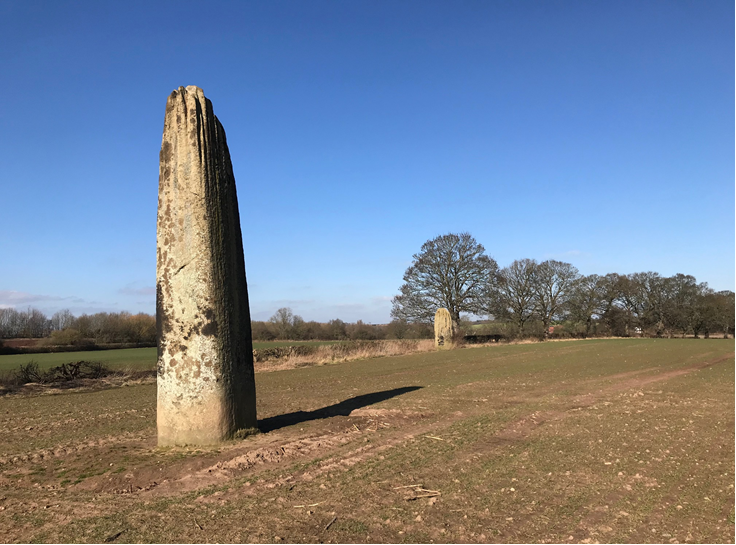
Thirty-five years is a long time and Mrs Edwards and I were the only people at Saturday's lunch who were there at the first meeting, but I must say that the current members are equally convivial and it was great to catch up with old friends again. Kate Ellis had proposed that some of us make a weekend of it and this proved a great success - we all had a lovely evening in the company of Peter's successor as convenor, Roger Forsdyke and his wife Penny, staying at a nearby gastro-pub. The gorgeous weather made the whole weekend memorable in its own right and it was good to explore parts of the area I've never seen before, including the mysterious Devil's Arrows - neolithic monuments in fields quite close to the main road. Interesting. It was so good to be back!


Wednesday, 11 January 2017

The Crime Writers' Association


The Crime Writers' Association has a new Chair. I can tell you this authoritatively, because it happens to be me. Len Tyler, who has piloted the CWA with aplomb for more than eighteen months, has stepped down early, because of the scale of the workload of the Chair's role. So I've taken his place. And the first thing I'd like to say is what a pleasure it's been working alongside Len as his Vice Chair. I wish him all the best with his writing projects, and very much hope he'll become involved again with the CWA at a future date once he's met a few killer deadlines.

As it happens, this year sees the thirtieth anniversary of my joining the CWA (I was only a lad at the time, you understand....) Shortly after I joined I was contacted by Peter N. Walker, and invited to the inaugural meeting of the CWA's northern chapter. That was a great occasion, if thinly attended. Reginald Hill, who was there with his wife Pat, dubbed us "the Few". That day I met Peter for the first time - long before he became famous as the guy who created Heartbeat. As well as Reg, I met another future CWA Diamond Dagger winner, Bob Barnard, and his wife Louise. Plus Peter Lewis, biographer of Eric Ambler, and his wife Margaret Lewis, biographer of Ngaio Marsh. What I remember vividly is how kind they were to a young chap from Cheshire they knew nothing about. We all became friends, and my admiration for them all will never falter. That experience also makes me feel strongly that looking after newcomers to membership is so important, just as is making sure that long-standing members continue to feel valued.

Before long I started going to CWA annual conferences, where I met many delightful people. Some are still around, some are not. All of them, pretty much without exception, were great fun to be with. Youngish writers by the name of Val McDermid, Ann Cleeves, and Margaret Murphy among others joined the northern chapter and I enjoyed their company as well as their books. Margaret formed Murder Squad in 2000, and this collective of writers is still going strong.

I am not by nature a very sociable person. Like many writers, I'm content with my own company and I often prefer it to the alternative. But I've found the company of my fellow crime writers truly life-enhancing over the years. The CWA is a terrific organisation and it's very significant that it has grown to a point where it's now bigger than at any time in its history of over sixty years. Its Daggers (their trademarked logo heads this post) are world famous. This is quite something in an era where membership organisations generally tend to be in substantial decline.

Of course, I am proud to have been picked to lead the CWA. And I'm startled to find that I'm the only person to have been both Chair of the CWA and President of the Detection Club at the same time. Inevitably I'll make a few mistakes as I try to move things forward, but I plan to do my best to make sure both organisations look after their members, and continue to play a significant part in the crime writing world, here in the UK and further afield.

Friday, 11 December 2015

Forgotten Book - The Nursing Home Murder

These are happy times for fans of Forgotten Books. There is much more interest in them now than there was a few years ago, no doubt due to the success of recent reprints. The media has cottoned on, and I've had the unfamiliar experience of talking about the Golden Age three times in the past week. Once for Channel 4 TV's Sunday Brunch - to be screened on 27 December - talking about The Golden Age of Murder, the Detection Club and Sherlock.. Once for a Japanese TV documentary, talking about Agatha Christie. And, yesterday, for Radio 4's Open Book, about Silent Nights and other Christmas mysteries. I shall never be a truly confident performer, yet these things really are fun to do - in small quantities, that is, as they are certainly time-consuming.

Now to Ngaio Marsh. She has long been regarded as one of the "Queens of Crime", and I started reading her in my teens, after I ran out of books by Christie and Sayers. I read and enjoyed quite a few of them, but a couple rather sagged in the middle,and in the last twenty-five years I've read little by Marsh. I decided it was time to give her another go, and The Nursing Home Murder, first published in 1935, is my Forgotten Book today.

According to Margaret Lewis, author of a superb biography of Marsh, this was her best-selling book, and although I've read mixed reports about this story, I enjoyed it. There was no mid-narrative sag, and on the contrary the story gained from brevity, and was crisp and uncluttered. Social conditions and preoccupations of the time feature strongly, and are integral to the plot, not mere window-dressing. Definitely a cut above most of the crime fiction being written in the mid-Thirties.

I say this even though Marsh dips a toe into politics, which is so often a mistake (although one quite often made by authors then and now.) Her treatment of political issues is extremely superficial, but not as inept as is sometimes found in Golden Age novels. Sir Derek O'Callaghan is the Home Secretary, tasked with piloting through Parliament some anti-anarchist legislation, making him a target for political assassins. He collapses with peritonitis and is rushed into a nursing home for an operation. Here he has the peculiar misfortune to be surrounded by members of a medical team who wish him ill. He meets his end as a result of a lethal dose of hyoscine.

Suspicions switches briskly from one suspect to another. This is one of those classic crime novels which focus on a single crime, but Marsh's handling of the material is assured, and my interest never flagged. Incidentally, the book was originally published under her name and that of Henry Jellett,a medical man who advised her on the technicalities of the storyline. Sad to say, my paperback edition of the novel contains no mention whatsoever of Henry. Rather a shame - he deserves credit for contributing to an enjoyable traditional mystery.

Wednesday, 16 July 2014

Eric Ambler - guest blog by Peter Lewis

Peter and Margaret Lewis have been good friends of mine for more than 25 years. They have a distinguished track record in academe, and have both written some fiction, but are best known for their books about other writers - Margaret, for instance, wrote a super book about Ngaio Marsh. They also ran Flambard Press, and published Dancing for the Hangman. Today, I'm delighted to host a guest blog by Peter about a book which I can strongly recommend. 

"Once upon a time I was commissioned by Continuum Publishing in New York to write a book about Eric Ambler, with the emphasis on his literary achievement, originality and influence. Not, then, a conventional  biography. This arose after I was awarded an Edgar (Edgar Allan Poe Award) by the Mystery Writers of America for the best non-fiction mystery title of the year published in the US: my book about John le CarrĂ©.

Eric Ambler was very much alive at this time and back in London after many years in Hollywood and Switzerland, so I approached him via his literary agent in the hope that he would be willing to discuss the proposed book. In reply, he cautiously expressed interest in it and suggested that we meet to see how he could help. That successful first meeting set the pattern for quite a few more in the late 1980s: an extremely leisurely lunch in Mayfair, always involving an excellent Chablis. Because of his reputation as a writer of that supposedly lowest of  literary forms, the thriller, he hadn’t attracted much in the way of academic interest, and was obviously keen to discover what an academic like myself was making of his oeuvre, especially his eighteen novels. My book about him, published as a hardback in 1990, was to be the first full-length critical evaluation of his fiction. I wrote it on an Amstrad, which still lurks in a corner of the attic. A museum piece. I didn’t have the advantage of the internet when working on the 1990 book, whereas I benefited enormously from it in preparing the new version.

Eric was not writing a great deal in his later years, and his final novel, The Care of Time, came out in 1981. Even so, he lived for almost a decade after my book was published, and it could hardly be described as a definitive study. It was bound to seem incomplete. I thought about revising and updating it, but didn’t get round to it until Endeavour Press expressed an interest in publishing the original version as an eBook. I wasn’t in favour of simply reissuing  it as it stood, and persuaded Endeavour to publish a revised and slightly expanded version to complete what seemed incomplete. Still a work in progress.

I continued to see Eric in London occasionally after my book was published, but neither he nor his wife, Joan Harrison, was in good health in the 1990s, and Joan died in August 1994 after a long illness. The most surprising thing that happened in that decade was the first American publication in 1990 of his debut novel, The Dark Frontier, more than fifty years after its British publication in 1936. Early on, Eric had lost the US copyright. It was thanks to Mysterious Press in New York that the novel finally surfaced in the US, and Mysterious Press soon followed this in 1991 with Waiting for Orders, subtitled The Complete Short Stories of Eric Ambler. This contains the eight stories he had published in a writing career of almost sixty years, indicating that he was much less at home with the short form than with the novel. Eric was to write one more story: ‘The One Who Did for Blagden Cole’. This longish narrative was commissioned for a fiction Festschrift, The Man Who . . . , to honor the distinguished English literary scholar, critic and writer Julian Symons on his eightieth birthday in 1992. The book, containing thirteen stories by prominent crime and thriller writers was edited by H.R.F. Keating on behalf of the British Detection Club and published in London by Macmillan.

After The Care of Time, Eric’s London publishers Weidenfeld and Nicolson encouraged him to write his autobiography in the 1980s, and in 1985 he published one volume covering the years up to the late 1940s, Here Lies,  with its teasing title printed above his name on the jacket to produce the startlingly ambiguous HERE LIES ERIC AMBLER. A second volume was expected in the 1990s but did not appear. Eric’s final book with another teasing title, The Story So Far: Memories & Other Fictions, was published in 1993 and is an unusual medley. It contains all nine of his published stories, the eight collected in Waiting for Orders plus the new one he wrote for The Man Who . . . in a slightly modified form, but these are interwoven with four sections of autobiography, ‘Beginning’, ‘End of the Beginning’, ‘Middle’, and ‘To Be Continued’. It is typical of Ambler’s fondness for irony that the fourth and final section  is not called ‘End’ but ‘To Be Continued’, although it seems clear that he had no intention of continuing with his autobiography. By the time of his death on 22 October 1998 aged eighty-nine Eric was at last receiving the serious academic attention he deserves for his major literary achievement. Books by the American scholars Ronald Ambrosetti, Peter Wolfe and Robert Lance Snyder followed in the wake of mine. It is a pity that Eric did not live long enough to see the Swiss scholar Stefan Howald’s monumental and magisterial Eric Ambler: Eine Biographie (2002). At long last Eric was being celebrated as a major novelist."


Monday, 8 October 2012

CWA Northern Chapter - Silver Jubilee Week-end


I had a memorable week-end attending the Silver Jubilee celebration of the Northern Chapter of the Crime Writers' Association in Pickering, North Yorkshire. Our convenor, recently retired former DI Roger Forsdyke, didn't allow a torn achilles tendon to interrupt his arrangements for what began as a celebratory lunch and turned into a rather longer and thoroughly enjoyable celebration that was blessed with excellent weather.


I attended the first meeting of the Northern Chapter back in 1987 - along with my then fiancee, now my long-suffering wife. That meeting was set up by our first convenor, another ex-cop, Peter Walker, who is most famous as author of the books on which the enormously successful TV series Heartbeat was based. And it was great to see Peter, along with his wife Rhoda, this week-end. The idea that partners of writers should be made welcome was Peter's original concept, and a very good one too. It has helped to enhance the social aspect of the Chapter, and has generated many long-lasting friendships.

Peter and Margaret Lewis, two authors and also publishers, were also at that first meeting and not only did they become great friends, a few years ago they actually published one of my books - Dancing for the Hangman. Meg Elizabeth Atkins and her husband Percy Moss were also founder members of the chapter, and it was lovely to see Peter, Margaret, Meg and Percy once again. Sadly, Robert and Louise Barnard, whom again I met that first time 25 years ago were unable to attend due to Bob's poor health, but Bob did write to Roger.to wish all his friends well - sentiments that were very warmly reciprocated. We also remembered the great Reginald Hill, who with his wife Pat was another founder member.


A highlight of the week-end (in addition to the excellent hospitality of the White Swan Inn) was a superb talk about an extraordinary double murder case by Detective Superintendent Steve Smith from North Yorkshire Police, who is pictured at the top of this post along with Roger. Special thanks to Roger and his wife Penny, as well as their son Toby, another police officer, for arranging such a tremendously enjoyable event. Amongst many others, it was great to catch up with Stuart Pawson, Lesley Horton and Sherlock expert David Stuart Davies. We look forward to the next 25 years!


Wednesday, 21 April 2010

Following the Detectives in Oxford


Last week-end I returned to Oxford, subject of the second of my essays for Maxim Jakubowski’s forthcoming book on scenes of crime fiction, Following the Detectives. In the April sunshine, the city of dreaming spires was looking at its photogenic best.

One of the most intriguing developments in Oxford’s recent past is the transformation of the city prison into a luxury hotel. It featured in an episode of Lewis a while back. The castle is also accessible nowadays, and for the first time ever I had lunch there, and also climbed the castle mound, which commands rather good views of the city centre.

Wandering around The Parks, and some of the college quadrangles, I was reminded of the pleasures of watching Inspector Morse, and of course the books of Colin Dexter are extensively referenced in what I wrote for Maxim’s book. There are, however, a good many other writers who have set crime novels or short stories in Oxford. I was even responsible for one of them myself. ‘The Mind of the Master’ is set in 19th century Balliol, and introduces the legendary Master of Balliol, Benjamin Jowett as a a sort of proto-Sherlock Holmes.

Over the week-end there was a folk festival in Oxford, and the city centre was full of Morris dancers. I know of at least one very successful crime writer who is a Morris dancer, and I believe that Morris dancing featured in at least one of the novels written by Gladys Mitchell. It’s a curious English tradition which, to judge from the enthusiasm on display in Oxford last Saturday, is in no danger of dying out. So – who will write the next Morris dancing murder mystery?

Monday, 19 October 2009

Back where it all began


Yesterday I made the three and a half hour round trip to Boroughbridge in North Yorkshire. Quite a long way to go for a lunch (and if the traffic is bad, it can be a five-hour plus trip) but definitely worth while. For this was the autumn lunch of the Northern Chapter of the Crime Writers’ Association, and the venue was the Crown Hotel, where I attended the Chapter’s inaugural lunch, more than twenty years ago.

At that time, I didn’t know any crime writers, but I was immediately made to feel at home by the convenor Peter Walker, who was there again yesterday. Peter is best known these days as author of the books on which the massively successful TV series ‘Heartbeat’ is based. He was one of three people at the lunch who have chaired the CWA – Lesley Horton and Margaret Murphy being the others.

Among those attending that inaugural lunch were Peter and Margaret Lewis, two academics who have written successful non-fiction books about the genre, as well as some good fiction. They have also set up that much-acclaimed small press, Flambard Press, publisher of Dancing for the Hangman. The three of us dined at the same table, accompanied (among others) by Roger and Jean from Cornwell Internet, who are responsible for the CWA’s website, and those of many leading crime writers.

There is always a ‘feelgood’ factor about these lunches, and this continues with Roger Forsdyke as convenor in succession to Peter Walker. Roger has just published a novel which benefits from his many years of experience in the police. There was an excellent turn-out of 37 people, a sure sign, as Roger said, that the Northern Chapter is the best supported of all the regional branches of the CWA. I enjoyed meeting up with friends old and new (the latter group includes Frances Brody and the historical novelist Karen Maitland). And on the drive back home, I reflected on how very glad I am that I accepted Peter’s original invitation to the Crown, all those years ago.