Showing posts with label Miles Burton. Show all posts

Friday, 12 August 2022

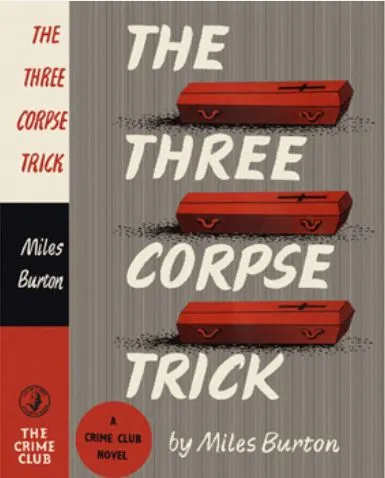
Forgotten Book - The Three Corpse Trick


Miles Burton, better known as John Rhode, wrote a long series of novels featuring Desmond Merrion. The Three Corpse Trick, first published in 1944, has been judged as one of the best if not the very best of them. Nick Fuller, a shrewd critic of Golden Age mysteries whose blog I heartily recommend, has described it as a masterpiece. For me, one of the most intriguing aspects of the story is that the Second World War is ignored. We are explicitly told that Merrion's duties in the intelligence section of the Admiralty have ceased and he is free to roam around the English countryside again, solving mysteries in the company of his chum Inspector Arnold. Presumably Rhode was by this time confident that the war would be won. Or perhaps he simply didn't want to think about it any more.

The first chapter is devoted to a Mrs Burge's wanderings around a village in Deanshire, collecting money for charity. This approach enables the author to introduce us to a host of characters who will later feature in the story and provide a wealth of background information. At this early stage I picked up on one reference which eventually proved to be crucial to the plot. These things can happen, but I think many authors would have introduced the characters more gradually and painted them in a little more detail. In the event, two people who are pivotal to the story are peripheral figures, to say the least, and this does seem to me to be a weakness. And including a map of the neighbourhood would have been a big help.

Poor Mrs Burge is promptly murdered and Inspector Arnold is determined that her husband  - who has vanished - is the guilty party. It takes quite a long time for the reasons for Burge's absence to become clear, and at around that stage of the novel we are also given some further information which proves to be highly relevant. At this point I realised the signifcance of the title and figured out what was going on.

Eventually, Merrion tumbles to the dastardly scheme. The crimes are neatly contrived, but I feel that a more talented writer could have made more of the raw material of the plot. It's definitely one of the better Rhode/Burton books that I've read, but it's also one which illustrates some of his shortcomings as a storyteller. Worth reading, but very guessable. 


Friday, 18 May 2018

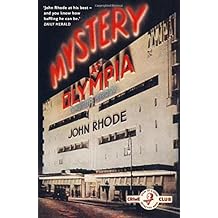
Forgotten Book - Mystery at Olympia


Mystery at Olympia

Not so long ago, the prospect of five of John Rhode's detective novels being republished as mass market paperbacks seemed as unlikely as the solutions to some of his more technically complicated mysteries. Rhode's books have long been popular with collectors (or at least, collectors with deep pockets), but the consensus in the publishing world was that there was no real market for them. But the British Library republished two of his Miles Burton novels with considerable success, and this breakthrough has been followed up by Harper Collins, with, so far, three more titles in paperback, plus a hardback of The Paddington Mystery due in June.

I've reviewed Death at Breakfast and Invisible Weapons previously; now it's time to take a look at Mystery at Olympia. This is a story which, on its first appearance in 1935, had a topicality and freshness about its opening scene. Rhode tried to keep up to date, and here he sets the first chapter at the Olympia Motor Show. Among the visitors is Dr Oldland, a chum of Dr Lancelot Priestley, and his professional skills are called upon when an elderly man collapses and dies from no apparent cause. The deceased, it turns out, rejoices in the name of Nahum Pershore, and Superintendent Hanslet soon has reason to suspect that he was murdered - but how, and by whom?

When Pershore's household is investigated, it becomes apparent that there have been some very strange goings-on in the run-up to his death. Someone shot him in the leg, but he made light of it, for some reason. The parlour-maid has been poisoned with arsenic. And another attempt seems to have been made on his life. In this story, unlike many of Rhode's, there's a good-sized cast of potential suspects, with a range of motives, and suspicion shifts around them in pleasing fashion.

So there are plenty of things to like about Mystery at Olympia. That said, it's also a novel that demonstrates Rhode's habitual failings. The first chapter devotes rather more than two pages to a discussion of a new motoring transmission device, but it proves not to have anything to do with the plot, and is simply a form of heavy-handed satire, when - speaking personally - I'd have been more entertained by a page or two devoted to satirising an obsession with cars. But that would have been too much for Rhode, whose love of motoring is also evident from the rather tedious The Motor Rally Mystery.

The murder method struck me as much more chancy than Rhode would have us believe, while the motive is thinly sketched. The same is true of books like The Motor Rally Mystery and Shot at Dawn, where Rhode's lack of interest in humanising his killers makes one as indifferent to their psychology and their fate as Dr Priestley, whose behaviour at the end of this novel offers an intriguing example of a Great Detective doing justice in his own inimitable way. Not a masterpiece, then, but certainly worth a look.


Friday, 13 January 2017

Forgotten Book - The Viper

Sometimes the question of what counts as a "forgotten book" is open to debate. One might use that term to refer to books by living authors that have been out of print for a long time, for instance, But I think there can't be any doubt that Roy Horniman's 1928 novel The Viper qualifies for the description of "forgotten". I've never come across any discussion of it anywhere.

If you do an internet search for the book, you may however find that I mentioned it here rather more than seven years ago. At the time, I'd just purchased a copy, though I confess that I've only just got around to reading it. I mentioned The Viper in the context of a discussion about Roy Horniman's most renowned book, Israel Rank. Though "renowned" is a relative term here; Israel Rank is a fascinating novel, but compared to the film version, that wonderful classic Kind Hearts and Coronets, it is still somewhat undeservedly neglected.

Why did it take me so long to read the book? One reason is that I was deterred by the opening paragraph, one of the dullest one could imagine, which is about train times from Weston-super-Mare to London. It makes the more tedious passages of John Rhode/Miles Burton seem as sparkling as Simon Brett or Colin Watson. But soon the story warms up, and it becomes clear that one of the travellers on that train is a sociopathic monster.

This fellow is a con man who is prepared to stop at nothing to get his way. He has his eye on a fortune, and he is ready to kill the innocent in order to lay his hands on it. In this respect, at least, there is some overlap with the famous storyline of Israel Rank. Perhaps Horniman was aiming for a comparable effect. But I can't claim that this book is a classic, although there are some nice ironic touches. Instead, what we have is a thriller that is, thank goodness, livelier than that opening paragraph suggested. Not a masterpiece, by any means, but quaintly readable.  

Friday, 29 July 2016

Forgotten Book - The Davidson Case


Today's Forgotten Book dates from 1929, and is an early case featuring Dr Priestley, John Rhode's cerebral and rather curmudgeonly Great Detective. The Davidson Case is an enjoyable mystery. I figured out the culprit's secret at a fairly early stage, but that didn't spoil the book for me, which strikes me as one of the best Rhodes I've read to date. (He also wrote as Cecil Waye and as Miles Burton, and two Burtons have been chosen for inclusion in the British Library's series of Crime Classics.)

The book has a background in business, something that was - perhaps surprisingly - quite common in Golden Age stories, especially those written by people like Rhode and Freeman Wills Crofts, who had extensive business experience. Guy Davidson's unpleasant cousin, Sir Hector, has taken charge of the family firm, and his behaviour - which includes getting rid of a senior employee called Lowry - is causing Guy concern. Sir Hector seems unstoppable, but when he is found dead after a train journey, Guy is able to take control of the company, and order seems to have been restored.

Until, that is, the police start to suspect Guy of having murdered Sir Hector. Priestley assists the police, but finds some aspects of the case troubling, and refuses to testify in court. Rhode offers a pleasing sequence of plot twists, and "justice" is mentioned in the very last sentence, a reminder of the extent to which notions of justify preoccupied Golden Age writers. I found the story held my attention from start to finish.

One line I enjoyed particularly came when Priestley and his secretary Harold pursue their investigations into Guy's activities. "Really, my boy," the great sleuth says, "the public house is the finest possible place in which to obtain information" There speaks Rhode, a pub-lover who enjoyed a pint or three (one can't quite imagine Poirot saying something similar to Hastings, can one?) A good book, well worth a read.

Monday, 29 February 2016

Serpents in Eden and other British Library Crime Classics


The British Library is responding to reader demand by continuing to publish a diverse range of titles in its Crime Classics series. The latest John Bude book, Death on the Riviera, which is in my opinion highly enjoyable, is selling tremendously well, while my anthology Murder at the Manor is also going great guns. The next anthology in the series, Serpents in Eden, is now out, and here I've gathered together stories about crime in the countryside. Some great writers features - Conan Doyle, E.C. Bentley, Margery Allingham and the under-valued H.C. Bailey among them. And there are also some less familiar names, including Leonora Wodehouse - yes, the daughter of the legendary P.G....

I'd also like to mention two other novelists whose work is due to appear in the series shortly. The first is Miles Burton, one of the aliases of Major John Cecil Street - crime fans know him best as the ultra-prolific John Rhode. The BL have opted to publish two of his stories about Desmond Merrion - The Secret of High Eldersham and Death in the Tunnel.

A writer who was, I have to confess,previously unknown to me before the BL identified his potential is John Rowland. He usually wrote about Inspector Shelley, who features in Murder in the Museum and Calamity in Kent. In writing my introductions to the books, I benefited greatly from information supplied by Fytton  Rowland, son of the author, and I discovered that Rowland was an interesting chap whose other writing included a tribute to Eden Philpotts and a number of true crime books -including a significant study of the Wallace case.

There's plenty more to come in the second half of the year, including another anthology, and a book that has a quite unique dimension; I'm especially excited about the latter project. At present, my lips are sealed, but all will be revealed before too long!

Friday, 13 March 2015

Forgotten Book - The Secret of High Eldersham

The Secret of High Eldersham, first published in 1931,was the second book that John Rhode (or, to be precise, Cecil John Street) wrote under the name Miles Burton. The first,was a thriller, and this book too is more of a thriller than a detective story. However,it is significant because it introduces Desmond Merrion, the clean-cut hero who went on to feature in dozens of Burton's books, including a post-war story, Heir to Lucifer, which I featured in this column recently..

The author was a great pub-goer, and it's typical of him that the first scene is devoted to a discussion about a publican's wish to move from one pub to another. How this bears on the plot becomes evident much later. After this preamble, the action moves forward five years, and the man who takes over from him as landlord of a pub in the remote East Anglian village of High Eldersham is found to have been murdered.

At first, it appears that the identity of the culprit is obvious, but the individual in question appears to have a cast-iron alibi. Well, we know about alibis in Golden Age stories, don't we? However, this isn't one of those railway timetable stories of the kind associated with Freeman Wills Crofts, and soon the plot thickens. The police are out of their depth, and Merrion lends a hand. He also takes an interest in Mavis, daughter of the local squire...

This book is very highly rated by Barzun and Taylor, those great American experts in Golden Age fiction, and I'm glad finally to have got round to reading it. For me, the particular appeal of the book lies in the rather spooky setting - East Anglia is a fascinating part of the country that has often featured in fine crime novels. It's also somewhere I'd like to revisit before long.


Friday, 20 February 2015

Forgotten Book - Heir to Lucifer

I've mentioned John Rhode (whose real name was Cecil John Street) several times in this blog. He was a prolific writer, and in addition to countless Rhode books, he wrote a long series under the name Miles Burton. Over the years I've picked up numerous Burtons, but only in recent times have I got round to reading some of them. One of them is Heir to Lucifer, first published in 1947, and it's my Forgotten Book for today.

Although it is a post-war book, it seems on the surface to be a classic country house mystery. Desmond Merrion, late of Naval Intelligence, is Burton's regular amateur sleuth, who made his debut in a much earlier book, The Secret of High Eldersham, that I read a few weeks back and will probably cover one Friday soon. The book opens with Merrion and his wife Mavis setting off for the small resort of Croylehaven, because Mavis has been under the weather. It's not an ideal choice, since mystery and mayhem promptly ensue - yet with each violent death, Mavis seems to perk up a bit more...

Croylehaven is dominated by Castle Croyle, home to the eponymous Lucifer, a rich old man surrounded by relatives who are financially dependent on him. Usually, this set-up means that the old chap will soon be a goner,but this is an unusual book. Lucifer survives, although a small boy is killed, an attempt is made on Lucifer's life, and a murder victim's corpse is discovered at an ice-house. By this time, the Merrions have become honoured guests at the Castle, forever popping in and out - the way you do when violent deaths keep occurring.

This is an odd book and its resolution is strange, untypical and rather disturbing. Yet I found it readable and interesting. Rhode/Burton does a pretty good job of making sure that you never know what to expect, and he certainly confounded my theory about the crime. There's a touch of darkness and irony about the ending that would, I suspect, have appealed to Rhode's Detection Club colleague Anthony Berkeley. Definitely worth a look, and by no means as conventional as the basic ingredients might suggest..

Wednesday, 24 July 2013

Valuing a rare detective novel

One of the joys of digital publishing is that it has made it possible for those of us who are fans of Golden Age detective fiction to acquire, at long last, copies of books that have long proved elusive. I've mentioned Bello and Faber Finds here in the past, and there are various other outfits who are doing sterling work in reviving old titles so that a new generation of readers can enjoy them.

But, at least for the present, there remain a great many obscure books that are still very hard to find. (Okay, some of them deserve their obscurity, but by no means all of them!) And there is something about having an original hard copy edition that is still very appealing to book lovers. But even if one can find a rare title, the question is whether one can afford it. And often, the answer is no.

There was a startling case on eBay recently when a little-known book by the prolific John Rhode, under his other pen-name, Miles Burton, was sold for in excess of £500. Yet this was a former library book that, from its description (by a totally honest bookseller from whom I've bought many much cheaper titles) was in pretty scruffy shape. The book was To Catch a Thief - no connection with the Cary Grant movie, though. Normally, you expect that a really expensive book will be accompanied by a dust jacket in good condition, or perhaps a really significant signature or inscription.

This did make me wonder if prices for rare Golden Age books are shooting up well ahead of inflation, driven by scarcity plus increasing interest and demand. When I talk to dealers like Jamie Sturgeon and Mark Sutcliffe, partly out of interest and partly as research for my portrayal of the world of Marc Amos in the in the Lake District Mysteries,the general theme is that it is harder to find old books in good condition than ever before. There is one rule that I've learned. If I come across an old book acceptably priced that I'm interested in, I tend to go for it. But the other day, at a book fair, I broke my own rule, and when I returned to the stall a few minutes later, the book I wanted had gone. A lesson learned!