Showing posts with label Rob Davies. Show all posts

Thursday, 26 July 2018

The CWA Dagger in the Library


I've written many times on this blog, and elsewhere, about my lifelong love of libraries. I vividly remember being, at the age of ten, allowed to become the smallest member of the adult section of Northwich Library, in order to feed my addiction to Agatha Christie, and then to many other crime writers. And in recent years, in recent weeks even, I've enjoyed doing a range of library events up and down the country, as well as hosting Alibis in the Archives at Gladstone's Library.

So you can imagine that I'm as pleased as Punch to find my name on the shortlist for the CWA Dagger in the Library, along with such luminaries as Nicci French, Peter May, Simon Kernick, Rebecca Tope, and Keith Miles (aka Edward Marston). This is an award where the nominees are selected by librarians throughout Britain, and I'm duly honoured.

There are some truly wonderful libraries in this country. It's been a privilege for me, over the past few years, to become quite closely associated with the British Library, and that relationship, in particular with Rob Davies and his team in the publications department, has brought me enormous pleasure. The same goes for Louisa Yates and her colleagues at Gladstone's, a very different place, an independent library run as a charity, and rich in history, atmosphere and charm.

And then there are the public libraries which mean so much to the communities of which they form part. I've enjoyed working, for instance, with local and area librarians, and also a Friends Group in Stockton Heath which aims to support the professional staff in a variety of ways.

Hard to believe, but it's almost two years since I wrote about the threat posed to Lymm Library, a short walk away from my home. Like other local people, I was deeply worried about its future, but I'm thrilled to be able to report that it's just been announced that the library is not only to be saved, the empty space in the building is to be utilised for the benefit of the community: the detail is here.

So there is a great deal of room for optimism about libraries, despite the undoubted financial pressures they face, if all of us who believe in libraries pull together. I look forward very much to trying to play a part, in the coming months and years, to trying to play a small part in helping their almost limitless potential to be realised for the benefit of communities not just in my neck of the woods, but further afield as well.

Monday, 19 June 2017

Bodies from the Library

I'm back from a brief but exhilarating trip to London, the highlight of which was the third Bodies from the Library event at the British Library on Saturday. The speakers and organisers had met the previous evening for a convivial meal, and I was also delighted to meet Professor Elinor Shaffer, sister-in-law of Peter and Antony Shaffer. This followed a catch-up with my former agent, Mandy Little, now retired, who had faith in  my writing before I published a single novel. It was Mandy who sold All the Lonely People, my first book, and I'll always be grateful to her.

I was asked to open and close Bodies, and between 10 am and 5.15 there was a lot happening. Jake Kerridge moderated a panel featuring Len Tyler, Seona Ford of the Dorothy L. Sayers Society and me, and we talked about aspects of the Golden Age. Tony Medawar spoke about John Rhode, Kirsten Saxton talked enthusiastically about The Incredible Crime, and John Curran about crossword puzzles and classic crime. Then Rob Davies interviewed me about The Story of Classic Crime in 100 Books.

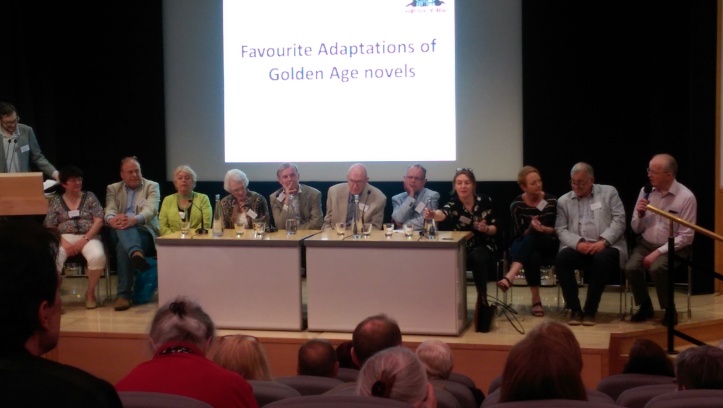
The book was on sale at the event, and upwards of 80 copies were sold. I've never sold anything like as many hardbacks on a single occasion. Plenty of copies of Taking Detective Stories Seriously were also sold - very gratifying. The afternoon events included a Sayers radio play, talks on Elizabeth Daly, Ethel Lina White, Ronald Knox and Edmund Crispin, and a panel in which the speakers talked about their favourite classic crime novels.

For me the day was something of a whirl, just as Alibis in the Archive was the previous week, I was delighted to have the chance to say hello to a lot of nice people, and even send a recorded message to fans of the Detection Club in Brazil (didn't expect that!) but of course there's never enough time during such concentrated events. The main thing was that several people expressed the view that this was the best Bodies yet, and we are all hoping that it will happen again next year. The atmosphere was hugely positive.

There being no rest for the wicked, I then hosted a CWA reception immediately afterwards, announcing that the winner of the 2017 CWA Dagger in the Library is Mari Hannah. The shortlist was very strong and so it was a particular pleasure to congratulate Mari. After dinner with a few friends,,I  must admit that I was quite exhausted. But it was worth it. A grand day.


Monday, 12 June 2017

Alibis in the Archive


I'm back from an exhilarating week-end at one of my favourite places, Gladstone's Library in Hawarden. We had the Alibis in the Archive weekend event to celebrate the official launch of the British Crime Writing Archives - that is, the archives of both the Crime Writers' Association and the Detection Club.

We organised a packed programme, and the aim was to give delegates plenty of value for money Even so, we were delighted when the week-end sold out back in March -  only a few weeks after being announced. Capacity is limited, and delegates who couldn't be accommodated in the lovely rooms at the Library were able to stay at a nearby hotel.

After dinner on Friday, the first event was an interactive murder mystery evening hosted by Ann Cleeves. This proved enormously popular. On Saturday, we kicked off with David Stuart Davies (who had acted in the murder mystery) giving a rousing talk about Sherlock Holmes. David Brawn of Harper Collins then talked about working with Agatha Christie's estate. I talked about the CWA and the Detection Club, and also their archives. And then Ann talked about Vera and Shetland. TV scripts that she has donated will in due course form part of the archives.

On Saturday afternoon, Rob Davies talked about the British Library, Linda Stratmann about poison, Kate Charles about clerical crime, and Kate Ellis about digging up the past. After dinner we had - yes! - a second murder mystery evening, this time hosted by Kate Ellis. Then on Sunday, Stella Duffy talked about Ngaio Marsh, Rob and I about the British Library's Crime Classics, and there was a panel discussion about Golden Age detective fiction.
We were delighted with the convivial atmosphere, and the enthusiasm of the delegates. A new group of people previously unfamiliar with Gladstone's Library fell in love with it. I had the pleasure of meeting many nice people - including John Bude's daughter, Jennifer.- and also of seeing a project that I've been involved with for a long time finally achieve a very significant milestone. The Archives will develop in the years to come, and I am optimistic that they will become an increasingly important resource for people who are interested in the heritage of crime fiction. The photos illustrating this post were taken by CWA Secretary Dea Parkin, to whom many thanks.

Wednesday, 13 July 2016

Celebrating Sergeant Cluff


Yesterday saw a very enjoyable launch event at the Grove Bookshop in Ilkley of the latest British Library Crime Classic. The book we were celebrating was Sergeant Cluff Stands Firm, by Gil North, the first novel in North's Yorkshire-based series. September will see the publication of a second book in the series, The Methods of Sergeant Cluff.


I'd got in the mood for the event by touring round scenic spots in Yorkshire, including Skipton, which North fictionalised as Gunnarshaw, Cluff's base. Landscape plays an important part in the books, and I enjoyed visiting Malham Cove, climbing a long way up to the fantastic viewpoint on the Limestone Pavemetnt, and taking a look at lovely Malham Tarn.


The Gil North books represent something of a departure for the British Library, because they were published in the Sixties, rather than during the Golden Age of Murder between the wars (at least that's how I define the Golden  Age,but really it's a concept that means different things to different people). But the Library takes the view that books that are more than 50 years old are certainly eligible to be considered as examples of Classic Crime, and that seems spot on to me..


I have a very, very distant memory of my father watching the Cluff TV series when I was a small boy. Yes, Cluff was a telly cop! He was played by Leslie Sands, well cast as the dour but compassionate Dalesman. The TV series was written by North, and enjoyed considerable popularity, but of course even TV fame is relatively transient. It's good to see these books - clearly influenced by Simenon in terms of style and approach - back in print.


Gil North was a pen-name for Geoffrey Horne, an interesting character about whom I learned a good deal from talking to his son Josh before writing my intros to the two books. I was sorry Josh was unable to attend the launch, but it was good to spend time with Rob Davies of the British Library, Peter Crangle, who represents the estate, and an enthusiastic audience including Catherine, alias that splendid blogger Juxtabook. We missed Lisa Shakespeare of Midas PR, who has been very busy n generating interest in Cluff, but I hope our paths cross before long. Perhaps at the Ilkley Literary Festival in October, to which I've been invited, and where I'll be talking about Cluff and Classic Crime (and a bit about my own books) in October. Really looking forward to it.


Monday, 27 June 2016

Felixstowe Book Festival and the Writer's Life


All of a sudden, we are living in extraordinary and uncertain times. I suppose it's true that throughout my life I've found reading and telling stories a means of escape from the real world, as well as a way of trying to make sense of it. So I'm absorbing myself in the reading and writing life at present, and what better way to so so than by attending a book festival in an agreeable and unfamiliar part of the country?


I was delighted to be invited to speak at Felixstowe Book Festival this year. The Suffolk resort is at the other end of the country from where I live and I've never been there before. A very long train journey culminated in my arrival, quite literally, at the end of the line, and I undertook a short reconnaissance of the resort before the day came to an end.


During the morning, I enjoyed visiting the town's very good bookshops, and walking along the lengthy promenade. past the old Martello tower, to Landguard Peninsula and the old fort there. It all seemed quintessentially English, and very pleasant. Then it was back to the hotel for a talk about Golden Age detective fiction with Rob Davies of the British Library. The organisers had done a great job in achieving as sell-out of all 50 tickets, and we enjoyed chatting with ace blogger Elaine Simpson-Long about the astonishing revival of interest in traditional crime fiction from the Golden Age. 


Saturday had begun with an enjoyable breakfast with Julia Jones, Margery Allingham's biographer,and Daniel Hahn, who was responsible for the Oxford Companion to Children's Literature and is a former chair of the Society of Authors. One of the topics we talked about was the writing life - and how social media, and taking part in events,occupies so much time these days. My trip to Felixstowe,for instance, really took up three days in all that could otherwise have been devoted to writing. It's fun to do such events (especially for me, given that I could hardly ever manage such things in the days when I was a full-time lawyer), but of course one needs to strike a balance. 


Daniel said some writers do a hundred or more events a year,but I'd never be able to manage anything like that - it would interfere too much with the writing. But at least on the lengthy journey back home the trains were less like crowded cattle trucks than was the case on Friday, and I was able to get plenty of reading done - one book for which I've been asked to write an intro, and a yet-to-be-published Kate Ellis, of which more at a later date. All in all, an excellent week-end of escapism.

Monday, 13 June 2016

Bodies from the Library

IMAG0882_BURST002_COVER.jpg

I'm back home - briefly -after an exhilarating trip to London for the second Bodies from the Library conference at the British Library. This was a highly successful event, one in which I was delighted to take part, and during the afternoon coffee break one of the attendees made things even more memorable by kindly telling me that she'd just heard that The Golden Age of Murder has been shortlisted for the Macavity award from Mystery Readers International. Not so long ago, if you'd told me that a book of mine would win three awards and be listed for three more, I'd have thought you were pulling my leg in a rather cruel way. But yes, it has actually happened...

Less of a surprise were two announcements about personal projects of mine which I'm very excited about. For one day only, copies of the new edition of Anthony Berkeley's The Poisoned Chocolates Case, a title in the British Library's Crime Classics series, were on sale - official publication is in October. And this edition contains not only an intro that I've written, but more importantly, a seventh solution (in addition to the six solutions Berkeley came up with) by Christianna Brand, first published in the US in the 70s. And there is a brand new solution written by me. This is a project that was, for me, enormous fun, and a large number of copies of the book were sold on the day. More about this one in October...

During my conversation with Rob Davies of the British Library, we also announced that next year will see the publication of my new non-fiction book The Story of Classic Crime in 100 Books. This book has occupied a good deal of my time over the past 18 months, and I recently finished work on the manuscript. It's very different from The Golden Age of Murder, even though there is an element of overlap in terms of the period covered, and I hope that crime fans will find it full of interesting - and often unexpected - material.

The first session of the day featured another book with which I'm very happy to be associated. This is The Sinking Admiral, by the Detection Club. Simon Brett, who masterminded the book, discussed it with me, and two other contributors, Janet Laurence and Stella Duffy. It was also announced that Stella has been awarded an OBE, and that she has been engaged to write a completion of an unfinished Ngaio Marsh novel: something to look forward to. As for The Sinking Admiral, it sold out by mid-morning.

Tony Medawar talked about Anthony Berkeley, while Len Tyler and Susan Moody championed Philip MacDonald and Georgette Heyer, and Barry Pike discussed the work of H.C. Bailey. Dolores Gordon-Smith focused on G.K. Chesterton, while Jennifer Henderson, biographer of Josephiine Tey, talked about Tey as a Scottish writer. John Curran discussed the Collins Crime Club - and his book on the subject is another that will be eagerly anticipated. Finally there was a group panel in which we picked favourite screen adaptations of Golden Age novels.

Dinners on the Friday and Saturday evenings provided plenty of opportunities for socialising, and I was delighted to meet Taku Ashibe, from the Honkaku Mystery Writers' Club of Japan, (modelled on the Detection Club) who presented me with several books, including one of his own. Saturday itself was extremely hectic, and although I had the chance to chat to a number of attendees, there simply wasn't time for as many conversations as I'd have liked. But you can't have everything, and overall this was a wonderful day, full of good things, and pleasant people. What more could you want?

The photo at the top of this post appears on an account of the day on Puzzle Doctor's splendid blog, In Search of the Classic Mystery Novel. Further perspectives on the day may be found on the similaly enjoyable Past Offences blog and Cross Examining Crime.
.


Wednesday, 23 September 2015

The Agatha Christie Festival


I was lucky enough to be invited to take part in last week's Agatha Christie Festival in Torquay. The festival has been running for some years, but it was my first time in attendance, and it was good to be back on "the English Riviera". The last time I stayed at the Grand Hotel was at the time of the Christie Centenary in 1990, a very memorable week-end. At that point, I'd never published a single novel or short story. So it was a particular pleasure to return for the 125th anniversary of Agatha's birth as a fully-fledged crime novelist.


My first talk was in the Spanish Barn (photo immediately above) at Torre Abbey (photo at the top of this post), an atmospheric and historic setting, and I was gratified that the organisers had gathered an excellent crowd. I was introduced by David Brawn, my editor at Harper Collins, and my subject was The Golden Age of Murder. I didn't talk to a script, but after working on the book for so many years,I felt I would have more than enough to say without one! Some very interesting questions prompted a lively discussion, and I met several delightful people for the fist time.


In the afternoon, it was time to head off to the Imperial Hotel (said to be the model for the hotel in Peril at End House.) This time I was doing a double act with Rob Davies, from the publications department of the British Library. Rob is series editor for the BL's crime classics, and we talked about titles in this remarkably successful series (370,000 paperbacks sold so far!) as well as future plans. In a nutshell, we have titles lined up until the end of 2017. It seems like a long way ahead, but even then, the books will be appearing at a rate of more than one a month. Quite a schedule.


Rob and I both enjoyed the session, and we are hoping to repeat it at future festivals and other literary events in the future. One interesting aspect at Torquay was that the audience included some heirs of literary estates,and it was great to talk to them. Unexpectedly, Andrew Wilson, whose biography of Patricia Highsmith I reviewed here quite recently, came and said hello. We hadn't met before and I didn't know he lives in Devon. Andrew tells me he's written a new crime novel, which should be well worth looking out for. After two talks, I was more than ready for a convivial dinner with the British Library team, followed by a drink back in the Grand.

Then, the following morning, after goodbyes at Torre Abbey, it was off to Winchester, where I was talking about The Golden Age of Murder at Winchester Discovery Centre, a fabulous venue. Winchester is a lovely and, of course, very historic city, where the library is a proper community hub, and the schedule of events at the adjoining Discovery Centre is impressive. A model for libraries and associated services in the 21st century, I felt. This time, I was being interviewed by Gilbert Yates of the Discovery Centre, and the question and answer format made a refreshing change from a conventional talk. Next morning I satisfied my inner tourist with a sight-seeing trip around the city,and then it was off home after what had been, to say the least, an eventful week. One of many gratifying aspects of the trip was the enthusiasm shown by so many people for The Golden Age of Murder. I signed a lot of copies,and I remain bowled over by reaction to the book from so many people.